Tag Archives: strategy

“Porting” a Strategy From One Game to Another

portingstrategy1
Even when you start playing a new game, your mind sticks to old, familiar channels of play. Take my Magic decks and my HeroClix strategies; when I first started playing Clix, I found myself choosing pieces that were self-regenerative, able to heal themselves from damage, just like I built my Life-Gain-centered Magic decks to do. I also went with lots of little close-combat pieces–they were much like my aggressive decks full of small but powerful creatures.

As I discovered, it’s possible to “port in” a favorite strategy from another game. Even Yu-Gi-Oh! and Magic: the Gathering can play nicely together–read on to find out how!

The Old Deck: A Yu-Gi-Oh! Shadow Ghoul Deck

Before I ever set foot into Magic, I played the Yu-Gi-Oh! TCG, well before Synchro Summons and mecha-Fairies. Maha Vailo, Mirror Force, and old-school “pretty” Fairies were among my cards of choice. But even after I quit playing Yu-Gi-Oh! in real life, I continued to mess around building decks on an old Yu-Gi-Oh! game for Game Boy Advance, using the old favorite cards I cut my TCG teeth on to try out new strategies.

One deck I came up with was based around two monsters: Shadow Ghoul and Chaos Necromancer.

chaosnecromancershadowghoul
Both images from the Yu-Gi-Oh! Wikia.

Both monsters get Attack Points for each monster that is in my graveyard. Thus, I built a deck full of just easy-to-play monsters–Flip Effect monsters that could control the board, plus some strong, no-Tribute high-Defense monsters to block hits from my opponent’s monsters. If either of these types of monsters were destroyed, in battle or otherwise, they would just pump up Shadow Ghoul or Chaos Necromancer to serious strength.

Below is the original decklist:

Defense Monsters

  • 3x Mystical Elf (800/2000)
  • 3x Giant Soldier of Stone (1300/2000)
  • 1x Battle Footballer (1000/2100)
  • 1x Soul Tiger (0/2100)

Big-Momma Attackers

  • 3x Chaos Necromancer (effect: Attack score of this card is 300 times the number of monster cards in your graveyard)
  • 3x Shadow Ghoul (effect: +100 attack points for each monster in graveyard)

Flip-Effect Monsters

  • 3x Man-Eater Bug (flip: destroy one monster on the field)
  • 3x Old Vindictive Magician (flip: destroy one monster on opponent’s side of field)
  • 3x Hane-Hane (flip: return one monster on the field to its owner’s hand)
  • 3x Penguin Soldier (flip: return up to two monsters on the field to owners’ hands)
  • 3x Needle Worm (flip: opponent takes top five cards from deck and puts them into graveyard)
  • 3x The Unhappy Maiden (flip: end Battle Phase immediately)
  • 3x Nimble Momonga (effect: when sent to graveyard as result of battle, gain 1000 life points, and then search out and set however many Nimble Momongas you have left in your deck)
  • 3x Poison Mummy (flip: opponent loses 500 life points)
  • 3x Yomi Ship (effect: when sent to graveyard as result of battle, destroy the monster that destroyed Yomi Ship)
  • 3x Witch Doctor of Chaos (flip: remove one monster from any graveyard)

The Strategy Behind This Deck

Since you don’t have to play one solid “color” or type of creature to have a solid Yu-Gi-Oh! deck, I could gather all the most efficient Flip-Effect monsters together in one deck. In Magic: the Gathering lingo, this deck contains creature kill, bounce, and removal; it also has life-gain, life loss, mill, damage prevention, AND big stompy creatures. In short, the deck had EVERYTHING, and it was very, VERY fun to play, especially against computerized opponents. I rarely (if ever) lost a game with it.

The Problem

There was just one problem with this incredibly fun deck–I couldn’t figure out how to port it to Magic. Since I don’t play Yu-Gi-Oh! in real life anymore, I wanted to play this same type of strategy in a game I’m still active in Plus, I was actually curious to see if something like this would even work in Magic at all.

Yu-Gi-Oh! To Magic–A Surprising Twist

I talked it over with my resident Magic guru (aka, my boyfriend), and he was surprised at the number of Blue and Black effects I had incorporated into this deck. “In fact,” he said as he studied the list of card effects I was looking for, “Black can do a lot of this, but a Blue/Black deck would probably get all the effects you want without having to splash in other colors.”

This surprised me–I am definitely not a Blue/Black player, since I’ve always seen Blue and Black as the meanest color in Magic. But as I looked at the effects I had written down from my own self-created Yu-Gi-Oh! deck, it seemed I was hiding a tactical player underneath all my trappings of Life-Gain and high defense.

Preparing to Port Your Strategy

For Magic especially, you can find some online help for porting strategies. Online services like Gatherer work well for searching out card effects and other types of text. But it also helps to have someone else who is more familiar with the new game’s mechanics, so that together you can figure out how to translate your old favorite abilities into the new game’s language.

In my case, since Magic works around a base of five colors and you have to have mana (resources) to play each spell, strategies work out a little differently from Yu-Gi-Oh!. Here, I couldn’t just pick “the best of the best” in terms of creatures and throw together a deck–I had to make sure I’d be able to PLAY all the creatures I picked. Thus, why my boyfriend said that Blue/Black could do most of the card effects I wanted; he wanted me to have a deck that could consistently get enough mana to play what it needed.

On to part 2 of this series–The Card Hunt!

The Best Offense is a Good Defense–Wait, What?

bestoffensegooddefense
[/shameless paraphrase of cliche]

A quick, efficient win is usually prized among gamers, especially when playing competitively. But let me bend your thoughts a minute. What if, instead of looking to win quickly, you wanted a SATISFYING game? A game that took a little while but afforded a win you could actually savor?

This second approach is my philosophy on gaming. I don’t want just a quick, easy win–it feels like cheating, or like eating cotton candy for dinner. I’d rather have a game which makes me think and allows me to socialize a little, too. I favor long games–which means that I play defensively.

Thinking Defensively Rather Than Aggressively

aggressivedefensive
If you want to play defensively, you’ve got to think long-term, because aggressive players will burn themselves out quickly. “Aggro” Magic: the Gathering players, for instance, soon run out of cards in hand and have less options to defend themselves. Aggressive Clix players usually wear out their first-string attackers by mid-game, leaving themselves only their second-string attackers and their support crew (if that).

So, a defensive strategy that wins has to have 3 basic prongs:

  • High defenses/support to stay alive long-term
  • Strategies that punish the other player for attacking
  • Good resource management/game control

Defensive Strategy Examples

Magic: the Gathering

  • Life-gain to offset opponent’s direct damage
  • Graveyard recursion to foil any milling or discard
  • High-toughness creatures to both block combat damage and deal a little combat damage of my own
  • Mill, board wipes, discard, targeted destruction, and other minor control elements to stay alive

HeroClix

  • A couple of Medics to heal wounded figures
  • Several sources of Probability Control and Outwit, to reroll dice and get rid of particularly damaging powers and abilities
  • A Mystic or two and some Wildcards, to punish the opponent for attacking me
  • Figures with high defenses (18+), or figures with Energy Shield/Deflection or Combat Reflexes

The Reason I Include Control With High-Defense Strategies

As I have learned from experience, if you focus on nothing but defense, you will get controlled and manipulated into destruction. Black and Blue Magic decks with a lot of control elements will keep a high-defense White deck from doing anything, for instance, while 6 or 7 damage from Vet Icons Superman holding an object will KO any support piece before you can use it.

As a defense player, you have to have a modicum of control included in your strategy, but you don’t have to make it irritating–just a strategically-placed and protected Windborn Muse can be enough to stop aggro, and a Story Circle can prevent even the fastest of Burn decks from hurting you once it’s out. Likewise, using Outwitters and long-range pieces can help your defensive HeroClix team win the day.

Summary

Defense is often discounted in most collectible card and miniatures games, but it’s a key strategy in a long-term game. Sure, if you want a 5-minute win, aggression is still your best way, but if you like longer games with more chances to socialize and more chances to laugh, playing “de” might be your best way to do that.

Empowerment Buffs, or “those buffs made from salvage”

empowermentbuffs
In City of Heroes, we focus a lot on Enhancements (most comparable to “gear” for World of Warcraft players)–they are permanent boosts to a hero’s selected powers. You can boost the healing potential of your hero, their damage potential, how accurately they hit, and many other facets of their powers. We also pay a lot of attention to Inspirations–temporary, ubiquitous boosts that can be activated during battle to help you get through tight spots.

We don’t, however, pay a lot of attention to Empowerment buffs–but they are important, too!

What ARE Empowerment Buffs?

You might be thinking, “Empower-what?” Well, you can think of Empowerment Buffs as something like the Mystic Fortune buff from the Magic Pack–it’s a long-lasting buff (1 hour), much longer than an Inspiration or an ally buff, but not quite as permanent as an Enhancement. What is least known about them is how they are triggered, and it actually takes a Supergroup base to get them.

How to Get Empowerment Buffs

To receive an Empowerment Buff, you must first have access to an Empowerment Station, which is generally part of a Supergroup Base. If you’re in a Supergroup that has an Empowerment Station, you only need certain pieces of salvage to trigger the stations.

Empowerment Stations look like this (all following pictures from ParagonWiki):

Arcane Empowerment Stations

  
From left: Enchanting Crucible (Tier 1), Arcane Crucible (Tier 2), Mystic Crucible (Tier 3)

Tech Empowerment Stations

  
From left: Radiation Emulator (Tier 1), Linear Accelerator (Tier 2), Supercollider (Tier 3)

It doesn’t really matter which type (Arcane or Tech) you go with–it’s mostly a cosmetic difference to match the theme of your base. What matters is that these stations, when activated with invention salvage of varying types, can give you buffs to your resistance to damage, your attack speed, and tons of other cool effects.

Example: Endurance Drain Resistance Buff for Fighting Malta Sappers

For instance, to fight Malta (and the resident Sappers who eat your Endurance when they shoot you), you’ll definitely need the Endurance Drain Resistance bonus–just feed a Hydraulic Piston into the Empowerment Station! You might not think this helps, but it surely does–I’ve been able to make it through a whole Malta battle without having to Rest or eat Catch a Breaths like Bon Bons.

Make Sure Your Empowerment Station Is Fully Upgraded!

There are three levels of Empowerment Stations–Tier 1, 2, and 3, as I noted in the pictures above–and the Tier 3 station will give you access to all the buffs you’ll ever need. However, to be able to build a Tier 3 station, your Supergroup needs a LOT of prestige. Also, you’ll have to buy and build the other two levels of Empowerment Stations first; Tier 1 stations are used to craft Tier 2 stations, and Tier 2 stations are used to craft Tier 3 stations.

When you upgrade stations, you still have access to the previous level’s buffs, so it’s worth it to upgrade when you can.

Find out more about Empowerment Stations (and how to craft them for your Supergroup Base) here: Empowerment Base Items.

What Kind of Salvage Makes Empowerment Buffs?

Salvage of all different level ranges can make Empowerment Buffs–it just depends on what buff you’re after and what level you are. Most of the required salvage for Empowerment Buffs is common salvage, but some buffs require uncommon salvage. Also, some buffs only need one piece of salvage, some need two, and some need three.

A complete table of Empowerment Buffs and the salvage it takes to create them can be found here: Empowerment Buff Recipes and Ingredients. Depending on whether you have an Arcane or Tech Empowerment Station, the salvage recipes will vary slightly for most of the buffs.

It’s a good idea to keep a stash of common and uncommon Invention Salvage in your Supergroup Base (or on your individual characters) that matches up with your characters’ needs. For instance, if your Scrapper keeps getting knocked back all the time, making it impossible to fight, you might benefit from the Knockback Protection Empowerment Buff. Therefore, you might want to carry the salvage that the buff requires (see the list here).

Summary

Using Empowerment Buffs might require a little time investment, but if it helps you get through mission arcs full of maddening enemy attacks, it could reduce frustration by 17.5%! 😛

Kaboom!

kaboom_start
If you’re looking for a challenging game that is a little bit old-school and a little bit new-school, Kaboom! is for you. Get in the “Kaboom Zone” and you’ll be in the high levels before you know it!

Basic Gameplay

In the game, a spooky pair of eyes in the darkened upstairs window of a house is throwing bombs out the window to the ground below. You have no character onscreen–instead, your mouse cursor controls a well-patched trampoline. With this, you have to protect your ground from the assaulting bombs.


Catch the black bombs with the trampoline and help them bounce their way harmlessly off-screen to the right. If you let a black bomb touch the ground, it will explode and make you lose 1 of your 5 lives.

Sometimes the little guy in the house will toss out one bomb at a time, and sometimes he’ll throw out 3 or 4 in rapid succession. It’s all about how fast you can juggle those bombs with your mouse cursor–there are times when you have to slide your trampoline under the bombs like a baseball player stealing second base!

Now, if a red bomb appears, avoid catching it–the red bombs will hurt you and make you lose 1 of your lives!

Sometimes, the guy throws out colorful letters instead of bombs. Catch these and help them bounce off-screen if you can spare the time–you’ll get an extra life if you completely spell out the word “KABOOM.” If you just can’t catch the letters (as in, you’ve got enough bombs in the air already), don’t worry; the letters don’t make you lose a life if they hit the ground.

Strategies

  1. I find it easiest to place my cursor in the horizontal center of the game window, and move back and forth as needed.
  2. Don’t look at your “lives left” total, your score, or anything else except for the bombs falling out the window. Let your attention wander and you’ll be sunk!
  3. Sometimes, your trampoline just can’t catch every single bomb; don’t let one failure to catch a bomb distract you from the other bombs on-screen. (It’s a life lesson in handling failures! LOL)
  4. The moment you bounce a black bomb into the air, be ready for another one to fall. Especially when the screen is chock-full of bouncing bombs, you have to stay alert if you don’t want to lose all your lives in one round!
  5. Don’t always dive for the colorful letters. If you have a choice between bouncing a letter and bouncing a bomb, go for catching the bomb every time.
  6. Watch the way the bombs fall. Some will bounce fast once or twice across the screen, and some will bounce slooooowly, taking for-EV-er to cross the screen. Pay closer attention to the slower-bouncing bombs!

Play Kaboom: Kaboom! at FreeOnlineGames.com

Mana Base: The Literal Foundation of a Magic Deck

manabase
Okay, I’ll admit it: I’m generally terrible at building a mana base for my decks, even though I’ve been playing Magic since 2005. When I start building a new deck, I’m usually focusing on the awesome cards I’m going to put in, rather than the mana I’m going to use to play said cards. Usually, I end up with way too many cards I want to put in and no room for mana!

I’m sure I’m not alone in this, either. I theorize that the reason Standard Magic (or Type II) has so many netdecks (copied strategies from pro and semi-pro players) is because most of us have a hard time building the right mana base. (Check DeckCheck, EssentialMagic, and the Standard General section of the Wizards of the Coast forums if you don’t believe me about copied strategies.) And, since mana bases are the foundation of any deck, when your mana base isn’t right, the deck doesn’t work.

So, how does a Magic player go about making a mana base that works? Here are some tips I’ve recently started to follow, with success:

#1: Determine what types of mana you need.

Sounds too simplistic, but this is the very first step to building a working mana base for your deck.

If you’ve got a mono-colored deck, for instance, you don’t need dual-color lands. And if you have dual-colored cards in your deck, you’re going to need both colors of mana to support them unless they are hybrid-mana cards (which means they could be played with either color).

How you choose to provide mana for your deck from color determination on is really based on what kinds of cards you have in your deck. For example, if you have a creature like Leonin Elder that gains life whenever an artifact comes into play, you will want artifact lands (like Ancient Den, at right) in your deck so that you have more artifacts to trigger that life-gain.
You also might have a creature that costs less to play for each certain type of land in play (this is called the “affinity” mechanic, seen on Tangle Golem at right). Playing this kind of ability means you’d want more of that land type in your deck than anything else.
Branching off the affinity concept, you could also use artifact lands to pump up a creature like Broodstar, who gets bigger for every artifact in play:
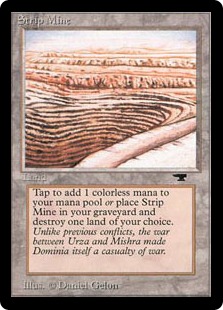
Other lands could support your deck in other ways, like lands that turn into creatures when a certain condition is fulfilled, or lands that can do other things besides give mana. Urza’s Factory, for instance, can put a 2/2 creature into play.
Strip Mine can get rid of an opponent’s land…
And Mutavault can become a 2/2 creature until end of turn.

You have to determine what you want your mana base to do for you before you proceed!

#2: Determine how much of each type you need.

Mono-colored decks get off easy in this regard. You simply put in enough mana sources of the color of your choice to constitute at least a third of your deck (so you’re drawing land about 33% of the time with a good shuffle), and you’re pretty much done.

However, if you’ve got a deck with more than one color, you need to balance things more carefully. Some things to consider include:

Casting costs of each spell.

Example: If you have a Green/White deck together, but all your Green spells have two Forests in the required casting costs, you’re probably not going to get away with an even split of Plains and Forests in your mana base. Instead, you’ll have to put in twice the number of Forests as Plains, so that you’ll more likely have the mana to play those double-green spells.

How many cards of each color you have.

Example: If you have a Green/White/Blue deck together, but you only have a few Blue cards, you won’t need many true Islands in the deck–you could possibly get away with just having a couple of dual- or tri-color lands. (I have such a deck together, and I’m only running 3 Islands, but I actually have enough access to Blue mana with the tri-color lands and land fetch I included in the deck.)

The land fetch you have included in your deck build.

Especially if you’re playing mono-Green or you’ve splashed Green into your deck, land fetch will help offset a troubled mana base. Land fetch, or the ability to retrieve another source of mana from your deck, is often necessary to offset turns where you have no land to play.

If you’re playing a lot of land fetch, you may not need as much of each color as you might have otherwise. If you’re not playing any at all, you will probably need to boost the amount of each type of mana you need for your deck.

#3: Determine how much of the deck you want to devote to your mana base.

I said earlier that about a third of most decks is dedicated to land. However, there are times when you don’t need 20 lands in a 60-card deck. You might need 24, or you might need 16. 20 is a good place to start, but depending on the type of deck you’re running, you may need to adjust that land count as you play the deck.

The only way to tell how much you’ll truly need for the deck’s best play is to test-play it quite a bit, either in a virtual environment or a real-life environment. I’ve had times where I built a 20-land mana base and got so consistently flooded with land it was unimaginable; I’ve also had times where a similar 20-land mana base got me stuck mid-game because I could not consistently draw enough land to support the cards I wanted to play.

Decks that discard a lot of their hands might have to ratchet up their land count to offset the cards they might lose in the process, for instance. Decks that need lots of mana to play super-high-costing stuff (such as Angels, Elementals, etc.), also generally need higher land counts. By contrast, decks that have lower-costed spells or creatures that tap for mana might not need as many lands. This is the most difficult part of refining a mana base, but it is necessary!

Summary

By taking into account your particular deck’s casting costs, spell types, colors, and abilities, you can be more informed about creating a good mana base the first (or thirty-first) time around. Research and consideration, plus a good dose of trial and error, is the best way!

Glassics: Thursday in the Zone

This is a complete topic review of all the posts in the Thursday in the Zone category. Hmm…I need to write more about multiplayer games and general gaming, it looks like. 🙂

General Gaming

Competitive or Casual?
Game Tactics: Are You Proactive or Reactive?

City of Heroes

City of Heroes
The Slow, Agonizing Death of AE Missions
Stress Test: Being the Healer
Building a Better Team Support Toon, part 1
Building a Better Team Support Toon, part 2

Magic: the Gathering

Magic: the Gathering
The Art of the Expensive Combo
Competitive Magic is for Plagiarists
Life-Gain: It’s Not Just a Stall Tactic Anymore!

HeroClix

HeroClix
Building with Wildcards
Bad Dice! Bad!
How Robin’s Getting Her (HeroClix) Groove Back
You Hurt Me, I Hurt You: The Mystics Team Ability

Internet Games

Castle Wars
Farmville
Boomshine
Onslaught 2: Tower Defense
Dice Wars

Multiplayer Games

Resident Evil Deck Building Game
Resident Evil: Alliance

Castle Wars

castlewars
This Flash game has been a longtime favorite of mine ever since I discovered it a few years ago online. It’s like Magic: the Gathering meets tower defense! (Curious to see how these two game styles combine? Read on to find out!)

Basic Gameplay

You can play 1-player or 2-player (2-player mode works by having two people play with the same computer, just on different turns). There is also an option for Multiplayer, where you can join a playing room as a guest or as a member and play Castle Wars with others. (For experienced players, there’s also a selection for “Card deck,” where you can build your own deck to face off against opponents, human or computerized. I usually just go with the default deck they give me.)

cw_start
Here’s how the screen looks as you play the game. Your “hand” of cards is displayed at bottom center; your “castle” (your life points, if you’re used to playing Magic) is blue and on the left, while your opponent’s “castle” is red and on the right.

Each castle has a fence in front of it that starts off 10 units high–this fence is like creatures in Magic that can block combat damage for you. When you have no more fence left, the castle has to take all the damage directly; this is just like when you have no creatures in Magic, you have to take all the hits to your life points directly.

Whenever either player’s castle hits the ground (reaches “0”), they lose. Whenever either player’s castle reaches 100, they win. Your objective is to either take your opponent down to 0 or build yourself up to 100.

Resource Points

As pictured in the screenshot at left, you start out with your castle at 30 and your fence at 10. You also start with 5 resource points in each color, which help you play spells, and 2 of each helper (builder, sorcerer, or soldier).

You will gain resource points every turn based on how many helpers you have in each color. Say, if you had 3 Sorcerers but only 2 Builders–you’d get 3 Blue resource points and 2 Pink resource points every turn.

Best part: these points stay until they are used, so you can build up your points over several turns to be able to play bigger spells.

Card Types

There are three colors of cards, denoting the three types of cards in the game. You can only play one card a turn.

  • Pink cards are “building” cards, all focused around building up your castle and fence.
  • Blue cards are “magic” cards, focused around boosting your own resources and controlling the opponent’s resources, with one powerful building spell and one powerful destruction spell included.
  • Green cards are “weapons” cards, focused around damaging your opponent’s castle and taking away its resources. There is a really strong destruction spell included in Green as well.

Strategies

Blue is the most flexible of the colors, since you can pump up resources in all three colors with Blue cards, as well as build your castle and take down the opponent’s castle. But you’ll need all three types to win. Pink keeps you in the game while you’re waiting for a good Green castle-damaging spell; Blue helps you build up your resources so you can cast bigger spells to either build yourself up or tear your opponent down. And Green harries your opponent, making them waste their one spell a turn on building themselves back up.

Whenever you see a Blue card marked “Sorcerer,” a Green card marked “Recruit”, or a Pink card marked “School,” play those ASAP–they will increase the number of resource points in that color that you get per turn. This is like playing a land card in Magic; the more you play, the more resource points you’ll get back every turn.

You start out with 2 points in each color, meaning that you’ll get 2 points of resources in each color per turn, and they do carry over from turn to turn. That way, you can build up resource points to play the larger spells.

You’ll notice in this screenshot that certain cards show up darker-colored than the others. Those cards are the ones I don’t have enough resources to play yet; the brighter cards are cards I can play this turn. Just like Magic, you have to have so much of a specific color resource (like mana) to play your spells. If you don’t have 28 Green (weapons) resources, for instance, you cannot play the Banshee card (the most epic destruction spell in the game, which happens to be in this starting hand!).

This game is a great little challenge–it’s harder than you think to defend your castle with just a hand of cards!

To Play The Game: Castle Wars

Building with Wildcards

buildingwithwildcards
As a longtime HeroClix player, I’ve already found a few favorite team abilities (see my post about Mystics here), but I also enjoy passing around such abilities to characters who wouldn’t necessarily have it. Thus, the Wildcard team abilities–any one of the six symbols below means that the piece can share many different team abilities.

Why Wildcards Are Awesome

Wildcards sharing abilities can become game-changing very quickly. For instance, 77-point Spider-Girl can borrow the Mystics team ability from Jason Blood and start damaging her attackers every time they hurt her, too. Borrowing an Avenger’s free move ability increases team mobility if you’ve got a lot of Wildcards to move around, and passing around better attack values courtesy of Bat-Enemy team can make even your second-string Wildcards good for something!

In essence, Wildcards can help round out your team–if you have a lot of ranged S.H.I.E.L.D. pieces, for instance, and you need a little close-combat to help them out, you can easily include a wildcard close-combat piece like Timber Wolf or Iron Fist to give you another person to help you kick up range or damage without being as squishy as your range pieces.

Some Caveats to Remember

  • When selecting team abilities, choose one aggressive or movement TA and one defensive–such as Bat-Enemy and Danger Girl, Avengers and Mystics, or Ultimates and Bat-Ally. That way, you can wildcard to the aggressive TA during your turn, and then wildcard to the defensive one when it’s your opponent’s turn.
  • Choose your team-ability-bearing pieces wisely–make sure they can defend themselves if your opponent tries to attack them first. POGs with TAs are notoriously fragile and shouldn’t be relied on as the sole source of a TA.

Some Aggressive Team Abilities

  • Ultimates, Superman-Ally, Avengers Initiative
  • Ultimate X-Men, 2000 AD
  • Batman-Enemy, Sinister Syndicate
  • S.H.I.E.L.D.
  • HYDRA, Police, Morlocks
  • Masters of Evil
  • Injustice League

Some Defensive Team Abilities

  • Mystics, Arachnos, CrossGen
  • Batman-Ally, Kabuki
  • Defenders, Justice Society of America, Alternate Team Ability Fantastic Four
  • Teen Titans, X-Men
  • Hypertime, Kingdom Come

Some Movement Team Abilities

  • Green Lantern Corps
  • Avengers, Justice League of America, Brotherhood of Mutants, Top Cow
  • Serpent Society

Team Abilities That Aren’t Worth It For Wildcards:

  • Crime Syndicate (easier just to use a Wildcard with Prob naturally on the dial)
  • Superman-Enemy (hard to set up, easy to destroy)
  • Crusades (very situational and doesn’t come up often enough.)
  • Guardians of the Globe (again, very situational.)
  • Suicide Squad (ideally, your Wildcards shouldn’t be dying…easier to use X-Team or Teen Titans for healing)
  • Regular Fantastic Four (doesn’t work when a wildcard dies)

Watch Out for Uncopyable Team Abilities!

TAs like Power Cosmic, Quintessence, and Outsiders can’t be copied by Wildcards–check the Player’s Guide list of Team Abilities before you build a wildcard team, just to make sure your selected team is actually legal!

Try Out Your Own Combos!

The Wildcard team building strategy is all about customization–trying all sorts of Wildcard characters and combos of TAs until you find what you like. Start off by adding a few different Wildcards to your favorite team, and see what happens!

Boomshine

This relaxing and yet mentally stimulating game is based on chain reactions–you try to set down your beginning dot in a place where it will ripple out and catch the most dots in its ripples. It is deceptively easy at first, with its soft piano accompaniment and simple goals. Just wait ’til level 12. 😀

Basic Gameplay


Level 2: The goal is to get 2 dots. Your goal number of dots is always in the bottom left part of the screen; there are currently 10 floating around in this level, hence the words “from 10”. For each level, you click a spot on the screen; the mouse cursor in this shot is the clearish dot with the pale halo around it.

Once you click, a white dot will expand out from where you clicked for a few seconds, and any dot that comes close enough to touch the white dot will expand out as well, showing that it’s been activated.


Here, I clicked close enough to 2 dots to get my goal, and then a third knocked into the first two I got, making my total score “3 of 2”–basically, I got more than the requirement. This is normal.

When you have reached the goal for the level, the screen turns a paler shade of blue-green, and then closes out; thus, the reason for the screen color change in the screenshots.

The chain reaction continues until either the goal for the level is reached, or the last activated dot shrinks away into nothingness.

You have infinite tries at the game, but if you can do it in as few rounds as possible (minimum 12 rounds), you’ll have a better score at the end.

Strategy

Boomshine is a patience game more than anything. I’ve found it requires a sense of timing and observation–you observe where the dots on the screen are bouncing around, and try to time your click to when the most dots possible will be intersecting with the dot you are about to place.

Do not feel compelled to click within the first five seconds–there is no time penalty! You’ll actually waste more time if you keep clicking and not getting enough dots every time you try. Waiting for just the right time and place to put down your dot will help you achieve your goal faster, especially in the harder, later levels.

Have fun–this is a great “don’t worry, be happy” game, with great music and a fun, simple interface!

Play the Game: Boomshine

Dice Wars

dicewars
This Risk-like Flash game has been both a favorite addiction and a source of frustration for me for the last several years. Even though your opponents are computerized and the dice rolls are random, there is plenty of room for strategy and plenty of ways that the game can change up, every time!

Basic Rules and Gameplay

You start out as the purple player in this game, and you get a random number of dice allotted to you, automatically spread out for you over 2 to 5 spaces (at least in my gameplay). (If you don’t like the number of spaces or dice you’re given, you can hit “No” when the game asks you “Do you play this map?” and it will give you another scenario.)

Each round, every player on the map tries to take over other territories from other players. To attack, click your space, and then click the adjacent space you want to try to take over. If the attacker’s dice roll exceeds that of the defender’s dice roll, the attacker gets that space (very Risk-like). With every space you gain, you get access to another die at the end of your turn; those dice are applied randomly to the spaces you control when you click “End Turn.” Luck and chance determine where your extra dice will be placed, so you have to play carefully to outlast your opponents.

The dice stack up on your owned spaces, from 1 measly die all the way to 2 stacks of 4 dice each (the highest you can go). I refer to dice stacks in-game by how many dice are in them–for instance, the 2 stacks of 4 dice I refer to as an “8-stack,” and the 1-die spaces are 1-stacks, etc.

A Typical Game

The following is a funny PowerPoint I put together to show a typical game of Dice Wars, almost turn-by-turn, with funny and real written commentary. My commentary was not recorded audibly because I want this site to be PG-rated. 😛

dicewars_typicalgame

Strategies

How Many Players?
I’ve found that I play best in a game with 7 other players, because I like to build my dice empire from the ground up rather than rely on the game to give me either a greatly stacked-up territory or territories of one- and two-dice stacks each. With 7 other people, you can easily take over the smaller territories and then camp out, waiting for the big guys to thrash each other while you build up and build up.

When To Attack and When to Hold Back?
Generally, you can attack an enemy territory and win it if you have a number of dice equal to or greater than what they’ve got defending that territory. For instance, you wouldn’t want to try attacking an 8-stack with a 2-stack, because you have no chance of winning those odds. But you could attack a 4-stack with a 5- or 6-stack, easy. You might not get it, but the chances are greater that you’ll take that territory over.

Turning Your Flank
In most cases, turning your weakest flank to the enemy is a bad idea. Where possible, move your strongest defenders (your 6-, 7-, and 8-stacks) to be your new borderlands–this can be accomplished with some creative arrangement, taking over territories carefully so that you have a smooth line of big dice stacks moving across the map.

Never leave a 1- or 2-stack open where an enemy can just stampede in, unless you’re like me and like to leave a small hole for your enemies to fall in. In my PowerPoint, I left a 1-stack of mine right beside a larger stack belonging to an opponent. That opponent attacked my 1-stack and took it over, but it freed me up to attack back with my 6-stack that had been inaccessible and unusable before. Sometimes, you can tempt opponents to push their luck, and they end up spending down their 8-stack into a much more manageable 5- or 6-stack, which you can then take over with a free 8-stack of yours adjacent to it.

To Play the Game

Play Dice Wars

For More Information

Dice Wars @ JayIsGames.com