Tag Archives: game

Thanksgiving Special: Loops of Zen

While you’re in your tryptophan-induced haze after mounds of turkey, dressing, and more sweet potatoes than you could ever want to see in a year, why not enjoy a game? Loops of Zen is that odd combination of rest and challenge–a peaceful yet thought-provoking game.

Gameplay

It looks and sounds fairly basic and simple: get all the curves, lines, and wavy pieces to link together into a shape that leaves no loose ends exposed. Not all lines need to be connected to the SAME shape–i.e., you could have random curves forming two separate circles and still win the level. To connect the various pieces together, you’ll have to turn them 90 degrees at a time with just a click of your mouse, until the game is satisfied that there are no loose ends remaining.

This, however, is more challenging than it seems, as you get fields of random lines and curves looking something like this:

Somehow, you have to make order out of this chaos. And it CAN be done–just click around, explore various ways to connect the pieces together.

I find that it’s something like a curvaceous form of Tetris, without the time limit. It takes time to plot your next moves, to turn pieces to their best advantage. You may have to form several different shapes before you hit on just the right one, and Loops of Zen does not penalize you for that. It only counts how many levels you completed, not how long you took to beat each level. (I love that about this game!)

A Sample Game in Progress

Below is a series of three pictures showing how I progressed in solving one of the game’s many svelte puzzles:


This is what I started out with. Hmmm…well, there’s a tackle-able mess at bottom right, let’s get that shored up first. But what can I turn to connect all those wonky pieces at top left?


Well, that got some of the randomness from the other side of the picture out of the way. I still have the wonky lines at top left, though.


Kinda looks like two aliens sitting and having a conversation, now! XD But what am I going to do with that random curve at top middle, and that random straight line at bottom middle? Not to mention the “arm” off the left “alien guy” shape. LOL, this gets funnier by the minute!

Bonus Section: The Music

Loops of Zen is kind of unique among Flash games in that it has an absolutely beautiful and appropriate song as its background. The song, “Surrealism” by XGamer, was an instant favorite of mine as soon as I played the game the first time. Its darkly flowing chords in F-sharp minor provide the perfect ambient-trance backdrop for this game, and it’s one of the reasons I enjoy this game so much.

Summary

If you want a Flash game that is utterly different from everything currently out there, I strongly suggest you check this out. It will make you think, and yet it is relaxing, too…perfect for an afternoon with a full belly and a comfortable chair. 😀

Play the game: Loops of Zen

Resident Evil: Outbreak

As the second official expansion set for the Resident Evil deck building game, Outbreak has a lot to live up to; its immediate predecessor, Alliance, set the bar pretty high for cards added to the game’s repertoire. And in most respects, Outbreak does not disappoint.

New to Gameplay: Infection System

Gameplay has not changed very much from the way the Base Set and the Alliance box play…except for one big addition: the Infection system.

Basically, every turn you do not Explore the Mansion, you receive one Infection Counter, in the form of face-down cards dealt from the Infection Deck (new to Outbreak). You can also get infection counters from creatures you happen to face within the Mansion, from other players facing creatures, or even as a side effect of someone playing a card. There are a few ways to get rid of Infection counters, but a whole lot more ways to accumulate them.

When you get 10 Infection counters, you take all the facedown cards you were dealt from the Infection Deck and add them to the deck you’ve been building since you started the current game. You officially become an Infected creature yourself at this point, and all you can do is attack the other players until the game ends.

The Infection System: Pros and Cons

Pros: Makes the game go a lot faster; makes for different levels, challenges, and styles of gameplay (i.e., struggling to keep yourself uninfected, actually trying to defeat the Mansion, or getting completely into the role of the Infected creature and taking out the other players).

Cons: Can’t get rid of counters as easily as you can accumulate them; one more thing to worry about in-game; distracts from original purpose of game; makes characters die a lot faster because you almost have to explore every turn.

My verdict: Infection system is not fun to play, because I like being able to have a decent weapon before I’m forced to explore the Mansion, and I hate having to focus precious game time on getting rid of those stupid counters. But for those who enjoy a faster gameplay or want something different from a typical deck building game, Outbreak does just that.

Amazing New Cards

I like this card especially for the “draw 3 cards” thing…but it’s fun to get 2 free actions, too. Can help you start an Action chain just like Reload did in the Base set.
This is THE way in the Outbreak box to Trash things out of your deck. Also great for Buying stuff without using up your Buy for the turn!
Not a joke card, by any means. You CAN now shoot stuff for mega damage, and it gets better when played at night. I like the situational boost, and I can only imagine the ruckus that the Base Set’s Jill Valentine would cause with this thing. See, she can reach the point where she keeps Explosives weapons instead of having to Trash them after every use, so… 😀

Imagine these two paired with The Merchant (Base Set), or with Gathering Forces (Alliance). Mwahaha. So much card-Gaining action…and SO much damage potential.
Yes, you get +1 Explore (usually, I hate that). But if you draw an Infected creature that is 20 or less health, you can put it back on top of the Mansion. And look–it’s a FREE 10 damage! Take that, Combat Knife.

To Learn More

Resident Evil DBG Wikia (source for Stun Rod and Samurai Edge images)
RE DBG: Outbreak on BoardGameGeek.com

We Love Katamari

This crazily fun game for the Playstation 2, released in 2005, has to be one of the most relaxing games I’ve ever played. But don’t let it fool you–the humor and fun in the game is only the surface of a game that actually requires more thought and strategy.

Basic Gameplay

You play as Prince Katamari Damacy, the son of the King of the Cosmos, and in this game (a sequel to earlier Katamari games), the King has gotten a little tipsy (okay, a LOT tipsy) and has accidentally destroyed all the planets in the universe except for Earth. In a panic, the King sends his son Katamari to Earth to collect lots of junk to make new planets out of. (To think of all the universes the King could make with the junk in my room…!)

The Prince is given a rather strange-looking, lumpy ball (also called a “katamari”), which “picks up” anything lighter than itself, and you are asked to roll the ball around and pick up items, making the katamari larger and larger. This process is called “rolling up” stuff. You use the two control sticks on the Playstation controller to roll the katamari around–the left stick controls the Prince’s left hand, and the right stick controls the right hand. (There’s a wonderful tutorial level which shows you more of the fine control skills–it’s a fun little mini-game in itself!)

Once you’ve gotten into the game, you explore several different areas of a park-like setting, where many people are hanging out waiting for the Prince to help them with a task. There’s a harried mother who wants her son’s room cleaned up, a schoolteacher who needs to get all her students home safely, a florist who wants a beautiful, large bouquet of flowers gathered, a camper who wants a big bundle of firewood for his campfire, and even a bird and elephant who want to see just how big a katamari can get. Each person you talk to gives you a different level to play on, and each person’s level requires a little bit different strategy and mindset to conquer.

As you play each level, new challenges appear. Some of the people you talked to before offer you new levels or new types of challenges later in the game. Example: the young sumo wrestler in training, who asks you to help him get big enough to fight first a relatively small opponent, then a medium-sized opponent, then a large opponent. Keep talking to everyone, even the people whose levels you’ve already done–you might find yourself breaking your old record, or completing an entirely new challenge!

What I Love about the Game

We Love Katamari is a fun, approachable game, suitable for children but challenging for all ages, with the different goals you must reach to complete different levels. It’s relaxing and hilarious (if you get the katamari big enough on the bird-and-elephant level especially…you start rolling up islands and giant buildings!). Though one would think the process of rolling up all these different items would get boring after a while, it never does–I’ve been playing it since 2007 and still love starting the game over and trying it all again.

The game is very easy in its controls, which frees up a lot of brainpower for thinking through the levels. In the levels where time is of the essence, for instance, you have to focus on getting just the essentials, not trying to roll up everything in sight. Other levels, like the campfire level where you have to make sure you’re rolling up something every few seconds so the campfire doesn’t go out, are very challenging. (Don’t let your campfire bundle fall into the water…just saying, it’s the only way to utterly fail at We Love Katamari.) There are still some levels I haven’t conquered completely–I may have completed them, but I want to complete them better. We Love Katamari is ultimately a game about bettering yourself, discovering novel ways to complete a task, and of course, laughing at all the junk you’re collecting along the way.

To Find Out More

We Love Katamari on Wikipedia
GameSpot.com’s We Love Katamari section

Pikmin

If you ever wondered “Isn’t there a way that I can lead an army of cute little creatures to help me do stuff?”, then the Nintendo Gamecube game Pikmin is definitely for you. Released in 2002 and again in 2009 for the Wii, this little real-time strategy game is like nothing you’ve ever played before.

Concept

You play as Captain Olimar, a lone spaceship pilot on his way back home after a long vacation. Unfortunately, the ship is struck by a passing asteroid and plummets to the surface of a nearby planet. Olimar is safe, but his ship is in pieces–30 pieces, to be exact. And this is a very, very big planet, and he is an itty-bitty little guy. Not to mention that the planet’s atmosphere is poisonous to him; he’s only got 30 days of breathable air in his spacesuit!

He bemoans his fate onscreen, as he ambles about the skeleton of his beloved Dolphin, assessing the damage. And then, he catches sight of what appears to be a growing carrot, a few feet away. He pulls experimentally at the stalk, only to uproot a bright red living creature, carrot-shaped, but definitely not food!

The little creature, which Captain Olimar names “Pikmin” after his favorite brand of carrots back home, clings to him, in need of protection and leadership. It turns out that in the immediate crash site area, there are several more sprouts; there are even some random numbered red pellets, which, when fed to the Pikmin’s apparent mothership (nicknamed “Onion” by Olimar), produces even more sprouts. These new Pikmin are just as loyal and clingy as the first Pikmin Olimar uprooted; it seems he now has a commandable and expandable army on his hands.

Basic Gameplay

Once you discover the Pikmin, you (as Olimar) lead them into battle and into ship part recovery, fighting off the natural Pikmin-eating creatures in order to get to the far-flung parts. A number of Pikmin then carry the recovered part back to the Dolphin, restoring its functions piece by painstaking piece. Upon evening falling, Olimar and the Pikmin both must leave the surface of the planet, since there are more dangerous nocturnal creatures about which could eat both the Pikmin army and Olimar as well.

In-Game Exploration

As the Dolphin is put back together, it can rise up higher in the atmosphere and seek out more parts in different places. You end up visiting five different areas in all.

Different parts you recover also help you in-game–once you get the Whimsical Radar, for instance, you can locate lost Pikmin on your map, whereas before you have to go whistling madly through all the areas looking for them.

Pikmin Types

Red Pikmin, the first type you discover, are fire-resistant and somewhat stronger, but slower. The slimmer Yellow Pikmin can carry and place explosives, and can be thrown higher into the air to retrieve hard-to-reach stuff–they also move the fastest. Blue Pikmin can swim and are medium-build, making them fairly good at fighting and moving quickly.

It is a good idea to build up your Pikmin army as quickly as possible, using the carcasses of creatures the Pikmin have defeated, as well as the scattered Pikmin pellets. Remember, let the red Pikmin carry the red pellets, yellow carry yellow, etc.–you will maximize your Pikmin sprouts in this way, because the pellet colors match the Onion they go back to.

Carrying Objects

Each portable object you come across in the game, whether it’s a ship part or an enemy carcass, needs a certain amount of Pikmin to carry it. The number will appear as the bottom half of a fraction floating above the item, with the number of Pikmin currently trying to carry the item appearing as the top half of the fraction. For instance, an item labeled “29/30” needs one more Pikmin to be lifted; an item labeled “2/2” is being carried by just enough Pikmin; an item labeled “30/20” is being carried more quickly because there are 10 more Pikmin to share the load.

Game Time and Sunsets

Your time in the game is divided up into 30 days, lasting about 13 minutes each (except the first “day”, which lasts until you find the Dolphin‘s engine). At sunset, make sure all your Pikmin are accounted for–if they are not actively walking with you or put up in their individual Onions, they will be lost to the nocturnal beasts when sunset arrives.

Multi-Tasking with Pikmin

You can multi-task with different groups of Pikmin recovering different objects at the same time. A popular way to do this is to work with one group of Pikmin to get one item, then assigning only as many Pikmin as are needed to carry the item back to the campsite, while you go forth and start working on retrieving the next. Be careful doing this, though–if you have not cleared the path back to the campsite of all enemies, the unsupervised Pikmin can be ambushed and killed.

Unnecessary Parts

Not all the ship’s 30 parts are necessary for the Dolphin to be able to take off and give you a successful game ending. There are 5 unnecessary parts, listed below:

  • Space Float
  • UV Lamp
  • Nova Blaster
  • Massage Machine
  • Secret Safe

List gleaned from the Ship Parts page on the Pikmin Wikia site.

Hidden Ending

If you get 29 of 30 parts, a new, final area will open up, which is full of challenges for your experienced Pikmin fleet. Getting through most of the stage is fairly easy after having gotten through all the other challenges of the game…until you get to the “final boss,” a huge, fat yellow caterpillar/slug thing called Emperor Bulblax, which sounds less like a critter and more like Dulcolax’s evil twin drug.

Defeating this horrible creature is one of the most frustrating endgame experiences I’ve ever had. I threw one of my poor yellow Pikmin into Bulblax’s mouth, just like my Nintendo Power guide said to do…and then watched in horror as the fat thing rolled over and killed my 99 remaining Pikmin in 2 seconds. I was about 14 at the time, so I had a nice little fit and swore never to play that level again. XD

Instead, after retrieving 29 of 30 parts, my Pikmin force is generally treated to several days of ego-boosting whooping up on local wildlife and making more Pikmin. The Secret Safe (the part that Bulblax guards) ain’t worth so much loss of life, in my opinion. BUT…beating Bulblax is the only way to retrieve it. So if you’re a completionist, go for it–just keep your Pikmin away from his girth and hungry maw, is all I have to say.

Consulting the Perfect Pikmin guide might help you towards this goal. (Hmmm…maybe I’ll finally avenge those martyred Pikmin after all!)

Summary

Pikmin is one of my all-time favorite games (despite its inherent challenges). It involves leadership and organization, nurturing little life-forms, and striving toward a goal of survival for everyone involved. It might look like a kid’s game, but trust me, it’s as tactical and strategic as you want to make it!

Read more about the game: Pikmin @ Wikipedia.com

“Swan Lake” Dressup Games

swanlakedressup
Today, I’ll profile one of my old favorite dressup games, which is no longer online but deserves a shoutout nonetheless.

“Swan Lake Dressup” was made by PuterDolls, and became an instant favorite when I discovered it on the Internet way back in 2005-2006. Offering graceful, pretty, well-drawn ballet-style clothes in a range of colors, plus pretty hair accessories, Swan Lake Dressup is a game I wish I could play again.

Basic Gameplay

You could click and drag the clothes you wanted onto the virtual Odette, even changing the basic white leotard. Other hairstyles and hair accessories were accessible by clicking the range of little headshot pictures up at the top of the page.

You could pretty much create any look you wanted–check out my small sample of looks, below:

Some Example Looks


  • Pale blue leotard
  • Long white tutu
  • White tights
  • Pale blue slippers


  • Pink leotard
  • No slippers


  • Brown leotard
  • Short white tutu
  • Sheer tights
  • Dark brown slippers


  • Long blue dress
  • Pale blue slippers
  • Delicate headband

Similar Games to Try

Though this game may be gone, you can try these:

Both these games have been personally tested and at least give some of the same graceful ballet feel. 🙂

Reader Question: Do You Know What Happened to PuterDolls?

In trying to find Swan Lake Dressup, I found that a Blogger website using the name “PuterDolls” was being run as of 2012, but it didn’t seem to be associated with actual game-making–more just game advertising. (Thus, why I didn’t link it here.) Nothing much came up otherwise, not even many pages into a Google search.

Do you know what became of this game website and where its awesome creators might be posting creative work on the Internet these days? If you do, please tell me in the comments! 🙂

Empowerment Buffs, or “those buffs made from salvage”

empowermentbuffs
In City of Heroes, we focus a lot on Enhancements (most comparable to “gear” for World of Warcraft players)–they are permanent boosts to a hero’s selected powers. You can boost the healing potential of your hero, their damage potential, how accurately they hit, and many other facets of their powers. We also pay a lot of attention to Inspirations–temporary, ubiquitous boosts that can be activated during battle to help you get through tight spots.

We don’t, however, pay a lot of attention to Empowerment buffs–but they are important, too!

What ARE Empowerment Buffs?

You might be thinking, “Empower-what?” Well, you can think of Empowerment Buffs as something like the Mystic Fortune buff from the Magic Pack–it’s a long-lasting buff (1 hour), much longer than an Inspiration or an ally buff, but not quite as permanent as an Enhancement. What is least known about them is how they are triggered, and it actually takes a Supergroup base to get them.

How to Get Empowerment Buffs

To receive an Empowerment Buff, you must first have access to an Empowerment Station, which is generally part of a Supergroup Base. If you’re in a Supergroup that has an Empowerment Station, you only need certain pieces of salvage to trigger the stations.

Empowerment Stations look like this (all following pictures from ParagonWiki):

Arcane Empowerment Stations

  
From left: Enchanting Crucible (Tier 1), Arcane Crucible (Tier 2), Mystic Crucible (Tier 3)

Tech Empowerment Stations

  
From left: Radiation Emulator (Tier 1), Linear Accelerator (Tier 2), Supercollider (Tier 3)

It doesn’t really matter which type (Arcane or Tech) you go with–it’s mostly a cosmetic difference to match the theme of your base. What matters is that these stations, when activated with invention salvage of varying types, can give you buffs to your resistance to damage, your attack speed, and tons of other cool effects.

Example: Endurance Drain Resistance Buff for Fighting Malta Sappers

For instance, to fight Malta (and the resident Sappers who eat your Endurance when they shoot you), you’ll definitely need the Endurance Drain Resistance bonus–just feed a Hydraulic Piston into the Empowerment Station! You might not think this helps, but it surely does–I’ve been able to make it through a whole Malta battle without having to Rest or eat Catch a Breaths like Bon Bons.

Make Sure Your Empowerment Station Is Fully Upgraded!

There are three levels of Empowerment Stations–Tier 1, 2, and 3, as I noted in the pictures above–and the Tier 3 station will give you access to all the buffs you’ll ever need. However, to be able to build a Tier 3 station, your Supergroup needs a LOT of prestige. Also, you’ll have to buy and build the other two levels of Empowerment Stations first; Tier 1 stations are used to craft Tier 2 stations, and Tier 2 stations are used to craft Tier 3 stations.

When you upgrade stations, you still have access to the previous level’s buffs, so it’s worth it to upgrade when you can.

Find out more about Empowerment Stations (and how to craft them for your Supergroup Base) here: Empowerment Base Items.

What Kind of Salvage Makes Empowerment Buffs?

Salvage of all different level ranges can make Empowerment Buffs–it just depends on what buff you’re after and what level you are. Most of the required salvage for Empowerment Buffs is common salvage, but some buffs require uncommon salvage. Also, some buffs only need one piece of salvage, some need two, and some need three.

A complete table of Empowerment Buffs and the salvage it takes to create them can be found here: Empowerment Buff Recipes and Ingredients. Depending on whether you have an Arcane or Tech Empowerment Station, the salvage recipes will vary slightly for most of the buffs.

It’s a good idea to keep a stash of common and uncommon Invention Salvage in your Supergroup Base (or on your individual characters) that matches up with your characters’ needs. For instance, if your Scrapper keeps getting knocked back all the time, making it impossible to fight, you might benefit from the Knockback Protection Empowerment Buff. Therefore, you might want to carry the salvage that the buff requires (see the list here).

Summary

Using Empowerment Buffs might require a little time investment, but if it helps you get through mission arcs full of maddening enemy attacks, it could reduce frustration by 17.5%! 😛

Kaboom!

kaboom_start
If you’re looking for a challenging game that is a little bit old-school and a little bit new-school, Kaboom! is for you. Get in the “Kaboom Zone” and you’ll be in the high levels before you know it!

Basic Gameplay

In the game, a spooky pair of eyes in the darkened upstairs window of a house is throwing bombs out the window to the ground below. You have no character onscreen–instead, your mouse cursor controls a well-patched trampoline. With this, you have to protect your ground from the assaulting bombs.


Catch the black bombs with the trampoline and help them bounce their way harmlessly off-screen to the right. If you let a black bomb touch the ground, it will explode and make you lose 1 of your 5 lives.

Sometimes the little guy in the house will toss out one bomb at a time, and sometimes he’ll throw out 3 or 4 in rapid succession. It’s all about how fast you can juggle those bombs with your mouse cursor–there are times when you have to slide your trampoline under the bombs like a baseball player stealing second base!

Now, if a red bomb appears, avoid catching it–the red bombs will hurt you and make you lose 1 of your lives!

Sometimes, the guy throws out colorful letters instead of bombs. Catch these and help them bounce off-screen if you can spare the time–you’ll get an extra life if you completely spell out the word “KABOOM.” If you just can’t catch the letters (as in, you’ve got enough bombs in the air already), don’t worry; the letters don’t make you lose a life if they hit the ground.

Strategies

  1. I find it easiest to place my cursor in the horizontal center of the game window, and move back and forth as needed.
  2. Don’t look at your “lives left” total, your score, or anything else except for the bombs falling out the window. Let your attention wander and you’ll be sunk!
  3. Sometimes, your trampoline just can’t catch every single bomb; don’t let one failure to catch a bomb distract you from the other bombs on-screen. (It’s a life lesson in handling failures! LOL)
  4. The moment you bounce a black bomb into the air, be ready for another one to fall. Especially when the screen is chock-full of bouncing bombs, you have to stay alert if you don’t want to lose all your lives in one round!
  5. Don’t always dive for the colorful letters. If you have a choice between bouncing a letter and bouncing a bomb, go for catching the bomb every time.
  6. Watch the way the bombs fall. Some will bounce fast once or twice across the screen, and some will bounce slooooowly, taking for-EV-er to cross the screen. Pay closer attention to the slower-bouncing bombs!

Play Kaboom: Kaboom! at FreeOnlineGames.com

Mana Base: The Literal Foundation of a Magic Deck

manabase
Okay, I’ll admit it: I’m generally terrible at building a mana base for my decks, even though I’ve been playing Magic since 2005. When I start building a new deck, I’m usually focusing on the awesome cards I’m going to put in, rather than the mana I’m going to use to play said cards. Usually, I end up with way too many cards I want to put in and no room for mana!

I’m sure I’m not alone in this, either. I theorize that the reason Standard Magic (or Type II) has so many netdecks (copied strategies from pro and semi-pro players) is because most of us have a hard time building the right mana base. (Check DeckCheck, EssentialMagic, and the Standard General section of the Wizards of the Coast forums if you don’t believe me about copied strategies.) And, since mana bases are the foundation of any deck, when your mana base isn’t right, the deck doesn’t work.

So, how does a Magic player go about making a mana base that works? Here are some tips I’ve recently started to follow, with success:

#1: Determine what types of mana you need.

Sounds too simplistic, but this is the very first step to building a working mana base for your deck.

If you’ve got a mono-colored deck, for instance, you don’t need dual-color lands. And if you have dual-colored cards in your deck, you’re going to need both colors of mana to support them unless they are hybrid-mana cards (which means they could be played with either color).

How you choose to provide mana for your deck from color determination on is really based on what kinds of cards you have in your deck. For example, if you have a creature like Leonin Elder that gains life whenever an artifact comes into play, you will want artifact lands (like Ancient Den, at right) in your deck so that you have more artifacts to trigger that life-gain.
You also might have a creature that costs less to play for each certain type of land in play (this is called the “affinity” mechanic, seen on Tangle Golem at right). Playing this kind of ability means you’d want more of that land type in your deck than anything else.
Branching off the affinity concept, you could also use artifact lands to pump up a creature like Broodstar, who gets bigger for every artifact in play:
Other lands could support your deck in other ways, like lands that turn into creatures when a certain condition is fulfilled, or lands that can do other things besides give mana. Urza’s Factory, for instance, can put a 2/2 creature into play.
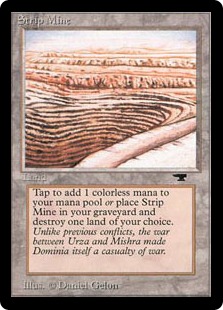
Strip Mine can get rid of an opponent’s land…
And Mutavault can become a 2/2 creature until end of turn.

You have to determine what you want your mana base to do for you before you proceed!

#2: Determine how much of each type you need.

Mono-colored decks get off easy in this regard. You simply put in enough mana sources of the color of your choice to constitute at least a third of your deck (so you’re drawing land about 33% of the time with a good shuffle), and you’re pretty much done.

However, if you’ve got a deck with more than one color, you need to balance things more carefully. Some things to consider include:

Casting costs of each spell.

Example: If you have a Green/White deck together, but all your Green spells have two Forests in the required casting costs, you’re probably not going to get away with an even split of Plains and Forests in your mana base. Instead, you’ll have to put in twice the number of Forests as Plains, so that you’ll more likely have the mana to play those double-green spells.

How many cards of each color you have.

Example: If you have a Green/White/Blue deck together, but you only have a few Blue cards, you won’t need many true Islands in the deck–you could possibly get away with just having a couple of dual- or tri-color lands. (I have such a deck together, and I’m only running 3 Islands, but I actually have enough access to Blue mana with the tri-color lands and land fetch I included in the deck.)

The land fetch you have included in your deck build.

Especially if you’re playing mono-Green or you’ve splashed Green into your deck, land fetch will help offset a troubled mana base. Land fetch, or the ability to retrieve another source of mana from your deck, is often necessary to offset turns where you have no land to play.

If you’re playing a lot of land fetch, you may not need as much of each color as you might have otherwise. If you’re not playing any at all, you will probably need to boost the amount of each type of mana you need for your deck.

#3: Determine how much of the deck you want to devote to your mana base.

I said earlier that about a third of most decks is dedicated to land. However, there are times when you don’t need 20 lands in a 60-card deck. You might need 24, or you might need 16. 20 is a good place to start, but depending on the type of deck you’re running, you may need to adjust that land count as you play the deck.

The only way to tell how much you’ll truly need for the deck’s best play is to test-play it quite a bit, either in a virtual environment or a real-life environment. I’ve had times where I built a 20-land mana base and got so consistently flooded with land it was unimaginable; I’ve also had times where a similar 20-land mana base got me stuck mid-game because I could not consistently draw enough land to support the cards I wanted to play.

Decks that discard a lot of their hands might have to ratchet up their land count to offset the cards they might lose in the process, for instance. Decks that need lots of mana to play super-high-costing stuff (such as Angels, Elementals, etc.), also generally need higher land counts. By contrast, decks that have lower-costed spells or creatures that tap for mana might not need as many lands. This is the most difficult part of refining a mana base, but it is necessary!

Summary

By taking into account your particular deck’s casting costs, spell types, colors, and abilities, you can be more informed about creating a good mana base the first (or thirty-first) time around. Research and consideration, plus a good dose of trial and error, is the best way!

Glassics: Thursday in the Zone

This is a complete topic review of all the posts in the Thursday in the Zone category. Hmm…I need to write more about multiplayer games and general gaming, it looks like. 🙂

General Gaming

Competitive or Casual?
Game Tactics: Are You Proactive or Reactive?

City of Heroes

City of Heroes
The Slow, Agonizing Death of AE Missions
Stress Test: Being the Healer
Building a Better Team Support Toon, part 1
Building a Better Team Support Toon, part 2

Magic: the Gathering

Magic: the Gathering
The Art of the Expensive Combo
Competitive Magic is for Plagiarists
Life-Gain: It’s Not Just a Stall Tactic Anymore!

HeroClix

HeroClix
Building with Wildcards
Bad Dice! Bad!
How Robin’s Getting Her (HeroClix) Groove Back
You Hurt Me, I Hurt You: The Mystics Team Ability

Internet Games

Castle Wars
Farmville
Boomshine
Onslaught 2: Tower Defense
Dice Wars

Multiplayer Games

Resident Evil Deck Building Game
Resident Evil: Alliance

Castle Wars

castlewars
This Flash game has been a longtime favorite of mine ever since I discovered it a few years ago online. It’s like Magic: the Gathering meets tower defense! (Curious to see how these two game styles combine? Read on to find out!)

Basic Gameplay

You can play 1-player or 2-player (2-player mode works by having two people play with the same computer, just on different turns). There is also an option for Multiplayer, where you can join a playing room as a guest or as a member and play Castle Wars with others. (For experienced players, there’s also a selection for “Card deck,” where you can build your own deck to face off against opponents, human or computerized. I usually just go with the default deck they give me.)

cw_start
Here’s how the screen looks as you play the game. Your “hand” of cards is displayed at bottom center; your “castle” (your life points, if you’re used to playing Magic) is blue and on the left, while your opponent’s “castle” is red and on the right.

Each castle has a fence in front of it that starts off 10 units high–this fence is like creatures in Magic that can block combat damage for you. When you have no more fence left, the castle has to take all the damage directly; this is just like when you have no creatures in Magic, you have to take all the hits to your life points directly.

Whenever either player’s castle hits the ground (reaches “0”), they lose. Whenever either player’s castle reaches 100, they win. Your objective is to either take your opponent down to 0 or build yourself up to 100.

Resource Points

As pictured in the screenshot at left, you start out with your castle at 30 and your fence at 10. You also start with 5 resource points in each color, which help you play spells, and 2 of each helper (builder, sorcerer, or soldier).

You will gain resource points every turn based on how many helpers you have in each color. Say, if you had 3 Sorcerers but only 2 Builders–you’d get 3 Blue resource points and 2 Pink resource points every turn.

Best part: these points stay until they are used, so you can build up your points over several turns to be able to play bigger spells.

Card Types

There are three colors of cards, denoting the three types of cards in the game. You can only play one card a turn.

  • Pink cards are “building” cards, all focused around building up your castle and fence.
  • Blue cards are “magic” cards, focused around boosting your own resources and controlling the opponent’s resources, with one powerful building spell and one powerful destruction spell included.
  • Green cards are “weapons” cards, focused around damaging your opponent’s castle and taking away its resources. There is a really strong destruction spell included in Green as well.

Strategies

Blue is the most flexible of the colors, since you can pump up resources in all three colors with Blue cards, as well as build your castle and take down the opponent’s castle. But you’ll need all three types to win. Pink keeps you in the game while you’re waiting for a good Green castle-damaging spell; Blue helps you build up your resources so you can cast bigger spells to either build yourself up or tear your opponent down. And Green harries your opponent, making them waste their one spell a turn on building themselves back up.

Whenever you see a Blue card marked “Sorcerer,” a Green card marked “Recruit”, or a Pink card marked “School,” play those ASAP–they will increase the number of resource points in that color that you get per turn. This is like playing a land card in Magic; the more you play, the more resource points you’ll get back every turn.

You start out with 2 points in each color, meaning that you’ll get 2 points of resources in each color per turn, and they do carry over from turn to turn. That way, you can build up resource points to play the larger spells.

You’ll notice in this screenshot that certain cards show up darker-colored than the others. Those cards are the ones I don’t have enough resources to play yet; the brighter cards are cards I can play this turn. Just like Magic, you have to have so much of a specific color resource (like mana) to play your spells. If you don’t have 28 Green (weapons) resources, for instance, you cannot play the Banshee card (the most epic destruction spell in the game, which happens to be in this starting hand!).

This game is a great little challenge–it’s harder than you think to defend your castle with just a hand of cards!

To Play The Game: Castle Wars