Tag Archives: opinion

Hidden Clix Gem: Tessa/Sage (AKA The Swiss Army Knife)

sage If you’re new to Clix or simply haven’t explored many of the older Clix pieces available, you probably haven’t heard of this little lady, who goes by Tessa in her Rookie form and Sage as an Experienced and Vet figure.

Though she doesn’t look like much at first glance, her entire set of 3 figures are excellent Support pieces–simply because they do it all! Whether you need Enhancement, Outwit, Perplex, or Prob, the Tessa/Sage REV is worth fitting onto your team; if she gets hit and/or healed back up, she’ll be useful no matter what click she’s on!

The Dials and Stats

rookie_tessa
Here’s the Rookie, called Tessa (the character’s real name). The front-dial combination of Energy Shield/Deflection and Enhancement is simple but effective for a range-heavy team, and if she gets hit or pushed 2 clicks, she falls into Perplex with Combat Reflexes–helpful if she gets involved in close combat! The last two clicks, combining Stealth with Prob, are a subtle but lethal addition; the Stealth protects Tessa at range, and the Prob can keep her teammates a little safer. All that, plus 6 range and free move (through the Brotherhood TA), for 39 points? WOW!

exp_sage
The Experienced figure, called Sage (her alter ego’s name), features Outwit instead of Enhancement front-dial, and keeps that for 2 clicks. The 3rd click is the main reason Sage made it into my collection–she becomes Destiny with 18 defense and Phasing! And, if she gets somehow knocked past 3rd click, she becomes useful as a Mind Control piece for a couple of clicks…then she becomes a Perplex piece, and finally an Enhancement helper. 6 range and Brotherhood makes her easy to fit into your team strategy, for 60 points–a good bargain, given that hilarious 3rd click!

vet_sage
I don’t own the Vet Sage (YET!), but this one is just as handy as her Rookie and Experienced, starting off with a powerful supportive combo of Super Senses and Perplex. (The 3rd click is hilarious, with Mind Control, Combat Reflexes, and Prob!) And past 3rd click, she’s useful as a range-team booster and Outwitter back-dial. This figure adds a second range target, which can make her a solid second- or third-string attacker. Plus, the Vet replaces Brotherhood TA with X-Men, giving her the option of being healed with fellow X-Men TA pieces, all for 78 points. Considering all the usefulness you get packed into that point total, that’s awesome!

Why Should You Run Tessa/Sage Figures?

In short, you should use these figures because they never lose their effectiveness. At no point do you look at a wounded Tessa or Sage and say, “Well, this figure’s completely useless to me now,” because no matter where she is on her dial, she’s got at least one power that can help you out. I love figures like this, who never become just a meat shield for other characters on your team–I don’t have to worry that my entire strategy’s blown to pieces because my Tessa or Sage got hit for a couple of clicks of damage. I might have to shift my thinking a bit, but I can still win! (And if you run a Medic on your team, you can heal her back to where you need her most! Well, maybe that’s just my strategy…LOL)

Credits

All images retrieved from HCRealms.

My Favorite Video Game Music

Loving both video games and music as I do, the genre of video game music has drawn me since I was a child. Over the years, I’ve found that many video game tunes have stayed with me and become part of my music collection; music from video games has also been a way to bond with fellow players as we share about which music we like.

Today, I present to you my collection thus far, retrieved in the form of Youtube videos arranged alphabetically by series (with a small miscellaneous game section at the end). Click through and enjoy!

(Currently, I have music from these game series: Animal Crossing, Beatmania, Castlevania, Chrono Cross, DDR, Digital Devil Saga, Everybody Loves Katamari, Final Fantasy, and Super Mario. I know there’s plenty of other great video game music out there, but these are most of the ones from my collection so far 😀 )

Animal Crossing Series


K.K. Bossa – Animal Crossing for Gamecube


Marine Song 2001 – Animal Crossing: Wild World!


Neapolitan – Animal Crossing: Wild World!


The Roost – Animal Crossing: Wild World!

Beatmania & DDR Series


Sphere (Tatsh feat. K. Nayuki) – Beatmania IIDX


XEPHER (from Beatmania or DDR? No one can agree; I saw this–or a version of it–played on a DDR game)


The Legend of Max – DDR Extreme


MAX FOREVER – Flash Flash Revolution


Sakura – DDR Extreme 2


Can’t Stop Fallin’ in Love – DDR 5thMix


Exotic Ethnic – DDR 6thMix


Butterfly – DDR 3rdMix

Chrono Cross Series


The Girl who Stole the Stars – Chrono Cross


The Girl who Stole the Stars (amazing live musicians cover)


Radical Dreamers – Chrono Cross


Time’s Scar – Chrono Cross

Final Fantasy Series


Battle with the Four Fiends – FF4


Cosmo Canyon – FF7


Gold Saucer – FF7


Looking… (this is called Ahead on Our Way here) – FF7


Main FFVII Theme


On the Other Side of the Mountain – FF7


Aerith’s Theme – FF7: Advent Children


Suteki Da Ne – FF9


Not Alone – FF9


Terra – FF9


To Zanarkand – FFX


To Zanarkand – Final Fantasy Orchestra (AMAZING :D)


Hymn of Fayth – FFX


1000 Words – FFX-2

Super Mario Series


Water World Theme – Super Mario 64


Wing Cap Theme – Super Mario 64


Star Cove Theme (Cosmic Cove Galaxy Theme) – Super Mario Galaxy


First Battle with Smithy – Super Mario RPG


Forest Maze – Super Mario RPG


Second Battle with Smithy – Super Mario RPG


SMRPG Boss Battle


SMRPG Ending

Other Game Series Music


Bloody Tears (Piano Arrangement) – Castlevania II: Simon’s Quest (Rey Tang, pianist)


Divine Identity – Digital Devil Saga


Blue Orb – Everybody Loves Katamari


Disco Star Prince – Everybody Loves Katamari


Wind’s Nocturne – Lunar: Silver Star Story Complete


The Forest of Hope – Pikmin


Still Alive – Portal: The Orange Box

Stable Sidebars: My New Favorite Layout of Choice

I know I’m probably about 3 years behind webdesign’s cutting edge (LOL), but I recently discovered how much I love the idea of a fixed, stable sidebar for my websites.

Wonder what I mean by “stable sidebar?” Here’s a couple of screenshots from my British TV shows fansite:

stablesidebar-1
This is how it appears when you first load one of the show pages…

stablesidebar-2
…and when you scroll down the page, the red sidebar on the left stays perfectly in place!

Why I Think This Design is AWESOME

I love the fact that the navigation and site branding stay in plain view, so nobody has to scroll all the way back to the top to browse between pages. Use convenience, YAY!

I also like that it’s a “headerless” design, which I wrote about back in June. Headerless designs force us as webdesigners to keep things more compact and less blathery (though I still found room for a little paragraph on the sidebar, as displayed in the screenshot, lol). Not to mention that the lack of a header means I don’t feel absolutely compelled to make a huge header image–and people don’t have to keep scrolling past that huge image to see content. Double WOOT!

Lastly, I like this kind of design because the sidebar functions as a visual ribbon decorating the page, adding a different color and look to this all-important bit of the page.

One Caveat: This Sidebar’s Not Exactly at the Leftmost Edge of the Page

One thing the above screenshots don’t show you is that the red sidebar isn’t actually at the left page edge; it actually hangs out kind of in the middle of the page in a fixed-width layout instead of being part of a fluid layout like most folks do.

The big reason for this? I can’t make fluid layouts work at the moment. I’ve studied, copied and pasted, and otherwise tinkered, but I’m still missing something important (my attempts at fluid layouts usually don’t scroll right, have horribly spaced out content in wide windows, or have a stinky vertical scrollbar on the side no matter what I do). I’m completely self-taught in webdesign and not really that great at understanding highly technical code, so I’ve had to mostly blunder through on my own when trying new layout styles.

So, in order to incorporate this look which I so loved, I had to find another solution, one that captured the essence of the stable sidebar without making the whole layout fluid (and thus breaking it). The following code was my fix:

How to Make a Robin-Style Stable Sidebar

#sidebar {float: left; width: 200px; padding: 5px; height: 100%; position: fixed; top: 0px; background-color: #8e0001; color: #FFFFFF; font-size: 14px;}

This is the code for the magic little sidebar. What makes the magic happen:

height: 100%;
position: fixed;

This makes the sidebar always as tall as the browser window it’s in, and it keeps the sidebar attached to the top of the page as well, so that it doesn’t scroll with the rest of the content. This sidebar stays right beside its content thanks to the old “wrapper-div” trick (seen below), which corrals both divs into a fixed-width layout.

#wrap {width: 1000px; margin: 0px auto;}

I’ve tested this in IE, Firefox, and Chrome with identical results; I don’t know how any other browser handles it, but it seems to be pretty obedient code. (IE usually has fits if I try anything creative, but this time it behaved itself!)

Comments or Questions?

Leave me a note in the comments about this design–like I said, I know it’s not the cutting edge of design anymore, but I really like it and it seems to function really well for my visitors. What do you think? (Oh, and if you have tips on how to make this kind of design work in a fluid setup, be my guest!! :D)

Unusual MTG Creature Types, part 5: Shade

To wrap up this little series on unusual Magic: the Gathering creatures, I’ll end with the Shades, which are a small but interesting part of Black’s pool of creatures. As you’ll soon see, Shades give Black a little more combat punch than it usually gets!

What Do the Shades Do?

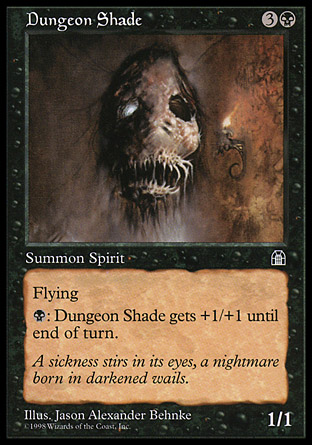
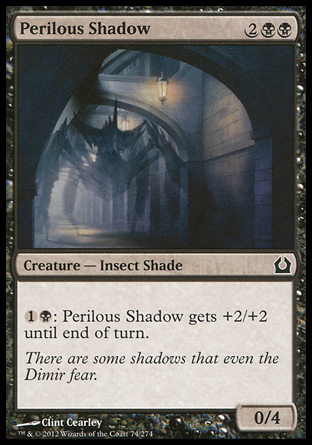
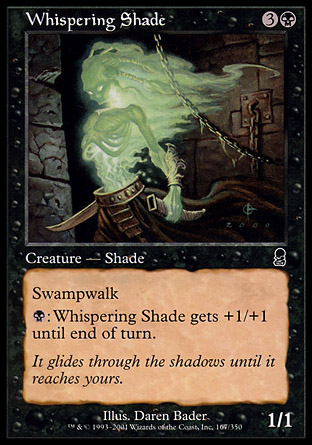
nantukoshade Almost all of the Shades work off the mechanic of paying a certain amount of mana to get +1/+1 till end of turn, like Nantuko Shade at left. This amount of mana can be paid as many times as possible, so you can easily end up with a ridiculously powerful Shade swinging at your opponent! (Black doesn’t get such combat-ready creatures very often, so this can give an otherwise control-based deck another way to win.)

Several of the Shades also manipulate mana in various ways, whether enabling you to search for it, giving you more mana per tapped land, or allowing you to sack lands to give it further +1/+1 boosts till end of turn. Other than that, there are a few scattered combat-aiding abilities like flying, regeneration, defender, fear, swampwalk and haste floating around the Shade creature type.

With 26 Shades printed thus far, most of them black (only 1 white and 1 red/black Shade exist), they can make a neat Black creature-based deck if one is so inclined. Their mana curve runs from 1 to 6, with most of them hovering around 4 mana.

More Examples of Shades

deepwoodlegate dungeonshade
lilianasshade perilousshadow
whisperingshade zofshade

All card images are from MagicCards.info.

Further Research: Complete List of Shades in Magic: the Gathering

Shade: Gatherer Search

Unusual MTG Creature Types, part 4: Ooze

Okay, all grossness and revulsion aside, Ooze IS indeed a creature type in Magic: the Gathering (even though only 23 exist to date). It’s a type that is not often explored on its own merits, but finds itself worked into various generic-creature-type strategies. Let me show you:

What Do the Oozes Do?

experimentone Oozes are all about +1/+1 counters, thematically speaking, even though their specific abilities vary quite widely among the 23 Ooze creatures printed. There are a couple with Deathtouch, one with Indestructible, and a few with cumulative upkeep costs, but even the cumulative upkeep costs have benefits resulting in +1/+1 counters. Depending on which Ooze you run, you can get +1/+1 counters for:

  • playing other, larger creatures (like Experiment One, at left)
  • sacking other creatures (like Gobbling Ooze)
  • attacking (like Predator Ooze)
  • tapping (like Experiment Kraj)
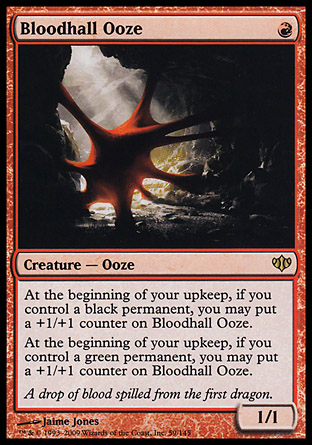
  • playing a black or green permanent (like Bloodhall Ooze)
  • playing any spell (like Manaplasm)

(There are plenty more abilities contained within the Ooze creature type which give you +1/+1 counters–it just depends on what you need.)

Oozes are mostly printed in Green, with a few Red and Black scattered among them; there is Blue involved in the casting costs of a few Oozes as well, though not many. The mana curve runs from 1 to 7. (There are also a couple of Unhinged joke cards that have the Ooze creature type, so be ready to laugh at some of their abilities!)

Other Examples of the Ooze Creature Type

bloodhallooze experimentkraj
gobblingooze manaplasm
necroticooze predatorooze

All images from MagicCards.info

Further Research: Complete List of Ooze Creatures in Magic: the Gathering

Gatherer Search: Ooze

Unusual MTG Creature Types, part 3: Griffins

As part of my “unusual creature types” series, I’ll be reviewing the Griffins today. I started off this post believing that Griffins were merely uglier, stronger Birds, but as you’ll see, I soon found out how wrong I was about them!

What Do the Griffins Do?

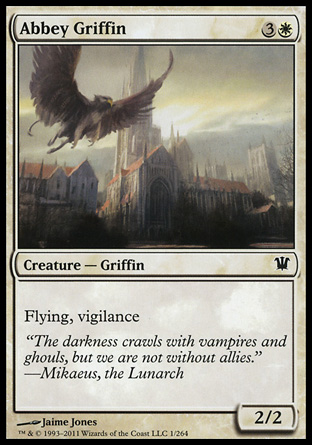
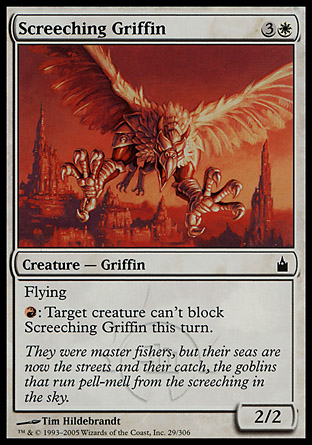
divinggriffin First and foremost, the Griffins are flying combat creatures, as expected, and quite a few carry vigilance and/or first strike as well. They are mostly 2/2, 2/3, or 3/2 creatures (though there are a few Griffins with larger powers or toughnesses than that), which make them fairly strong contenders against other flying-based creature decks.

But aside from their combat prowess, the Griffins have another feature: possessing some of the most random and unusual creature abilities. Here’s just a sampler of some of the stranger abilities within the Griffin creature type:

  • Pay a snow land to gain first strike
  • Sacrifice to deal 3 damage to target attacking/blocking creature
  • Can be recast from exile
  • If no enchantments are in play under your control, the Griffin dies
  • Bounce back to hand to return another Griffin from grave to hand
  • Sacrifice to destroy target black creature
  • Gets a +1/+1 counter for each damage you were dealt from an opponent’s source

In essence, many of the Griffins carry abilities from other colors into White, since most of the Griffins are White, with only a few exceptions (a few Blue and one Red/Green/White). It makes them an interesting creature type to play in a Tribal deck, and makes them also suitable for playing in more generic White or multi-color decks as well.

With a mana curve running from 1 to 6 mana, most of them hovering around 3 or 4, the 33 Griffins printed so far in M:TG can make a pretty solid White creature-based deck. Give them a try–they’re a very different flavor from Birds!

Other Examples of the Griffin Creature Type

abbeygriffin azoriusfirstwing
darajagriffin misthollowgriffin
mistmoongriffin peregrinegriffin
screechinggriffin zuberigoldenfeather

(All card images retrieved from MagicCards.info.)

Complete List of Griffins in M:TG

Griffins: Gatherer Search

WordPress “Easy Mobile Layout” Plugins: YIKES

These days, more and more people are viewing blog content through mobile means–our phones and tablets have largely replaced our laptops when it comes to simply taking in content. We bloggers must keep pace with these demands when possible; after all, visiting a site and having to re-zoom in to see the text every time you open a new page can be an off-putting hassle. (Take it from me, I’ve run into this annoyance factor even on my own blog!)

But what if you don’t have the time to develop either an app or a mobile-friendly version of your site? The solution seems to be simple: use a mobile layout plugin! It’ll build your mobile design automatically!

Since I am running a self-hosted WordPress installation on my blog, I looked up WordPress plugins which create mobile-friendly layouts. The following is what I discovered while investigating 3 of the most Internet-viewed “popular” plugins…and it’s shocking, to say the least.

WPTouch

Free or Paid: Both options available, but the paid “Pro” option appears to have better tech support overall.

Brief Reviews: Most people get what they’re looking for–a quick, usable mobile layout with a little customization. However, the free version seems to have some issues, especially with themes giving a “too many redirects” error or not serving menus properly to mobile devices. Upgrading to the Pro version apparently fixes this for some users. Check out more reviews on the WPTouch reviews page.

More Information: WPTouch by BraveNewCode

WordPress Mobile Pack

Free or Paid: Free

Brief Reviews: Lots of bad reviews about this plugin not working properly, messing up blog databases, and and being almost impossible to install. Looks like you’d better steer clear of this one…check out more reviews here.

More Information: WordPress Mobile Pack

Mobile Website Builder for WordPress

Free or Paid: Paid

Brief Reviews: This one looked very, very promising–the best of the three I reviewed, in fact!–until I read about all the ads that the plugin puts all over your site, which are very difficult (if not impossible) to remove. Couple that with the fact that this plugin apparently hosts the mobile version of your site on a DudaMobile web address, and this doesn’t seem as strong a contender as I first thought. Check out more reviews here.

More Information: Mobile Website Builder for WordPress by Dudamobile

Conclusion: You’re Really Better Off Doing It Yourself

If you can believe it, this post started out as a way to let people know about great plugins to simplify the process of making our blogs mobile-friendly. Sadly, after considering all the reviews, I can’t in good faith suggest any of these–it’s not worth risking all your hard work just to save time on developing your own mobile-friendly layout. (Of course, this is just my opinion, but after reading about the database problems some of these plugins created, it’s kind of given me the willies about it all!)

I’ve written a few articles here before about developing mobile-friendly designs–these will be helpful no matter whether you want to develop a mobile app, make a separate mobile site, or build a responsive layout that adjusts to all sorts of browsers.

Unusual M:TG Creature Types, part 1: Sphinx

With all the popular decks built around ubiquitous creature types (such as Elves, Fairies, Merfolk, Elves, Angels, Goblins, Elves, Zombies, Clerics, and did I mention Elves? LOL!), many of the other, less-printed creature types can go by unnoticed. As a direct result of both number of creatures printed and “the new hot decks” being played to death in tournaments, most MTG players don’t often get to dig into these rarer creature types (which is what spurred this new series of blog posts).

Thus, I begin my “Unusual Creature Types” series with a personal favorite rare creature type: the Sphinxes!

What Do the Sphinxes Do?

sphinxofthesteelwind Basically, the Sphinx creature type is Blue’s answer to Angels. Sphinx of the Steel Wind, at left, is as close to Akroma, Angel of Wrath as you can get (all that’s different about her abilities is what colors she’s got protection from, and the lifelink instead of haste).

Aside from flying like Angels, however, the 27 Sphinxes printed so far in M:TG operate very differently from their White counterparts. Sphinxes provide a lot of card draw, offer a fair amount of synergy with artifacts, and have neat mechanics where you can name a card and then do something cool with that information (like Isperia the Inscrutable’s ability, seen below). Otherwise, Sphinxes can manipulate cards, shuffle and search libraries, mill opponents, or glance ahead at the top card of your deck.

The cheapest Sphinx so far is Vexing Sphinx, at 3 mana; the most expensive Sphinxes are 8 mana (both Sphinx Sovereign and Sphinx of the Steel Wind cost this much)–the mana curve is very similar to Angels. Primarily, Sphinxes are Blue, but a few splash in White and Black; they feature huge power and toughness (but, unlike Angels, their toughnesses are often larger than their powers). Sphinxes can definitely handle combat, but only a few of their number actually deal with boosting P/T or are given combat-centric abilities such as vigilance.

Overall, Sphinxes are a really interesting addition to Blue; they take the Angels’ basic combat numbers and add card draw and manipulation to the mix. I like ’em–how about you?

Other Examples of the Sphinx Creature Type

vexingsphinx isperiatheinscrutable
sphinxofmagosi ceruleansphinx
windreadersphinx sphinxsovereign

(Images of cards retrieved from MagicCards.info)

Further Research: Complete List of Sphinxes in Magic: the Gathering

Gatherer Search: Sphinx

You’d Be Surprised How Psychiatrists Determine Who’s “Normal!”

A few months ago, on a whim, I checked out a book titled They Say You’re Crazy: How the World’s Most Powerful Psychiatrists Decide Who’s Normal, by Dr. Paula Caplan. The title sounded interesting, especially to a person like me who had made some forays into the study of psychology during undergrad and graduate studies. But I had no real idea of the epiphanies that I was about to read.

This book, published in 1996, covered how the APA (American Psychological Association) makes its handbook of mental disorders, called the DSM (short for Diagnostic and Statistical Manual of Mental Disorders). Caplan had worked with the mostly-male committees who made the DSM in the first place–her recountings were an insider’s perspective, and she told of the arbitrary, biased decision-making and filibustering of “unfavorable” ideas that formed this so-called “scientific” manual.

At first it was hard to believe that men of psychology could allow the process to be so political and biased. After all, they’re supposed to be held to the scientific method just like every other scientist, right? They’re supposed to form a hypothesis, test it repeatedly, and prove beyond a shadow of a doubt whether the hypothesis is true or not. But all throughout Caplan’s book, she documented experiences of exactly the opposite: mental “disorders” which were seemingly invented to marginalize the valid emotional experiences of women and minority groups.

For instance, the APA was going to outline a supposedly “new disorder” called “Self-Defeating Personality Disorder,” in which the sufferer actually invites someone else to abuse them and acts in overly submissive ways toward the other person. Um, excuse me, but when someone is being abused, the abuser is the one who chooses to actively hurt that person. And not only that, but when one is being abused, one tends to try to minimize and avoid abuse as much as possible–usually by acting submissively, trying to vanish as much as possible.

The only reason this disorder was even suggested in the first place was because all the committee members (mostly old white guys) deemed this behavior “pathological.” They could not fathom someone acting in this way, because they had never acted in that way themselves–thus, this was a “disorder.” Not really scientific reasoning at work here, even to an untrained eye like mine. And SDPD wasn’t the only “disorder” to make it into the DSM without proper testing. They Say You’re Crazy also details other cases of wrongheaded disorders being legitimized, much to the detriment of patients who were diagnosed and medicated for these ultimately nonexistent problems.

Does This Problem With the DSM Still Exist? YOU BET!

After I finished the book, I was disturbed about the huge problem Dr. Caplan had presented. “But this book was published back in ’96,” I thought. “Surely the field of psychology has matured past all this junk.” Still, I wanted to see whether Dr. Caplan had written any more books.

So, I Googled her name…and was astounded at the sheer amount of information–RECENT blog articles, petitions, Websites, and the like–which were still talking about this problem. And the most troubling part? It seemed that the APA was no closer to listening to Dr. Caplan and her allies than they were back in ’96, either.

For instance, this 2012 article by Dr. Caplan chronicles another case of harm done by misdiagnosing and overmedicating, in which a young, overworked mother was diagnosed with bipolar disorder, forcibly committed to a psych ward, and given psychiatric drugs. The woman lost friends and husband because of this misdiagnosis, ended up on permanent disability, and the drugs they gave her gave her an eye condition that could end up leaving her blind. And This WordPress.com blog archives quite a number of other informational (and eye-opening) posts about Dr. Caplan’s recent work on this issue, including a video series called “The Stories of Harm the APA Refused to Hear.”

Stories of individuals’ struggle with being misdiagnosed abound all around the Web. It’s not just average everyday people, either–military veterans have suffered with misdiagnoses too, often being given drugs that only exacerbate the problem or keep them drugged to avoid real emotional healing. Even some members of the APA have gone on record admitting that the DSM series has serious problems which must be addressed.

Yet the APA has apparently closed its ears and eyes to all of this. In a painfully honest article in May of this year, Dr. Caplan admits that even her stalwart resolve to keep talking about this problem has wavered in the face of such stony rejection and determined dismissal. But she continues to write about this in objective yet passionate tones, striving toward the goal of changing bad diagnoses and really using psychology to help people rather than just slapping on a label.

My Conclusion: This Needs Attention, Yesterday

I’m not a psychological or psychiatric expert, by far. But I have been exposed to some mental health services, especially in middle and high school, and I have experienced how a label, whether right or wrong, can have such a powerful effect on a person’s life. (I was 12 when I discovered that the “counselor” I’d been seeing in school actually worked for my county’s mental health services. I remember the hysterical question I flung at her: “So y’all all think I’m crazy?!” It was like my stories of being mercilessly teased and physically abused at school had meant nothing; I had been labeled as a “troubled child,” as if I myself were “the problem,” instead of the mean kids I had the misfortune of going to school with.)

Even just seeking therapy these days carries a social stigma, after all; imagine how a wrong mental diagnosis could wreck your career, marriage, social life, etc. How do you fight back against doctors who are telling you that you’re permanently screwed up and you’re always going to need drugs? How do you insist that you’re screwed up because of the things that have happened to you, not because of some inborn defect, when they are telling you exactly the reverse?

I for one applaud Dr. Caplan’s work, which draws attention to the need for more research and sheer SCIENCE to be applied to such a delicate problem as the human mind. We aren’t just talking about using the right medication at the right time–we’re talking about actually alleviating emotional pain rather than staving it off and avoiding it. (We in America tend to want, as Dr. Caplan says, “a quick fix and a pill for everything,” but our minds must be treated with more care.)

One last troubling thought: if the APA is more concerned with handing out drugs rather than actively treating mental illness as the serious, life-altering group of conditions that it is, then we as a society ought to be concerned that maybe their interests don’t lie in helping hurting people anymore. After all, if psychiatry has become a “science” of “diagnose somebody in 5 minutes and shove pills at them,” is it worth our money and time anymore?

Resources/Further Reading

Calls to Action/Petitions

Find They Say You’re Crazy Online

Online Articles About or By Dr. Caplan

Profiles and Archives of Dr. Caplan’s Online Work

Selected Bibliography for Dr. Caplan, from FeministVoices.com

  • Caplan, P. J. (1985). The myth of women’s masochism. New York, NY: New American Library.
  • Caplan, P. J. (1991). How do they decide who is normal? The bizarre, but true, tale of the DSM process. Canadian Psychology, 32, 162-170.
  • Caplan, P. J. (1992). Gender issues in the diagnosis of mental disorder. Women & Therapy, 12, 71-82.
  • Caplan, P.J. (1995). They say you’re crazy: How the world’s most powerful psychiatrists decide who’s normal. Jackson, MI: De Capo.
  • Caplan, P. J. (2000). Don’t blame mother: Mending the mother-daughter relationship. New York: Routledge.
  • Caplan, P. J. (2004). The debate about PMDD and Sarafem: Suggestions for therapists. Women & Therapy, 27, 55-67.
  • Caplan, P. J. & Caplan, J. (1998). Thinking critically about research on sex and gender, 2nd edition. New York: Addison-Wesley Longman.
  • Caplan, P. J. & Cosgrove, L. (Eds.).(2004). Bias in psychiatric diagnosis. Lanham, MD: Jason Aronson.

Pitching City of Heroes to Google: You Can Help!

After the hubbub last fall over the closure of City of Heroes, most people outside the City of Heroes playerbase (and many people in the former playerbase, for that matter) probably think that the #SaveCoH movement is dead.

Not so.

In fact, a relatively new part of the #SaveCoH movement, called “Task Force Hail Mary,” is gathering steam over on the CoHTitan Forums (see details in this forum thread). They are in the process of pitching City of Heroes to Google, following up a tendril of interest from a contact of Mercedes Lackey’s within Google.

Now, before you scoff at your computer screen or utter a cynical “That’ll never work,” please realize that everyone involved knows this is a long shot. But if enough people send letters to Google supporting this idea, perhaps we can make enough waves and draw enough attention to the game to make Google or another company interested in picking it up. After all, what’s the use in rolling over and playing dead when we are most certainly not dead yet?

How You Can Help

What the Task Force Hail Mary needs now is letters–real, paper letters, telling Google how much you enjoyed City of Heroes, how unique a game it is among MMOs, and how it could bring Google positive press and profit (as well as a permanent place of affection in the playerbase’s collective heart). Be heartfelt but also grounded in reality, acknowledging that the company needs to profit from this move just as much as the players need to.

When you have written your letter, send it on to:

Jeson Patel
Engineering Manager
Google Inc
Google Mountain View
1600 Amphitheatre Parkway
Mountain View, CA 94043

This is the original contact within Google who was interested in seeing a City of Heroes pitch. You may also want to send your letter to Jamie Rosenberg, Vice President of Digital Content, using the same mailing address.

A Final Note

Since one of the posts I made about City of Heroes garnered some negative opinions about the game, as well as shaming comments about people who wanted to save the game, I will go ahead and say this: if you don’t care about the #SaveCoH movement or are glad that the game was shut down, then please do not post. Every gamer is allowed his or her opinions, and the #SaveCoH movement is no different. If you believe we are silly for trying this, if you think the game was stupid and isn’t worth saving–we simply don’t want to hear it, and any such derogatory responses will be deleted from the comments. As I said before, we know this is a long shot, but if we do not try, we will indeed be “playing dead” when we are not dead at all.