Category Archives: Saturday with the Spark

Creative pursuits and life-related happenings.

Take 15: Rest Your Overworked Brain

We creative types can get physically overworked pretty fast if we’re not careful. Countless late nights spent revising a new story chapter, endless rehearsals of that one pesky dance step, or multiple frustrating tries at shading that picture just right can end up taxing our bodies beyond exhaustion.

But what about our brains? Even while we physically rest, sometimes we allow our brains to continue whirring away, essentially nullifying all the resting that we’re trying to do. You can’t rest really well when you’re tense and nervous about getting something done (and getting it done “just right”)!

The concept of “taking a break” while trying to complete creative work may seem counterproductive, but our creative energy does need time to recharge. Continuing to push through mental exhaustion may seem sort of effective, but all we’re really doing is banging our heads against a mental wall after a while. (Trust me, this blog week has been ALL about pushing through exhaustion and pain, and having very little to show for it. It happens to everyone!)

Thus, I have come up with the following steps to ease just about anyone’s creative exhaustion. (These REALLY work, by the way–I used them before I even drafted this post!)

1: The Next 15 Minutes are YOURS, No One Else’s

First, you need to block out at least a 15-minute window of time in which no one will bother you and nothing needs doing. If you simply must get some household chores done or call back a few people first, just so that doesn’t weigh on your brain, do so. But when all that is done, the next 15 minutes belong to you alone. Silence your phone, turn off your computer and TV–these minutes are not for them, either, unless you want them to be.

2: Find Something Soothing

“Something soothing” could take the form of a hot or cold drink, an especially soft blanket, a favorite scent, etc. Anything that delights some or all of your senses can work for this. My personal favorite thing is to get into my freshly-made bed sometime during the late afternoon, turning the lights off, and lying with a fan blowing over me, cooling both the bedding and me. I can smell the clean laundry scent, relax into the sheets and pillows…it’s all good. 🙂

3: Allow Yourself to FEEL, not Think

During this 15-minute window of time, don’t think about your to-do list. Your to-do list is anathema right now. Instead, fill your mind with what your skin is sensing, what your nose is smelling, what your tongue is tasting (hopefully something good, right?). Just enjoy this rare moment to actually sense instead of blocking out your senses in order to work more. Focus on the taste of that drink, the smell of that wonderful scent, the feel of the blanket under your fingers, as if you were gathering details to describe the experience to someone else.

I would recommend not even using your eyes or ears during this time, if possible; we use our eyes and ears so often to take in important information, so they need a bit of rest, too! An eye mask and ear plugs would be a good idea, especially if you’re having trouble settling. (Note: If you end up drifting off to sleep during this time, that can be even more beneficial than just a bit of quiet time. Don’t get mad at yourself if your 15-minute block ends up being a bit longer!)

4: Come Back to Work Gradually

Once you’re ready to start your creative work again, do it slowly. Don’t just hop right back on the mental treadmill; poke around lazily at a few ideas, perhaps ideas you had while you were taking your 15-minute break. Explore them, but not too fast just yet. Treat this as “just waking up,” even if you didn’t actually go to sleep. You’ll feel a lot less groggy and “ugh” if you allow your brain this transitional time between rest and work.

Finding New Music: 4 Sites to Explore

If you’re like me, sometimes the good ol’ Top 40 list can get a bit boring, and you end up wanting new music to listen to–or you want to hear music first without having to buy the track and end up hating it. Thankfully, there are websites out there which cater to us musical explorers; the following list are sites I’ve happily explored. And believe me, your music collection will thank you!

musicovery Musicovery.com is responsible for exposing me to about 15% of my music collection. It gives you a little interactive module which lets you visually choose between various moods of music (Energetic, Dark, Calm, and Positive), and between all sorts of genres. You can even choose a blend of different moods–for instance, clicking the little graph somewhere between Energetic and Dark will likely get you a thrumming trance track, whereas clicking the graph between Calm and Positive will probably get you a lovely, soft instrumental piece. Try it out!
soundclick SoundClick is one of those nifty little sites that helps indie artists share their music, but it also serves as a way to find songs that aren’t available anywhere else, no membership required. Search through the genre lists to find new favorites, or check out the “Hot on Soundclick” list to find out what others are listening to. (This is where I’ve found most of my video-game-music collection, as well as some beautiful trance and driving techno songs.)
soundcloud SoundCloud is kind of like SoundClick’s big sister, because it has more than just music on it–it’s also got podcast-like audio featuring comedy, audiobooks, business and technology talks, and even educational audio. It’s kind of like an auditory TED, in that way. Though you have to be a member to access anything, it allows members to repost audio clips they like to their “stream,” which means that you can find it again easily later. (I’ve found several wonderful song mashups through this site, since there are several different users who specialize in sharing mashups.)
newgrounds Newgrounds’ Audio Portal is an unusual place to look for music, since Newgrounds is usually known for flash videos of all sorts. But here, you can find lots of different musical genres, plus remixes and experimental tracks of all sorts (including voice acting!). (Though the audio player seems not to like Firefox (keeps crashing), I still found some cool remixes, including a techno mix of “He’s a Pirate” from Pirates of the Caribbean that is AMAZING.)

Repurposed: Jewelry Organizer as Hair Notions Organizer

Earlier this week, I spoke of my long, straight hair. As you might imagine, to style such long hair, I have a collection of scrunchies, elastics, clips, etc. But the sheer amount I have is kind of ridiculous.

How ridiculous are we talking? Well, I knocked over my big basket of scrunchies the other day, and they literally covered about 2 square feet of carpet in front of my dresser, with no carpet visible between them. (I should be in “Scrunchie Hoarders Anonymous” or something…XD)

Not to mention that I usually have to dig for several minutes in that basket to find the ONE scrunchie I’m looking for. My organizational skills seemed to have stalled out when it came to sorting out my hair notions–I had no idea what would work best to store all these scrunchies and clips and such, yet keep them all accessible and visible.

…Well, that is, until I found a neat little jewelry organizer which worked great for the purpose.

dressorg_front
This is Walmart’s knockoff of the popular “Little Black Dress” jewelry organizer–this version was about 10 bucks, and as you can see in the picture, all the little pockets are stuffed with elastics and scrunchies. (I told you it was a lot! LOL!)

dressorg_back
On the back of the “dress,” you can see I’ve hung all my hair clips and other hard-plastic notions. (Getting those big clips to behave properly on those Velcro strips wasn’t easy, but I did it!)

The reason I chose this kind of visual organizer is because I needed something that would display all the hair notions, yet be easy to sort and organize (and easy to put stuff away). I honestly thought I was going to have to build what I wanted, until I saw the Little Black Dress organizer, and then found a good-enough knockoff at Walmart.

This solution works really well so far (I’ve been using it about a week); not only has it shortened my time spent looking for the right hair accessory, but I also found several hair notions that I thought had gone missing permanently! (Which just goes to show that if you organize properly, you’ll end up saving yourself time and frustration in the long run :D)

Helpful Sites for the Budding Musician

With almost everything in life being so digital these days, it’s no wonder music rides the cyberwaves as much as it does. But there’s a huge (and I mean HUGE) gulf of difference between buying music online and creating it for others to enjoy. The online world of music creation and promotion is a broad horizon indeed…so broad, sometimes, that it’s hard to know where to begin!

Whether you prefer toying around with music in your Web browser or seriously crafting and promoting it, there are plenty of websites out there which can help you along. Here, in the following sorted lists, are the best I’ve found:

Musical Games

Carol Maker
Music Mixer
VirtualMusicalInstruments.com (try out different instruments’ sounds)
Sound Factory
A Break in the Road (this one lets you put in your own recorded sounds!)
Isle of Tune (build a city that makes music as the cars drive around…you’ll just have to see it for yourself!)

Learn How to Make Better Music

AudioTuts
SonicAcademy
MusicTheory.net
Serious-Sounds.net (especially for people who make electronic music)
Production Advice (for learning how to master your recordings so they sound their best)
What Makes “Good” Music? (thoughtful essay on making good music)
How to Write a Song @ WikiHow

Online Tools/Sites for Musicians

Scalerator (along with the Chorderator, Chord Designer, and Guitarator Toolbox :D)
BandCamp (host your music)
SoundCloud (share your music)
TheSixtyOne (share your music AND network with other artists!)
8notes.com (online metronome, blank sheet music, MIDI converters, and more!)

Create Music

UJam
JamStudio (newbie-friendly)
Soundation.com

Also, I have a roundup of free downloadable music-creation software in this blog post.

Make an Official Website for Yourself/Your Band

HostBaby
FourFour
BandZoogle
SoundFolder

Performing and Selling Your Music

GigMasters (find places to perform and get paid!)
SonicBids (connecting bands and promoters)
CDBaby (CD-making service)

For Further Reading

Check out Mashable’s list of online music sites for even more musical websites!

“So What?” The Silly Question That Can Polish Our Writing

As writers, when we get all wrapped up in a plot idea or go crazy with character development, sometimes the words flow out as if we’re erupting, with lava-hot paragraphs cascading down the page at a blazing speed. Who cares if this sentence isn’t written the best or has a few misspelled words, for instance–the plot must go on!!

But once our writing ardor has cooled, once the mental volcano of literary inspiration has settled back down, we must go back and critically examine our work, beginning to shape the raw flows of words into art. This can be INCREDIBLY daunting–I should know, I’ve been doing this intermittently on my novel for several months. I know well that it gets difficult to cut away some of your most fervent words, some of the awesome sentences that arose out of the huge head of steam you had when you first wrote this paragraph or that page.

So how do you do it? Simple: with every paragraph, every sentence, ask yourself:

SO WHAT?

Yes, It Actually Works–You Just Have to Be Honest

You might be surprised that such a simple, silly-sounding question could help you know what to cut and what to keep in your writing. But it really does. Ask yourself “so what?” after every paragraph, sentence, or even word; ask yourself whether that part of your writing REALLY needs to be there in order to impart your meaning.

When you ask yourself “So what?” about your own writing, it’s tempting to be light-handed with criticism. Don’t. Be ruthless if you have to; dare to see your writing as a reader will. You are the artist of this written work–you have a responsibility to produce the best quality writing you can.

An Example

Here’s an example paragraph I wrote to demo this process:

“The fabric of her dress shimmered faintly in the moonlight. It looked silken, inexplicably heavy on her slight frame–she looked almost overwhelmed with the folds of blue-green fabric. On this muggy, uncomfortable night of about 80 degrees, who would wear such a dress except for those who were rich enough to have a cool shelter to retreat within?”

Start the “So What?” Process

The above paragraph is pretty good. Now, I have to dig into it, tear it apart a little bit, and see how I can make it even better.

“The fabric of her dress shimmered faintly in the moonlight.” So what?

  • Adds atmosphere
  • Gives hints of the setting
  • Phrased somewhat poetically, could be tightened up a bit

“It looked silken, inexplicably heavy on her slight frame.” So what?

  • Does the detail of the dress fabric have to be explicitly stated?
  • The last part of the sentence gives more hints about the character–good

“She looked almost overwhelmed with the folds of blue-green fabric.” So what?

  • More character information, but this could be folded into the previous bit of description
  • There has to be a better word for describing the color, and a synonym for “fabric”–or maybe take that out altogether?

“On this muggy, uncomfortable night of about 80 degrees, who would wear such a dress…” So what?

  • Don’t need the “of about 80 degrees” part–too specific/scientific
  • “Muggy” automatically conjures up “uncomfortable”–can trim that if need be
  • “who would wear such a dress”–implies a narrator’s judgment

“…except for those who were rich enough to have a cool shelter to retreat within?” So what?

  • More narrator judgment–negative in tone, so it provides a little drama
  • Moves the story along to the next paragraph
  • Can we get rid of the preposition at the end of the sentence? Please? LOL

The Result: A Better Paragraph (IMO)

Okay, now I have an idea of how I want to rewrite it…so I take my own advice, and reshape the paragraph entirely. Here’s my second draft as the “result” of this process:

“Her dress, with all its silken, heavy turquoise folds, shimmered faintly in the moonlight as it draped on her, just as the muggy air hung over all of us. On such an uncomfortable night, who would wear such a gown, except for those who were rich enough to have a cool shelter in which to retreat?”

I think this paragraph says more in less space, which is always good from a reader’s standpoint; the scene is, if possible, even more described now. I also think the phrases and sentences are a little bit more graceful and “finished”-sounding than the first draft. (But, as always, writing is subjective–which paragraph did you like best?)

Summary

When you take time to revisit and rewrite your own writing, you have to be honest about each word, each paragraph, each page. Asking yourself “So what?” after each section of your writing will alert you to ill-chosen words, weird extraneous information, and anything else that could distract your reader from your amazing plot and characters. It just takes being willing to step back from your work a bit and really seeing your writing for what it is, aside from being your hard work.

Struggling Writer? Here Are Sites That Can Help!

Writing can often feel suspiciously like banging your head against a wall of your own thoughts–thoughts which are unhelpful and keep getting in the way of real creative work. And when you’re struggling through a rough patch of writing, it can feel as if you’re the only writer who has ever gotten stuck like this.

Well, believe me, the Internet is full of writers who have all been there. And what’s more, plenty of them have made websites to help their fellow writers get un-stuck and back on the road to a finished work. See the following sorted list to get restarted on your own writing journey!

Social Networks for Writers

WritersCafe.org
Writing.com

Grammar, Style, and Structure Help

Grammarphobia Blog
Chicago Manual of Style
Banned for Life (about overused cliches)
GrammarBook.com
The Phrase Finder
Grammar Girl
The Word Detective

Fun Online Writing Exercises and Tools

Language is a Virus
Fifteen Minutes of Fiction
WriteForTen
750Words
Wordsmith.org
Libroville (make your own writing website in minutes)

Helpful Articles about the Writing Process

WritingForward
WriteToDone
Vocabula
Daily Writing Tips
The Writing Corner

Contests and Getting Published

WritersDigest
Winning Writers
ForWriters.com
AgentQuery.com
FirstWriter.com

Custom Trading Cards as a Memory Tool

If you’ve ever had difficulty with memorizing information of any type, you’re likely familiar with using flashcards to help you learn it. But what if you have more information you need to remember, or very detailed information? You don’t want to have to write out a flashcard chock-full of information, after all!

One solution: make trading card flashcards!

The Process

Over at ReadWriteThink.org, they’ve got a cool little trading card creator (suitable for kids, but usable for adults, too) that can make trading cards about all sorts of subject matter. See below:

tradingcard_startscreen
Simply enter the name of what you’re creating the card for, then choose the category it falls in…

tradingcardcreator
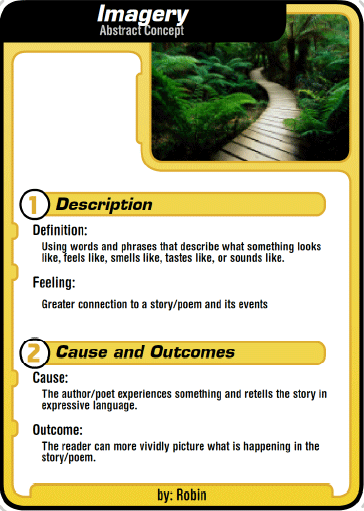
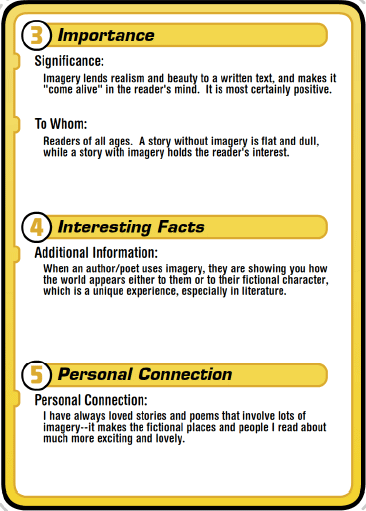
…and fill in the answers to the questions presented to you. Click the right arrow at the bottom right of the screen to advance, and the left one to go back; you can add a suitable picture at the end of the card-making process. (In this example, I’m making a card about the literary concept of imagery.)

The Custom Trading Card and How to Use It

imagery_front
imagery_back
Here’s the finished product–a card that details what imagery is! Once you’re done with your card, you can save it as a PDF file, print and cut it out, and assemble it with tape. (Or you can just leave it as a digital file for reference, if you’re lazy like me, xD)

Where Else Can You Use This?

I like this idea for school group projects and for memorizing specific concepts for essay tests, of course. But I also like the idea of using this for remembering how to do creative projects (like how to put a lobster clamp on a beaded necklace, or how to make various paper projects). And it could be a good way to remember directions to a friend’s house, or for your child to remember their address and phone number!

I think this trading card creator could also be useful for remembering settings, characters, and plot details of a book you’re writing. HMMM…I might just need to mock up a few cards for my novel, now!

To Make Your Own Flashcards:

Trading Card Creator @ ReadWriteThink.org

The “Virtual Museum:” GoogleArtProject.com

Ever wanted to visit all the world’s museums and art collections just to view all those amazing artworks? Well, you’ll definitely want to check out one of Google’s newest projects: GoogleArtProject.com.

googleart_landingpage
When you land on the website, a random artwork will be displayed as the background–you can mouse over this image to see more detailed information, and click through to see more pictures by the artist, more artwork from the collection, etc. (Click and drag on the image to see a small portion of the artwork in more detail!)

recentlyadded_ticker
Down toward the bottom of the page, you can see a ticker full of recently-added collections going by–this is a great way to stay updated!

browse_specificcollection
If a collection intrigues you, you can click its title and go straight to its specific page, seeing all the images housed together within easy viewing reach.

browse_collections
Or, if you’d like to see the full list of available collections to view, you can browse by the “Collections” tab at the top left.

browse_artists
Browsing the “Artists” tab (second tab from the left) brings up an alphabetical click-through list, so you can go right to the artist you’re searching for. (This would be great for art history research!)

browse_artworks
And most certainly, if you just want to take in some gorgeous, thought-provoking art, you can browse by “Artworks” and see a randomized assortment of beauty.

You can also browse user galleries, and you can sign in to Google and make your own gallery, too.. (There are not a whole lot of user galleries quite yet, but you can change that 😉 ) All in all, this is a great Internet tool for discovering, appreciating, and studying art–well worth a visit (or 100!)

4 Ways to Be a Kid Again (For 5 Minutes)

As a kid, I always thought I had it pretty rough in terms of school responsibilities. That was, of course, before I grew up and found that out in the “real world” lay tons more responsibilities, more than I could have ever dreamed. Being grown-up can be very, very stressful…no wonder we’re all medicated and in therapy these days!

So, instead of trying to medicate our stress away, how about we approach it a little more creatively? How about we access some of that crazy kid energy we used to have? It’s actually still there, if we take the time to tap into it.

Create a Crazy Masterpiece…in MS Paint

Remember when art was fun, not something you worried over? Remember when the coloring of a single page in a coloring book could consume your whole being till it was done? We may not have coloring books for adults, but we have software programs that can stand in.

mspaint_1
Start off by drawing something like this, just wild and crazy lines streaking across the image…

mspaint_2
Then add a little color, whatever color you want and wherever it ought to be…

mspaint_3
Keep going, focusing only on the task at hand, till you either get tired of it or you’re finished! If you get tired of it or want to start anew, no problem; if you finish it and yet don’t want to save it, no worries–kids crumple up drawings and restart all the time. (And who knows, you might just inspire yourself with the random art you create!)

Go Outside for No Reason

Kids always seem to be drawn like magnets toward the outdoors, but as adults, we somehow lose that desire to be out and about as much, especially if it doesn’t have anything to do with our jobs or our more “grown-up” relaxation time. More of us end up staying indoors where the technology (and the to-do lists) reign.

So, how about just going outside, for absolutely no reason other than to be outside? Feel the air temperature, breathe a little easier, and just be open to whatever you discover. “Enjoying the day” doesn’t have to be part of a vacation itinerary, nor does it have to be penciled in on your calendar. It can happen any time, any day you want or need it to happen. For most of us, just taking time to see the actual environment we live in would be a revelation of senses. This is not necessarily about “getting in tune with Nature,” but about experiencing the physical world around us rather than being locked in our own mental world full of deadlines and other “grown-up” stuff.

Make Up a Silly Game

In childhood, almost anything could be made into a game–remember that? We didn’t need hardly anything to create a game of our own, either to play by ourselves or to play with others. Making super-long chains of paper clips to stand in as “jump ropes” (I remember doing that–it was kinda successful, LOL), or wadding up great quantities of paper and rubber bands to make monstrous, lumpy creations that were sort of like baseballs to throw around…and making up rules as you go along, like “You can only jump over the paper-clip chain 3 times, and then you have to toss the paper ball as far as you can.”

These days, it can be hard for us to think about making our own games when so many fun technology-based games exist. But what about turning everyday tasks into little games? Like Mary Poppins said, “in every job there is an element of fun–you find the fun, and SNAP! the job’s a game!” Challenge yourself to Housecleaning Games, where collecting the most trash in the fastest time gets you points–and even more points for collecting it with style. Or turn your daily to-do list into a game where every item is a “level” to be conquered. It doesn’t matter what the game is or what the prizes are–sometimes, the prize can be in the creation of the game itself!

Imagine Something Outlandish

As children, we are taught that imagination is wonderful; as adults, we learn that imagination is “not company policy,” “not the way things are done around here,” etc. Sometimes that can really leave us stymied when it comes to creativity–we constantly self-censor and push aside the most wildly creative impulses as being “too childish.”

So, to let that childlike creativity out to play again, try the following trick: Imagine that a character from your favorite TV show/book/movie is doing something totally and hilariously out of character. Where does that action take him/her? What happens when other characters from the TV show/book/movie see or hear about this? (Here’s my example: Cinderella becomes a punk rocker and writes songs about her stepmother and stepsisters.)

Follow this story out as long as possible, adding details, making it as outlandish and funny as you want. Even when it gets kind of “awkward,” keep pursuing it–this is how you let your inner child free!

Summary

All of these ideas might sound a little silly to us “grown-ups.” But then again, we used to revel in being silly, and we had a whole lot more fun back then. We don’t have to completely give up our adult life, but we can put it aside just for a few minutes, to get back a little childlike joy. Isn’t that worth trying?

5 Useful Writing Inspirations

As a novelist who often feels “stuck” because of certain writing hang-ups, I know that sometimes writer’s block feels like a steel trap caught around the leg of your plot, refusing to let it go anywhere. I think sometimes we writers psych ourselves into a state where we can’t even write because we’re afraid of what will come out of our heads–afraid it won’t be “good enough,” somehow.

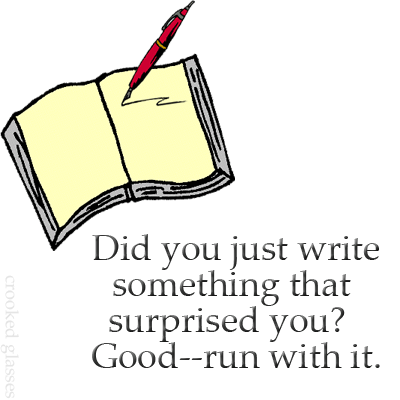
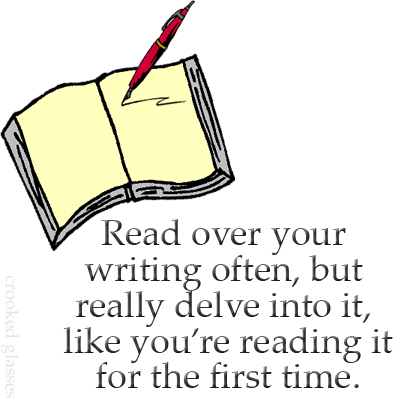
Thus, I came up with the following 5 simple tips, which have helped me begin to break through the ice covering my novel; I hope they will help you begin to write again, too.

writinginspiration1

writinginspiration2

writinginspiration3

writinginspiration5

writinginspiration4

Image Credits: Source of image of book with pen