Category Archives: Saturday with the Spark

Creative pursuits and life-related happenings.

Delicate Beaded Jewelry: Not an Oxymoron

With the current beaded jewelry trend tending towards huge rocks strung on string (I’m not kidding), those of us who are drawn toward more delicate, light creations may feel somewhat at a loss.

But there is no need to despair: there are several ways to bead necklaces, bracelets, and even earrings and rings that don’t look like you just went to a jewel mine and dug something out of the wall. I was honestly quite surprised to find several tutorials and ideas for such beautiful beaded jewelry styles, so I collected my favorites and have shared them here. No heavy multi-stranded necklaces or chunky earrings here–just truly lovely pieces of wearable art!


Ombre Crystal Necklace Tutorial

Pearl Drop Earrings Tutorial

Lacy Clover Bracelet Tutorial

Beaded Rings Idea Post
(you have to “like” the Facebook page to get the tutorial)

Blue Beaded Bracelet Idea Post

Beaded Flower Necklace Idea Post
(you can purchase the tutorial)

…and I am definitely going to try the beaded rings and pearl-drop earrings tutorials. 😀 😀

The Stupidity of Trying to Produce Art Alone

For weeks–maybe months, now–I’ve been trying to bring my novel to fruition by myself, trying to continue the story I was once bursting to tell. Sadly, it’s not working out that great. It almost seems like I’ve lost the fire for it. Some days, I just look at the filename and feel sad; I feel like nobody will like it, or that nobody will want to read it.

During the years I’ve been writing this novel, I’ve been scared to show more people what I’ve written, either for fear it’ll get stolen/ripped off, or afraid that others won’t like it. It’s a ludicrous feeling, like a pregnant woman being afraid to give birth because she fears her baby will be ugly, while at the same time she fears that her baby will be stolen. And yet…it’s a valid feeling, too; this half-finished novel is a product of my hard work, and I don’t want that hard work credited to someone else, or cast aside as unworthy.

Why Artists Can’t Create in Complete Solitude

Pop culture (and even some art about artists) generally paints artists as loners, but that’s at least partially untrue. As much as we might need peace and quiet to finalize our ideas, we actually can’t produce art in a vacuum–other people help and influence us, even if they never realize how much they’ve helped.

So many times I’ve been in public, for instance, and heard an exchange between people that reminds me of something in my novel, or reminds me that I should put something similar in a certain scene. Not to mention my friends’ opinions on the bits of novel I do share with them, the snapshots of scenes I’m not too scared to share with them. Talking about our art with other people is a way to keep us believing in what we’re doing; isolating ourselves, or our art, slowly kills the budding artistic expression.

And yet, creating in isolation is precisely what I’ve been trying to do for the last few months. I love my little novel baby, but I’m afraid she’s not good enough for others, or that she will be stolen from me, so I’ve isolated her and hidden her from the world. How silly and stupid of me, in retrospect. No wonder I can’t write anymore; no wonder I get sad when I look at even just the filename. The novel is becoming synonymous with failure and sadness instead of joy, because I only have my opinion to go on, and my opinion becomes more negative by the day.

This is, as I have unfortunately discovered, dangerous territory for me, and indeed it’s dangerous for any artist. We who make art simply can’t hoard it to ourselves; art is for sharing with other humans, whether that’s a small group of people to a worldwide audience. I have big dreams of this novel going worldwide and brightening lives everywhere, and I would wager a guess that other artists dream of showing off their works, too. But in order to get our art to completion, it’s almost necessary to let a few, trusted friends see it, to help us shape it and better it. And, much as a mother-to-be needs help from others in the last months of pregnancy, an artist’s friends surround him or her and help keep the process grounded.

Breaking Out of the Isolation Shell

As artists, we have to realize that it’s okay to share the knowledge of our unfinished art “babies,” even if we’re afraid of the feedback. I suppose it’s much like an expectant parent showing off ultrasound pictures–people will still ooh and ahh, even though the little one is not yet fully formed, because we respect and admire the miraculous process.

Likewise, people at least know a little about the artistic process, and sometimes are willing to help, to offer feedback that will bring our baby projects into the world at last. We just have to be brave enough to let someone else see the ultrasound pictures first. Others, and others’ opinions, are not to be feared; that fear is actually the enemy of art itself.

Keyboard Barf (a poem)

It is not my day for writing,
Though the “New File” button waits
It’s just not the day for writing,
‘Cause my brain is not in gear

I’ve begun to type a couple of lines,
But can’t continue my thoughts
So the Backspace key is my best friend
And the document remains blank

How am I supposed to create like this?
How am I supposed to write?
My brain won’t ignite, and will not take
The spark I’m trying to light

No plainer words can I state it in:
I’m well and truly stuck
Because every word that I’ve written so far
Just sounds like keyboard barf

…and ironically, this is probably the coolest poem I’ve written all year. My Muse has a maddening sense of humor.

Being a Newb at Art: Not a Bad Thing

Most people look at newbies or people who are new to something, negatively. Newbies are seen as lacking knowledge, always needing help, and not worth the time of experienced people. This most certainly goes for artistic pursuits; many times, I’ve seen experienced artists of every type look down on the “newbs” in their field, as if they have no talent or aren’t worth even talking to.

But, in my opinion, being a “newb” at something doesn’t mean you won’t have any talent for it. In fact, I’ve found that instead of my own newbish-ness getting in the way of learning more, I feel freer to explore whatever I’m trying to learn. I’m not yet so “experienced” that I’m locked into thinking a certain way or always doing things a certain way. Creatively speaking, being a newb can actually be more fun and more enlightening.

Newbs Have More Fun! (And Make Better Art)

Why do I say that being a newb is more creative and enlightening? Because as artists, as creative people, we can get sucked into the trap of “creating what other people like” or “creating art that sells” instead of “creating what we want.” We can easily fall for doing things the way other people have done them, just because the other people were successful and we want to be successful, too.

The bad thing about following the crowd in this way is that it can kill your desire to do art for yourself, as I have found out with my novel and my webdesign. Try to please others too often and for too long, and you end up completely dissatisfied with your soulless work.

But allowing yourself to be a newb, or getting back to a newb state of mind, can free you from this constrained thinking, and thus get you back into creating what makes you happy and what expresses your thinking the best. For example:

  1. Visual Art: Being an art newb means you can paint, draw, sketch, and/or sculpt any way you please; you aren’t constrained by the “laws of the Masters” or what’s currently avant-garde.
  2. Music: Being a music newb means you can put chords and melodies together according to what sounds good to YOU, not what sounds good to some dusty expert, or even what other musicians think.
  3. Dance: Being a dance newb means you can try out different poses and motions without worrying that it’s not part of a “traditional” dance routine, and without trying to do moves that you physically can’t do yet.
  4. Drama/Theater: Being a drama/theater newb means you are free to play any kind of role you want and explore many different characters without being typecast yet.

Creativity is All About “Thinking Outside the Box”–Why Put Your Art in a Box, Then?

In essence, being a “newb” at art means that you’re still defining your style, still exploring your art, and still having fun with it. The moment you lose that sense of wonder and exploration for your art is the moment the artistic sense in you wilts, in my opinion. See: my novel, and my increasing difficulty with writing it because I’m afraid nobody will “like it enough.” As soon as that fear crept in, writing slowed to a crawl for me.

But it is possible to get your “newb groove” back, as I have written about recently. Just allow yourself to experience art the way you used to, allow yourself to be childlike and “newbish” all over again. You’d be surprised how well this works! After all, yours truly just wrote a new page in her novel. 🙂

The Lost Song (A True Story)

In January of 2011, I had written a wistful, prayerful contemporary Christian song, titled “Adrift,” and performed it for my church. They enjoyed it, and I loved singing it because it was a way to worship. Once I had performed the song, however, I moved on to composing newer songs and working on other projects. Little did I know that it would be the last time I would perform the song as it existed then.

Sickness, Difficulties, and Losses

A few months later, I began to fall ill repeatedly, suffering strange new headaches that lasted up to 3 days and were not treatable with any medicines. My will to create, my will to write and sing and play, were thus taken from me, since I sometimes suffered up to 10 headaches a month like this. Soon, weeks went by in which I was never without burning, crushing head pain, whether I was sleeping or awake.

It felt, as spring blossomed into summer and summer faded into fall, that I was living 25% of my life. I went to bed feeling like I had been run over by an 18-wheeler, and woke up feeling like I’d been run over by a school bus. And the constant pain, which got worse if I tried to sleep it off and never truly went away, about drove me nuts. During this time, I also lost the use of my laptop for a little while (due to someone else’s carelessness), and that added stress didn’t help my health much. My mental creativity stunted, my physical energy sapped, and my creativity-producing machine gone–it felt as if I were getting slapped around by life.

Finally, during a routine visit to the dentist in October 2011, we discovered that my wisdom teeth were severely infected and had to be removed. The subsequent oral surgery in early November not only pulled the sources of infection from my jaw, but also seemingly got rid of those burning, never-ending headaches. At last, I could live my life again! I thought everything would be back to normal concerning my creativity, so I could get back to doing what I loved–writing and polishing my prose, poetry, and music.

Not so, as I found out. A mere month after my surgery, my poor injured laptop’s hard drive died, and the data on it was completely irrecoverable. All the work I had done since June 2010 was lost–including the lovely song I had written and performed almost a year previous. All I could remember, because of my grave illness and all the stress, was the title. No lyrics, no melody…no nothing. I mourned it along with the rest of my lost works, knowing that with my forgetfulness, I would likely never remember it.

A Little Scrap of Unexpected Song

I was horribly sad over this, but at least I could comfort myself with a large fraction of my work, which I could still build off of. Slowly, I began to amass more works, though they were nothing like what I had lost, I knew that.

In the middle of all this personal, creative rebuilding, my boyfriend and I had gone to the movies to watch The Avengers when it came out, and I was reminded of how much I had liked some of the other Marvel movies that had come out before, especially Thor, which had come out in March 2011, during the first stages of my terrible headache/wisdom tooth infection.

I ended up borrowing the movie from my boyfriend’s family, then buying a copy of my own, since it had quickly become a favorite of mine. (And, as is my wont when I really enjoy a film, I had already watched it several times back-to-back-to-back. xD)

But it was during one of my many repeat plays, as I watched the scene in Thor where Loki discovers he is not truly Odin’s son, that a little scrap of song started playing in my head. Occasionally this happens to me, where a character or a mood will inspire a new song within my head–it’s a great way to get new ideas. And, since I had composed very little during my illness, I was understandably stoked.

“COOL, I finally got an idea for a new song,” I thought, watching the evocative, sad scene play out as the plaintive, new little melody curled around my brain cells. The melody ached, expressing such wistful sorrow that it nearly brought me to tears. And then…something in the tune jarred memory awake. “Waitaminnit…” I thought, analyzing the short little melody. “That tune–oh, my God, that’s ‘Adrift!’ That’s my lost song!!”

Rebuilding The Lost Song

You never saw a chick pause a movie and run down the stairs to get to her piano keyboard so fast. In minutes, it felt like, I had reconstructed not only the chorus melody, which was the first bit I had remembered, but I had also gotten back the melodies for the verses and the bridge. Not only that, but some lyrics were coming back, too, albeit slowly and in pieces.

A couple of frenzied rebuilding hours passed, and I was able to get back 90% of the original song, with new lyrics put into the places I simply could not remember. I was overwhelmed with the creative urge–after all, my lost song had come back after I had feared I would never, ever remember it all.

Though I am still a little sad for the bits of lyrics I can’t remember, the new lyrics seem to fit even better than the old ones, at least in my estimation. This gives me hope that perhaps all of my lost works, all the little stories, poems, and beginnings of songs, might one day come back better than ever, too, after being cast “adrift” in the void of memory.

Sometimes, You Have to Let Your Mind Go Wild

Have you ever been hopelessly stuck on a creative project? I sure have. For all the times I bragged about how I never got writer’s block, I’ve sure endured it enough times now to be sick of it. It’s such a frustrating feeling, KNOWING you want to create and yet feeling stymied by your own brain.

While blundering about trying to solve my latest writer’s block, I found an unexpected solution–try writing something completely different. Think it sounds crazy? I did, too, until it worked for me.

Writer’s Block from Heck–but Just on My Novel

I had been spinning my mental tires for nearly a month on my novel. I felt increasingly silly about continuing to write it; I was beginning to lose faith in my ability to write it, and in the strength of the novel’s themes and ideas itself. Some days, I couldn’t even bring myself to open the file.

But, it seemed, I was perfectly able to do other creative stuff…like the hilariously teenagerish fanfiction story that was simply busting to come out of my head. It was like a hyperactive bunny in my brain–it would not leave me alone. I resisted working on it for a while because I wanted to use that awesome energy to write my novel…except that the hyperactive energy all drained away when I tried to work on my novel. I had no idea why this was happening; I was bewildered.

Last Resort: An Unusual Writing Binge

Finally, I began to write the fanfic instead, feeling guilty all the while–but it was like eating a bag of chocolates after a month of trying to force veggies down my throat. The fanfic progressed by leaps and bounds, in the way that my novel had in the early days; it was exhilarating. I hadn’t written like that in what felt like years.

Eventually (about 40 PAGES in!), I came to a point in the fanfic where I wrote a character development piece similar to one I had done in my own novel. I wanted to make sure I wasn’t just plagiarizing myself or falling back on a cliche, so I went back, found the similar development in my novel file, and started reading.

…And reading. …And reading. Page by page, I began to fall back in love with my own novel.

Wait, What Just Happened Here?

It was an “OMG!” moment, a “Eureka!” moment. It was like I was rediscovering why my novel was awesome all over again. What I had effectively done was to take my brain out of the infinite loop of “gotta write this novel–ugh, I’m afraid this novel stinks–gotta write this anyway,” simply by focusing on a completely different creative project. The fanfic, as crazy and silly as it was, was also so very different in scope that it allowed the “noveling” part of my brain to shut down and restart.

Letting my brain go wild and write what it so desperately wanted to write (even if I had first deemed the project “not worth my creative time”) was the key. It got me writing again, after being horribly stuck. Like being towed from a muddy ditch, I emerged from my month-long struggle quite disheveled, but ready to go on the novel again. It just took remembering that yes, I COULD write well, and no, writing did NOT have to be an uphill battle.

The Moral of This “Novel” Story…

…If you’re absolutely stuck on one creative project, it is not a sin to start another one. Do whatever you can to get the treads of your creative mind running again!

Clutter and Creativity: A Little Goes a LONG Way

Ever heard the old saying that “clutter is a sign of a creative mind at work?” Well, if that’s true, then I have the most creative mind on the PLANET.

I will demonstrate, with a potentially highly-embarrassing picture of my room as it is right now.

I’m not sure if this kind of clutter is what the saying-makers had in mind… xD It looks like I’ve been in the process of moving for the better part of half my life. (For reference, the left side of the picture shows the closet puking its cluttery guts up on the floor; the bottom right corner is a small slice of the bed, remarkably tidy; the top right corner is one part of the dresser, also covered in clutter. The rest of the room is similarly “decorated”…I need not inflict more suffering on my viewers than this.)

How a Too-Tidy Room Can Inhibit Your Creative Juices

Now, I admit, I can be pretty clean and organized when I put my mind to it (or if I get ticked off enough at not being able to find anything). But I have always hated a too-perfect room, too. You know, where everything’s SO tidy and SO put away that you feel like you can’t even step into the room without wrecking the perfection of it. A too-tidy room feels like a doll’s house or an operating room rather than a person’s real living space.

My mother always loved for me to have a room that looked like a doll’s room as a kid, because she liked that everything looked really cute and was easy to clean up. I had difficulty even breathing or sitting down in my room when it was like that, by contrast–it felt like anything I did in the room was going to spoil it all somehow. Trying to work in that space, then, was almost impossible, when every creative project I tried to do in there seemed to undo all of the hard work that had gone into cleaning and straightening the room.

However, I think I may have taken the “clutter = creativity” thing a little bit too far. What do you think? 😛

How a LITTLE Clutter Can Help Creativity

A little clutter, I believe, makes it easier for one to think outside the box. With a little disorder around, you don’t feel like you just HAVE to think along certain, well-beaten paths, and you have mental “room” to innovate or just toy with an idea for a while. A little clutter reminds you that disorder is part of the creation process–things have to get a little messy (to paraphrase Ms. Frizzle) in order to come up with something AWESOME.

I notice that when my desk is just a little disordered–not covered up, but not empty of my personality either–I feel a little more “at home” and feel more inclined to use it to work. I can easily clear a little space to work, but I have things on the desk that inspire me to work more if I get stuck, or are ready at hand if I need to switch gears for a moment to refresh my creative juices.

How MEGA-Clutter Hurts Creativity

But, on the flip side, too much clutter makes it impossible to think of anything. Well, anything besides “Where IS everything?!”, “****, I just lost my pen! Again!”, and “I am SO tired of this grocery bag sticking to my foot every time I walk in here!” (True story…that picture of my room is definitely not faked.)

In my room as it is now, my desk is so covered with junk I couldn’t show it to you, for fear the Clean Police would beat down my door. Using it as a workspace is a lost cause, and has been for many a year; it’s just not feasible to “clear off a space” when everything is in a jumble and it’s hard to tell what to keep and what to get rid of. Nothing creative can go on when there’s so much distracting stuff to look at, and so much to clear off before one can even get started.

The Solution: Balance–Not Too Tidy, Not Too Cluttered

So, how does one include just enough things out of place or disordered, without the whole space becoming too aggravating to work in? Here is what I’m trying in my current space:

  • First, put away anything that doesn’t have anything to do with the current project you’re working on. Looking at a bunch of bills and junk mail while you’re trying to craft the next great symphony, for instance, will only distract you.
  • But don’t clear everything away! Leave out in the open anything that directly pertains to your current project. If you’re working on a novel, you’ll want pen and paper, maybe a whiteboard, all the random notes you’ve scribbled down on random napkins and receipts, etc. If you’re trying to paint or draw, you’ll want your art supplies, extra paper, those extra sketches and doodles for inspiration, etc.
  • Don’t go nuts trying to make your workspace tidy, unless an untidy workspace sets your OCD off. For me, a too-tidy workplace hems me in, and I feel trapped by pristine perfection; having things a little tiny bit scattered gives me breathing room. But whatever you choose to do, put pertinent objects on and around your workspace in places that feel natural to you, so you won’t be distracted trying to find things in the middle of your creative frenzy.

A Final Note: Don’t Confuse Clutter with Garbage

If you find yourself wading in paper scraps, gift wrap, old receipts you don’t need to file, grocery bags (again, true story)…do take time to remove the obvious trash, so that your perfectly disorderly workspace doesn’t end up covered over and unused. Trash is not creative, not unless you’re making an art project or a sculpture with it. (And if you are making a trash sculpture, let me know, and I will happily donate materials to your cause. xD)

Old Favorite Toy: Like a Wayback Machine for Your Mind

Isn’t it awesome how playing with a found favorite toy can put you right back into the mindset you had when you last played with it? It’s like a cheap time machine, a warp back to a simpler time–something like the Wayback Machine does for the Internet.

In some cases, however, reminiscing over old favorite toys can bring you back into contact with other forgotten pastimes, too…like I found out a couple of weeks ago.

Found: One Jacob’s Ladder Toy

Recently, the cleaning bug struck me while I was wading through the junk piles in my room, and in a fit of productivity, I actually managed to get some things sorted and put away (gasp!!). But, in the process of this archaelogical-scale “dig” in my room, I discovered a few pieces of my childhood, buried in the rubble.

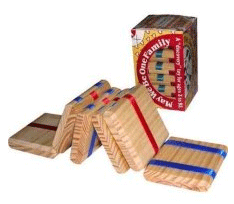
Mostly they were errant Legos and Barbie clothes, the detritus of a little girl’s life. But there was, I discovered, an old Jacob’s Ladder toy, which is simply slabs of wood connected by ribbons in a cunning way so that it can be configured into lots of cool shapes and do neat effects. It looks like this:


Image from Google Shopping

In the middle of my cleaning spree, I sat down and started to play with it again, idly, almost like seeing if I remembered how to ride a bicycle after many years of not riding. My hands moved the toy through its various forms; even though I didn’t have the instruction manual anymore, I still remembered, because I had played with the toy so often. All over again, though, I was rediscovering how to work the simple toy, remembering along the way how long I had toyed with it as a child.

Also Found: Spark of Creativity

Playing with this old favorite toy reminded me of childhood, but it also reminded me of a lot of favorite things I no longer had time for; after all, this toy had been buried in my room for God knows how long. What other stuff had been buried in the mess of my adult life? Fun video games, TV shows, things I haven’t allowed myself to indulge in because I’m so “busy” all the time.

Though it was a moment of idleness, a moment, perhaps, of returning too keenly to childhood, it provided a shock of realization: I used to play the piano a lot more than I do now, too. The piano was an old favorite toy much like the Jacob’s Ladder toy, and in the business of adult life, I had laid both aside.

Suddenly, I had a brain spark: didn’t I have a piece of music I had been trying to write for some time? Didn’t I have some free time–well, as soon as I finished cleaning–to go downstairs and use the digital keyboard?

Out of my reminiscences came a sudden, urgent drive to go and play the piano like I used to, treat it like an old favorite toy. So I did…and in so doing, I formed up the basis of a new piece, right on the spot. It’s not finished, it might not go anywhere, but at least I touched those musical keys for the first time in months! And I believe that what helped me to do so was allowing myself to remember how much fun I had playing the piano, allowing myself to fall back into that older mindset…and becoming freshly motivated to try it again.

Finding Your Own “Forgotten Favorite Toy”

If you’re currently in a creativity rut right now, you might want to try this. You might not have a physical favorite toy right where you can lay a hand on it, but think about playing with it. Or, think about a favorite childhood pastime or group of people who positively influenced you. Anything that conjures up a positive memory and puts you in an earlier mindset will work.

Now, think: what is so compelling about that memory? What makes it so happy? If it’s something you did back then that you could easily do now, why don’t you try it, just for a few minutes, and see what starts coming to mind. Who knows, you could end up like I did, one minute cleaning and the next writing a new piano solo!

Art I Don’t “Get”…and Why It Doesn’t Matter if I “Get” It

I consider myself a fairly decent “traditional” art absorber. I listen to classical music on occasion, have watched my fair share of Shakespeare plays, Broadway musicals, and staged dance productions, and have visited art galleries galore over the course of my school career. And I’ve even participated in the creation and performance of art, from drama and dance to music and visual arts. I like to think I know how to take in and appreciate art, speaking in the broadest sense.

And then, I come across spectacles like these:


Source

Source

Source

Source

…Um…yeah. These, plus those weird twisted metal sculptures that always seem to be outside big institutional buildings or performing arts centers? I just don’t know what to make of them.

An Attempt at Reasoning Out This Art

I can see why the beer belly art is funny (first pic); I live in the South U.S. and have seen a few live beer bellies that look remarkably like that (sadly enough). And I guess I can see why somebody wanted to make a car out of glass (second pic)–just ’cause they could, I suppose. The random metal animal in the middle of a field (fourth pic) is kinda weird, but I guess it’s “natural” in subject matter, so it works being stuck out in the middle of nature. And the yellow circle kinda reminds me of my Play-Doh days, modeling the clay around the base of the container…

But the question keeps rising in my mind: “WHY?” Why bother doing something like this? Is there some kind of esoteric philosophy embedded in this that I’m not getting? Is this art going to expand my mind like a ’60s-era drug if I just stare at it long enough?

What is Art without Meaning? Quite a Lot, Actually

I keep looking for meaning in the art I take in, because that’s the kind of art I like. Absurd-ism annoys me; my real life is absurd enough. And doing things “just ’cause” feels too random and meaningless. I like to take in examples of artistic expression that MEAN something to me, that change the way I think about something or show me a completely different mode of living. Just a personal preference, I suppose…

…and yet, as crazy/meaningless as I find these examples of art, there’s likely somebody who gets a lot of meaning out of them and enjoys them. The thing about art is that everyone views it differently–the yellow circle art, for instance, could be representational of anything or nothing, just something to make you think a minute.

Art is weird like that; show a random picture of anything to a crowd, and there will be people in the crowd who try to pull out meaning (like me), people who like the colors, people who hate the subject matter, and on and on. Different interpretations will be piled on, and any or none may be “correct” from the artist’s viewpoint, but they’re still all valid thoughts.

So, whether I enjoy and/or understand the meaning of such artwork is almost beside the point of art itself. The point is, somebody made it because they liked it and wanted to do it, and somebody else thought well enough of it to showcase it. Each piece of artwork, then, whether it’s traditionally “understandable” or not, is an example of someone’s personal expression, someone’s mark on the world. It might look like a big ball of excrement to me, but to someone else, perhaps, it’s life-changing. Art’s meaning is, then, all in how one approaches it.

Summary: What Do You Think?

What do you think about art like the examples I’ve shown in this article? Do you agree that art’s meaning is created by the artist’s perspective plus the viewer’s opinion? Are there art types you don’t understand that aren’t represented? Leave a comment and share your opinion!