Tag Archives: writing

5 Useful Writing Inspirations

As a novelist who often feels “stuck” because of certain writing hang-ups, I know that sometimes writer’s block feels like a steel trap caught around the leg of your plot, refusing to let it go anywhere. I think sometimes we writers psych ourselves into a state where we can’t even write because we’re afraid of what will come out of our heads–afraid it won’t be “good enough,” somehow.

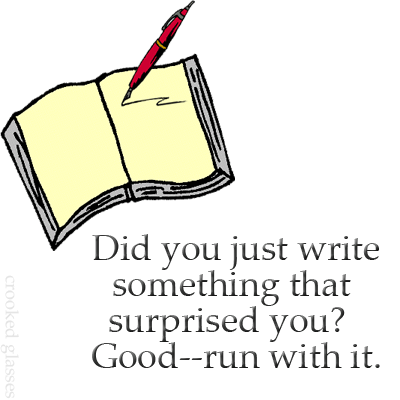
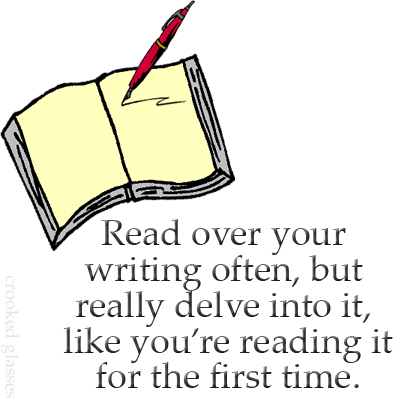
Thus, I came up with the following 5 simple tips, which have helped me begin to break through the ice covering my novel; I hope they will help you begin to write again, too.

writinginspiration1

writinginspiration2

writinginspiration3

writinginspiration5

writinginspiration4

Image Credits: Source of image of book with pen

Armchair Critics: A Pet Peeve Personified

Too many times, I’ve seen it happen: a person who can’t dance criticizes a dancer at a competition, saying “Even I could do better than her! She’s awful!” Or somebody snickers at a singer on The Voice or American Idol, calling the person “terrible” even though they themselves have never taken any formal voice lessons. These kind of people irritate me no end–I call them “armchair critics,” because they make negative judgments without knowing the least little bit of what they’re criticizing.

These days, however, I’m seeing another type of armchair critic–the fiction armchair critics, lobbing fireballs of negativity at both book and author, despite never having attempted writing any kind of fiction themselves. Much of the criticism surrounding books like the Twilight series and the 50 Shades series seems to fall into this category, at least for me.

As a budding novelist and holder of a Bachelor’s degree in English, I am accustomed to criticizing literature in an academic sense; I freely admit that neither of these mentioned book series are exactly the heights of literature. But let’s set aside opinions about books of this type for a second and think about the principle behind negative, biased, non-academic criticism. How much sense does it make to criticize someone else for doing something you’ve never attempted and therefore know nothing about?

To me, it makes no sense at all. It’s almost as if the armchair critics believe that their criticism will make a quality book magically appear–they toss their criticism far and wide on the Internet, decrying the books they dislike as “wastes of paper,” etc., yet I don’t see them writing any “quality” literature for us to read instead.

Thoughtful Criticism: More Than Just Opinions

I believe that if we are to offer the best and most thoughtful criticism of anything, we must first have an understanding of the effort and processes behind whatever we’re criticizing. Thus, for criticizing successful fiction, we must first have tried to write successful fiction–we must have grappled with creating a relatable, believable character, must have worked to choose exactly the right words to paint a scene, etc.

Doing so will not only make us more knowledgeable about the work of writing, but more understanding about the struggles of an author. Then, and only then, will we be able to offer an in-depth and HELPFUL critique of an author’s work. That’s part of what criticism is for, anyway–to help someone else better their work.

My Solution: Armchair Critics, Go and Write!

So, here is my solution for all the fiction armchair critics out there: if you think you can write a better book series than Twilight, 50 Shades of Grey, etc., then do so. Start crafting an original idea in your head; create your characters, give them life on the blank page. Mold that storyline so that it conveys the overarching meaning you’re trying to communicate to the audience. Shape those themes, sculpt that imagery–really dig your proverbial fingers in and do the work that you have criticized others for doing so poorly. Experience what it is like to be an author. It’s not as easy as it looks!

If all the people who criticize Twilight and 50 Shades of Grey try out this solution, for instance, then the modern literary world should soon be inundated with a wealth of successful, quality fiction, if the critics’ opinions of themselves are to be believed. (And even if they aren’t successful, at least they will know more about what they’re criticizing!)

TL;DR and the Destruction of Attention Spans Everywhere

tldr “TL;DR,” meaning “Too long; didn’t read,” is a common acronym found around the Internet these days, usually in response to a longer story or essay. Sometimes, authors will even write a short, one- or two-sentence summary of their point as a preface to their article and have “TL;DR” out beside it for those readers who don’t want to read further.

But this is more than an acronym. This is a PROBLEM.

Two Reasons This Is a HUGE Problem

As an English major and former English teacher, I find this “too long, didn’t read” trend distressing, for two big reasons:

  • All of us–including those of us who study literature and written publications–are becoming entirely too impatient when we read. Either that, or we feel easily daunted when we see long blocks of text. We have become more dependent on short written bursts of news and entertainment, and most of us do not take the time to read on a deeper level daily.
  • Because of the instant gratification of TV and the Internet, our kids are growing up with this same “TL;DR” mentality in schools. This doesn’t help them learn to deeply read literature–they find shortcuts online or read Cliffs’ Notes, rather than sitting down and really studying the actual work.

Even I’m finding it hard to concentrate on a long essay or a long work of literature these days, and I used to be one of those folks who consumed the written word like it was candy to my brain. One could attribute it to stress or illness, but I think there’s something else wrong–my ability to concentrate has dwindled with the lessening need for extended concentration. And I’m likely not the only one.

The (Sad) End Result?

I fear that the day is quickly coming where people will not know how to make themselves read for long periods of time, and will forget how to lose themselves in well-written literature for hours. I fear that we as a society will forget how to pay attention to something that isn’t flashing and/or brightly colored.

The main reason I fear this? Because it will, quite simply, put me and other writers out of a job. As a writer, I want generations of people to read my novels, to immerse themselves in the world I am painstakingly building with my words. But if in the future no one can pay attention for that long, will my words ever be read and enjoyed at all? I’m sure I’m not the only writer out there who worries about this.

The Solution: Building Up “Reading Stamina”

I believe that we all must work on our “reading stamina”–the ability to read for long periods of time without getting distracted or bored. The reason I call this ability “stamina” is that it can be trained and increased, just like physical endurance. We can endure longer reading sessions; we just have to want to do so, and schedule time to “work out” in the mental gym.

  1. Search up a subject you really enjoy, and read 2 articles about it. Compare and contrast how each author approaches the subject. For instance, I might read a couple of articles on astronomy, music, the geek life, etc., and see how each author’s opinions match up with each other, and where they differ.
  2. Closely read 1 short story, poem, or 1 chapter of a novel per day. Don’t just scan the work, but read it almost as if you were reading it aloud, going word-by-word. Really delve into what the author is saying; study their word choice as if through a microscope. How does the piece of writing make you feel? What is the author’s point?
  3. After you finish reading anything, mentally summarize what you read. Does what you just read change your opinions or worldview in any way?
  4. Share what you’re reading with others on social networks. Offer questions on the points you didn’t understand in what you read; offer opinions on the points you understood and reacted to. Start a discussion!

These are all exercises that will help you beef up your understanding of what you’re reading, which will make it easier to read for longer periods of time–you won’t feel so overwhelmed. Just like you have to start exercising with short bursts of activity and longer rests, so you must train your brain with short bursts of reading every day, rather than jumping into a huge novel right away.

I’m also suggesting that you make reading a more social activity; it’s long been seen as something that isolates us, much as computers isolate us today, but in fact becoming well-read can help us make new friends as well as enrich all our conversations.

Summary

(Ironic that I’m putting a summary on this article, isn’t it? LOL) If we want to continue being a literate society, we need to stretch our reading muscles. We need to be okay with reading longer works, or reading for longer periods of time, because being willing to read deeply can help us do everything from enjoying literature to avoiding financial pitfalls (reading the fine print). If we don’t use that skill, we lose it; if we lose the ability to read longer pieces of writing, how long before we lose the ability to read deeply at all?

Grammar Matters Online (Really)

Though it may not seem like grammar still matters online, considering how some websites are written, it most certainly does.

I say this not just as a former English teacher, but as someone who communicates with words. We who create content for the Internet are creating websites to communicate our ideas; if our grammar is incomprehensible, our ideas will not be understood. (For instance: how would some ill-constructed English content translate into another language if a user needed it translated? It probably wouldn’t translate well at all.)

Thus, we webdesigners and developers must be concerned, at least partially, about our grammar, especially if we are running an informational website. Above all, we want our users to understand our content!

Recognizing Bad Grammar: A Quick Little Quiz

They is gonna go, down their soon.

There are four grammatical problems with this sentence. Can you find them all? Not only is this a common spoken sentence, but this contains some of the most common Internet grammar slip-ups, too. (Answers at the bottom of this article!)

The Difference Good Grammar Makes

Read the following two samples. Which one seems more professional, more trustworthy, and worth following up?

Example #1

Hey what up Im an web master and I could do your web site. Cause I can program and style it too. I been trained 3 year. Me and my brother been working on web sites together 4 a long time we like it. If you want me 2 design your site just msg me and well work something out.

Example #2

If you’re looking for a webmaster, I would be glad to offer my services. I can do both development and design, and have 3 years’ experience working both with a design team and on my own. Please send me a message if you are interested.

Analysis

While there is something to be said for #1’s easygoing style, #2 takes the cake in terms of professionalism, trustworthiness, and clarity. To understand #1, you need a basic working knowledge of textspeak/chatspeak; additionally, the sentences run on a bit long, yet they don’t really add anything to the “sales pitch,” so to speak. #2 makes its points clearly and quickly, and with more polish.

The only difference between #1 and #2? Grammar. Sentence construction, punctuation, even some basic elements of writing style–all fall under the broad heading of “grammar.” Simply put, grammar can make or break your website’s readability and enjoyability, not to mention its use as a reference.

If you had to choose between these two webdesigners for a project, which one would you trust more to do a better job? Most clients would go with the second designer, simply because the person sounds more capable and professional. We have to remember that our websites will be judged for their professionalism and trustworthiness in the same way.

How to Achieve Good Grammar

  • Read your content aloud. Just like with checking your spelling, reading what you have written out loud will help you catch most of your grammatical errors, because your sentence won’t “sound right.”
  • Consult Internet references–I have a selected list picked out below.
  • If you’re still unsure of your grammar, have someone who is good with grammar and writing read over your content before you post it to your website. Better safe than sorry!

Online Grammar References

GrammarBytes
The Elements of Style
GrammarBook.com
Guide to Grammar and Writing

Final Notes: Answer Key

  1. “They is” is incorrect. It should be “They are,” unless you are purposefully writing in Southern dialect.
  2. “Gonna” is not technically a word–only in casual speech. “Going to” is the proper form.
  3. The comma between “go” and “down” is unnecessary.
  4. “Their” is a word that is spelled right but not used correctly. The right word to use in this sentence is “there,” which references a place, rather than “their,” which references possession of something.

A Day for Writing–Literally

A few Tuesdays back, I wrote about how the Alarmed iPhone app has revolutionized the way I do household chores, schedule blog posts, and do a whole bunch of other things. In short, it’s made me much more organized and on-time doing things. Now I have entire days set aside for things like cleaning the kitchen, tackling cluttered areas of the house, posting all the blogs for the upcoming week, etc.

But I did not mention that this app has also revolutionized the way I write…because I simply did not think of it as a “writing app” until about two weeks ago.

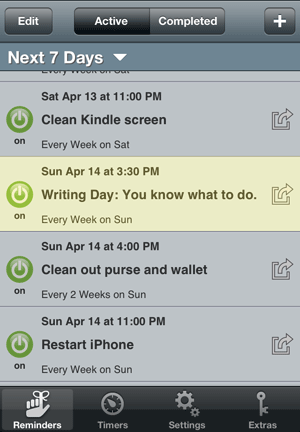
How did a reminder app change my writing habits? Simple: I set aside a “Writing Day” reminder, just like I set aside a “Kitchen Day,” a “Clutter Day,” etc.

writingday This screenshot from my phone shows how Writing Day falls on Sunday every week, sandwiched in between mundane, tiny little tasks. Sunday afternoons are the times I can finally wind down for the week and recharge for the next–it’s a time of reflection, and more importantly, a time of just being able to BREATHE. No one needs my time, no one really needs me to do anything–everything for the week is done, and my time is my own. In short, it’s the PERFECT time to write.

I’ve left myself a simple instruction, too–“You know what to do.” Because I do know what to do on Writing Day–just write. I can write in my novel, I can write in a fanfic or two, I can write anything I want as long as it’s creative. That’s the only rule.

Has This Helped? YES!

This app has already helped me move ahead three pages in my novel. Though it might seem paltry, three pages is a victory, since I’ve been stuck in one place for nearly a year.

Before making a specific “writing day” reminder, I had had a hard time making time to write. It seemed I wrote all the time, either doing blog posts like these, preparing my Sunday school lessons to teach on Sunday, or writing website content…but I hadn’t really done much creative work aside from just little random bits here or there. I ended up almost burned out on writing, just not feeling like I had the energy to write anything when I had free time.

When I finally set aside a special “day” to write, boy, did that change. I’ve begun to write more on my novel, and I’ve started looking forward to Sunday afternoons as “my time,” even. Just allotting a special day of the week to writing makes me feel less anxious about accomplishing my creative writing goals, and less anxiety = more productivity. This is a HUGE change for the better. I don’t force myself to produce a certain number of words or pages when I write this way–I just relax, get rid of all my anxiety about “getting things done,” and just enjoy the process.

Making a “Writing Day” for Yourself

  • Choose a day of the week which is less busy than all the others, or which has mostly non-writing tasks. This is important–you don’t want to be mentally “burned out” on writing before you even begin.
  • How much time do you have during that day? According to your schedule, budget in a block of time to write. It can be 15 minutes, one hour, 3 hours–whatever time you have free.
  • Create a consistent reminder for yourself, either on your phone/computer as I did, or place a paper note somewhere where you will see it every day.
  • When your chosen “writing day” comes around, just write SOMETHING creative. If it’s a few words, awesome. A few lines or a paragraph? Great! A whole page, or even a bunch of pages? Amazing! Count it all as progress, because it is.

I hope this helps you get back on track with your own creative writing–it certainly has helped me!

“Synonym Syndrome”

As I’ve written about before, choosing exactly the right descriptive word when you’re writing is important–words carry not only a direct meaning, but an implied meaning as well, called a connotation.

I noticed this afresh during an impromptu “writers’ club” meeting with my guy friend; we had switched computers to read each other’s stories so far, and I saw that while he had scattered descriptive words all throughout his story, some of them didn’t quite seem to fit the tone of what he meant. Instead of saying “said” a million times, for instance, he had put in apparent synonyms for the word “said”, like “noted,” “stated,” etc. Yet these words didn’t have the right “shade” of meaning in the context of what the characters were saying, etc.

I’ve run into this same problem many times in my own writing–I call it “synonym syndrome,” when you’re trying desperately not to use the same word over and over. The problem comes in when the synonyms you’re trying to use don’t quite match your meaning; they can cause a little confusion in the reader as they try to picture the scene you’ve written.

Examples of Synonym Syndrome

“I can’t believe this is happening to me!” Sandy noted.
“Psst, look over there,” Nathan stated.
“This is my original opinion,” he cited.
“WILL YOU JUST LISTEN TO ME?!” she murmured.

All of these speaking words in these examples do have the basic meaning of speech, but the more subtle shades of meaning in each one render our mental picture of the described action a little differently. It’s hard for readers to imagine a character murmuring in all caps, for instance. When you overuse synonyms like this, which is very tempting to do, it’s almost like your writing becomes a thesaurus in and of itself–it reads in a more stilted fashion rather than flowing naturally.

Some Ideas to Fix Synonym Syndrome

  • First of all, don’t be afraid to use the same word a few times in as many pages. If the right word to describe a character’s speech is “said,” then use “said,” and don’t worry about it. It will read much smoother.
  • As you look at a synonym list, mentally picture the action you’re trying to describe, as if you’re watching a movie form of it. How are the “actors” in your mental scene acting or speaking? Which of the words you’re looking at describes that action the best?
  • If you can’t find exactly the right synonym for an action verb, remember that you can add an adverb, which will spike the verb with a little more descriptive meaning. Just be sure to use adverbs sparingly–they’re like garlic, good in small quantities but easily overwhelming if you put in too much.

    Examples (adverbs in italics):

    • “She sighed tiredly
    • Swiftly, he answered”
    • “The box slid slowly down the slope”
    • “Sinking down into a chair dramatically, she closed her eyes”

Additional Food for Thought: Taking Apart Synonyms’ Meanings

Really take time to dissect the words you want to use. Do they really mean what you want them to mean? This can help you determine whether your word choice is natural or whether it’s got a little synonym syndrome. As examples, let’s look at the words “said” and “moved.”

Synonyms for “Said”

  • remarked – implies that the sentence spoken is either a retort/comeback or a pointed/smart reply.
  • noted – implies a quiet addition to someone else’s comment
  • cited – implies a quotation by the speaker rather than an original thought
  • answered/replied – requires another character to have spoken before to make sense
  • stated – implies a strident or resolute tone of speech, unmovable by others’ opinions
  • muttered – implies a resentful tone
  • murmured – implies a very quiet tone, either of a shy comment or a loving one
  • whispered – implies a quiet tone, but more of passing information secretly between characters

Synonyms for “Moved”

  • stomped – implies anger/frustration
  • tiptoed – implies timidity or caution, possibly stealth
  • glided – implies graceful movement–can be snakelike (negative/evil) or swanlike (positive/good)
  • skipped – implies carefree, blissful state of mood
  • sneaked – implies stealth, usually for an underhanded purpose
  • strode – implies confidence, possibly arrogance or anger
  • moseyed – implies an unhurried, almost lazy pace
  • strolled – a casual walk
  • sauntered – a casual walk with a slight shade of conceitedness/overconfidence; often used when a female character is approaching a male character she’s interested in

Bloggers Aren’t Real Writers? I BEG to Differ!

Recently, I caught sight of this picture floating around the Internet, and it admittedly ruffled this little robin’s feathers:

bloggers_arent_real_writers
I retrieved this picture from buzzfeed.com, but it’s all over the internet.

Now, I have censored out the language for propriety’s sake, but what I really took issue with was the last sentence or two: “Bloggers aren’t real writers.”

At the risk of opening myself up to criticism, I’d like to address this viewpoint, because it seems to be shockingly commonplace among most non-bloggers. As a writer who has picked up blogging as a hobby, I find that this acid view of blogging is overly simplistic and based in ignorance rather than truth. I seek to dispel at least some of that ignorance with this post.

#1: All Bloggers Are Not Identical

One cannot categorize “bloggers” as one solid group of people with one fixed set of interests, methods, and talents. That’s like saying “all fruits taste the same” or “all sneakers fit the same on everybody’s feet”–it’s simply not true. People blog about all sorts of things, and they blog in various ways; some use mainly pictures, some use video, and some, like myself, use mainly text to get their point across.

I could potentially understand this person’s perspective if all bloggers just used visual media as their posts; visual media does not require as much text editing and revising. But not all bloggers use pictures and video to the exclusion of all else. I’m a prime example, and I know plenty of other bloggers who produce text-heavy posts as well. Given that, how is text blogging not real writing, when it is primarily carefully-chosen words?

#2: Text Blogging Forces More Careful Editing

Blogging is a time-sensitive form of writing, produced on a schedule and conforming to content demands as well as formatting and time demands. What kind of writing does that sound like? Journalism! And, while blog articles are not always the highest of art forms, producing a good blog article DOES require a certain ruthlessness and discernment in one’s writing and editing process, which most if not all types of writers can benefit from.

For instance, I’ve noticed that I’ve become a much more concise, word-conscious writer since I began my blog in January 2011–I used to go on for days about a topic, and now I can condense that into a paragraph or two and get my point across much better. Blogging has forced me to reevaluate my writing style, and has helped me cut out some of the unnecessary verbosity as I revise and edit. My paragraphs are shorter and feel more “zingy” as a result.

Given this, how is blogging not real writing, when it requires the same amount (or often more) of typing, editing, and revising that I did while working toward my English major in college?

#3: Blogging = Written Communication = WRITING

Blogs, even and especially text-heavy blogs, communicate ideas between people, break news, and invite discussion, much as TV news stations and newspapers do. How is this not real writing, when all of these tasks are precisely what writing was first designed to do? People have been using writing as communication for over a millennium now, at least, and many forms of writing have since developed. Text-based blogging, while relatively new to the literate scene, is just as viable as any other form.

I don’t know for certain, but I have a feeling that the creator of this particular image categorizes “writing” as “creative writing” or “expository writing” only–basically, that “real writing” is only telling a fictional story or getting across an academic point. Unfortunately, that is like saying that “carrots and onions are the only real vegetables, and everything else you grow in your garden is a fake veggie;” it is a perspective that ignores every other opinion or fact as “invalid” except its own narrow, opinionated view. Writing is not only for creativity nor just for arguing points of opinion; it is also for communicating facts and discussing points, which bloggers do quite well.

In Conclusion

I don’t claim that text blogging is the be-all and end-all form of writing, but it does take time and patience to craft and complete well-thought-out articles, and it does take discipline and dedication to produce such articles on schedule every day or every week. It is no different from the other forms of writing out there, which have similar mental requirements.

Additionally, if this person and others like him/her believe blogging is so stupidly easy, I would challenge them to try keeping up a daily text-only blog for about 6 months, coming up with original articles (about 500-1000 words apiece) and fresh perspectives every day. I think their experience would teach them quite a bit about how blogging IS “real writing” if done in this way.

3 Tips to Revolutionize Your Creative Writing

After having been stuck on my novel for the better part of a year, I knew I had to do something to light the spark again. I looked at all I’d accomplished so far, and I found myself asking, “How in the world did I ever get to 50,000 words, let alone 150,000, when these days I can barely be bothered to come up with 500?”

You might feel just as stuck in your own creative writing process. It may feel as though those cogs and gears will never turn again, that they are rusted into place. But I have 3 tips that have helped my own writing engine begin to turn over, and they just might help you. It doesn’t hurt to try!

#1: Write What You Really Want To

You have to give yourself a compelling reason to write again once your engine has stalled out for a while. So, if you have an idea that’s simply bursting to come out of your head, write it down. It doesn’t matter if it has anything to do with your current projects or not; write it. If it’s a very future part of your novel, several chapters ahead of where you are now, go ahead and write it–you can connect the plot dots later. If it has nothing to do with anything you’re currently trying to write, go ahead and write it anyway; it’ll help keep those creative wheels greased.

For example, I have several ideas for future chapters of my novel–let’s say these are going to appear in Chapters 14 and 16. But right now, I’m stuck back on Chapter 7 or so. Very, very annoying! But I can go ahead and write those very far-flung chapters; who knows, it may spark an idea for how to finish Chapter 7, and how to build up chapters 8-14 to those next plot points!

#2: Don’t Make Writing a Chore, Make It an Escape

When something’s a chore, it’s not very fun, is it? We dread it, but we put it on our schedules in an attempt to make us do it. Yet many of us creative writers try to mold our writing schedule into “daily writing” programs, or try to follow those “write X number of words daily” plans…and we end up hating to write, where before we had loved it.

I don’t mean to disparage such motivational programs; if they work for you, then do them gladly. But for me, such programs create more anxiety than they solve; I end up anxious about not completing the programs or following the plans to the letter. And believe me, when writing gets associated with anxiety or boredom, you’re in deep trouble as a creative writer. That’s what I’ve run into with my own novel this last year–it’s not that my novel bores me, but that the situation I’m writing is hard to write about. I’ve become so anxious about “fixing” it that I have hobbled my writing ability. Sounds ridiculous, but it happened…and it happens to many more writers, I’d wager.

So, how to break free of this? Make your writing something you do when you need to wind down, something to reward yourself with when you’ve finished a real chore, or something you do when you want to cheer yourself up. Make it an escape, like a favorite book you can’t put down, a favorite food you look forward to eating, or a favorite place you love to visit. Make it FUN again, make it the process of discovery and creation that it ought to be, instead of hedging it about with tons of rules. If you’re like me and have problems following overly structured plans, this might just spark your engine again.

#3: Let Dreams Inspire You

Have you ever woken up from an incredibly intense dream, only to have certain scenes stick with you throughout the day? How about using these scenes as inspiration for your writing? Whenever you have dreams like this, write down the most vivid scenes from the dream in as much visual and sensory detail as you can remember–then save that scene where you can find it easily. You never know when that dream scene may become fodder for a future plot detail! (Being a pack rat is okay in this case!)

For instance, I dreamed a very powerful, evocative scene for a future subplot in my novel about a year ago–I actually woke up weeping and shaking, and it stayed with me for hours. I know it will be a very painful scene to write when I put it into my book, but it will also be a point of great character development, too. So I’ve written some quick notes about it and it’s sitting in my novel file on my computer, waiting to be used alongside a few other little scraps of dreams I’ve written down. The others may never make it into the book, but they just might!

Summary

I hope these three tips help your writing engine start again. Remember, just because it hasn’t cranked in a while doesn’t mean it won’t crank ever again. Unlike old cars, our brains are never rusted!

What to Do When You Run Out of Blog Content

No matter how long you’ve been running your blog, sometimes it happens: you end up at a loss for what to write about. I call it the “Blog Doldrums,” where any good topic you come up with is one you’ve already done, and any other topic seems not worth writing about. The Blog Doldrums kill off many good blogs before they really get started, and can cause a great blogger to suddenly go silent.

So, how do we as content creators combat this? First, by not letting these doldrums get hold of us for too long, and second, by getting a little creative with our blog topic ideas.

Approach #1: Search for Similar Books and Websites, and Present Them to Your Audience as Resources

Whatever you’ve made a blog about, likely there’s been a book (or several) written about it, and likely there are other websites which cover similar ground. Check out books at your local library (or through an e-library), and do fairly involved searches for websites (i.e., not just the first page of Google results).

Once you find books and websites that are on your particular topic, browse through them, making notes of which ones are most useful and relevant to your blog’s audience. Compile a short list of the best of the best, and write a short description of each book or website, along with relevant links (website link, place to buy the book, official book website, etc.) and any appropriate pictures (screenshots and book covers).

Example: For my Monday web design and development posts, I could do a post about some great webdesign guidebooks as well as helpful development websites, linking to each and showing my readers resources they’ve potentially never heard of.

The resulting blog post will be basically an online report about what other people are doing in your content area. Visitors will still be enriched by this post, and you can start to build a little community with other website owners and bloggers who are interested in your same topic, too!

Approach #2: Just Write Your Perspective on an Issue

Rather than trying to do a really in-depth post with TONS of information and LOTS of “expert advice,” how about just doing a blog post about your own perspective? Write about what this topic means to you, or how you interact with it on a daily basis, or even what you think about particular trends going on in your chosen topic right now.

Why bother doing this? Because you, as a blogger, have a very interesting point of view that others would like to read about, so why NOT share your opinions? This gets you writing from the most primal level–your own mindset. You can explore your own thoughts and reasoning as you choose, and can then tie it all together in an understandable way.

Example: For my Saturday creativity posts, I could write about what music has meant to me over the course of my life. Or, for my Thursday gaming posts, I could write about the current HeroClix team trends appearing in local gaming stores versus team trends at conventions.

This blog post will be virtually guaranteed to be original, new content–it came out of your head, after all! Plus, visitors will likely be intrigued by your words, and may be inspired to think differently about your topic because of your post.

Approach #3: Research Your Topic and Bring Something Obscure to Light

No matter what your topic, there are likely several unexplored corners within it, several small things most people gloss over, assuming everyone knows about it. Take time to research your chosen topic in depth, and research anything that surprises you about your topic or anything you personally have never known much about before.

Once you’ve done that, take time in a blog post to expand on one or more of these hidden gems, really digging into it and exploring it. (Don’t forget to do a lot of linking in this post to show where you found this information, and where people can go to find out more!)

Example: For my Wednesday Bible posts, I could take a Bible verse that is either not often talked about or very often misunderstood, and really delve into it, comparing and contrasting the meaning most folks take from it and the Biblical scholars’ interpretation(s).

When you publish this post, you will be bringing something very new and interesting to your audience’s attention, and your post will likely spur readers to learn even more. You might even draw attention from other bloggers and website owners who write about your same topic!

Summary

When you find yourself in the Blog Doldrums, don’t despair–there are plenty of ways to get yourself out of them AND produce a useful, worthwhile blog post at the same time!

Don’t Hate Your “Work in Progress”

I have a little confession to make: I’m often disgusted with my own efforts while I’m making art.

If I’m trying to design a web layout, I get frustrated if the design or the implementation just won’t align right; if I’m writing a bit of story, I get mad when I just can’t seem to script out the scene stuck in my mind. And that’s to say nothing of how I try to learn a new piece of music. I absolutely hate how slowed-down and imperfect the piece sounds if I can’t seem to play it correctly at normal speed. (As a child, I used to burst out crying and run from the room because that sound created such anxiety in me–playing it slow made every song sound stupid, and it made my skin crawl!)

This is part of my perfectionism, and I would wager that many fellow creative people go through similar emotions–the gripping fear/frustration of the physical creation not matching the mental idea. But this isn’t a healthy mindset, either for your creativity or your sanity. In fact, this mindset has kept me from a lot of my best work.

How This Actually Stunts Your Creativity

This fear, disgust, and frustration is one reason my novel isn’t published; it’s a reason that I wait so long between layout designs for my websites. I hate looking at (or listening to) a half-finished product and detesting what I see because it doesn’t match the perfection in my mind. But as much as I hate seeing the terrible, muddy chaos of a half-finished work, it’s part of the process–and it must be endured, if I’m ever going to finish anything!

For example, this week, I’ve finally begun to write on my novel again after six months of being completely stalled. As I began to write again, I wondered, “Why did I wait so long? What had me stalled?” The answer: I hated looking at my unfinished work and seeing how badly it compared to the awesomeness in my head. (Thus, this article came about, documenting my own silliness and fear; like a bad dream, the negative emotions get easier to bear if you share them.) But I lost six months of writing time just being stalled because I thought the work wasn’t worth finishing. I stunted my own creativity with my perfectionism.

Don’t Make the Same Mistakes I’ve Made!

If you’re suffering these same feelings, and you let them stop you, then you too will be stuck as I have been. Remember, nothing looks or sounds right until it’s finished, whether it’s a painting or sketch, a piece of music, a poem, a novel, anything. This is part of being an artist–being courageous enough to dig into your own work and finish it. And in fact, once your piece is finished, you end up with a much better product, because you’ve subjected it to your own criticism first, and you’re more aware of any flaws or mismatches in your work.

So, today, I encourage you to go back to an unfinished work of yours. Go back to it, and just see what you can do with it. If you have to push aside your first idea and try something new, go ahead; if you need to rework just a bit of your previous efforts to continue on with your next idea, that’s perfectly fine, too. Just don’t be afraid to dig in and get your hands dirty. I promise you, it will turn out better than you think.