Category Archives: Saturday with the Spark

Creative pursuits and life-related happenings.

Just Sing a Song! (Or Write a Poem, Or Draw a Picture…)

justsingasong

This little song, “Sing,” first written for Sesame Street in the early ’70s, spawned many covers and gained lots of popularity–and for good reason! It’s one of my favorite “kid-friendly” songs because it has a great message, not only for kids, but for artists of all sorts. Check out the lyrics, below:

“Sing
Sing a song
Sing out loud, sing out strong!
Sing of good things, not bad;
Sing of happy, not sad…
Sing
Sing a song
Make it simple to last your whole life long!
Don´t worry that it´s not good enough for anyone else to hear;
Just sing…

Sing a song!”

The bolded section above is the most important part of the song, for me. “Don’t worry that it’s not good enough for anyone else to hear; just sing.” We singers–and for that matter, all of us artists/creative people–can get so wrapped up in worrying whether our gifts are “good enough” for the world that we strangle the creativity within us. It’s hard to put aside criticism and the fear of other people’s judgments, but it’s far worse to never even be creative for your own sake. “Sing” is a simple reminder to just enjoy our creative gifts, whatever they might be, and not to worry about what other people will think of our efforts.

Do you have a favorite song, quote, etc. to inspire you when you get discouraged about your creativity? Share it with me in the comments!

The Journal: A Writer’s Sandbox

writerssandbox

I used to think of “journals” as strictly diaries or classroom assignments; I was never very good at doing either of them for long because they both involved handwriting, which I hate doing because it’s horrifically slow and makes my hand cramp within seconds.

But as I’ve gotten older, I’ve realized there’s something actually quite magical about a journal, whether it’s an empty book of pages or a blank Word document–it’s YOUR space as a writer, YOUR space to create, transform, innovate, and revise as you see fit. No one else ever has to see it, but it’s as big as your brain needs it to be. It is your writing sandbox, and you are the kid with the shovels and the sand bucket.

How Do You Start a Writer’s Journal?

Very simple:

  1. Choose your format–paper or digital document.
  2. Write or type in anything you want to. Random character lines you thought up while out and about, blurbs and dribbles of stories you may or may not finish, brief character descriptions, feelings about topics, blasts of ARGGGGGHHHH I CAN’T WRITE ANYMORE, things that make you laugh, mocking a writing style you hate…this is your sandbox, so feel free to throw some words around and make it messy!

(Note: if you have a digital journal, it can definitely span more than one document if you want/need it to. No need to keep it all in one file, especially if you end up turning one or more blurbs into full-blown stories. My digital journal, for instance, takes up hundreds of files and multiple sorted folders!)

But I Don’t Have Anything to Write About!

If you’re absolutely stuck on what to write about, there are a few really good websites out there that give you journaling and writing prompts. Here are some to start with:

DavidRM.com: Journaling Prompts
WritingExercises: Random Subject Generator
Creative-Writing-Now: Journal Writing Prompts

Approach these prompts as fun challenges rather than drudgery. Can you write about the experience of skydiving by just imagining it? How much do you remember from that childhood memory–can you remember the scene, the smells, the sounds? Dig into each idea, sense it, and describe it.

Whatever you choose to write, try out all sorts of writing styles, plots, topics, opinions, and characters in your journal; shape your words like wet sand. You might be surprised what you end up sculpting with your words!

Scraping the Bottom of the Ideas Pot? Try This!

Sometimes the flow of creativity just STOPS, for whatever reason. It feels suspiciously like scraping the bottom of the pot for the last bits of dinner (thus the title of this post)–you hope and hope you’ve got enough in there to feed you, but you fear you’ve run out.

For instance, I’m running into a lot of problems coming up with new topics for this blog, especially for my Monday and Saturday posts. For almost every idea I have, it feels like I’ve already done it (or I can look back through my posts and prove I’ve already done it).

So what’s a creative blogger girl to do, when it’s time to come up with a new week of posts but there’s no more ideas? Simple–revisit and revamp! And that’s what I suggest to you, if you’re stuck in a similar creativity rut:

#1: Look Back through Old Ideas

Whatever creative project you’re stuck on, look back through your completed projects, especially the ones you’re most proud of. This alone may be inspiration enough to start a new project or to get you going again on your “stuck” project, but if you’re still stuck, pick out 2 or 3 completed projects you’re not quite as proud of, and move on to step 2.

(Example: I’ve looked back through my old blog posts and found a few that, well, aren’t my best work.)

#2: Think: “How could I do this better?”

Study those completed projects. Even though they’re complete, is there anything you would like to go back and do differently? Are there any choices you regret making during the creative process last time? Review your creative project with a critical eye, and really try to see what could be done differently. You don’t have to tear up the completed project–just make notes about what you see that could be done better.

(Example: While reading through my not-so-awesome blogs, I started thinking, “Hmm, I could make that paragraph shorter and more expressive…ooh, I could add in a bit more research to make this point stronger.”)

#3: Make An Old Project New Again

Using your completed projects as guidelines, start reworking and reshaping those ideas. Like I said, don’t get rid of the completed work–use it as mental scaffolding to build your new creative project. Try new things with old ideas; the old dogs might just have a few new tricks you didn’t see before. Bring in some research or some other people’s opinions as well…whatever helps!

(Example: After discovering I could write these blog posts better, I drafted new versions of them and read them aloud to myself, seeing if the words flowed better this time, or if the posts were stronger this time.)

Result: Better Quality Work, Happier You!

Once you start grappling with actual ideas instead of having anxiety about not being creative, your mental creativity factory can begin to work again–or at least, mine has! You may not finish your revising/revamping work right away, especially if you get energized to work on your new project again, and that’s perfectly okay. Let the creativity flow as it will, and I promise you that you’ll be happier with it!

8 Strange Sculptures You Won’t Believe

When most of us think of sculpture, we think of cool, well-lit enclosed galleries, polished floors and glass cases where either a well-realized human form or some crazy angular abstract thing is on display. To the average human (aka me), sculpture is a weird, rather unapproachable art form for these reasons.

Thankfully, there are sculpture artists who think differently–who have literally thought outside the glass box and created amazingly weird (and funny) pieces of art that we can study, laugh at, and even interact with. In this way, they exemplify what it means to be creative: making stuff that no one else has attempted, just because no one else has done it and it sounds cool or funny. Here are some examples:

hangingoutman
Looks like a pretty normal statue…except it’s hanging by one hand! How’d they do that?! (image source)

spilledcoffeefaces
This sculpture just speaks to me–it says “STARBUCKS.” (Also, you might be addicted to coffee if your whole face is made out of it…image source)

weirdblueguitar
Awesome way to both celebrate music and a musical instrument, with this neon-blue outdoor guitar sculpture. (image source

babystrollerwatermelon
Aww, this is cute–sculpture can be small and sweet (and edible), yet still bring happiness! (image source)

tracksculpture
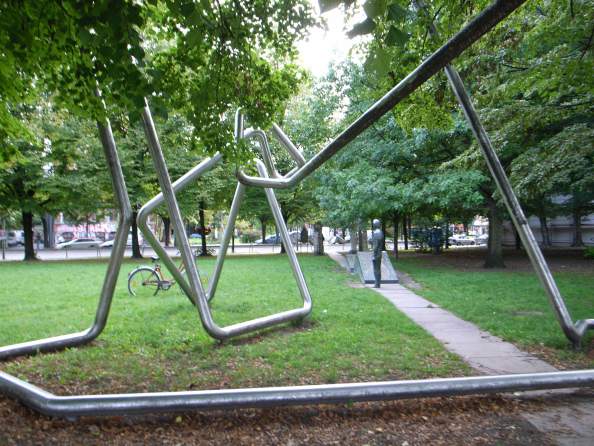
These slender metal sculptures out in the middle of nature are what I like to call “Earth decorations.” (image source)

flexiblepapersculptures
Stretch it, play with it (or prank somebody with it) and yet it retains its shape–nope, it’s not some sort of goop, it’s PAPER! (image source)

singingringingtree
Not only is this a really neat-looking tree made out of pipes, it also makes sounds when the wind blows! (Video/audio of this “Singing Ringing Tree” available by the following link–it sounds SO creepy and cool. image source)

pugpeople
And sometimes, sculpture doesn’t need to make people think deeply–it just needs to give them a “What the–LOL!!” reaction. (image source)

Spiritual Metal: Gamelan Music

My studies of music have been windows into various cultures, and the style of music I’m writing about today is no different. I first learned about this in my “Music Cultures of the World” class in college, and it was easily some of my favorite music to learn about.

A Gamelan Crash Course (Figuratively Speaking)

Gamelan (pronounced “GAH-meh-lahn”) music comes from the islands of Java and Bali in Indonesia, and is based on defined musical scales, such as Pelog and Slendro, that differ significantly from Western scales. The word “gamelan” can reference both the type of musical ensemble that plays this music, and the style of music that said ensemble performs. A variety of different instruments, ranging from flutes and vocals to drums and all sizes of metallic gongs, make up the ensemble.

To Westernized ears, this music can sound more like people dropping pans in a busy kitchen at first. But, in reality, each gamelan song is a complex orchestral work, with each instrument built and tuned specifically to fit within its particular gamelan ensemble and no other. It has also influenced world music–even composers like Claude Debussy and John Cage brought in some of its concepts in their music!

The history of gamelan music is intertwined strongly with the spiritual traditions of the various cultures living in Indonesia, to the point that you pretty much can’t talk about gamelan without involving faith, and vice versa. Gamelan music is used in so many ceremonies and rituals, but it’s also broadcast on radio–it’s an integral part of
Indonesian life. It is, quite simply, a form of worship music, used to speak to the gods and invite them into human presence.

Gamelan Styles with Examples (Videos)

There are two broad categories for gamelan music. Javanese gamelan, featured in the first video below, is generally smoother, calmer, reverberant, rhythmical/flowing…it’s almost like being inside a giant, harmonic clock. Balinese gamelan sounds more “exciting,” with a harder, ringing metallic sound and faster, more complicated rhythms that don’t necessarily adhere to the clock-like, echoing steadiness of Javanese styles.

A third style, Sundanese gamelan, is from West Java, yet sounds slightly different from the Javanese style–to my ears, it tends toward the ringing metallic tones from Balinese gamelan. Check out the videos below to hear these styles:


Javanese gamelan


Javanese gamelan with dance performance


Balinese gamelan


Balinese gamelan (with some Javanese influences around 2 minutes in)


Sunda Javanese gamelan


Sundanese gamelan

To Learn More

Gamelan music @ Wikipedia
Javanese Gamelan Music Notation
Balinese Gamelan Rhythms
History of the Word “Gamelan”
American Gamelan Institute

Don’t Let Anyone Kill Your Art

This post arose out of a conversation I had with my little cousin (who is now 19 and in her second semester of college, so I guess she’s not so “little” anymore, lol). Around Christmas I asked her how her art classes had gone, knowing that she had planned to major in Art and had likely faced a rocky transition into college art classes. Boy, I didn’t know the half of it.

“Oh, I changed my major,” she replied when I asked her. “I took an art class and the teacher basically killed my desire to do any more art.” She went on to describe how the art teacher had insisted on each student doing dozens of drawings each week, ostensibly to “practice their skills,” but then apparently had used the opportunity to harshly critique rather than build their skills up.

She seemed pretty buoyant about the whole thing, and about her future in her new major, but I was sad about it. While we spoke, I encouraged her to keep at her art, even if it was only a hobby, and not to let it go just because of one teacher, whose opinions were not fact (and whose art teaching methods seemed a bit suspect).

Now, my advice, while perfectly fine, is easier said than followed. How often has my enjoyment of my own art been tainted because I didn’t get the reaction I expected from my audience? How often have I doubted myself and my abilities because of an offhand judgmental comment from someone else? When I make art, I am literally displaying part of my soul…and when someone else finds it unworthy or is indifferent to it, I am wounded as a result, even if I gamely try to continue on.

This is a dangerous path for us artists to travel; once we start prioritizing others’ opinions of our works (especially the ones that seem meant to destroy our desire rather than perfect our skill), then we can easily lose the passion for our art that we began with. And yet, many of us fall victim to this specifically because our art is so close to our selves. We have to actively combat this problem, otherwise the creative fountain within us will be stilled–not by lack of ability, but by the anxiety that comes from wondering whether anyone else will like what we make.

I leave you with this point: art, in whatever form it takes, is a subjective thing–the beauty of a piece can’t be quantified completely. Thus, no one else’s opinion is more unbiased than your own opinion when it comes to your artworks. If you like your work, and other people like it, that’s great. If you like your work, and you’re the only person in the world who likes it, so what? Art is meant to soothe, to inspire, and to be enjoyed rather than to be cut apart and analyzed to death like a dissected frog in a lab. If it only soothes, inspires, and brings enjoyment to its creator, then it has done what it was designed to do already; other people’s positive opinions are just icing on the cake (and the critical people don’t deserve a slice of the cake).

(now I just have to follow these words of wisdom when it comes to this blog! LOL)

My #1 Poetry Pet Peeve

I didn’t realize I had any pet peeves about poetry until I took one of my high school English classes. One 6 weeks we were supposed to write a poem in the style of the literature we were studying, and we were required to read them aloud to the class. This was all fine, until a classmate of mine got up and introduced the “po-EEEEM” she was about to read.

Something about her pronunciation of the word “poem,” with the emphasis on the second syllable and a strange stressing of the “e” vowel, set my nerves on edge. And it wasn’t a simple misspeaking–she continued to call it her “po-EEEEEM” through her entire presentation. It was all at once nasally annoying and haughty, as if her “po-EEEEEEM” was the best “po-EEEEEEEEEEEEEM” that had ever been written.

Somehow I made it through that presentation without going off my rocker. But, since I’d never heard the word pronounced like that before, I chalked it up to a personal choice on the classmate’s part, and thought no more about it. It was so outlandish and silly-sounding, too overdone for normal life…surely no one else would pronounce it like that. After all, who could seriously pronounce “poems” as “po-EEEEEEEMS” without cracking up, right?

WRONG. Several of my classmates in poetry and literature classes throughout college apparently labored under the same delusion–that pronouncing “poem” as “po-EEEEEEM” instantly gave their opinions and works an otherwise unreachable touch of class, artistry, and intelligence. Never mind that I was sitting there with my hands clawed around the edge of my desk as if someone was raking their nails down the chalkboard at the front of the room. And usually, the people who pronounced “poem” like this were the most conceited English majors in the room, acting as if their subjective opinions on literature were mathematically provable facts. Either that, or they were convinced that they were the next “famous dead poet,” and the rest of us were all just wannabes.

For me, then, the “po-EEEEEEEM” pronunciation has become shorthand for “I’m a huge snowball of arrogance barreling straight toward your brain and nothing can stop me!” It stands as an instant signal that this person thinks very highly of themselves, their opinions, and their art, and that everyone else is just a little bit less important. (You know, sometimes I really hate that the fine arts often attract this type of personality, because it gives the rest of us artists a bad image. We’re not all high-and-mighty nose-in-the-air types, after all!)

So if you ever see me cringing at a poetry reading, remember this post, and you’ll probably understand why. Just remember to duck the snowball of arrogance!

Creativity Boost: Be Around Creative Folks Like Yourself

On November 18th, I had the unique pleasure of singing with a massive choral and orchestra group at Gardner-Webb University–we presented an evening of classical music the likes of which I hadn’t done since my college choir days. And boy, was it an evening of creativity and art! I was nearly bowled over with it!

I really didn’t expect to be so moved or touched by performing with this amalgam of musicians, and yet I was; I was up there singing my heart away, feeling for all the world as if I was in my element at last. I had come in dressed for performance like always, and some part of me viewed the event as “business as usual,” but it certainly wasn’t! With almost 400 people packing the stage for the choir/orchestra numbers, I felt myself part of a large, well-oiled musical machine, and it was ELECTRIC.

I got home, kinda dazed, after the performance, and wondered over my reaction for a little while. The thought that kept coming back was: “I was around people like ME!” All of the performers were classically trained musicians like me, and this was a collegiate performance, much like the ones I enjoyed being in during my own college years. I had gotten in touch with a part of my musical soul which had lain dormant, likely, since that time. It felt so good to know that other people were as passionate about music as I was, and were experiencing music in the same way. This group musical experience sparked a mini-tidal wave of creative musical ideas, which I’m still happily riding.

Want this kind of experience for yourself? Here are some ways you can find other artsy people like you, no matter what art you make and enjoy:

  • Post on social media accounts about wanting to find creative/artistic people. Make it shareable, and others WILL show interest. Through this kind of post, you can find people both in your area and around the world!
  • Check with your local Arts Council to see if they have or know of any local arts groups and when they meet. (Do a Google search for “arts council of [your city]” and it should bring some results up.)
  • Start up a blog or small site about your art form; search for other small blogs and sites on your topic, and email the owners about affiliating or link-exchanging. That way, you can make connections and friends! (Good free blog/site creation: Blogger, Tumblr, and WordPress)