Category Archives: Saturday with the Spark

Creative pursuits and life-related happenings.

Clumpy Character Description = Boredom

When I’m reading a novel, I personally hate character descriptions that are “clumped”–the kind that go on too long when they first introduce the character. You probably know the type; there’s almost a whole page dedicated to how shockingly beautiful the heroine is when you first meet her, or how devastatingly handsome the villain is despite his horrible ways. Bo-ring.

Here’s an example I crafted of “clumpy” character description:

Boring Character Description

“In the doorway stood Jean. She was about 41, with curling red hair down to her mid-back, porcelain skin with ruddy patches on the cheeks, and eyes that seemed to be nearly silver. If I had to guess, I’d say she wore a 36DD bra, had no waist to speak of, and hips that nearly took up the whole doorway space. Aside from the expensive, deep green blouse she wore, the rest of her clothing looked worn; even her shoes looked too scuffed to be new. Her rounded belly, not of pregnancy but of years not spent on the treadmill, became more obvious as she moved into the room. If she had once been beautiful, the bloom was rapidly fading.”

While this does make a great character sketch of “Jean”, it’s not very interesting. The story stops while this snapshot in words is taken; additionally, the character sketch is almost too detailed. Prime example of a “too-detailed” sketch: the “36DD bra” and the age of “41” detail, which is something I’ve actually seen done in many amateur stories. Like anybody can tell what size bra a girl wears or exactly how old she is by just looking at her! It’s like you’re reading a police report on somebody’s description rather than a story.

When you do a detailed character description like this, especially at the beginning of a story where it’s the first appearance of the character, it tends to slow down the storytelling, and many readers (like me) will want to skip over it. Nothing’s happening to advance the story in there, so why bother reading it?

Instead of clumping all my character description into one paragraph, I like to space it out across several story-moving sentences, slowly weaving a picture of the character while describing him/her through his/her actions.

I reworked my earlier example into the following sample, below:

Hopefully Not-So-Boring Character Description

“Jean appeared in the doorway just then, her generous hips grazing the doorjamb as she moved through. ‘What are y’all even talkin’ about?’ she said, defiantly placing a large hand on one hip. ‘You think I’m deaf in there, you don’t think I’m hearin’ you talkin’ junk ’bout my fam’ly members?’ For a moment, her anger seemed to spark along her tumble of red curls, and her pale, gently-lined skin flushed only on the cheeks in unbecoming spots. ‘I’m in there cookin’ supper an’ all I can hear is this mess, on a holiday, no less!’ Her large bosom, even constrained as it was underneath the silky green blouse, quivered with the force of her words and feelings. ‘If that’s what you think about my fam’ly, you can just git out, for all’s I care. Why should I bother feedin’ you when you’re talkin’ trash, in MY house?’

No one could say anything against her, not with her gray eyes flashing an unsettling silver, not with her words condemning them. Already a statuesque woman, she seemed to stand even taller in her frustration, and everyone was too intimidated to speak.”

For me, this character description works better because the story continues to move along–we get hints of what “Jean” looks like, especially in anger, and we also get the reasons why she’s angry through the dialogue she has. It feels like a much more active scene, a better emotional scene, not just a paragraph-long, flat painting of a character.

Your Opinion: Which is Better?

Depending on your personal opinion, you might like the first example better than the second, or vice versa. Which do you think is more interesting to read? Which provides a better character description? Is neither particularly interesting to read, for that matter? (That would be a sad result, considering I wrote both, but… LOL)
Find Your “Style,” and Revel In It

What defines you as an artist? Is it the short poetry you write about random objects? Is it the monochromatic shades you use to define a mood around the subject of a painting? Do you use dance to show the fluid motions of air and water in human form? Or do you design websites that stun with only beautifully-chosen fonts on the page?

No matter what art you choose to do, if you try to stray too far from the things you love to do most, you will find yourself easily running out of steam. Stretching your creativity too far, into things you don’t particularly like creating or thinking about, will inevitably lead to the well of creativity drying up for a while.

Making “Fresh” Art Doesn’t Mean Trying to Be Someone Else

Artists should not be bullied into doing art that isn’t natural for them. Take a musical artist who is encouraged to “find a new sound” because his/her old sound is “tired.” If that “new sound” differs too much, the musician may not feel as connected to his/her music as before, leading to a less inspired sound. The same could happen to a painter who is told he/she needs to change the style and approach to painting–too far away from the natural style, and the subsequent paintings could end up looking and feeling like so much tripe.

Trying new things in art is great–it stretches your creative “wings,” and can allow you to become a better and more experienced artist. But that evolution and exploration must be a natural process. Artistic style evolution cannot be forced along by anyone’s good intentions, not even our own.

Art: A Growing Process, Not a Personality Change

For instance, I’m a little bit different composer and poet than I used to be. I used to write long tirades of poems going on about my inner life, school, and the junk I was going through; now, I write shorter poems about the life going on AROUND me. I used to write huge, long piano solos, and now I write piano/vocal music, mainly Christian in theme.

And yet, this evolution was not forced. It happened gradually as I grew up. No one shouted over my shoulder and told me I “shouldn’t be writing this way” or “shouldn’t make music like that.” I was allowed to grow as an artist naturally, by both my parents and my musical instructors, and I feel that this made me a much more balanced experienced artist later.

Experiment With and Explore Your Chosen Art, but Stay True to Self, Too

As artists, and as friends of artists, we have to be similarly supportive and understanding of our own works as well as others’. Being creative means we allow ourselves to try new things without fear of rejection, either self-rejection or others’ rejection, just to see if it works. Heck, at least half the art I do starts out as a silly experiment, something along the lines of “Hey, never tried this, wonder if it works? Ah, what the hey, give it a shot.”

But we should never pursue “different” and “new” art so far that it becomes alien to what we believe in and what we love. I cannot compromise my taste for symmetry, lovely blended shadows, and flowing, lyrical melodies, not even long enough to make a little money, because if I tried my hand at sharp, angular, and irregular art, it would feel fake. It isn’t my style, and it would show.

So, even though the sharp, the angular, and the irregular modern art are “all the rage” these days, I stick to what I love and what I can do best. I may never shock anybody or create headlines with my music and my writing, but since it is in my natural style, it will be better art.

Summary

Your art is your own, and don’t worry about it not being “the current style” or “what anybody’s looking for.” Create it first for yourself, to reflect your own tastes, and you might just find more people drawn to it for its authenticity.

Scheduling Your Creative Time

Are you currently stalled out when it comes to your creativity? If so, I have been there, and this article is for you.

I’ve written in some of my Saturday articles before about having trouble writing my novel, and the troubles have continued even up until a week or two ago. It literally felt like it had come to an immovable standstill; some days I would just open the file that contained it, read over the last few pages of my writing, and just close the file again, not sure what to add or where to go from where I stopped. I felt paralyzed.

That is, I felt paralyzed until I began to put my novel on my to-do list.

Can You Really “Schedule” Creativity?

Well, no, you can’t plan when you’ll have inspiration. But you can carve out part of your busy day to allow yourself to BE creative. When you allow yourself time to be creative, you open the door for inspiration.

Not realizing this was my biggest mistake: I hadn’t scheduled myself any time to be creative. Without a definitive, set time for “noveling,” I was depending on “feeling like” writing, and I didn’t “feel like” writing because I didn’t see that I had time or energy to do it. The underlying problem was stress over ill-managed time.

Overcoming the Time/Motivation Problem

The last straw came when it had been about a month since I had last written in my novel. I knew that because I looked at the “Last Modified” date, and it read January 17th, 2012.

I was astonished at the date. How could it have been that long? How could I have stopped writing for that long? What was wrong with me?

And, just as quickly as I realized it, I got mad at myself. “If I’m intending to be a great novelist, I first have to get off my butt and WRITE the aforementioned novel,” I grumbled to myself.

Using the Sticky Notes desktop gadget, I finally wrote in a definitive goal for the next day: “Write 1,000 words.” That’s all I had to do–write a thousand words. Didn’t matter how far it took me in the story or anything. Just 1,000 more words: progress. 1,000 words is what I’d been doing every day before I had inexplicably dropped the ball; I wanted to hit the ground running.

…And It Worked

The next day, I looked at my to-do list for that day…and suddenly, 1,000 words in my story didn’t seem so unconquerable, especially when compared with the other stuff I had to do (write 2 blog posts, finish writing my Sunday school lesson for the week). Suddenly, I found myself thinking, “Hey, I can write a few hundred words in my novel when I get tired of writing my blog posts or reviewing the lesson.”

And that’s exactly what happened. That day, I finally started writing again, editing and adding new bits in the story in between crafting my blog posts and reviewing/writing my Sunday school lesson. Like a key had been turned in my brain, the creative “engine” had turned over and started up again, all because my novel had been given a place in my writing life again.

So, How Do You Restart Your Creative Engine?

These are the tricks that worked for me. Try them and see how they work for you and your form of creativity, whatever it may be:

  • Make “creative time” part of your to-do list. Making it a priority is the first step. If you never allow time for it, it won’t happen.
  • Write reminders for “creative time” somewhere prominent. For me, that meant putting it on the computer desktop; for you, that might mean writing it on a whiteboard in your office, or leaving a note on your coffeepot. Anywhere where you will see it consistently and be reminded to do it, especially if you’re absent-minded and living in the future like me, will help you.
  • Remind yourself of what you were attempting to do when you last left off. I’ve taken to writing “When last I left my brave hero, [X], [Y], and [Z] happened/was going on” in my to-do list so that it makes me laugh and remember what I was writing about. That way I don’t have to “catch up” on my own book if it takes a week or two before I get back on the horse. (That’s saved me a LOT of time!)

Summary

It may make writing (or any other creativity) a little less glamorous if you “schedule” time to do it, but believe me, trying to force yourself to find time (when you already feel like your day is packed full) is only going to make you feel more stressed and more down on yourself. Making sure you give yourself even 15 or 20 minutes to be creative can jump-start that long-dead project or that abandoned flight of fancy. And believe me, it works and is worth it. 🙂

Don’t Let Others Smush Your Spark

When you’re doing creative work, no matter if you’ve been doing it for 20 years or 20 minutes, sometimes others’ judgments intrude upon your mindset. “What would Mom say about what I’m writing?” “What would my boyfriend think of this painting? Would he think it’s good enough?” “I wonder if this dance routine is really good enough to show my dance teacher.” Those vague fears become reality when we show our hard work to someone else, and see that twist of the mouth or narrowing of the eyes that indicates they don’t quite “get” what we’ve done.

This is ultimately one of the most dangerous threats to your creativity–the judgments of other people. As creators of any type, we tend to be more vulnerable to criticism, especially in our early years, and we fear rejection of our works because our works stem from us. Someone else pooh-poohing our creations is like them pooh-poohing US, all we are, all we ever will be.

I suffer this same fear, in just about every creative aspect of my life. Somewhere in the back of my mind is a hypodermic needle full of paralyzing comments I’ve heard about my work, and every time I start to worry, it stabs my brain cells and pumps them full of uncertainty, leaving me unable to work. Why bother working, when no one but me is ever going to like it?

A Personal Example of Others’ Judgments Snuffing Creativity

During Christmas of 2010, I wrote a song about the day after Christmas. I was trying to talk about the “back-to-business” mindset of December 26th–after the emotional warmth of the holidays, December 26th always feels like a day of cold shoulders, of people shrugging their shoulders and breaking the magic spell of family togetherness with an attitude of “Oh well, Christmas is over, I don’t have to be nice to people anymore till next year.”

I wrote the song and brought the lyrics up to show my parents (always my first audience for anything). But instead of smiles and praise, I got befuddled looks, especially from Mom. Mom couldn’t understand why I hated December 26th so much–to her, it had always been a restful day, a day of relaxing after the rush-rush of the holiday season. She kept saying she “couldn’t relate” to why I hated taking down the decorations and throwing away gift wrap (some of the symbolism in my song, depicting how the warmth and love of the holiday season is “taken down and thrown away” after Christmas).

No matter how much I tried to explain it to her, that it wasn’t about the decorations or the gift wrap but about the sudden lack of caring for other human beings that I mourned, I couldn’t get through to her. Finally, I went away, completely dejected; she hadn’t understood me. Had I lost my gift for writing songs? She always used to enjoy what I did, but this felt like a total rejection of everything I’d been working on.

I haven’t shown her or Dad another song since, and for a long while I went without writing a song at all, convinced that I had “lost my touch.” It made me sick to even look at the keyboard anymore.

Why My Reaction Was Wrong

Though my reaction was natural (at least for me), it was the wrong way to look at it. Yes, Mom usually likes my songs and understands them. But the law of probability says that at least a few times, even our parents won’t understand what we’re saying/doing/thinking. Instead of letting one negative critique bog me down for what ended up being over a year, I should have continued to work on my songs.

For instance, I could have reworked the song to make it more understandable (even though I thought it was already perfectly understandable and didn’t want to make its sentiment too painfully obvious). I also could have set the song aside as a failed project and come back to it when I was less emotionally invested in it or upset by it. What I should not have done, in any case, was to let one perceived “failure” eat me and my creativity whole.

How I Can React to Criticism Better

The following realizations helped me finally pull out of my self-hatred spiral and emotional creativity block:

  • Others’ judgment is others’, and not my own. Mom, and everyone else in the world, is allowed the right not to like or understand my works, and that doesn’t make them any less if I still find value in them. I still have a need to create and a need to express, regardless of what someone else says about it, and if it helps me, it’s done its primary job.
  • I have to know that what I’m creating is the best I can do, right now. If I’m not putting whole heart and whole soul into it, and I’m not making the best effort, then I need to either get my head in the game or leave the project alone. And if I’ve made my best effort and someone else still doesn’t like it, that shouldn’t be my problem to solve.
  • If I don’t leave myself room for improvement, I’ll always be hamstrung when it comes to creative works. If I keep feeling like everything I do has to be absolutely perfect and fully formed like Athena springing from Zeus’ brow, then I’ll feel too daunted to do anything.
  • I can’t allow others to discourage me from continuing my work, either directly or indirectly. Others who criticize and offer no constructive help are, as I’ve found out, generally a wee bit jealous. Others who don’t understand the work or make no attempt to understand before walking away from it literally cannot be a focus of worry (otherwise I’ll drive myself nuts).

It’s Not About Others’ Judgment, but About the Work Itself

If you’re a creator and often get daunted or discouraged by others’ comments or opinions, much like me, then I hope you take away from this article the knowledge that your work IS good enough if you find value in it. If you find awesomeness in your work, and it helps you emotionally and mentally to create it, then it’s helping someone, and it’s worthwhile to someone, even if only one person ever sees it or values it. Creative works are not just for other people, but for the self…perhaps even especially the self.

The Creativity Leak: Fatigue

My novel, unfortunately, has come to a standstill, and not because I’m out of ideas. It’s because of a slow leak in my brain called fatigue.

Well, Isn’t “Fatigue” Just Being Tired?

Not necessarily. I used to think fatigue just meant I wasn’t sleeping well enough, but I have come to understand how wrong that viewpoint is.

Fatigue doesn’t just make you sleepy. In fact, it can make you the opposite of sleepy–you can end up so tired you can’t sleep, so used to the flow of adrenalin keeping you going that your body can’t relax enough to sleep.

Fatigue also takes away your energy to think and do things. You feel about 50% alive at all times, as if the other 50% of you is still in bed, and your thought processes are noticeably slower and less fleshed-out. There’s tons of stuff you want to do, tons of stuff you need to do…but even just thinking about it all makes you more tired.

This is what I’ve been suffering for the last few weeks, and my overall creativity has really taken a hit. Aside from time spent at the keyboard, I haven’t done much creative work except these Saturday blog posts (which, admittedly, have been much harder to come up with because of fatigue). And it’s not for lack of wanting to create–I just end up feeling too tired to deal with it.

This kind of tiredness, as I’ve found, leads to frustrated creative desire…and can leave you feeling painfully unfulfilled in your creative life.

Getting Rid of Fatigue So You Can Be Your Creative Self Again

This is as much for me as it is for y’all–I need this advice, too!

First, don’t fight fatigue with forced energy.. Pushing on through and trying to force creativity will only render an inferior product. You’ll be unhappy with what you’ve done, and you won’t want to try again for fear of the same terrible results. (See: my failed attempts at writing a “really good” song, leading to the fear that I’d “lost my gift.”)

Second, uncover the cause of your fatigue. It could be a chemical imbalance, a minor illness that just won’t go away, a vitamin deficiency, job stress, or even just a simple lack of GOOD sleep. Explore all these causes, and truly listen to your body.

In my case, I’ve had a cold and sore-throat bug that has been ongoing for several weeks, and the resulting fatigue left me nearly unable to write anything creative. How I’ve been able to come up with blog posts consistently is beyond me–I guess it is a labor of love. LOL

(I also must warn you to get checked out by the doctor if at-home treatments like vitamin capsules and meditation do not work for you. Fatigue can be a symptom of something worse going on. 🙁 )

Third, allow your energy to come back slowly. Don’t expect to feel absolutely AMAZING the day after you’ve figured out what’s wrong and started treating it. It will take a few days for your body to get back on the energy train, and possibly even longer for your brain to get back its precious creative juices.

Right now, for instance, I’m using these creative Saturday posts to get back my own creative juices. I know the ideas for my novel are up there, but I can’t pressure them to come out–it’s like pressuring a souffle to cook. If you rush it, it deflates. So I have to be okay with what I can do now, and look forward to getting back on the ball.

Fourth and finally, celebrate your efforts, however small they might look. Right now, I’d be glad if I could write 50 words in my novel; that’s how bad my fatigue has been. If I can muster the mental energy to do it, I will be as happy as if I’d written 5,000.

Similarly, you can’t be upset with yourself if you don’t snap back to epic creativity right away. Be glad for the little, itty-bitty victories. If you let yourself celebrate those, you’ll have a more positive frame of mind and thus set yourself up for bigger and bigger victories.

With this good advice in mind (I’m like Alice in Wonderland, I guess–“I give myself very good advice, but I very seldom follow it”, lol), I hope I’ll be back to writing my novel very, very soon. I hope, if you’re feeling a little tired and out of creative energy, that this helps you get back in your game, too. 🙂

Desktop Art: Wallpapers

As long as I’ve had a computer of my own (which was when I started college), I’ve had the urge to design backgrounds for my desktop. In a way, it was part of creating art for me–I wasn’t particularly good at drawing, wasn’t particularly good at coloring, but I did seem to be good at making desktop wallpapers.

Unfortunately, most of the wallpapers I’ve created over the last few years are locked on a hard drive that may or may not be recoverable :(, but I can share with you the few that I uploaded to my deviantArt account many moons ago. I can also give you a few tips on creating a desktop wallpaper that will be a delight to your eyes.

Picking the Desktop Style that’s Right for You

What you like as a wallpaper varies greatly, depending on what you need your desktop to do. I know plenty of people who cover their whole desktop with icons for files; I myself prefer a desktop uncluttered with icons (regardless of how my physical room looks…*snicker*). Other people have hyper-organized desktops with tons of informational widgets and gadgets all over the place, from daily calendars to how hot the CPU is getting, and so forth.

I’d say that your desktop should represent you, and should also be functionally beautiful for what you need. In the next few examples, I’ll show you various ways of organizing as well as decorating your desktop wallpaper.

Make it Expansive and Gorgeous

A wide, panoramic shot is great for a large-picture desktop; I favor nature pictures for these, and I try to make them as uncluttered as possible, with very few desktop widgets or gadgets. Any picture with a broad view, lots of color, or an amazing light effect works great for desktops.


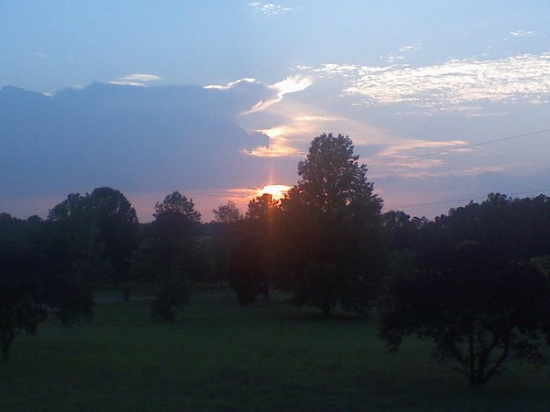
A Beautifully-Colored Sunset

This is a photo I took with my cell phone camera; I used it for several months as a desktop image, though I don’t have the actual desktop screenshot available. I loved the colors and plays of light and shadow in the picture, and so I fought to keep my desktop as clear as possible for this picture–I think I only had four icons on my desktop the whole time I used this picture. GASP!

A Desktop’s Not Just for Pictures

I like to include verses of poetry or quotes on my desktops, along with pictures or images. Usually I come up with my own poetry or quotes in direct response to what the image evokes in me; sometimes, though, I’ll mix my own words with someone else’s on the same desktop if I want a variegated desktop.

For these two screenshots, I show how I organize my desktop differently depending on my needs for that span of time.


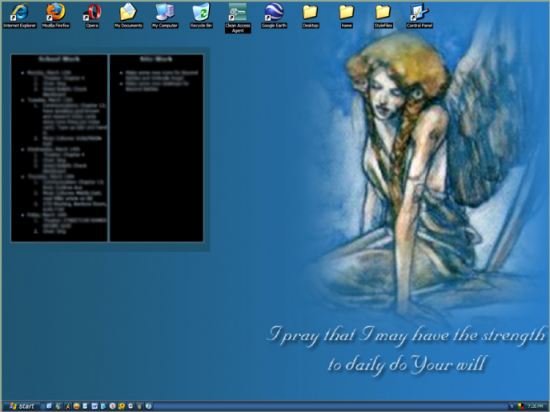
Desktop January ’07 to March ’07

During the time this screenshot was up, I needed a constant HTML to-do list up on my desktop–thus, the large black area on the left, balancing the image (Sustaining Spirit, by Rebecca Guay) and my poetry on the right. (Had to motivate myself to do my homework somehow! I miss that functionality of Windows XP, to put an HTML page directly on the desktop…)


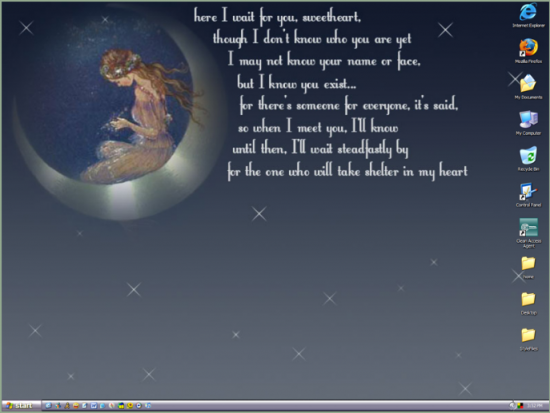
Desktop September ’06 to January ’07

For this desktop, I didn’t need a to-do list, so I just kept all the icons to a minimum and let the background speak for itself, with self-created poetry and a lovely image for which I cannot remember the source.

Make It Look Like a Scrapbook of Your Life

To create a “scrapbook” look, I’ll often put several pictures on a plain or subtly-patterned backdrop, arranging them so they look either neat or haphazard, either all together or spread out across the page. I find this to be an inspiring and fun background style to use on a daily basis–gives a little “oomph” to a bad day!


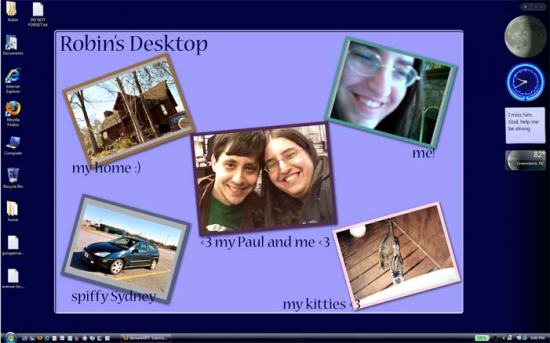
Desktop June ’08

During this time, I was away from home and was very homesick, especially being away from awesome boyfriend of win, so I created this bulletin-board-like desktop with five real pictures, including a picture of us together. ^_^ I also had Vista’s Sidebar active (on the right, with some gadgetry in it), so I made sure the background did not compete with the Sidebar, nor did the icons on the left.

(Also, this was the infamous desktop that one of my classmates saw and asked, “Aww, is that your boyfriend? How many years younger is he?” I replied, “I’m twenty-FOUR and he’s twenty-NINE.” LOL)

Designing a Desktop of Your Own

To try out some of your own desktop art, pull out a few personally-meaningful photos, find some lovely patterns and images online (or make some yourself if you like), and start working. Play around in your favorite image-creation software or online image-manipulation site (like Pixlr or Aviary); arrange the photos and images any which way, add text if you want, and splash color all over it. It’s your desktop, after all–try everything and see what works best.

A few guidelines and tips for this process:

  • Check out your monitor’s screen resolution settings before you design, and make sure your image is as close in size to the resolution as possible. For many of my old desktops, I designed for a 1024 x 768 resolution; later, I had to design for a 1300 x 1050 resolution (I think), and so on.
  • Remember that the desktop background will likely be stretched a little bit to fit your screen if it’s not the same size as your monitor. Keep this in mind when selecting images, especially big images–you might end up with a funhouse-mirror photo!
  • Know where you’d like to put your icons and desktop widgets before you start designing your background. In my June ’08 desktop, I knew that I wanted Vista’s Sidebar to display on the right, so I offset the pictures left of true center so that the pictures wouldn’t be shadowed.
  • Try out “framing” your pictures in colorful patterns and shapes, and play with drop shadows and blur effects. These all seem to work well in a desktop setting.

Summary

Making wallpapers into “desktop art” can be an easier and more accessible way to involve creativity in your life. If you’ve never tried it, I encourage you to do so–who knows, you might make something truly inspirational!

Writing a Relatable Song

What makes a song “work?” What makes a song resonate with people?

Musical artists have been trying to capture that idea for centuries, and yet it still seems like it’s more luck than anything. Sometimes you just have a wonderful idea, not a winning formula.

As a longtime poet, composer, and songwriter (since the age of 12), I’ve written a lot of songs that either just don’t captivate me or don’t get a whole lot of response, even though they have a lot to say. Then, I’ve written songs that other people absolutely love and enjoy. Studying my “better” songs versus the less-popular ones has brought me to understand something about music that I never really thought about before.

Songs people enjoy are ones they can relate to best.

Seems too simple, right? I thought so, too. But as I thought about how I listen to music, and what kind of music I like, I realized more and more it was right. As a songwriter, you have to make your song relatable to others, and to do that, you have to balance between being too personal and too generic. So, I came up with lists of what makes a song too personal (as in, I can’t really listen to it because there’s so much detail I don’t relate to), or too generic (as in, it doesn’t have a point and/or doesn’t feel like it’s saying much of anything relatable to my life).

Note: Even though I ain’t professional yet and am not formally trained in “songwriting,” I have had a lot of experience playing, writing, rewriting, reworking, and eventually performing my songs.

You know your song is too personal when…

  • Your lyrics are cluttered with many specific place and people references, like a diary entry
  • You’re having trouble stretching your melody to fit around all these specific place names and friend names
  • There doesn’t seem to be enough room within the “2-verses, 2-choruses, 1-bridge, final chorus” song template to say all you want to say about the situation

I’ve fallen into the “too-personal” trap a good bit with my own songs. When others hear lyrics that are more about you than about how your situation parallels theirs, they can find it hard to relate to your song. Personal details flesh out the story you’re telling or the imagery you’re crafting, but don’t load the song up with tons of personal details that are too specific to you. It’s hard to sing along when you don’t know the story and can’t imagine it!

You know your song is too generic when…

  • The verses seem “empty” when you sing them, like there are too few words, but there are plenty in there
  • You’re not sure anymore which episode in your life you’re drawing inspiration from for the song
  • It seems like you’ve heard something similar on the radio, somewhere along the line

While trying to come up with an awesome new song for my church, I was falling into this trap over and over again. Everything I wrote felt forced, trite, and stupid–I kept thinking, “This verse could have been written by anybody! It sounds good, but it’s…not me, and it’s not about me. Grr!” I was trying too hard to write something people would like, and I was going too generic to do it. When audiences hear a song that’s too generic, the usual comment is that it feels like it’s been done before. And it likely has been!

So What Makes a “Relatable” Song, Anyway?

I believe it’s all about being just personal enough and yet appealing to all listeners’ emotions. (Good songwriters know how to strike that over and over; I hope I’ll get there one day, though many people have already told me they hear themselves in my songs just as much as they hear me. But not every one I write is a hit, and I have to remember that–it’s a balance you have to recalibrate every time.)

The following list of tips are the ones I follow when I’m writing a new song. To make this list, I thought, “What makes ME love a new song?”. The resulting list seems to work well and cover all the bases. (It’s more about crafting lyrics than melody, but there’s ways in which crafting one definitively influences the other.)

A Relatable Song…

  • …References emotions/repercussions coming from a specific event, rather than referencing the whole event itself
  • …Describes a state of being, even a transitional or transformational state of being (like coming to terms with death, entering a new relationship, etc.)
  • …Uses visual imagery to describe a place, intertwined with feelings that the place evokes
  • …Matches the mood of the melody (bouncy, somber, peaceful, tormented) with the mood and tone of the lyrics
  • …Contains the main emotional idea of the song within the chorus, and expands upon the main idea (and how it came about) in the verses

Summary

Though writing a “good” song may not always be quantifiable, I think we can weed out some of the too-personal/too-generic problems that hurt many beginning songwriters. It’s not about trying to “market” something, but trying to make something that others genuinely respond to. When I weep or laugh aloud at the end of the first playthrough of my song, I know it’s pretty good. When others weep or laugh aloud at the end of the first performance, because they have felt that way before and know exactly what I’m singing about, I know it’s really good.

I’ve Still Got It!

My creative musical life has gotten a huge boost very recently–in fact, “Monday of this week” recently! Thus, the following blog post is in honor of it. And if you’re experiencing a slump in your own creativity, I urge you to read this for advice that really helped me get back my creative groove.

Before Monday: I Haz a Musical Sad

It seemed that I was no longer interested in composing music, as I once had been. I had been used to writing tons of piano solos and piano/vocal music every year (at least 15 every year); in recent months, however, it felt like years since I had even sat down to compose. Once, I had done performances for other people, but even those were rare. It was like the desire for my own music had been drained from me, replaced by performing others’ music, as well as not having a ton of time anymore to muse at the keyboard.

I mourned this loss, and it made me downright unsure of my creativity in music anymore. I wondered, “Do I even have “it” anymore, the gift of writing beautiful music? Or has it all been replaced with ‘everyday life’ and random stuff?” Not only that, I feared I had lost the capacity to write beautiful melodies, and had also lost the time to just sit at the keyboard and expand upon them.

Then, I Got Mad

On Sunday, I realized all this. My first instinct was to wallow about in my sadness, and I started to draft a Saturday with the Spark post about “losing my musical mojo” or something like that.

And then, I stopped about halfway through. “Why am I LETTING this happen to my music?” I thought, staring at my writing. I was starting to get ticked off. “What is all this stuff about ‘I used to be good at music?’ Dangit, I want to be good AGAIN. And I can be–it’s just there’s all this CRAP in the way!”

Getting Rid of the Aforementioned “Crap”

So, in a fit of drivenness rather than rage, I systematically removed all the obstacles towards practicing music. Since my keyboard is currently set up in our finished basement, there were a LOT of physical obstacles in the way. I replaced the cold, creaky, too-short keyboard chair with another; I moved the pile of junk that sat boldly in the path to the keyboard; with Dad’s help, we fixed a light on the basement stairs to make it easier (and safer) to go down.

But that still didn’t remove all the mental obstacles. I had a lot of fear about whether I still had “it,” whether I could still write beautiful music. That, I left ’til Monday, and rested the rest of the night.

The next day, I spent most of the day writing, kindasorta avoiding the melody (and part of a little song) that had been twisting and twining between my brain cells for the last month and a half. At last, about 6:00 Monday evening, I set aside what I was writing, and began to fix up the song’s lyrics properly so that they matched the melody–what I had roughed together was okay, but it wasn’t the best.

About 10 minutes later, I took computer and all down to the keyboard, and set up the screen so I could see it from the keyboard. Then, I began to play and sing the song…

And Then, I Haz a Glad

…and it was magic. The song slid from my fingers easily, and I maneuvered the vocal melody just as easily as if I’d been practicing it for days (which, in a way, mentally, I had been). Not only was it prettier than I had imagined, but it was easy to sing, was honest, and…it was good. Much better than I had expected from myself after months of not doing this.

I had been so long out of practice that I had been afraid to try anymore. But I was pleasantly surprised–and very, very happy. I wept at the keyboard–it was like a long-lost friend had finally come home.

Have You Lost “Mojo” for Anything Creative Lately?

(Pardon the Austin Powers reference 😛 ) If you’ve lost the ability or time to be creative due to too much work, illness, etc., then you know the sense of emptiness and loss I was feeling. It really took me getting mad about it and getting fired up enough to change what had been happening, and I think that’s what it takes for any change like this to come about. You have to be dissatisfied with how it’s been going, and know what to change to make it better.

One key, as I found, is to remove all the obstacles towards being creative. If you feel at a loss for writing because you have no space to work, for instance, make a space to work. It might be at a kitchen table or counter, or it might be a cheap folding table in the corner, but make a place for your creativity. For me, the junk pile, the lack of light, and the too-short chair made it easy to make excuses…they had to be changed.

Another key is to make time to be creative. If you allow no time for creative activity, it won’t just happen on its own. If you keep yourself busy, don’t leave the Internet behind for a few hours, or don’t carve out even a teeny bit of time in your commute to just think out a couple of ideas, it won’t happen. I had to leave the Internet behind on Monday afternoon, just long enough that I could draft and play my song…and it was WORTH IT! 😀

The last key? Trust your ability. If you could do it before, you can do it again. You might be a touch out of practice, you might feel a little differently about the process, but if you expel all the doubt and fear from your system, you’ll do fine. At least, that’s what I found out.

Words as Pictures: The Wordle Way

A few years ago, while stumbling about on the Internet, I discovered a very creative site, and I think it’s one of the best modern ways to use words in visual art (besides web design, of course).

Wordle is a Java-enabled way to make blog entries, feeds, articles, pasted-in text, or even Delicious tags into a graphic. Now, I know that doing graphic arrangements of words is not new to the world of visual art, but Wordle does it in a particularly interesting fashion, with the largest words being the most used in whatever text sample it gets.

Some Personalized Examples

For some beginning examples, I used Wordle to do a couple of graphics based on two large samples of my writing, below:


Based on my webmistress page
It amuses me that “Grits” and “driveway” are two of the biggest words…LOL


Based on Crooked Glasses’s RSS Feed
You can tell the gaming post was prevalent on my feed this particular day. Haha

In both these cases, I chose the font color and style, as well as the background color. I also chose how the words spread themselves across the image. All of these tools and many more options are available to you through the Wordle interface–play around with it and see what you like best!

Some “Famous Poetry” Wordles

I also used Wordle to make word pictures with a couple of my favorite poems, seen below:


From the poem “The Raven” by Edgar Allan Poe


From the poem “Stopping By Woods on a Snowy Evening” by Robert Frost

Wordles as Wall Art/Gifts

Making a Wordle would be a fun thing to do with a particularly inspirational monologue, poem, or prose piece you like–print it large and frame it to put it on your wall, or just stick it on your bulletin board with tacks and call it a day. Anything that gets it into your line of sight on a daily basis would work well.

Also, if you wanted to give a Wordle as a gift, you could easily copy in the text of something a family member or friend has written, and transform their writing into evocative visual art that they can enjoy. Choose favorite colors for the words, arrange it all for best effect–it can make a beautiful personalized gift.

You could even write in just random positive words that describe the gift recipient into the text box provided. Just make sure the words that you want to be largest are there multiple times, and you’ve got it! Almost anything that uses words could become a word graphic using Wordle…you might come up with a totally new way to use it, too!

Try It On Your Own Writing!

Take the largest sample of writing you have, or the most vibrantly written work you have. Anything you want. It could even be a long Facebook status. Copy in your text, and see what Wordle can do for you. It’s not only a fun timewaster, but a great tool for design and art, too. 🙂

Finding the Harmony

Singing along with the radio or my personal music in the car is awesome–and yet it poses a unique challenge for me, as a person with perfect pitch. Whenever I go anywhere in the car, I challenge myself to find pretty harmony to sing along with the songs I hear, without any help from other instruments to find the “correct” note.

My Personal Experience with Vocal Harmony

With any singer, I can generally add either a harmony line below the melody line or above it, as appropriate for my vocal range. (My normal vocal range is from F-sharp below middle C to F-sharp above C above middle C, which is two octaves. I can get down to E below middle C and get up to A above C above middle C fairly comfortably, buuuuuut not all the time. :D)

I sing either soprano (high) or alto (medium-high) harmony with female singers, and either alto or tenor (medium-low) harmony with male singers. It’s kinda funny to sing harmony that goes below where a guy singer is singing, but it does happen–listen to “Eye of the Tiger” by Survivor for a perfect example of a song that I sing below the melody line on.

Another song that I can do really cool harmony on is Adele’s “Rolling in the Deep”; I sing a harmony line that is generally a third above her melody, making a haunting, lovely chord (even if it does get a teensy bit close to the top of my vocal range, LOL).

Why Bother Doing This?

Firstly, it’s fun; it adds a new, personalized twist to the songs you love to sing along to. Secondly, it’s a great way to keep in practice if you’re a harmony singer in a singing group–it gets you used to picking out harmonies. Thirdly, it can train your musical ear to “hear” these harmonies better in general, whatever instrument you play, whatever kind of musical training you’ve had.

Try It At Home!

Even if you don’t have a sense of pitch that helps you make harmony on-the-fly, you can still do it using an instrument. I use a physical piano keyboard; you could also use piano sites, like Virtual Piano, or apps like LittlePiano (for Androids) and Magic Piano (for iPhones)! (Since many band and orchestra instruments are tuned differently, you’ll probably want to stick with a piano for picking out melody and harmony–I find it’s easier. But maybe that’s the pianist in me talking. LOL)

First step is to pick out the original melody. Easiest way to do this is to listen to the song in the background and then try to match the notes you hear, one at a time.

Then, you’ll want to add a second line of notes to what you’re playing, either below or above the melody–this will form your harmony line. Follow the key signature and the sharps and flats that the key has for these steps; for instance, “Rolling in the Deep” is in C minor, so the E and A will be flatted (they are the third and sixth steps in the octave, respectively), and after you hit the A-flat, you’ll go up to a B-natural for the seventh step (called a “raised seventh”).

I’ve made up a small sheet-music-style selection of the melody and proposed harmony lines from the first two lines of the chorus of “Rolling in the Deep,” below. (Please forgive the fail quality of these–this sheet music approximation was all I could do using Microsoft Paint and a laptop mouse. LOL)


This is the original melody, with no harmony put in.

This shows harmony a third above the melody, in light blue. This is what I usually sing in the car along with the song. ^_^

For those who do not read sheet music (or if the images aren’t showing up), here’s the translation for playing it on the piano.
(“Bb” = “B-flat”; “Eb” = “E-flat”)

Original Melody

“We could have had it all – ll, roll – ing in the dee – ee – eep”
(G) (Bb) (G) (Bb) (G) (C) (Bb), (Bb) (G) (Bb) (G) (C) (D) (Bb)

Proposed Harmony

“We could have had it all – ll, roll – ing in the dee – ee – eep”
(Bb) (D) (Bb) (D) (Bb) (Eb) (D), (D) (Bb) (D) (Bb) (Eb) (F) (D)

More Tips on Finding Harmony

Singing an interval of a third above the melody (like I’ve done in my example), or a third below the melody, or even singing in intervals of sixths above or below the melody line make generally pretty harmony. In some cases, you may have to change the intervals slightly for harmony that fits better in a chord (such as changing a third-above interval to a fourth-above interval so it doesn’t sound out-of-key), but otherwise it usually works out okay.

A Note (tee-hee) About Voice Timbre

If you sing this along with the song, try matching voice timbre with the singer as much as possible–if he or she sounds a little more nasal than full-throated, try to match that, or if they have a lighter, bouncier voice rather than a big, heavy sound, try matching that. If you match how they sing really well, the harmony ends up sounding like a seamless part of the song. (Matching Adele’s bell-like pronunciation of the “ee” vowel on the word “deep”, while singing the higher E-flat…chills and goosebumps. It’s COOL 8D)

Summary

If you’ve never tried finding vocal harmony before, I encourage you to try it. It may take a couple of tries (or more), but it’s something you can use to train your ear and give you a new way to enjoy your favorite songs.

(And I don’t own any rights to “Rolling in the Deep”–I used it as an example in this post because it’s a lovely song, and the chorus is easy to translate into sheet music.)