Tag Archives: gaming

Why “Casual Gaming” is Actually Great

casualgaminggreat
This just in: you don’t ABSOLUTELY HAVE TO win at every game you play. Casual gaming IS a viable option!

Current Gaming Culture: Win All the Time or You’re “Not a True Gamer”

Unfortunately, these days, casual gamers (like me) often get treated as an inferior breed by winning-obsessed meta-gamers. Those who treat winning at a game like their career are venerated, after all; their motive seems to be “If you’re not playing to win, why play at all?”

I only have to look as far as Magic: the Gathering and HeroClix to find this infectious mindset, but it’s invaded all sorts of gaming. We all naturally want to prove we’re strongest, we’re smartest, etc., in all areas of our lives, including gaming.

Competitive Gaming = Anger and Frustration

Personally, however, I’ve had to get out of competitions in about everything I do. Not just because I don’t win/succeed as much as I’d like (though that’s part of it)–it’s because competition turns me into a horrible person. I yell, I bite my fingers, I stomp around, and otherwise express unwarranted anger that other people should never have to witness. When my efforts lead to failure, I explode. I’m just not a good Christian when I do anything competitively, and that unfortunately extends to gaming, too.

Casual Gaming = Relaxation and Fun

To combat my anger in gaming, I’ve become a casual gamer, and I’ve found it to be a much more enjoyable experience than trying to be competitive. I’m actually much more suited to casual gaming–I like exploring around and coming up with my own ways to solve puzzles, not just copying what everybody else did to get through a level. (This is possibly one reason I get so angry in competitive gaming, because it pretty much requires you not to be creative, at all.)

As I’ve continued to game casually rather than competitively, I’ve noticed a few other perks:

Other Benefits of Casual Gaming

  • Socializing with others takes the place of just “beating the game.” I love being able to joke with my friends about the game instead of being so concerned about the “big win.” Not to mention that I have the mental freedom to come up with new strategies that my friends haven’t thought of–in casual games, they can appreciate it without being angry that the strategy is beating them.
  • In a casual game, you can piddle around and find all kinds of new things. If you’re not worried about completing a game in a certain time limit, for instance, you can just explore and wander around–that’s my favorite part of any console game or large online game.
  • You can try new strategies and add to or abandon them as you see fit. Playing casually lends a “sandbox” feel to any game–since every idea is equally worth pursuing, there’s more room for creativity and less inhibition about trying your new ideas out.
  • You can use the game as an escape rather than a worth-proving exercise. Gaming competitively does not let me wind down–it tenses me up and makes me feel worse about myself when I lose, because I put a bit of my self-worth into winning. When I game casually, I let go of that concept and just enjoy the time spent not working. 🙂

Why This Might Not Work for Everybody

As cool as casual gaming is for me, it might not be the natural playstyle for everyone. There are just some people who thrive on competition–and I might be describing you! For some, competitive gaming is their forte and casual gaming is an exercise in futility; indeed, casual gaming might be irritating rather than fun.

If you like competing with others and it doesn’t send you into fits of rage, that’s wonderful. However, neither form of gaming is superior to the other. It just depends on what you get out of the game, whether you like the challenge or like the escape from everyday life.

Summary

Casual gaming is a worthy pastime, great for anybody who prefers using a game for socializing with friends and escaping from the pressures of normal life. Us casual gamers may not be winning any “speed gaming” or “fastest A button in the West” prizes any time soon, but…that may not be the most important thing!

Gaming Makes You Smarter

gamingmakesyousmarter
You might be one who looks at most games and scoffs. “What educational value could this game possibly have?” you might think. Most video games and even collectible games these days seem either too violent, too cartoony, or too simple. Where’s the challenge? Where’s the mental stimulation?

Or, perhaps, you’re one of the millions of people who have discovered how stimulating and challenging games can be. As a gamer from the time I was five years old, I feel I’ve messed with enough games (and messed UP in enough games) to understand the true challenges and learning situations that can come up in all sorts of gaming concepts, from video games to collectible games, RPGs to first-person shooters and beyond. I truly believe gaming can make you smarter!

Gaming Teaches Time and Resource Management

Video games and collectible games alike help us manage time and items better. In Super Mario World for the SNES, you got a “Time Bonus” if you finished the level in a certain number of seconds. The game rewarded you for getting through the level without getting poor Mario killed or dawdling about. Not only that, but if you managed to keep all the lives that Mario was allotted in the beginning, you had them saved for later battles with one or more of Bowser’s children.

Learning to manage time effectively is one of the hardest things to teach kids–I should know, I tried to teach middle-school kids with limited success. If you give most kids a time limit of 15 minutes to do an in-class activity, chances are most of the kids are going to goof around for 10 minutes and then rush to do the assignment in the last 5 minutes. What games teach us is to value the time we’re given to complete an assignment, and to use that time to the best of our ability–i.e., not standing at the beginning of the level for a few minutes looking at the pretty background, but actively moving through it and solving the puzzles that come up.

Resource management is also difficult to teach, but easy to learn through games. While a kid may not understand that he or she only gets limited access to the glue sticks, crayons, and scissors, they can better understand that Mario only gets 5 lives to try to complete this level. Older kids might not be able to grasp that their research papers need accurate and reliable sources to be good papers, but they’ll likely understand what happens if you don’t draw a 7-card hand with enough mana in Magic: the Gathering. (A hand with no land, or mana-producing cards, leads to turns and turns of “I draw. Your turn.”)

Gaming Teaches Long-Term Planning

In HeroClix (“chess with superheroes”), having no plan of attack means you’re likely disadvantaged from the beginning. You have to assess the other player’s team, figure out which piece needs to be defeated first, and decide how best to approach to offset the other player’s strategy. This takes long-term planning, which isn’t always a strong suit for kids or adults alike.

Planning ahead, like time management, takes careful thought, and gaming strategies help people of all ages get more comfortable with how to plan ahead, what to think of ahead of time, and how to make the best of your situation. You can plan too far ahead of your opponent, or plan too far ahead of your road trip, but you can never make too many tweaks to your original plan–that’s the beauty of long-term planning!

Gaming Teaches Diplomacy

In multiplayer games, as in real life, other people’s plans may interfere with yours, or may co-opt or ignore your plans altogether. When you play a multiplayer game like the Resident Evil deck building game, you have to “buy” the resources you need without taking too much away from other players, all while trying to be the player that takes out the most zombies hiding in the Mansion. Some players choose not to be diplomatic, and end up hogging all the resources to themselves; I find, however, that diplomacy serves you well in the long term by allowing everyone to play at their best level.

Diplomacy goes beyond gaming to the classroom and to the workplace. Kids can easily be inclined not to let the other kids have their blue crayon because they’re coloring the sky in their picture; adults can easily be inclined to complain to management if someone else asks to use the room that they unofficially reserved for their special group meeting. By sharing diplomatically instead of taking all the resources for oneself, you encourage better relations among your fellow gamers (or your classmates, or your co-workers)!

Gaming Teaches Critical Thinking

Which card should I play next? Which character should I use to beat this challenge? Games often bring us mental puzzles to work out, which boosts “critical thinking,” a skill I often saw talked about in my teacher literature but which was never quite defined. I think of “critical thinking” as “deeper thinking”–not just “what” something is and “how” it works, but “when” to use it and “why” it was developed.

Going beyond facts to inferences and interpretations stretches the gray matter a good bit, and can get you out of a tight squeeze in Pikmin for Nintendo Gamecube just as easily as it gets you writing for that state test. For instance, just as you have to figure out how many and which types of Pikmin should be in your army for the day by studying what objective you want to complete, you have to figure out how to best present your position on an issue at work. It challenges you to think about the problem in different lights.

Gaming Teaches Multitasking

Games’ multitasking goes beyond hitting two buttons on the controller at once? Most certainly! In HeroClix, you often have two or three pieces going after a couple of objectives at once. You might have dispatched your second-string attacker to go and mop up the support crew of your opponent’s team, while you sent in your first-string attackers to deal with the primary damage-dealer of their team. If you don’t multitask during games, you can find yourself in a bind pretty quick.

It is the same way in our lives–if you don’t multitask, sometimes things don’t get done as quickly as they might need to be. Multitasking is a great skill to pick up because it makes you a more efficient worker. I find that multitasking keeps me from grinding away at the same problem for hours; if I find myself stuck on something, I just switch to another task for a few minutes, accomplish maybe a small goal or two, and then come back to the first task with slightly fresher eyes.

Summary

While games are entertaining and great fun, I also find that games can teach us quite a few skills that we’ll need either in the school world or the work world. Try a challenging game sometime, and see how your skills improve!

Empowerment Buffs, or “those buffs made from salvage”

empowermentbuffs
In City of Heroes, we focus a lot on Enhancements (most comparable to “gear” for World of Warcraft players)–they are permanent boosts to a hero’s selected powers. You can boost the healing potential of your hero, their damage potential, how accurately they hit, and many other facets of their powers. We also pay a lot of attention to Inspirations–temporary, ubiquitous boosts that can be activated during battle to help you get through tight spots.

We don’t, however, pay a lot of attention to Empowerment buffs–but they are important, too!

What ARE Empowerment Buffs?

You might be thinking, “Empower-what?” Well, you can think of Empowerment Buffs as something like the Mystic Fortune buff from the Magic Pack–it’s a long-lasting buff (1 hour), much longer than an Inspiration or an ally buff, but not quite as permanent as an Enhancement. What is least known about them is how they are triggered, and it actually takes a Supergroup base to get them.

How to Get Empowerment Buffs

To receive an Empowerment Buff, you must first have access to an Empowerment Station, which is generally part of a Supergroup Base. If you’re in a Supergroup that has an Empowerment Station, you only need certain pieces of salvage to trigger the stations.

Empowerment Stations look like this (all following pictures from ParagonWiki):

Arcane Empowerment Stations

  
From left: Enchanting Crucible (Tier 1), Arcane Crucible (Tier 2), Mystic Crucible (Tier 3)

Tech Empowerment Stations

  
From left: Radiation Emulator (Tier 1), Linear Accelerator (Tier 2), Supercollider (Tier 3)

It doesn’t really matter which type (Arcane or Tech) you go with–it’s mostly a cosmetic difference to match the theme of your base. What matters is that these stations, when activated with invention salvage of varying types, can give you buffs to your resistance to damage, your attack speed, and tons of other cool effects.

Example: Endurance Drain Resistance Buff for Fighting Malta Sappers

For instance, to fight Malta (and the resident Sappers who eat your Endurance when they shoot you), you’ll definitely need the Endurance Drain Resistance bonus–just feed a Hydraulic Piston into the Empowerment Station! You might not think this helps, but it surely does–I’ve been able to make it through a whole Malta battle without having to Rest or eat Catch a Breaths like Bon Bons.

Make Sure Your Empowerment Station Is Fully Upgraded!

There are three levels of Empowerment Stations–Tier 1, 2, and 3, as I noted in the pictures above–and the Tier 3 station will give you access to all the buffs you’ll ever need. However, to be able to build a Tier 3 station, your Supergroup needs a LOT of prestige. Also, you’ll have to buy and build the other two levels of Empowerment Stations first; Tier 1 stations are used to craft Tier 2 stations, and Tier 2 stations are used to craft Tier 3 stations.

When you upgrade stations, you still have access to the previous level’s buffs, so it’s worth it to upgrade when you can.

Find out more about Empowerment Stations (and how to craft them for your Supergroup Base) here: Empowerment Base Items.

What Kind of Salvage Makes Empowerment Buffs?

Salvage of all different level ranges can make Empowerment Buffs–it just depends on what buff you’re after and what level you are. Most of the required salvage for Empowerment Buffs is common salvage, but some buffs require uncommon salvage. Also, some buffs only need one piece of salvage, some need two, and some need three.

A complete table of Empowerment Buffs and the salvage it takes to create them can be found here: Empowerment Buff Recipes and Ingredients. Depending on whether you have an Arcane or Tech Empowerment Station, the salvage recipes will vary slightly for most of the buffs.

It’s a good idea to keep a stash of common and uncommon Invention Salvage in your Supergroup Base (or on your individual characters) that matches up with your characters’ needs. For instance, if your Scrapper keeps getting knocked back all the time, making it impossible to fight, you might benefit from the Knockback Protection Empowerment Buff. Therefore, you might want to carry the salvage that the buff requires (see the list here).

Summary

Using Empowerment Buffs might require a little time investment, but if it helps you get through mission arcs full of maddening enemy attacks, it could reduce frustration by 17.5%! 😛

Why Do We Game?

whydowegame
Games in many forms have somewhat taken over our modern life. Oh, who am I kidding–they’ve taken over almost all of our lives these days. Even buying groceries is a game for extreme couponers; even Facebook is a game for social networkers. We love the competition, pleasantly pitting ourselves against friends and neighbors to see how many virtual crops we can grow in a week, how many items we can sell on eBay, etc.

But WHY do we game? Why is this such an important part of our world culture? I think there are five reasons why:

#1: Escape from Real Life

For most of us, life is either the drudgery of a 9-to-5, days full of hectic parenthood, or a combination of both. Games, by contrast, are things we don’t have to do, things we aren’t expected to succeed at (at least the first time), and are a way for our brains to wind down. During the time we’re gaming, we don’t have to think about our responsibilities outside the game.

#2: Mental Challenge

Games help us think in different ways, whether it’s fitting all the blocks together just so on Tetris or figuring out how not to get killed on Call of Duty. Some people unwind best when faced with a totally new type of challenge, one they would never see in their day-to-day work or family life. Plus, it can boost your real-life ego when you conquer a challenge in your virtual life.

#3: Social Competition

Admit it: It’s fun to see how your skills stack up against somebody else’s, even if we’re just growing some crops in Farmville. That’s why the Playstation Network and XBox Live exist–we as a human race like to compete against each other, both to test our own skills and to see how we compare to others. Virtual competition just takes some of the physicality out of the contest and makes it into a mental competition, leveling the playing field somewhat for people (like me) who aren’t as sports-oriented.

#4: Entertainment Experience

When a game is really fun, it’s a memorable experience, and we actively seek it out again and again. It’s like watching a favorite movie again–reliving it brings back some of the fond memories of the first experience, and we build on those memories as we replay. Games are not just challenges, but interactive entertainment, and it activates some of the same emotions, memories, and morals/values that other forms of entertainment do.

#5: Fantasy Experience

Some games are more based on social interactions than anything, and this brings in yet another element: fantasy. You might think this is interconnected with the “escape from real life” point, and it partially is; however, in a game with a heavy social interaction component, such as The Sims or even World of Warcraft, you can literally make yourself over in a fantasy world. You can feel more open to speak your mind, be funnier and wittier than you usually get a chance to be otherwise. You may even begin to judge people by what they say instead of their avatar’s looks!

Summary

I believe gaming has become very important to us today because it fulfills many of our needs. Yes, we have a real life to return to outside of our games, but games do help us to unwind, challenge ourselves, compete socially, be entertained, and experience a very different type of life.

Mana Base: The Literal Foundation of a Magic Deck

manabase
Okay, I’ll admit it: I’m generally terrible at building a mana base for my decks, even though I’ve been playing Magic since 2005. When I start building a new deck, I’m usually focusing on the awesome cards I’m going to put in, rather than the mana I’m going to use to play said cards. Usually, I end up with way too many cards I want to put in and no room for mana!

I’m sure I’m not alone in this, either. I theorize that the reason Standard Magic (or Type II) has so many netdecks (copied strategies from pro and semi-pro players) is because most of us have a hard time building the right mana base. (Check DeckCheck, EssentialMagic, and the Standard General section of the Wizards of the Coast forums if you don’t believe me about copied strategies.) And, since mana bases are the foundation of any deck, when your mana base isn’t right, the deck doesn’t work.

So, how does a Magic player go about making a mana base that works? Here are some tips I’ve recently started to follow, with success:

#1: Determine what types of mana you need.

Sounds too simplistic, but this is the very first step to building a working mana base for your deck.

If you’ve got a mono-colored deck, for instance, you don’t need dual-color lands. And if you have dual-colored cards in your deck, you’re going to need both colors of mana to support them unless they are hybrid-mana cards (which means they could be played with either color).

How you choose to provide mana for your deck from color determination on is really based on what kinds of cards you have in your deck. For example, if you have a creature like Leonin Elder that gains life whenever an artifact comes into play, you will want artifact lands (like Ancient Den, at right) in your deck so that you have more artifacts to trigger that life-gain.
You also might have a creature that costs less to play for each certain type of land in play (this is called the “affinity” mechanic, seen on Tangle Golem at right). Playing this kind of ability means you’d want more of that land type in your deck than anything else.
Branching off the affinity concept, you could also use artifact lands to pump up a creature like Broodstar, who gets bigger for every artifact in play:
Other lands could support your deck in other ways, like lands that turn into creatures when a certain condition is fulfilled, or lands that can do other things besides give mana. Urza’s Factory, for instance, can put a 2/2 creature into play.
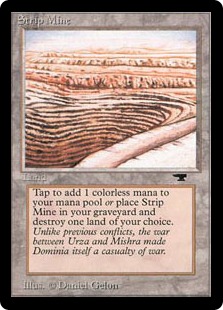
Strip Mine can get rid of an opponent’s land…
And Mutavault can become a 2/2 creature until end of turn.

You have to determine what you want your mana base to do for you before you proceed!

#2: Determine how much of each type you need.

Mono-colored decks get off easy in this regard. You simply put in enough mana sources of the color of your choice to constitute at least a third of your deck (so you’re drawing land about 33% of the time with a good shuffle), and you’re pretty much done.

However, if you’ve got a deck with more than one color, you need to balance things more carefully. Some things to consider include:

Casting costs of each spell.

Example: If you have a Green/White deck together, but all your Green spells have two Forests in the required casting costs, you’re probably not going to get away with an even split of Plains and Forests in your mana base. Instead, you’ll have to put in twice the number of Forests as Plains, so that you’ll more likely have the mana to play those double-green spells.

How many cards of each color you have.

Example: If you have a Green/White/Blue deck together, but you only have a few Blue cards, you won’t need many true Islands in the deck–you could possibly get away with just having a couple of dual- or tri-color lands. (I have such a deck together, and I’m only running 3 Islands, but I actually have enough access to Blue mana with the tri-color lands and land fetch I included in the deck.)

The land fetch you have included in your deck build.

Especially if you’re playing mono-Green or you’ve splashed Green into your deck, land fetch will help offset a troubled mana base. Land fetch, or the ability to retrieve another source of mana from your deck, is often necessary to offset turns where you have no land to play.

If you’re playing a lot of land fetch, you may not need as much of each color as you might have otherwise. If you’re not playing any at all, you will probably need to boost the amount of each type of mana you need for your deck.

#3: Determine how much of the deck you want to devote to your mana base.

I said earlier that about a third of most decks is dedicated to land. However, there are times when you don’t need 20 lands in a 60-card deck. You might need 24, or you might need 16. 20 is a good place to start, but depending on the type of deck you’re running, you may need to adjust that land count as you play the deck.

The only way to tell how much you’ll truly need for the deck’s best play is to test-play it quite a bit, either in a virtual environment or a real-life environment. I’ve had times where I built a 20-land mana base and got so consistently flooded with land it was unimaginable; I’ve also had times where a similar 20-land mana base got me stuck mid-game because I could not consistently draw enough land to support the cards I wanted to play.

Decks that discard a lot of their hands might have to ratchet up their land count to offset the cards they might lose in the process, for instance. Decks that need lots of mana to play super-high-costing stuff (such as Angels, Elementals, etc.), also generally need higher land counts. By contrast, decks that have lower-costed spells or creatures that tap for mana might not need as many lands. This is the most difficult part of refining a mana base, but it is necessary!

Summary

By taking into account your particular deck’s casting costs, spell types, colors, and abilities, you can be more informed about creating a good mana base the first (or thirty-first) time around. Research and consideration, plus a good dose of trial and error, is the best way!

Glassics: Thursday in the Zone

This is a complete topic review of all the posts in the Thursday in the Zone category. Hmm…I need to write more about multiplayer games and general gaming, it looks like. 🙂

General Gaming

Competitive or Casual?
Game Tactics: Are You Proactive or Reactive?

City of Heroes

City of Heroes
The Slow, Agonizing Death of AE Missions
Stress Test: Being the Healer
Building a Better Team Support Toon, part 1
Building a Better Team Support Toon, part 2

Magic: the Gathering

Magic: the Gathering
The Art of the Expensive Combo
Competitive Magic is for Plagiarists
Life-Gain: It’s Not Just a Stall Tactic Anymore!

HeroClix

HeroClix
Building with Wildcards
Bad Dice! Bad!
How Robin’s Getting Her (HeroClix) Groove Back
You Hurt Me, I Hurt You: The Mystics Team Ability

Internet Games

Castle Wars
Farmville
Boomshine
Onslaught 2: Tower Defense
Dice Wars

Multiplayer Games

Resident Evil Deck Building Game
Resident Evil: Alliance

Castle Wars

castlewars
This Flash game has been a longtime favorite of mine ever since I discovered it a few years ago online. It’s like Magic: the Gathering meets tower defense! (Curious to see how these two game styles combine? Read on to find out!)

Basic Gameplay

You can play 1-player or 2-player (2-player mode works by having two people play with the same computer, just on different turns). There is also an option for Multiplayer, where you can join a playing room as a guest or as a member and play Castle Wars with others. (For experienced players, there’s also a selection for “Card deck,” where you can build your own deck to face off against opponents, human or computerized. I usually just go with the default deck they give me.)

cw_start
Here’s how the screen looks as you play the game. Your “hand” of cards is displayed at bottom center; your “castle” (your life points, if you’re used to playing Magic) is blue and on the left, while your opponent’s “castle” is red and on the right.

Each castle has a fence in front of it that starts off 10 units high–this fence is like creatures in Magic that can block combat damage for you. When you have no more fence left, the castle has to take all the damage directly; this is just like when you have no creatures in Magic, you have to take all the hits to your life points directly.

Whenever either player’s castle hits the ground (reaches “0”), they lose. Whenever either player’s castle reaches 100, they win. Your objective is to either take your opponent down to 0 or build yourself up to 100.

Resource Points

As pictured in the screenshot at left, you start out with your castle at 30 and your fence at 10. You also start with 5 resource points in each color, which help you play spells, and 2 of each helper (builder, sorcerer, or soldier).

You will gain resource points every turn based on how many helpers you have in each color. Say, if you had 3 Sorcerers but only 2 Builders–you’d get 3 Blue resource points and 2 Pink resource points every turn.

Best part: these points stay until they are used, so you can build up your points over several turns to be able to play bigger spells.

Card Types

There are three colors of cards, denoting the three types of cards in the game. You can only play one card a turn.

  • Pink cards are “building” cards, all focused around building up your castle and fence.
  • Blue cards are “magic” cards, focused around boosting your own resources and controlling the opponent’s resources, with one powerful building spell and one powerful destruction spell included.
  • Green cards are “weapons” cards, focused around damaging your opponent’s castle and taking away its resources. There is a really strong destruction spell included in Green as well.

Strategies

Blue is the most flexible of the colors, since you can pump up resources in all three colors with Blue cards, as well as build your castle and take down the opponent’s castle. But you’ll need all three types to win. Pink keeps you in the game while you’re waiting for a good Green castle-damaging spell; Blue helps you build up your resources so you can cast bigger spells to either build yourself up or tear your opponent down. And Green harries your opponent, making them waste their one spell a turn on building themselves back up.

Whenever you see a Blue card marked “Sorcerer,” a Green card marked “Recruit”, or a Pink card marked “School,” play those ASAP–they will increase the number of resource points in that color that you get per turn. This is like playing a land card in Magic; the more you play, the more resource points you’ll get back every turn.

You start out with 2 points in each color, meaning that you’ll get 2 points of resources in each color per turn, and they do carry over from turn to turn. That way, you can build up resource points to play the larger spells.

You’ll notice in this screenshot that certain cards show up darker-colored than the others. Those cards are the ones I don’t have enough resources to play yet; the brighter cards are cards I can play this turn. Just like Magic, you have to have so much of a specific color resource (like mana) to play your spells. If you don’t have 28 Green (weapons) resources, for instance, you cannot play the Banshee card (the most epic destruction spell in the game, which happens to be in this starting hand!).

This game is a great little challenge–it’s harder than you think to defend your castle with just a hand of cards!

To Play The Game: Castle Wars

Building with Wildcards

buildingwithwildcards
As a longtime HeroClix player, I’ve already found a few favorite team abilities (see my post about Mystics here), but I also enjoy passing around such abilities to characters who wouldn’t necessarily have it. Thus, the Wildcard team abilities–any one of the six symbols below means that the piece can share many different team abilities.

Why Wildcards Are Awesome

Wildcards sharing abilities can become game-changing very quickly. For instance, 77-point Spider-Girl can borrow the Mystics team ability from Jason Blood and start damaging her attackers every time they hurt her, too. Borrowing an Avenger’s free move ability increases team mobility if you’ve got a lot of Wildcards to move around, and passing around better attack values courtesy of Bat-Enemy team can make even your second-string Wildcards good for something!

In essence, Wildcards can help round out your team–if you have a lot of ranged S.H.I.E.L.D. pieces, for instance, and you need a little close-combat to help them out, you can easily include a wildcard close-combat piece like Timber Wolf or Iron Fist to give you another person to help you kick up range or damage without being as squishy as your range pieces.

Some Caveats to Remember

  • When selecting team abilities, choose one aggressive or movement TA and one defensive–such as Bat-Enemy and Danger Girl, Avengers and Mystics, or Ultimates and Bat-Ally. That way, you can wildcard to the aggressive TA during your turn, and then wildcard to the defensive one when it’s your opponent’s turn.
  • Choose your team-ability-bearing pieces wisely–make sure they can defend themselves if your opponent tries to attack them first. POGs with TAs are notoriously fragile and shouldn’t be relied on as the sole source of a TA.

Some Aggressive Team Abilities

  • Ultimates, Superman-Ally, Avengers Initiative
  • Ultimate X-Men, 2000 AD
  • Batman-Enemy, Sinister Syndicate
  • S.H.I.E.L.D.
  • HYDRA, Police, Morlocks
  • Masters of Evil
  • Injustice League

Some Defensive Team Abilities

  • Mystics, Arachnos, CrossGen
  • Batman-Ally, Kabuki
  • Defenders, Justice Society of America, Alternate Team Ability Fantastic Four
  • Teen Titans, X-Men
  • Hypertime, Kingdom Come

Some Movement Team Abilities

  • Green Lantern Corps
  • Avengers, Justice League of America, Brotherhood of Mutants, Top Cow
  • Serpent Society

Team Abilities That Aren’t Worth It For Wildcards:

  • Crime Syndicate (easier just to use a Wildcard with Prob naturally on the dial)
  • Superman-Enemy (hard to set up, easy to destroy)
  • Crusades (very situational and doesn’t come up often enough.)
  • Guardians of the Globe (again, very situational.)
  • Suicide Squad (ideally, your Wildcards shouldn’t be dying…easier to use X-Team or Teen Titans for healing)
  • Regular Fantastic Four (doesn’t work when a wildcard dies)

Watch Out for Uncopyable Team Abilities!

TAs like Power Cosmic, Quintessence, and Outsiders can’t be copied by Wildcards–check the Player’s Guide list of Team Abilities before you build a wildcard team, just to make sure your selected team is actually legal!

Try Out Your Own Combos!

The Wildcard team building strategy is all about customization–trying all sorts of Wildcard characters and combos of TAs until you find what you like. Start off by adding a few different Wildcards to your favorite team, and see what happens!

Boomshine

This relaxing and yet mentally stimulating game is based on chain reactions–you try to set down your beginning dot in a place where it will ripple out and catch the most dots in its ripples. It is deceptively easy at first, with its soft piano accompaniment and simple goals. Just wait ’til level 12. 😀

Basic Gameplay


Level 2: The goal is to get 2 dots. Your goal number of dots is always in the bottom left part of the screen; there are currently 10 floating around in this level, hence the words “from 10”. For each level, you click a spot on the screen; the mouse cursor in this shot is the clearish dot with the pale halo around it.

Once you click, a white dot will expand out from where you clicked for a few seconds, and any dot that comes close enough to touch the white dot will expand out as well, showing that it’s been activated.


Here, I clicked close enough to 2 dots to get my goal, and then a third knocked into the first two I got, making my total score “3 of 2”–basically, I got more than the requirement. This is normal.

When you have reached the goal for the level, the screen turns a paler shade of blue-green, and then closes out; thus, the reason for the screen color change in the screenshots.

The chain reaction continues until either the goal for the level is reached, or the last activated dot shrinks away into nothingness.

You have infinite tries at the game, but if you can do it in as few rounds as possible (minimum 12 rounds), you’ll have a better score at the end.

Strategy

Boomshine is a patience game more than anything. I’ve found it requires a sense of timing and observation–you observe where the dots on the screen are bouncing around, and try to time your click to when the most dots possible will be intersecting with the dot you are about to place.

Do not feel compelled to click within the first five seconds–there is no time penalty! You’ll actually waste more time if you keep clicking and not getting enough dots every time you try. Waiting for just the right time and place to put down your dot will help you achieve your goal faster, especially in the harder, later levels.

Have fun–this is a great “don’t worry, be happy” game, with great music and a fun, simple interface!

Play the Game: Boomshine

Bad Dice! Bad!

baddicebad
Usually, I have horrible dice rolls while playing HeroClix. Lady Luck, I think, would rather have a good ol’ fashioned hair-pulling scrap in the ladies’ restroom with me than be my friend. Say I need a 5 on my pair of 6-sided dice to succeed–I’ll usually roll a 4. I need anything but “snake eyes?” Guess what I roll.

Why Do the Dice Hate Me? Several Possible Reasons

I’m not sure why I am so prone to bad dice rolls. Sometimes I think it’s how hard I throw the dice, or how tentative I am about rolling them. I tend to go “bowling for Clix figures” if I roll them too hard, or send the dice rolling off the table and away. Thus, I often hold and roll them very, very carefully so that they land just right. Perhaps this extra care is not good for my luck.

Also, I’ve often wondered if it’s the actual temperature of the dice–if the dice are cold to the touch, I have found that they will somehow roll better for me. If I’ve sat there holding them in my hand for a while, they get “hot” and start rolling badly. This might have something to do with the nature and quality of the plastic used to make most of my dice, but I’m not sure. All I know is that I’ve rolled far more double-sixes and single-sixes at the beginning of a game of HeroClix than I do at the end!

How I Try to Fix My Bad Dice Rolls

Many Clix players have posted on a topic about influencing dice, trying to get around their own runs of bad luck playing Clix, so I’m not alone in this. The primary way I get around bad rolls is to build in a lot of Probability Control for my teams, so that if I have a bad roll or two, it doesn’t have to “stick.” My habitually bad dice rolls are the #1 reason I play Destiny, Jason Blood, Jinx, Saint Walker, etc.!

Secondly, I try to roll the dice against something solid, either a box on the table or actually dropping them into a box lid, so I don’t worry so much about damaging figures or dice rolling off the table. (I find it helps if you don’t roll directly across the HeroClix map–those nasty little “hills” and “valleys” made by the map folds get my dice every time, turning a 5 into a 1 in a heartbeat!)

Lastly, I switch dice often (testing out the “cold” versus “hot” dice theory), and about 60% of the time, it works. (It’s probably still a placebo effect, but it just FEELS good to put aside a pair of dice that seem to be malfunctioning!)

I’m not sure if any of these fixes really get around my bad luck or if I’m just staving off my Crit Misses for later (LOL)…only time (and more games) will tell! But for now, it eases my mind just a little so I can get back to playing a good game of Clix. 🙂