Tag Archives: gaming

Dice Wars

dicewars
This Risk-like Flash game has been both a favorite addiction and a source of frustration for me for the last several years. Even though your opponents are computerized and the dice rolls are random, there is plenty of room for strategy and plenty of ways that the game can change up, every time!

Basic Rules and Gameplay

You start out as the purple player in this game, and you get a random number of dice allotted to you, automatically spread out for you over 2 to 5 spaces (at least in my gameplay). (If you don’t like the number of spaces or dice you’re given, you can hit “No” when the game asks you “Do you play this map?” and it will give you another scenario.)

Each round, every player on the map tries to take over other territories from other players. To attack, click your space, and then click the adjacent space you want to try to take over. If the attacker’s dice roll exceeds that of the defender’s dice roll, the attacker gets that space (very Risk-like). With every space you gain, you get access to another die at the end of your turn; those dice are applied randomly to the spaces you control when you click “End Turn.” Luck and chance determine where your extra dice will be placed, so you have to play carefully to outlast your opponents.

The dice stack up on your owned spaces, from 1 measly die all the way to 2 stacks of 4 dice each (the highest you can go). I refer to dice stacks in-game by how many dice are in them–for instance, the 2 stacks of 4 dice I refer to as an “8-stack,” and the 1-die spaces are 1-stacks, etc.

A Typical Game

The following is a funny PowerPoint I put together to show a typical game of Dice Wars, almost turn-by-turn, with funny and real written commentary. My commentary was not recorded audibly because I want this site to be PG-rated. 😛

dicewars_typicalgame

Strategies

How Many Players?
I’ve found that I play best in a game with 7 other players, because I like to build my dice empire from the ground up rather than rely on the game to give me either a greatly stacked-up territory or territories of one- and two-dice stacks each. With 7 other people, you can easily take over the smaller territories and then camp out, waiting for the big guys to thrash each other while you build up and build up.

When To Attack and When to Hold Back?
Generally, you can attack an enemy territory and win it if you have a number of dice equal to or greater than what they’ve got defending that territory. For instance, you wouldn’t want to try attacking an 8-stack with a 2-stack, because you have no chance of winning those odds. But you could attack a 4-stack with a 5- or 6-stack, easy. You might not get it, but the chances are greater that you’ll take that territory over.

Turning Your Flank
In most cases, turning your weakest flank to the enemy is a bad idea. Where possible, move your strongest defenders (your 6-, 7-, and 8-stacks) to be your new borderlands–this can be accomplished with some creative arrangement, taking over territories carefully so that you have a smooth line of big dice stacks moving across the map.

Never leave a 1- or 2-stack open where an enemy can just stampede in, unless you’re like me and like to leave a small hole for your enemies to fall in. In my PowerPoint, I left a 1-stack of mine right beside a larger stack belonging to an opponent. That opponent attacked my 1-stack and took it over, but it freed me up to attack back with my 6-stack that had been inaccessible and unusable before. Sometimes, you can tempt opponents to push their luck, and they end up spending down their 8-stack into a much more manageable 5- or 6-stack, which you can then take over with a free 8-stack of yours adjacent to it.

To Play the Game

Play Dice Wars

For More Information

Dice Wars @ JayIsGames.com

The Art of the Expensive Combo

expensivecombo
In Magic: the Gathering, I gravitate toward late-game awesomeness. Forget quick and easy combos–I want something that takes several turns to set up, so that I can savor the win when it becomes unstoppable. The idea of building an invincible combo one unassuming card at a time is so much fun.

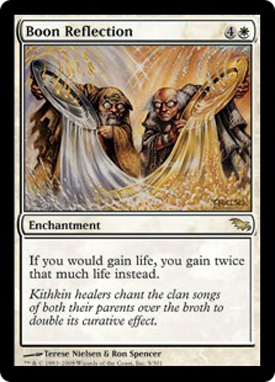
This tendency certainly hasn’t dimmed or vanished in recent years. One of the recent decks I’ve been working on is basically a combo deck involving Sanguine Bond and Boon Reflection.

 
The epic–and expensive at 10 mana–combo

I LOVE This Idea…

These two card effects blend beautifully, making my opponents lose double life every time I gain life. I’ve actually been able to use two Whitesun’s Passages to defeat somebody in one turn with that combo on the table.


With Boon Reflection on the table, you gain 10 life instead of 5. Two of these played while Sanguine Bond’s out, and you’ve just made your opponent lose 20 life… 😀

…But It Took a Lot of Work to Get Here

However, just because a combo works beautifully in your head doesn’t mean that it will ever come to fruition. I worked on my Sanguine Boon deck (as I’ve come to call this particular combo deck) for almost a year before it really got off the ground, because I couldn’t draw enough mana to play all the combo pieces when I needed to play them. Either that, or I couldn’t even draw the combo pieces at the right time. Since it’s a deck that involves enemy colors working together, I knew it would be difficult, but I didn’t expect it to be impossible.

So, I ended up chatting with one of my friends about this conundrum I was having, forgetting momentarily that he was quite knowledgeable about many of the cards and strategies available to Black. I was (admittedly) venting about my frustration with the deck, and after a few thoughtful moments, he said, “Hey, you ever tried Dark Ritual or Demonic Tutor in that deck?”

 
These cards solve two problems: having enough mana and getting the card you need at the right time.

I hadn’t. Truth be told, I kinda knew the cards existed, but I hadn’t really paid attention. Black has never really been “my color” in M:TG, so I didn’t know the color inside and out like I know White and Green. His question made me ask myself: why am I not using Black’s support cards to get my combo, anyway?

Making This Expensive Combo Run Right at Last!

I realized then that I had been relying completely on the luck of the draw with this deck. I had built the deck with only Sanguine Bond as the main Black card, and had not used Black’s wealth of searching cards (also called “tutor cards”) to get the cards I needed into my hand. When you have an expensive combo like Sanguine Bond and Boon Reflection, you need both the actual cards to play AND the available mana to play it, fast!

The addition of Demonic Tutor and Dark Ritual has helped Sanguine Boon become a truly winning deck in the games since then. The Black components (deck-searching and mana generation) helps all the White components be able to gain their life and defend life points long enough to get the combo in play. Once Sanguine Bond and Boon Reflection are both in play, White takes over and begins to kick butt by gaining life (a LOVELY strategy if I’ve ever heard of one!).

Moral of the Story

Don’t put aside the idea of a combo just because it takes too much mana to pull off. There are plenty of cards in M:TG to support even the most expensive of combos, if you’re willing to look outside your comfort zone!

Resident Evil DBG: Alliance

residentevildbgalliance
Resident Evil: Alliance works as a standalone game box or as an addition to the Resident Evil: DBG basic box. I’ve played Alliance as both its own game and as a addition, and I have to say, it offers some pretty amazing cards to amp up your Basic box.  12 new character cards (some revisions of existing cards, and some totally-new characters) await, as well as some awesome new game mechanics.

New Rules: Partners

The Alliance box brings with it a totally new envisioning of the Resident Evil game–playing with two characters instead of one. You get two Character cards, usually at random, at the beginning of the game, and you choose one to be your Main and one to be your Partner, playing both characters together. Your Partner is basically another character to use when you Explore, and another pair of hands to hold a Weapon or two; whenever your Partner character takes lethal damage, however, he or she is removed from the game completely, and you continue on with just your Main character, who respawns one turn after death as usual.

Who Leads When Exploring the Mansion? You Decide!

Whenever you Explore, you declare one character to be the leader, but both characters help Explore with their weapons. The only time this matters is if one of your characters has a special effect that specifies that it happens when he or she explores. For instance, Ada Wong’s Level 1 “peek” ability specifies that it can only happen when she is the one to lead an exploration; thus, you must declare her the leader if you want to use that ability. Your leading character does not have to be your Main character.

Attaching Weapons and Other Cards to Your Partner

You can attach up to 2 weapons or action cards to your Partner unless otherwise indicated. This is a wonderful asset–the act of attaching a card to your Partner gets it out of your deck, and it can be a constant weapon that you don’t need to Reload onto every turn. Best of all, any cards attached to your Partner character cannot be removed, except by your choosing to replace it, or a small number of specific game effects. For instance, there’s a Zombie that removes the highest-costing card from your Partner if you didn’t kill it with exactly 35 damage, and there’s an Action that makes everyone else discard down to 1 card or less on their Partners.

New Cards

There are several new weapons and actions, lots of them able to be abused, such as Gathering Forces and the Flamethrower. My personal favorites so far, however, are as follows:

Quirk of Fate: like Ominous Battle in that it allows you to Trash a card from your hand, plus you get an Action back and get to draw a card. Drawback: you can’t Trash Quirk of Fate out of your deck once you buy it (unlike Shattered Memories), making it a dead card late-game.
  Russian Assault Rifle & Signature Special: X Ammo required, X damage cost. The RARs can only be filled with a max of 20 ammo for 20 damage, and the Signature Special has a max of 60 damage. But these are both awesome, since you fill them with just as much ammo as you have available and that’s exactly how much damage you deal.
Star-Crossed Duo: attached to your Partner, this gives them +10 damage if they are the ones leading the Explore. Helps out more than you might think! You also get +2 cards and +1 Buy when you first play this on your Partner.
Fierce Battle: Have somebody else in the game draw 1 card, and you draw 4 cards. Absolutely awesome with a deck full of Russian Assault Rifles and the Signature Special, and/or with the new Jack Krauser–you have the possibility of drawing tons of ammo and rifles to feed said ammo into!

For More Information

Images courtesy of: BoardGameGeek.com’s Resident Evil DBG: Alliance page.

How Robin’s Getting Her (HeroClix) Groove Back

gettingclixgrooveback
“Game fatigue” is not a new phenomenon, but I’ve found that it occurs more often in collectible games like HeroClix. As the game evolves with new expansions, new figures, etc., the old standby figures get pushed aside or simply outclassed by the new hot stuff.

HeroClix is definitely no exception to that rule, and it’s one reason I virtually quit playing Clix tournaments for a while. But I’m starting to get back into it…and for more of that story, read on!

Before: No Groove Left

As a largely Casual Clix player, I just wanted to PLAY the game–to play my favorite pieces, which I could combine into many game-winning teams. My teams, made up of little figures with lots of support powers, might not win in 50-minute rounds, but give me about an hour and a half and I could outlast most any opponent. I had more fun when my games with an opponent were a back-and-forth tug-of-war, never knowing until the last few turns who would come out on top–thus, I favored longer games and lots of backup.

Unfortunately, my slower, defensive swarm style didn’t translate well into tournament play. I kept getting beaten by kids running huge, overpowered figures broken out in special powers, or people running almost unbeatable “gimmick” teams. And to add insult to injury, it seemed that tournament/competitive play was all that my new gaming shop friends wanted to do. But they could afford all the new pieces, and I couldn’t…and honestly, I didn’t WANT to resort to buying and playing overpowered figures just to “survive.” Tournaments were simply NOT what I wanted to be involved in, but it seemed to be the only game in town (pun intended).

So I kept trying to play in the tournaments, just to try to keep my hand in the game and to connect with friends, but I only ended up getting angrier and angrier over my losses. I felt outmatched, and soon the game was little more than a frustration engine.

The Breaking Point

Something had to give. I was taking it all too seriously, and I couldn’t seem to stop being angry about the game long enough to have fun. After all, I couldn’t exactly hang out with my friends when I felt ready to throw my hard-earned Clix pieces across the room. So, I finally quit the tournaments, and almost completely quit playing HeroClix casually as well. I got away from it, put aside my pieces I’d worked so hard to collect for myself, and just came to the gaming shop to use the Internet for a couple of months.

I was a lot happier in the short-term (probably a good move for my blood pressure), but after a few months, I was ready to try again. I wasn’t about to step foot back into the tournaments, but I did know what kind of game I wanted–a casual game, the type I had first learned to love back when my boyfriend taught me how to play. (In all the hubbub of quitting HeroClix, I had also temporarily lost that link with him, too, which hurt more than I realized!)

A New Game, a New Outlook

So, one day, I just asked my boyfriend if we could have a true casual game–not a crazy overpowered game full of new figures and special powers, but just a good ol’ classic HeroClix game. He agreed–he wanted to see me have fun, too, and we were both hopeful that I could start afresh.

That first casual game led to a second, and then a third a few days later. He never pushed me about it, but suggested it as something we could possibly do rather than something I absolutely HAD to do. I was starting to enjoy it again, even though I knew he was building less powerful teams to match mine. It was not ideal, but it was better than being shut away from the game entirely.

I began to share possible strategies with him again, and we even began to talk about the metagame, discussing how I could possibly make my old favorites playable amid newer figures. It wasn’t just that I wanted to save money by not buying a ton of new figures; I also wanted to be able to beat the “hot new figures” with my favorite old standards, showing other players that you don’t always have to play overpowered stuff to win.

And, once I started playing some Casual games at the shop again, the craziest thing happened…suddenly, some people became interested in the Casual Clix scene again. They wanted to know more about using support powers, or using figures with no special powers. And best of all, they wanted to play me in one-on-one games outside the tournaments, or even group games. Little by little, the change I had so wanted to see was finally happening–and it had started with me!

Success, a Little at a Time

So this, finally, is how I got my HeroClix groove back:

  • Combining older figures with newer to update teams without having to buy all new pieces
  • Playing strictly casual games rather than trying to win in tournaments
  • Being open to playing casual games rather than just using the Internet at the shop
  • Being willing to learn about new figures and not just relying on old ones

This new approach to Clix is much less competitive, and thus less likely to aggravate my competitive tendencies. It’s also better for building community between all my gaming friends–now, we’re no longer just playing tournaments, but we’re also just enjoying the pieces we have and building teams out of the ones we love to play the most. It might not be as “hardcore,” but then again, I’ve seen what a “hardcore” mentality does to players like me. I much prefer this new outlook on Clix.

Summary

If you’re suffering from “tournament fatigue,” or even “Clix fatigue,” then how about trying something completely different–how about a casual game? Don’t laugh…you might just find yourself getting your HeroClix groove back, too!

Stress Test: Being the Healer

stresstestbeingthehealer
Players of MMOs, like World of Warcraft and City of Heroes, know the value of a “healer”–the character who heals damage in a team, so that the team’s big bruisers and snipers stay alive long enough to do their job. Healers are always in demand, whether a group is advertising for a priest or for an Empath; they know they will need someone backing them up with supportive, team-oriented powers.

But not everyone is cut out to play a Healer. If you like to deal lots of damage and kick a bunch of butt, the Healer class is not for you. If you don’t like playing with other people, and prefer to go your own way, the Healer class is also not for you. Creating and playing a Healer is about being defensive and supportive, being team-oriented, and most of all, maintaining that team as long as you can. It can be a lot of hard work, but I like to think of it as a “stress test.” If you can handle being a Healer, you can handle just about anything the game throws at you.

Throughout this article, I’ve used actual screenshots from a session of playing Lyssadia, my Empathy/Energy Blast Defender. Empath Defenders are one of the most common builds for Healers in City of Heroes, and Energy Blast typically knocks enemies back so that they are stunned for a few seconds, so her attacks still work to support the team.

Healers have to care. A LOT.

No longer can you just run ahead of your team, heedless of everything the other players are doing, and shoot or slash the living daylights out of everything. If you’re a healer, you need to care about what your team is doing, because without you to back them up, they can easily get wiped out in the middle of a big enemy spawn.

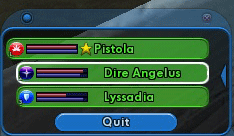
You also need to care about the welfare of each of your teammates mid-battle. Your particular MMORPG, like City of Heroes, may allow you to have a sort of “Team Window” where you can monitor each member’s health and other vital stats.


This little window is a godsend for healers. Out to the side, you can see all the little icons representing many of the buffs each character has on them–this helps me figure out who needs which buff, who needs healing, etc. I just look for the bright green icons to know whether I’ve buffed somebody recently, and I can easily watch their red Health and blue Endurance bars, too.

Believe me, as a person who’s played just about every Archetype available in City of Heroes/Villains, damage-dealing characters do depend on their healer teammates to be the “net,” to catch them if they fall! Caring healer players can literally be the saviors of their teams during huge battles.

Healers have to be responsible.

Caring also entails responsibility. You have to be paying attention to where the team is going, not wandering off randomly by yourself because you accidentally closed your Map (*raises hand* Guilty). You also need to scan the battlefield at all times, not just focus on the particular enemy or ally in front of you. This helps you stay alert to rapidly-changing battle events.

For example, here’s what happens when you focus too long on one particular thing as a Healer:

I’ve selected one of my teammates’ names in the Team Window at left, denoted by the white box around the name, and have just healed him close to full health. My own health bar isn’t looking so great, though, because in healing my teammate, I’ve come a little too close to the battle front.
See all those red numbers above Lyssadia’s golden halo? That means somebody’s damaging her. The red and blue bars just above the halo show her health and endurance–her blue endurance bar is nearly full, but her red health bar is almost half gone. I have to get her out of the line of fire fast!

Healers have to be careful not to make themselves targets; that’s one reason I say to keep moving and keep watching your screen. Otherwise, you can end up with one very dead Healer…


(This is what happens when I’ve gotten a little overzealous shooting stuff and forgotten to heal myself. Poor Lyssadia. Learn from my fail.)

Healers have to FOLLOW the team, not lead.

Healers actually work best at bringing up the rear–many healers have secondary attacks that they can fire off to prevent a few straggling baddies from stabbing the group in the back, and you can also monitor your teammates more carefully if you are behind them rather than in front of them. As the healer, don’t be the first to fling an attack or explore ahead of your group, because this is a good way to get your Empath character killed.


(Through the confusion of colors, you can see the two names in green in this screenshot–those are my two teammates up ahead of me. Since I’m behind them, I can visually monitor what is going on, and I can click-and-heal them if I need to.)

Several of my healers can fly, so usually I will hover above the fracas, healing, buffing, and offering a bit of cover fire when needed. This elevated position helps a Healer see more of the battlefield, and it can keep you in range of allies who would otherwise be out of range of targeted heals and buffs. Whether you choose to fight from the air or ground, however, it’s important to stay in a central position in the team–if you’re too far forward or too far back, you might not be close enough to a teammate to help them.

Here’s Lyssadia in flight, going “pewpewpew” at the Auto Turret in her sights. My teammates were still in sight in the larger version of this screenshot, so I could take a few shots, then heal or buff if necessary.

Healers have to heal/buff first and fight second.

Even though most healers on City of Heroes are ranged attackers as well, they really work best if you focus on buffing everyone and healing everyone first, and only attacking if absolutely necessary. It can be very tempting to start fighting along with your teammates if you start taking damage yourself, but stay the course–if you can keep your teammates alive by a few well-timed heals and buffs thrown their way, then you won’t have to worry very much about taking damage!


(In this shot, I’ve targeted onto one of my teammates, marked by the green box around his character, and am sending an application of Fortitude his way, which will increase his Damage Resistance to just about every type of damage for 1 minute.)

Healers have to focus.

Eating, watching TV, or doing anything else while trying to play a healer will not work. Even if you can type quickly, sometimes even chatting with your teammates takes too much attention away from the job at hand. Since much of the team depends on you to keep them in fighting shape, you have to maintain a focus that you don’t necessarily have to have when you’re playing a damage-dealing character.

It can be a bit stressful, especially if you’re trying to keep up with a team whose members don’t talk about what they’re going to do before they do it. But if you’ve got a good team going, with lots of communication, it’s relatively easy to stay focused.


(I’m staying a bit further back from the fray in this shot, because there are still several high-level enemies alive, but my teammates are generally mopping ’em up okay. I just need to be alert in case a teammate gets caught unawares by an enemy shot. This time, I’m not making Lyssadia fly into the fight just to get shot!)

Summary

Playing a healer does require a bit more work, but it is a very rewarding type of character to play if you enjoy being needed. It’s a team-oriented mindset that can make battle less boring and more involved…for certain, it is a VERY different kind of challenge. If you’ve never played a Healer before, give it a shot!

Resident Evil Deck Building Game

residentevildbg
For those who are not familiar with any of the Resident Evil video game series, the whole concept sounds like something you don’t want to mess with. Arming yourself with various and sundry weapons to fight zombies? Sounds like a horror movie gone crazy.

I certainly thought this way about the video games, and wasn’t too enthused about playing a deck building game based on the same mythos. Horror and killing stuff really isn’t my bag in movies or video games either one, so when my boyfriend (a major Resident Evil fan) asked if I would like to try the deck-building game, I expected it to be not much fun.

Boy, was I proved wrong! In the Resident Evil DBG, like many other deck building games such as Ascension and Dominion, the long-term strategy is the winning strategy, which means lots of fun happy times for gamers like me who like to play for the long-term gain rather than the short-term strike.

To Begin The Game

All players in the Resident Evil DBG start out with a character card of your choice (more about those later) and the same 10 cards in their decks:

7 ammunition/gold cards, worth 10 ammo and 10 gold each, used for powering your weapons and purchasing upgraded items and ammo
2 combat knives, each of which can deal 5 damage and doesn’t require any ammo
1 handgun, which requires 20 ammo to work and which can deal 10 damage

From this original 10-card deck, you draw 5 cards and begin your turn. On your turn, you may buy 1 resource from the rows of resources laid out on the table, play 1 action, and explore the Mansion 1 time if you choose. Once your turn is over, you take all the cards you’ve played this turn and place them in the graveyard (your used cards), and draw 5 new cards to prepare for your next turn.

Wait, What’s the Mansion?

The Mansion is familiar to those who have played the Resident Evil video games, but in the context of the game, it’s simply another deck of cards on the table. When you want to “explore the Mansion”, you must have a weapon (like the Combat Knife, the Handgun, or other sundry upgrades to these items) in your hand, as well as enough ammo to power it. You then declare you’re going to explore, and then turn over the top card of the Mansion deck. Whatever Infected zombie creature is revealed, your weapons must deal it enough damage to defeat it in one hit, otherwise the Infected creature deals your character damage and then goes back under the deck.

Say, if you explored the mansion with two Combat Knives and a Handgun. You’re able to do 20 damage, because each Combat Knife does 5 damage, and the Handgun does 10. All the weapons you play combine together for total damage, unless otherwise specified on the card or the character.


If a Male Zombie shows up as the top card, you’re in luck, because it has 20 health and will be defeated with your combined 20 damage. You then get 1 decoration for having defeated it.


However, if the top card is a Licker instead, you’re out of luck–it has 40 health, and will not be defeated by two Combat Knives and a Handgun combined. You will instead take 30 damage from the undefeated Licker, which will then go under the Mansion deck to be rediscovered later. (Be careful–you can end up taking enough damage from undefeated monsters to actually kill your character!)

Different enemies have varying levels of decorations–some give you 2, 3, or 4 decorations if you defeat them, and the two strongest monsters in the Mansion (Nemesis T-Type and Uroboros Aheri) give you 5 and 8 decorations, respectively. Whenever Uroboros Aheri is successfully defeated, the game ends, and everybody counts up decorations–the highest total wins.

Character Cards

Fans of Resident Evil games will recognize the various characters included in each box of Resident Evil:DBG. Familiar faces like Jill Valentine and Chris Redfield are there, alongside others like Jack Krauser, Sheva Alomar, and Ada Wong (my personal favorite).

Some characters have weapon specialties–you’ll want to give Jill all the Grenades she can carry, for instance, while Sheva makes magic with Rifles and Krauser is a beast with Knives.

Each character in the original DBG has two abilities that activate when they have gained a certain number of decorations. At Level 1, the character can use the first ability listed on their card; at Level 2, they can use both abilities.

The reason Ada Wong (at left) is my favorite is because of her Level 1 ability, which allows her to “peek” at the top card to see if it’s something she can defeat with her current damage total. Ada can put the “peeked” card on the bottom of the Mansion instead of trying to defeat it, and she can then go for the second-from-the-top card instead. (This is great for moving Uroboros Aheri out of the way when I don’t have 90 damage to defeat his 90 health, because with my luck, I’m ALWAYS drawing the boss. XD)

Another important point to remember: each character also has a set amount of health. Some characters can survive a 70-point hit by Uroboros and live to tell about it next turn. Unfortunately, Ada and several other characters only have 70 health to begin with, so they have to be played more carefully. No haphazard reckless exploring the mansion for them!

Look through each of the character cards and see which ones fit your playstyle. Since I’m horribly unlucky in my Mansion draws, Ada’s ability suits me well. But you may find that another character is your favorite!

Game Modes and Resources

You can play Resident Evil: DBG several ways–a list of possible scenarios follows.

  • “First-Timer:” helps you get used to the game mechanics, basic and fun
  • “Mercenaries:” timed game, with various mini-scenarios to act out
  • “Versus:” where instead of fighting the zombies, you try to defeat the other players!
  • “Custom:” you and your fellow players choose resources to purchase, and play much like First-Timer

There are many, many different resources you can use to build your perfect streamlined deck in the game, such as upgraded weapons, healing herbs, and cards that let you get weapons back, trade out items, draw more cards, etc. Each game mode has its own set variety of resource cards–in First-Timer, for instance, there are some cards in the box that aren’t even allowed on the table, whereas in Versus mode, you’d make copious use of those cards.

My Personal Strategies

After several times of playing the game, I generally know what some of my first purchases are going to be. Purchasing upgraded ammunition cards is the first order of business–trading out all those 10s for 20s and eventually 30s will help power bigger weapons and will help you pay for those bigger weapons, too. Also, purchasing cards that help you clean out the cards you no longer need is very important. (Once you’ve purchased bigger and better weapons, you’ll want to get rid of the Handguns and Knives unless your chosen character has a specialty with them, for instance.)


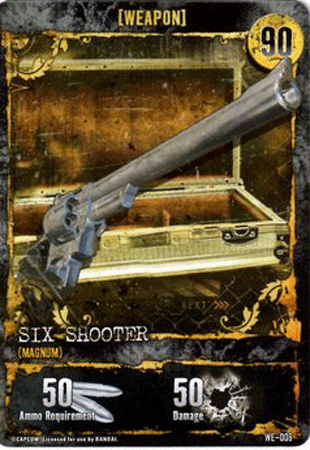
The Six Shooter is kind of an upgrade from the Handgun, is it not?

Action cards such as Shattered Memories, Ominous Battle, and Item Management (no image) are great support cards for early- to mid-game deck thinning and streamlining. Other helpful Actions include Reload (get a weapon back from your graveyard, get 2 actions), Umbrella Corporation (draw 2 cards, put 1 card from your hand back on top of your deck, get one more Action to play), and Escape from the Dead City (draw 1 card, get 2 actions).

I generally don’t explore the Mansion for about half of the game–most of the first half of the game is getting my deck streamlined, and I usually avoid getting damaged by too-strong monsters until I’m ready to take them on.

However, by not exploring the Mansion, I sometimes miss out on the two most epic weapons in the game, which are actually hidden in the Mansion. Sometimes, you’ll Explore and come across one of these babies as the top card:

 
The Gatling Gun can be filled with any amount of ammo for equal amount of damage; the Rocket Launcher deals a flat 90 damage for 0 ammo investment.

For me, I’m not willing to risk Ada on the possibility of getting one of these weapons, so I play carefully. If the other players get the Gatling Gun or the Rocket Launcher, that’s great for them–I am simply more comfortable using tried-and-true (and safe) methods to last through the game. I don’t know if this playstyle would work for everyone, but it’s won me most of the games I’ve played so far!

To Find Out More

Unfortunately, the official game website has been closed because Bandai is no longer publishing RE:DBG as of 2013. But you can still find information through the RE:DBG page on the Resident Evil Wikia. Also, BoardGameGeek’s page on this game is a great resource as well, and I used it heavily while writing this article.

Life Gain…It’s Not Just a Stall Tactic Anymore!

lifegainnotstall
In my other posts on Magic the Gathering and casual gaming versus competitive gaming, I’ve often touched on the fact that there are many ways to play a game like Magic. Many competitive strategies involve lots of aggression or opponent control, and certainly these are faster ways to win than the style I’m about to describe. But just because a strategy doesn’t win quickly doesn’t mean it’s not worth looking at.

Life-gain in M:TG has often been characterized as nothing but a stall tactic, a way to keep yourself in the game while you build up slowly over turns. But choosing to keep your life total high can be much more important. The following are 3 ways you can use life-gain in your own decks: as a stabilizer, as opponent deterrent, and even–GASP!–a win condition!

Dipping Your Toe Into Life-Gain: Life-Gain as Stabilizer

Most times, life-gain is the net that opens below you as you fall from the tightrope. Many of the instant life-gain spells (see a fairly complete list here) give you the ability to partially or fully recover from a hit on your opponent’s turn, leaving you open to gain more life on your turn. (Remember, you have to live through the damage your opponent has dealt to you before you can gain the life off the instant spell.)

This kind of life-gain can be fitted into your existing strategy without making your deck too life-gain-based–it adds just a touch of resiliency. If you find that your super-aggressive deck isn’t staying around long enough when games go beyond 5 or 6 turns, you can put in a bit of life-gain (often combined with other control-based game effects like removing a creature or land, countering a spell, etc). Also, if your control or combo deck is having trouble staying stable in the first few turns before it can really build up, life-gain can give you a little cushion against high-damage decks while you’re searching up your combo pieces.

Partial Devotion to Life-Gain: Life-Gain as Opponent Deterrent

Sometimes, though, life-gain can be a way to discourage your opponent from attacking, especially in a group game. If all you’re doing is gaining life, and no damage your opponent deals really sticks, then they are likely to go for an easier target, or instead just build up their own strategy and leave you alone. Even in a one-on-one game, a good bit of life-gain can work as a mind game on your opponent, making them despair of ever taking your life total down permanently.

You don’t have to have tons of life-gain cards to make this work–just a playset each of Life Burst and Rest for the Weary can be enough for some decks, as well as some good lifelink creatures to block with. With a partial devotion to life-gain, there will be enough life-gain to shield you AND to keep your opponent guessing about how hard they’ll have to hit you for any damage to stick!

Total Devotion to Life-Gain: Life-Gain as Win Condition

Now, when I think of the concept of life-gain as a win condition, two cards come to mind: Test of Endurance and Felidar Sovereign. Both of these cards have a “You win if your life total is at or above this level at the beginning of your upkeep;” one is an enchantment, one is a creature. It is an unusual way to win, but it is actually quite effective; I have a deck based around Test of Endurance, visible here, which incorporates both damage prevention and steady life-gain off of everything one can possibly gain life off.

Building a deck like this means that you’re largely hunkering down and waiting to win–you’re not going to be doing a whole lot to the other player, unless you choose to use Lifelink creatures to do combat damage, or unless you build in a bit of opponent control into your own deck. Since I’m a more reactive, defensive player, I like this hunkered-down style of playing–the other person gets to play what they want, and they can TRY to attack me, but it’s not going to do much good, since I can bounce back pretty easily from any hit.

Summary

If you’ve never tried life-gain before, remember that you don’t have to devote 40 out of 60 cards to gaining life–you can add as few as 8 to give your deck a little more rebound from the depths of single-digit life totals. And it’s definitely not a weak strategy; indeed, if used correctly, it can blindside your opponent and bring you an unexpected win!

You Hurt Me, I Hurt You: The Mystics Team Ability

youhurtmeihurtyou
In HeroClix, most gamers typically gravitate towards high-damage, high-attack pieces, especially the ones that can move and attack in the same turn. Pieces with 11 or 12 attack, 3 or 4 damage, and either Charge, Running Shot, or Hypersonic Speed are the “Most Wanted Clix.”

I am not one of these gamers–in fact, the pieces I choose for my collection could be labeled “second-stringers” at best. If I have a 10 attack showing among my teams, it’s an unusual team for me. Most of my teams are made up of support pieces and a few solid but not overpowered pieces. It’s only when people begin to play against me that they realize those smaller pieces are actually serving another purpose besides attack: they are all Mystics. And they are FAR stronger than my opponents recognize, until it’s too late.

What Is The Mystics Team Ability?

The Mystics team ability (not to be confused with the “Mystical” keyword!) is indicated by any of the following team symbols on a HeroClix figure’s base:


From left:  Mystics, CrossGen, Arachnos

Any of these three symbols, printed on the back of a character’s dial, mean that if an opponent attacks and successfully damages this figure, the attacking figure takes 1 unavoidable damage. It’s a “You hurt me, I hurt you” strategy–very reactive in playstyle, since it depends on the other person making a successful attack.

Mystics In Practice

This might seem counterproductive at first. Why would someone want their own figures to be damaged? Doesn’t that mean you’ll be beaten faster?

Not necessarily! 😀

Run Lots of Support with Mystics

Here’s the primary beauty of the strategy: more often, the people I play against are not running pieces that have Support (the ability to heal a friendly character). I, however, am running one or two pieces with Support (also known as “Medics”). If one of my Mystics pieces takes a wee bit too much damage and is in danger of being KOed, I simply get him or her back to a Medic while some of my other Mystics pieces take over. In a few turns, my hurt Mystic is back on top click, and the opponent’s pieces have likely taken more damage in the meantime, either from a Mystic hit or from actually being attacked.

Run Wildcards with Mystics, Too!

One way I love to run Mystics pieces is to run them with a bunch of Wildcards–a list of Wildcard team symbols follow:


From left:  Spiderman-Ally, B.P.R.D., Minions of Doom, Legion of Superheroes, Calculator, Freedom Phalanx

The reason? Wildcards can copy the Mystics team ability. Suddenly, Young Superman is a Mystic–you deal him damage, you take a damage! Spider-Girl is a Mystic, too–you deal her damage, you take a damage! And so on.

So, if my whole team is full of Mystics such as these, and you don’t have a Support piece, you are in trouble. True, your pieces might deal more damage to mine at first, but I likely have more Wildcard Mystics ready to fill in for the one who’s running back to the Medic. Not only that, but the Wildcard pieces help round out the team with some higher damage and attack, as well as some strong abilities of their own, like Charge, Incapacitate, or my favorite, Super Senses. (I roll a 5 or 6–your attack misses my character. I roll a 1 through 4–my character takes damage, which means yours takes a damage, too. It’s a win-win!)

Important Pieces of Strategy

This team ability works best if you have a lot of small point-value characters rather than a few large point-value characters. Having a Mystic over a hundred points is great, but you’re not going to have a lot of room for support, other Mystics, or Wildcards. My favorite strategy is to actually choose two of the cheaper Mystics (Zatanna Zatara, Jason Blood, Nightshade, etc.) and build my team full of Wildcards and Support from there. That way, I have the Mystics team covered, but I also have room for attacking pieces that will likely take some damage along the way.

Try the Mystics team ability sometime if you’re looking for a different way to win. Sometimes, an opponent’s successful attack can work against them!

Building a Better Team Support Toon, Part 2

betterteamsupport2
As I discussed in part 1 of this topic last Thursday, team support is made up of a conscientious playstyle and helpful powers. Part 1 showed how any player’s toon, no matter how damage-dealing, can be equipped with some team-support powers that boost effectiveness in large teams.

Today, I’m going to go through the natural team-support power trees available in the game–these are generally only available to Defenders, Controllers, Corruptors, and Masterminds.

Cold Domination

Available to: Controllers, Corruptors, Defenders
Best for: Debuffing enemies, buffing allies
Complete List of Powers

Cold Domination coats your allies in icy armor so that they can resist many types of damage; you can also slow your enemies’ movement, recharge rates, and even reduce their ability to damage you or your allies. It can be a great fit for an Ice Control Controller who wants to maintain thematic attacks, or really for any of the three builds to get some strong debuffs and buffs.

Dark Miasma/Darkness Affinity

Available to: Corruptors, Masterminds, Defenders; Controllers get Darkness Affinity instead
Best for: Healing, resurrecting, & hiding allies; debuffing and holding enemies
Dark Miasma Power List/Darkness Affinity Power List

Dark Miasma/Darkness Affinity does a little bit of everything–a little heal and rez, a little stealth, a little scaring the pants off your foes, and even a little damage thrown in there for good measure. You generally suck health or stats away from the bad guys and give it to yourself and your team around you. It’s a great power set for toons who need to be a backup healer for a team, since the heal and rez both require Accuracy checks to work, but I have also had success being the main healer for a team on a Dark Miasma Corruptor. Playing your Dark Miasma/Darkness Affinity character carefully (i.e., not running into the fray like a Tank–guilty as charged) will yield better results.

Empathy

Available to: Defenders, Controllers
Best for: Healing, resurrecting & buffing allies
Complete List of Powers

Empathy is the go-to set for healing, for the most part, but it’s not the only healing set out there. It is, however, a set that doesn’t require Accuracy checks for healing. You can boost your allies’ Regeneration and Recovery rates (how fast they heal and regain endurance), as well as buffing them against all types of damage, and helping them resist negative status effects like Sleeps and Holds.

Force Field

Available to: Defenders, Controllers, Masterminds
Best for: Buffing allies, controlling enemies
Complete List of Powers

Force Field ally buff powers help your allies avoid getting hit in the first place; the occasional foe captures, knockbacks, and disorients you can fire off help your teams survive big enemy spawns. It’s not one of the more popular choices, but I find that Force Field toons just make the rest of the team’s jobs easier. It’s easier to mow down enemies when you’re not taking as much damage, and with your enemies either struggling to get back on their feet or wandering around drunkenly, it’s a much shorter battle. You, as the Force Field toon, may not do a lot of damage, but you are invaluable to the team.

Kinetics

Available to: Defenders, Controllers, Corruptors
Best for: Healing and buffing allies; debuffing and controlling enemies
Complete List of Powers

This set, along with Empathy, is renowned for its buffs (Speed Boost and Increase Density, for instance), but it’s also a passable healing set as well as a debuff set. I don’t have a lot of experience with my Kinetics character so far, but in the midst of battle, she’s very efficient at pulling health off bosses (much like Dark Miasma). I also find that the debuffs, much like Force Field, make the team’s job of owning face much easier–it pulls away speed and Recovery rate from your enemies, weakening them.

Nature Affinity

Available to: Controllers, Corruptors, Defenders, Masterminds
Best for: Heals and buffs with a few debuffing effects
Complete List of Powers

This power set forms a perfect thematic set with Plant Control, since most of its powers are defensive and protective. LOTS of healing, lots of buffing, and just a bit of enemy damage through poison and holds means that Nature Affinity is a good alternative to Empathy, Radiation Emission, and Kinetics. (For instance, Lifegiving Spores giving both +Regen and +Recovery? AWESOME!)

Pain Domination

Available to: Corruptors, Masterminds
Best for: Healing with a large side of combat boosts and tricks.
Complete List of Powers

Pain Domination is like Empathy with teeth–you’ve still got heals and buffs, but there are some seriously powerful enemy debuffs hidden within those powers, too. This is a great set for a multitasking healer who doesn’t have time to heal/buff and damage/debuff in separate actions. (Conduit of Pain as a retaliatory Rez is hilarious!)

Poison

Available to: Controllers, Corruptors, Masterminds
Best for: Damaging enemies, healing and buffing (occasionally)
Complete List of Powers

Poison is best for somebody who doesn’t want or need to play healer much, but does want to debuff enemies in all sorts of ways, reducing defenses, resistances, speed, To-Hit, and even Regen rate. There are some healing/buffing powers, and even a limited Rez (Elixir of Life), but this is more in the capacity of “emergency healer” rather than “primary healer.” Bright side: the debuffs alone should make it pretty easy for a team to mow through enemies, rendering the healing less necessary anyway!

Radiation Emission

Available to: Defenders, Controllers, Corruptors
Best for: Healing, resurrecting, and buffing allies; debuffing enemies
Complete List of Powers

This power set is one-half of the popular Controller build called “Ill/Rad,” or Illusion Control/Radiation Emission. It’s a potent healing set, not quite on par with Empathy, but pretty close, from my estimation. I’ve seen Radiation Emission toons be the main healers of a team, or sometimes the secondary healer–it depends on your playstyle. They also are great for debuffing enemies, bringing down their ability to recharge, to move quickly, to damage you or your allies, or even be able to hit you at all. There’s also a surprising damaging attack late in the set, when all else fails!

Storm Summoning

Available to: Controllers, Corruptors, and Masterminds
Best for: Debuffing and controlling enemies; buffing and healing allies
Complete List of Powers

I’ve played a Storm Summoning Controller for a good while, and I find that the power set is best for locking enemies in place and debuffing them. Heals and buffs are few and far between, which means that your Storm Summoning toon won’t be the main healer, but you can be backup healer in a pinch. The storms are great for debuffing and knocking around your enemies, and it does a good bit of damage (at least, for a team-support character!). While they’re busy trying to recover from what you’ve done to them, your teammates are mowing ’em down. Fun fun!

Sonic Resonance

Available to: Defenders, Controllers, Corruptors
Best for: Buffing allies, debuffing enemies
Complete List of Powers

This is a pretty basic set, and not a very popular one…but I disagree with popular opinion. Played right, your Sonic Resonance toon can make enemies up to 50% less resistant to all types of damage. What does this mean? It means that your team mows through high-level bad guys as if they were your level, demolishing them in 5 seconds or less rather than standing there slashing for close to a minute. (I didn’t know just how much this would make a difference until I played a Sonic Resonance toon of my own, and saw how cool it was.) Debuffs aside, there are also some great team buffs for Defense and Damage Resistance, but you need to be in the middle of your team to make sure everybody is getting the benefit.

Thermal Radiation

Available to: Controllers, Corruptors, and Masterminds
Best for: Healing, resurrecting, and buffing allies; debuffing enemies
Complete List of Powers

This set is more like Empathy in that none of your healing powers require an Accuracy check; however, your buffs and debuffs make up more of your power tree. Thermal Radiation toons help their teams by keeping them shielded from harm, boosting their fighting abilities, and drawing stats away from your enemies. I don’t have a lot of experience with my Thermal Radiation character as of yet, but I like how her powers work so far–everything helps my teammates, even when I target an enemy!

Time Manipulation

Available to: Controllers, Defenders, Corruptors, and Masterminds
Best for: Recharging allies’ powers, boosting ToHit, healing, and enemy debuff
Complete List of Powers

Time Manip toons help with combat by boosting +Recharge, +Damage, and +ToHit, as well as bringing down enemy defenses and resistances…AND there’s healing, too! It’s an excellent power set for somebody who doesn’t just want to be “the healer” for a team, since these powers facilitate battle for the rest of the team. (Farsight and Temporal Selection are standout buffs, while Temporal Mending looks like a great Heal!)

Traps

Available to: Corruptors, Defenders, Masterminds
Best for: Enemy debuff and damage
Complete List of Powers

Traps aren’t necessarily your typical “team support” tree, but they can help a team weaken/get rid of very large mobs, which is supportive in its own way, much like Controllers’ Primary Power Sets. A Traps toon can’t do much healing, but the Force Field Generator and Triage Beacon can help in a pinch. Otherwise, you can pretty much pick your preferred flavor of debuff (Caltrops, Acid Mortar, Time Bomb, etc.), and run with it!

Trick Arrow

Available to: Controllers, Corruptors, Defenders, Masterminds
Best for: Enemy debuff
Complete List of Powers

Trick Arrows are purely for negatively affecting enemies, nothing else. Pull a Hawkeye and bring an arrow for all occasions–keep your enemy from flying, recharging their powers, recovering endurance, dealing damage, etc. Or you can use a couple of the arrow types to hold them in place, make them slip, or even put them to sleep! A toon with Trick Arrows can thus help a big team manage lots of enemies. (And, if you happen to be playing with a Fire toon, shoot a few Oil Slick Arrows for extra fun.)

Summary

Building a natural team support toon takes having a general idea of what you want to do with your team support powers, and which toon archetype you want to build on (Defender, Controller, Corruptor, Mastermind). But there are literally dozens of combinations that can make you able to support any team you work with!

Building a Better Team Support Toon, Part 1

teamsupporttoon1
On City of Heroes, many people spend lots of time playing solo–running a few quick missions before work or school, or just taking some time to hunt for badges to unwind. This in itself calls for a very efficient damage-dealing type of character (“toon” in the game’s parlance); you must be able to deal with everything you come up against on your own, so there’s no room for useless powers in your build.

Building a Solo Character =/= Building a Teaming Character

However, this style of building toons does not always suit team play. In a team, there are other players to think of–you can’t just go charging in, aggravate all the bad guys in a room, and expect that everyone will survive. Neither can you be the sole damage-dealer for the whole team, when there are enough bad guys generated for up to 8 players in a team. This is just asking for trouble.

To play best in a team, you’ve got to be willing to support your teammates. This usually requires a mindset shift, as described above, but it also helps if you have the following powers, too:

Helpful Team-Support Powers for Every Toon

  • Recall Friend (from the Teleportation power pool): Enables me to get another player’s toon across a wide hero zone in seconds, or to pull them back to a safe area in a mission if they have been defeated. Efficient for helping lowbie toons without travel powers get around faster, or for moving large teams from mission to mission in quick succession.
  • Aid Other and Resuscitate (from the Medicine power pool): These are both healing powers–Aid Other gives some health back to a fellow player, and Resuscitate brings a character back from being defeated, with full health but no endurance. These two powers don’t always work (they require an Accuracy check), but they are great for when the main healer of the team has been defeated and we need healing NOW.

These powers are the most useful, and since they are available from power pools rather than primary or secondary power trees, any toon can choose them as one of their power picks when they level up or respec.

I generally take both Recall Friend and most of the Medicine pool with my ranged-damage toons, but I even build my close-combat toons with at least the healing powers (Recall Friend is better with toons who play more at range than close-combat, I’ve found). This might take away from my damage-dealers’ available attack powers or defensive powers, but I find that building my character this way helps my teams (which makes me feel useful and helpful, leading to happy Robin).

Don’t forget, though: when you play team support, this means you need to watch out for your team. Have your Team window open so you can monitor the health and endurance of your teammates without having to see them personally on your screen, and don’t run ahead of your team or lag behind. Match this conscientious playstyle with good team-support powers, and you’re on your way to helping whatever team you join!

We’ll cover specific team-friendly powersets in the next installment of “Building a Better Team Support Toon:” Part 2!