Category Archives: Tuesday on the Soapbox

Anything from politics and current events to strange and beautiful life philosophies.

Glasses Off: 4 Uplifting and Helpful Sites

With all the negativity and drama that spreads around the Internet all the time, I find myself wanting happier (or at least more positive) things to read and learn from. Thankfully, there are other people who think like me and have made the following sites:

Upworthy
Videos and short blurbs about things that are either happy or important to learn.

DailyGood
Inspiring news…we can all use a dose of good news and happy things to read!

BigThink
These articles may not ALWAYS be happy, but they will generally be very helpful. 🙂

LifeHacker
Who knew that lifehacks could encompass bettering ourselves?

Glasses Off: 4 Thought-Provoking Sites

Sometimes I get awfully tired of seeing the same news and “shocking” stuff regurgitated all over the Internet. Sometimes, I just want something new and nourishing, something to actively learn rather than something just to read and forget. For those times, I look to the following four sites:

Comics That Say Something
Subtle wisdom in visual form…really awesome!

Contemplate.us
Little text wisdom blurbs you can browse through.

LongReads
Longer articles/essays on various subjects–bet you can guess why I like this one, LOL

PBS.org
All kinds of shows and topics, from scientific discoveries to art history, with a common thread of making you think.

10 Weird/Funny OCD Rules from My Life

OCD, or Obsessive-Compulsive Disorder, is something we joke about in modern society. We use it as shorthand for being excessively picky about things, for instance, or for being overly bothered. Things like fixing crooked pictures and not letting foods touch on our plates are almost part of our culture now.

But for those of us who either are diagnosed with OCD or are pretty certain we have it, it’s a reality, however strange and funny it may seem to others (and to ourselves). I even have to laugh at myself when I realize how many things in my life are regulated with OCD’s little rules! Such rules make perfect sense to me, so I rarely think about them–that is, until I started brainstorming for this post. 😛

To demonstrate, here’s a few of the standout ways OCD runs my life:

  • In the shower, my hair must not touch my shoulders when it is covered in shampoo and I am scrubbing my back with body wash. (Shampoo mixing with body wash? A HUGE no-no, at least in my head!)
  • All apps must be force-closed on my iPhone before I charge it.
  • Socks must not be put on before pants. (I hate the feeling of fabric dragging against fabric!)
  • Posts on Tumblr must be thoroughly tagged with proper subject matter and general category tags. (It also bugs me when I see others’ posts not properly tagged, though I don’t say anything :P)
  • Salty and sweet flavors must not mix, either on the plate or in my mouth. (Different sweet flavors may mix with each other, however; same with different salty flavors.)
  • Freshly washed and blow-dried hair must not be stuck in a ponytail–it must be left loose.
  • All lights and appliances must be off in a room before leaving it, unless I am returning very soon.
  • Decks of cards must be shuffled exactly 3 times before playing.
  • The gas tank in my car must always be filled to top when refueling.
  • When arranging a music playlist, the same artist or same album must not occur back-to-back in the track list.

If you definitely have OCD (or are pretty sure you do), what are some of the weird and funny rules you live by? Tell me in the comments! 😀

Hoarder Confessions, part 3: The Hoarder’s Assistant

If you’ve ever tried to help anyone else clean their house out, you know how physically difficult it is, even if the person hasn’t hoarded things. From personal experience, however, I can safely say that helping a hoarder clean things out is about 3 times as physically exhausting and about twice as emotionally exhausting–for all parties!

So, if a hoarder in your life ever asks you to help them with their home, you can rely on the following road-tested guide as you work. This will keep you both less frustrated and more productive (and won’t destroy your friendship along the way)!

While They Sort, You Clean

One of the most irritating things about cleaning out a hoard is finding all the collected dust and dirt all over items, the floor, and even the walls sometimes (depending on how stacked-up the hoard is). When I’m trying to clean out my own collection of stuff, having to dust, sweep, and wipe off everything is a HUGE distraction from my real task. So, as the hoarder’s assistant, your primary task is to clean–dust surfaces, mop, sweep and/or vacuum newly exposed floor areas, wash or wipe off usable items, etc.

This takes a lot of the “cleaning” pressure off your hoarder friend so they can focus on the monumental task of sorting and purging items; it also serves as a confidence boost, as the hoarder sees progress being made. (Plus, it keeps you from having to figure out what to do with all these items which have no meaning to you–see next point.)

Don’t EVER Throw Anything Away Without Hoarder’s Permission

Speaking as a hoarder myself, this is my worst nightmare: somebody coming into my house like a tornado of cleaning power, and throwing away EVERYTHING in sight, no matter what it means to me. You might think a brutal purging spree is “just what they need to get started,” but I’m telling you, that’s a friendship-destroying move right there.

Clean and straighten to your heart’s content, but do not throw ANYTHING away until the hoarder has had a chance to check it. Something that looks worthless to you may not be worthless to them, and it will make things a lot less emotional if you just let them deal with it. One helpful tip: if you come across items that look more like garbage
(old receipts, broken/dented objects, crumpled papers with writing on them, etc), create a separate box for them so that they’re not just scattered atop more obviously keepable items. (If they’re having difficulty getting rid of even a wadded-up food wrapper or some crumpled gift wrap, however, gently encourage them to think about what use the item would have.)

Allow Breaks in the Cleaning Process

Both you and your hoarder friend will need breaks fairly often, due to physical exhaustion if nothing else. Breaks are necessary, otherwise your energy will flag early on and both of you will be sorely tempted to quit. When you take breaks, by the way, leave the room you’re working on and go somewhere cleaner, even if that means leaving the house so you’re not just sitting there surrounded by all the work you need to help with. This will refresh both of you, and make the process a lot easier.

Do Not Judge or Ridicule–Just Help and Listen

For a person who is trying to recover from hoarding, a purging process is not only physically demanding, but emotionally distressing. The hoarder can feel shame that they “let the house get this bad,” or they can spend the whole time fearing that they’ll “accidentally throw away something important.” (These are in quotes because I’ve thought these very phrases myself.) Hoarding is often a secretive, intensely private habit, and when another person becomes privy to the secret, it can leave the hoarder feeling painfully vulnerable.

As their assistant, then, you need to be as soothing and trustworthy as possible as you work alongside them. Your hoarder friend will need a lot of support and reassurance–they may need to talk out their feelings about the process, or they may even cry while working. Be there for them, facilitate the process of purging and cleaning as much as you can, and keep any negative words to yourself, since discouragement or judgment in any form can be more hurtful than you ever imagined.

If They Get Daunted, Help Them Restart–Or Find a Stopping Place

During my massive cleanouts, I tend to get daunted very easily; sometimes, I just look at the enormity of the task and want to either cry or vomit. I feel safe in guessing I’m not the only hoarder who reacts this way, either!

If your hoarder friend is getting daunted early on in the process, it’s up to you to be their cheerleader; you can keep dusting and mopping as they rest, visually demonstrating the progress you both are making, or you can stop and give them a pep talk. Keep it all positive, though–don’t shame them for this reaction, but help them conquer it!

However, if the purging process has been going for quite a while (several hours), and the hoarder is getting daunted because of mental and emotional exhaustion, it’s better to find a stopping place rather than to push them to keep working. Finish the section you’re working on together, and let that be enough–remember, this hoard wasn’t built up in a day, so it won’t be taken down in 24 hours!

Summary

When you’re helping a hoarder in your life, it will be demanding on you, but it’ll be even more demanding to them. Being a positive, encouraging, helpful hoarder’s assistant will be key to them finishing the job. Trust me, we recovering hoarders REALLY appreciate awesome people who are willing to help!

Hoarder Confessions, part 2: Help for Hoarders

As I discussed last week, hoarding is not a “weird” problem–it’s actually something that a lot more people do, and while some people are happy living with their various collections, some hoarders, like me, feel trapped by it.

I speak mainly from my own experience, having been a hoarder as long as I can remember. My main reasons for hoarding: I hate throwing away items that cost a good bit of money, even if they aren’t doing me any good anymore, because all I can see is dollars going in the trash. I also hate throwing away broken things, because all I can focus on is the waste of a good item…I end up keeping some broken things in the hope that I can somehow clean them up and fix them to work again.

However, one can only keep so many items before the collection begins to overwhelm your life. I am now in the fourth year of trying to dig out my life from amid the detritus…it’s not been an easy road, to put it mildly. But I’ve discovered a few tricks along the way that are helping me break through, and I hope this article will help fellow hoarders as well!

#1: The “Month Box”

monthbox
The boxes pictured above have been the biggest help to me in deciding what to keep and what to get rid of. I call them the “month boxes.”

How It Works

The “month box” is a temporary storage place for items that need re-evaluation. Often when I’m cleaning and organizing, I become overwhelmed with the weighty task of discarding and purging items. Sometimes I’m getting rid of so much stuff that it makes me anxious. What if I’m getting rid of something I’m going to need later, just because I’m caught up in “purging?”

This fear has brought cleaning and organizing to an utter halt in the past; to ease the fear of discarding an important item, I have the “month box” set aside for items which I don’t really want to get rid of, but which I’m not sure that I need to keep. The ideal “month box” is small enough to keep it from becoming a junk storage place in its own right, but is big enough to hold a good number of items. (I’ve got two “month boxes” going at the moment, simply because one box has a couple of big, more fragile items and the other has a lot of smaller items.)

The most important thing about the “month box:” if after one month has passed, I have not touched any of the items in the box, then they can likely be safely purged.

This has helped me keep on cleaning and organizing without so much of the crippling fear of “losing something important,” and it also holds me accountable for either keeping or purging items at the end of a set time frame. (That box on the left is coming up on its month deadline here in about a week…eek, I better get moving on that!)

#2: The “Important Box”

I don’t know about other hoarders, but I do know that my house’s mess tends to “eat” important things, like medical paperwork, keys, bills, phone chargers, car registrations, spare change, appliance manuals, etc. The mess then regurgitates these items in various random places throughout the house…I kid you not, I’ve found spare change in kitchen drawers, thin appliance manuals stuffed between stray towels in the laundry room, and all sorts of weirdness.

When you’re trying to purge, these items serve as a HUGE distraction. All of a sudden, you have to shift out of “purging” gear and into “save-this-item” gear–you have to absolutely stop everything you’re doing and go find where this item is actually supposed to be. VERY ANNOYING, especially for us hoarders who have a hard enough time shifting out of “save-this-item” gear in the first place!

Thus, the “important box” is a set place where these items can live until you’re otherwise done cleaning and organizing the space you’re working on.

How It Works

As you discover important items hidden among the hoard, just stow them in the “important box,” and make sure that the box doesn’t get mixed up with other cleaning/organizing boxes. (I use a small, bright blue plastic bin as my “important box”, which stands out among the white bins and random boxes I usually use for cleaning and organizing.) Keep the “important box” close at hand, but not directly in the way of your flurries of cleaning effort.

Once you’re done cleaning and organizing for the day, it’s time to deal with the contents of the “important box.” This is imperative–if you don’t empty the box at the end of your purging, then it’s just going to attract more junk to lay on top of it. Trust me on this. Take the “important box” around the house with you, putting like items with like, until the box is empty; THEN you are officially done organizing for the time being! (For instance, put the random appliance manual near the appliance itself; put the keys near the door or in a purse as appropriate, etc.)

The “important box” keeps you from getting distracted and bogged down with one item while you’re trying to tackle a large organizing/purging project. Believe me, it works a lot better this way!

#3: The “Sorting Chair”

For me, the process of purging, cleaning, and organizing is physically exhausting, as well as mentally stressful. Not only do I feel like the purging process is about as easy as wading through quicksand, but I rarely have anywhere to sit while doing it. Usually the nearby flat surfaces, including chairs and beds, get covered with sortables in a matter of seconds. My injured joints and flat feet can’t take the strain of standing for even half an hour, and so sometimes I quit the cleaning and organizing project before I’ve even properly begun because of pain.

Thus, I have found that a simple folding chair works–I call mine the “Sorting Chair” (with a nod to the Harry Potter series, LOL).

How It Works

As you process each small section of your hoard, carrying your “month box” and “important box” along with you, have your “sorting chair” nearby, so that you can sit as needed. Sorting and purging of items can still take place while seated, since you can set a trash bag beside you and your Month Box and Important Box nearby, but at least you’re not getting as exhausted.

You wouldn’t think just a place to sit would be any help to organizing and cleaning, but it can help you regain some energy and keep you from getting tired so quickly. Cluttered collections in and of themselves are visually and emotionally daunting to tackle, so don’t give yourself any other excuses to quit. (Again, trust me on this–I’ve lived this truth often enough, sadly.)

Plus, if you’re able to stand for longer periods of time and don’t need your chair as much, it can also serve as another flat surface to work off of, whether you need to move a stack of stuff so that you can get into other areas of your house, or whether you just need a higher place to set all those magazines for a minute while you sort and purge them. (Bonus: when you’re finished with the chair for the time being, you can fold it up so it doesn’t take up extra organizing space!)

Next Time: The Hoarder’s Assistant

If a hoarder in your life has asked you to assist with their excavation project (hey, sometimes dealing with your collection is kind of like an archeological dig!), next week’s article will have tips on how to help. It’s not just a matter of holding a trash bag for them, after all!

Further Reading

WebMD: “Hoarding: More Than Just a Mess”

Hoarder Confessions, part 1: Humanizing the Cluttered Life

Hoarders–usually characterized as “packrats” by modern media–seem to be quite mythical, eccentric characters. We even have TV shows about them now (both fictional and non-fictional), which paint such people as willful clutter-gatherers, antisocial, and even crazy.

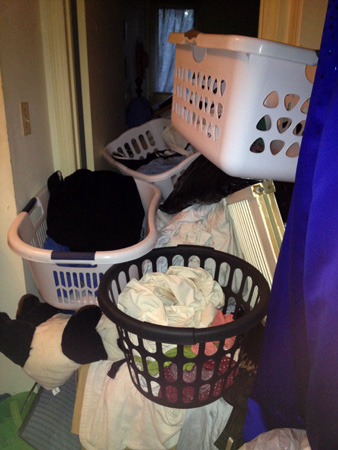
hoarding_example I, however, have a different perspective on this description of “hoarder”–because by most modern standards, I am a hoarder, and several other members of my family have been as well. (The pictured area is the hallway outside my bedroom door, just as an example.) I’ve been battling against my natural hoarding tendencies for a couple of years now, most notably seen through my Slaying the Clutter Dragon article series, but as you can see from this picture, I have a LONG way to go. What you see here is the unofficial “laundry station” in the house, a tiny bit of order balanced precariously on decades of junk.

What Exactly IS Hoarding?

According to the Wikipedia article on compulsive hoarding, it amounts to gathering and keeping objects long after their usefulness has passed, and being unable to let items go. In severe cases, it can actually keep a person from using much space in their house, turning the “livable” rooms into literal obstacle courses (I should know, my room is like this!). Hoarding is considered either a mental disorder all its own, or part of another mental disorder (usually it’s paired with OCD). (Additional information can be found on Psychiatry.org’s Hoarding Disorder page.)

A “Clutter Continuum,” Constantly Changing

Hoarding is not, however, made up of just a couple of easily-recognizable behaviors. Rather, it can appear in mild, moderate, and severe forms, all along a continuum of clutter. My maternal grandmother was a severe hoarder; for example, she had a stack of TV Guide magazines so large that it had formed a side table of sorts in her TV room. The entire second floor of her home was unusable, and several of the first-floor rooms were piled so full of boxes that the doors could not even be opened. And let’s not talk about the refrigerator. By contrast, I would call myself a mild to moderate hoarder; I don’t hoard old newspapers and REALLY obvious trash, but I have a hard time letting go of broken/messed-up items, old toys from childhood, etc.

Hoarding tendencies can also develop and change over one’s lifetime as life events happen; as a child, I hoarded just about everything that was “mine” because it was simply mine and I liked knowing that I could claim these items for myself. As I grew up, I realized that my cluttered room was not only keeping me from using about 80% of my bedroom space, but kept me from inviting friends and family over. Thus, I got a big attack of “Sick-Of-It-Itis” and started a slow purge of items that continues to this day. By contrast, my mom’s previously uncluttered and almost painfully-tidy rooms have become more cluttered as her health has declined; de-cluttering has become an almost insurmountable task.

The Mindsets Behind Hoarding

Having observed the hoarding tendencies both in myself and in my family members, I believe I can describe the thought processes that cause and perpetuate hoarding:

“I’ll Need It Later/Someone Else Will Need It”

This is the constant belief that the item will be useful for someone at some point in time–just not right now, or not for me personally. I fall victim to this all the time, especially if the item was REALLY useful to me in the past, or if it’s messed up and “just needs a little fixing” to be ready for someone else to use. It makes my skin crawl to think I’m throwing out a perfectly good item! (See next point for more on this)

“I Paid Good Money for This”

This, above all, is where my hoarding comes from. I cannot STAND it when something I paid for is broken/no longer useful and everyone else says I should throw it away–I can’t STAND seeing money go in the trash. During the Great Purge of 2009, I actually got physically ill at the thought of having to throw away a really expensive blouse, even though it had some staining and a little rip in it. I was angry at myself for letting the blouse get messed up, and I was angry that the money I had spent on it was virtually wasted. (Thanks to some super-awesome stain remover and a few stitches, however, I was able to save the blouse and wear it again…LOL)

“I’m Keeping the Memories in This Item”

This, I think, is what Gran suffered from the most. By the time her hoarding had gotten severe, my granddad had already died and a lot of her friends had passed away, too. Keeping Granddaddy’s old papers, records, and books, as well as cards from her late friends and old newspaper articles featuring them, may have made her feel more secure, as if she hadn’t lost all these people in her life. Plus, if she had started to deal with all the boxes in Granddaddy’s old study (one of the rooms that you couldn’t even walk into), she would have had to deal with the onslaught of grief at realizing he was really gone. I don’t know for a fact that this is what caused ALL her hoarding, but it’s a really good guess based on what I observed.

“If I Don’t Hang Onto It/Remember How Important It Is, Who Will?”

This question arises from a sense of preserving history as well as memories, as if the hoarder is somehow a caretaker and curator of their own personal museum. Mom and I both do this a lot–she and I have both kept a lot of old stuff from my childhood. In a way, the clutter becomes a memory book, except that you have to walk around it instead of being able to leaf through it…and there’s an underlying fear that if you get rid of the item, whatever it is, you’ll forget why it was important to you, and forget something vital to who you are today.

In short, hoarding (at least from my experience) comes from wanting to be prepared for everything, trying to keep memories (even when it seems no one else will), and preventing waste (either of money or items). These are all pretty valid concerns, but in our brains, it takes top priority. It seems it all boils down to preventing loss; it is our way, perhaps, of fighting Father Time and Death, and staving off grief. (I know I don’t deal with loss very well, at least, though I can’t speak for any other hoarders out there.)

Don’t Judge or Shame, PLEASE

If you don’t live as a hoarder or live in a house with one, chances are you have no idea why or how all this happens; the tendency to judge hoarders as “crazy” or “gross/weird” people is very strong, especially now that hoarding TV shows are such a media hit. But people really do live this way, and a lot of it is based on fear. Either we’re terrified to lose memories or be unprepared, or we’re terrified to let other people know how deeply we are mired in a mess of our own making. Other people’s judgments and shaming, including the TV shows which seem to just make a spectacle out of us, do not help in the LEAST.

If you know a hoarder who wants to get out of their cluttered mess, and you want to help them, then be supportive, be available to help, and be patient. Tangled in the clutter is a lot of emotions, possibly grief as well as fear and humiliation; be sensitive to that, even as you plod on, gaining ground inch by inch. Understand that not every hoarder wants to give up their lifestyle, but some of us feel more trapped than soothed by the clutter and would LOVE a helping hand. And finally, respect that we are human beings and don’t deserve to be treated like naughty children; after all, if a hoarder willingly shows you his or her house, you have just been deemed trustworthy enough to bear a secret, one that may be much more painful than you know.

Next Time: Help for Hoarders

In Part 2, I’ll discuss how we hoarders can start to overcome our fear and humiliation with a few simple-sounding tactics. You’d be surprised how much these little changes can really make a difference!

Wardrobe Purge: Where to Donate?

Once you’ve selected the clothes you want to donate and cleaned and repaired them, you need to find out where to donate your clothes. It isn’t always just Goodwill that needs clothes, after all!

Caveat: Sometimes Your Donated Clothes Don’t Always Go to the Needy

Unfortunately, as I began researching this post, I discovered a couple of articles (over at ABCNews and ApartmentTherapy) that tell of a shadier side to the clothing-donation story–sometimes donated clothes don’t end up immediately clothing needy people in our neighborhoods, but instead are shipped elsewhere and SOLD for profit. (Check out CharityWatch.org to find out about charities like Planet Aid, which has been reselling its donated items instead of just “keeping them out of landfills”). Not exactly what I was intending when I thought of donating my clothes!

Solution: Donate to Vetted Charities–or Better Yet, Community Needs

So far, Dress for Success, Salvation Army, Goodwill, and Vietnam Veterans of America are all good charities for clothing donation. Additionally, you can sell items through eBay and donate to American Red Cross through eBay’s GivingWorks program.

But if you REALLY want your clothing to alleviate an immediate need, donate directly to your local community, as this Moneycrashers article says. Helping out with local church or school clothing drives, donating to local thrift stores and community outreach centers, and most especially donating to homeless shelters and missions can really help! Also, ask around in your neighborhood and see if there’s a needy family who could use the sizes and types of clothes you have–you can just take the clothes directly to their house, no middleman required!

Summary

Though donating clothes to the needy has been a little overcomplicated (and corrupted with greed, unfortunately), there are still plenty of places who will take your used clothing and directly help someone else in need. Just make sure you vet the place first so that you know your donations are going where you intended!

Things Zumba Dancers Think

Since I’ve been attending Zumba classes since June 2011, I’ve learned quite a bit about how much I think I can do versus how much I can actually do; I can actually do much more than I ever expected! Day by day I conquer the ailments in my feet and legs long enough to dance and have fun, and that’s the wonderful, inspirational, freeing side of Zumba.

…But Zumba would not be complete without hilarious fails and passing thoughts, either–humor makes Zumba fun, even as you wildly contemplate how long you can keep up with the instructor. Going along with the “S–t People Say” meme, here’s my take on what we Zumba dancers sometimes think while we’re moving:

  • Uh, yeah, I know how to do that move…sorta…kinda
  • I don’t think anybody saw me slip–I’ll pretend it was a new dance move 😀
  • …How do you even DO that???
  • Looking like a HOT MESS in this exercise room mirror right now…
  • I forgot I even had that muscle.
  • This is my JAM \m/ \m/
  • 30 more seconds…20 more seconds…I CAN MAKE IT
  • Ooh, ow, okay, definitely not stepping down that hard again!
  • My workout clothes should come with “Anti-Jiggle Technology” included…
  • If I had the energy of a toddler, I still couldn’t move that fast.
  • Oh, air conditioning grate, how I love you <3 yay, cold air
  • Have no idea what the singers in this song are saying, but it sounds great!
  • Step 1: Dance; Step 2: Pretend you look as awesome as the instructor while dancing.
  • Geez, how LONG is this SONG?! Seriously?!
  • This just in: sweat definitely stings eyes. Film at 11.
  • Whoops, hope that wasn’t anybody’s water bottle
  • Desperately trying not to look like a complete noob: 40% complete
  • I shook my rear so much I think it might fall off 😛
  • –Oh, wow, I just did that crazy hard move! I JUST DID THAT 😀 😀
  • That settles it, I think this instructor is a super-limber alien just pretending to be human. LOL

Wardrobe Purge: Cleaning and Fixing the Clothes that Go

(Author’s Note: Sorry this second installment of the Wardrobe Purge series took so long–the Procrastinator Queen strikes again. :P)

Once you’ve determined which clothes you want to sell or donate, it’s time to get them clean and fix any small tears.

You might wonder why you should bother with this step, but if you take the time to clean and repair these clothes, you will be saving your thrift shop/consignment shop a lot of time and effort, and making the new owners happy, too. You may even get a better price for your garments if they are clean and in good repair!

Step 1: Mend Small Holes

Before you clean the garment or even try to remove any stains by hand, fix any small holes in the garment. (If you do not sew, look around in your area for a sewing center or fabric store which might be able to direct you to someone.) It’s important that you get holes repaired so that washing and stain removal do not tear them open further.

Step 2: Remove Stains

stainedshirt Tackle any stain, major or minor, before you try washing the garment. (For instance, this shirt at left is one of the ones I’m getting rid of–the giant dark stain under the arm comes from wearing too much anti-perspirant. Regular washing DEFINITELY doesn’t get rid of this–trust me, I’ve been trying!!)
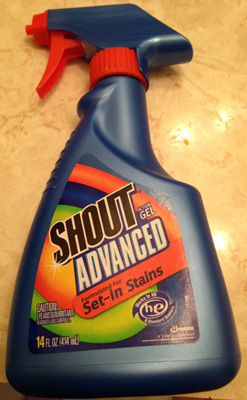
shoutstainremover This stuff, called Shout Advanced Gel for Set-In Stains, is absolutely the best and easiest stuff I’ve ever used to get rid of stains. It has gotten out stuff that I thought the dryer had baked in long ago. If you have an especially tough stain, you can spray this in and wait up to a week to let it work its magic before you wash! (I don’t know how this behaves with dry-clean-only fabric–best to let the professionals handle those, I believe.)

Step 3: Wash/Dry-Clean

Now that you’ve repaired the garment and treated any stains, it’s time to wash or dry-clean it (as appropriate). Just think, it’ll be the last time you have to deal with these clothes if they’re a pain to clean!

Final Notes

After the garment is clean and dry, examine it again to make sure you got all the stains and holes taken care of, and tackle those if necessary before trying to sell or donate it.

If the holes turn out to be too big to mend, or if the repair is too obvious or fragile, do not try to sell the clothing–perhaps donate it to a rag shop or to someone who needs fabric for craft purposes. And if a stain is too stubborn to remove, don’t sell or donate it; you wouldn’t want to buy or get stained clothing, so why try to sell or give a badly stained item away?

Summary

Getting your sellable/donatable clothes in shape is one more step to getting them out of your house. It takes a good bit of effort, admittedly but it’s worth it if it finally motivates you to sell or give away these old items!