Category Archives: Tuesday on the Soapbox

Anything from politics and current events to strange and beautiful life philosophies.

Too Tired to Think Straight: The “Tired Derp”

tiredderp
As a person who usually fights sleep for hours before finally closing her eyes, I’m one of the world’s worst at actually understanding when I actually need to sleep. Thus, sometimes I end up saying and doing some pretty silly things in my super-tired state, which I like to refer to as “Tired Derps.” Here’s a few gems from my experiences:

  • Walking all the way to a building on my college campus, only to find out when I got there that not only was I at the wrong building, I was trying to go to a Monday-Wednesday-Friday class on a Tuesday. (Remember, kids, staying up all night to finish a paper can sometimes make you a little crazy!)
  • Taking off my glasses for the night, but putting them in my purse instead of on my bedside table as usual. (You can imagine the frantic flurry of searching the next morning!)
  • Experiencing temporary dyslexia by reversing a couple of letters in a street name I was supposed to find. (Needless to say, I figured out my mistake pretty quickly.)
  • Trying over and over again to type the word “infinite,” but constantly spelling it “inflinite”, “infinatie”, etc. (Did that while assembling yesterday’s post! LOL)
  • Forgetting that a restaurant was only in Shelby, NC, and driving all the way to Forest City, NC (30 minutes in the other direction) before realizing my mistake. (SUPER herp derp!)
  • Waking up from a 3-hour night’s sleep and not remembering who I was or why I had to get up at such an ungodly hour. (I did remember after about 3 or 4 minutes of concentration, LOL)
  • Driving home, only to miss the turn-in to my driveway by almost exactly a mile. (…How?! ROFL)
  • Hurrying out the door to Sunday school, only to realize that I forgot my keys…ran in, got my keys, left my purse; ran back in, got my purse, left my Sunday school book. (Scatterbrained much? Haha)

Have You Ever Had a “Tired Derp?”

Do you have a funny “Tired Derp” experience? Share it in the comments!

Lifehack: Give Yourself Time Limits to Complete Tasks

lifehacks_timelimits

This post seems counter-intuitive at first, especially for somebody who hates being timed as much as I do. But I tried this and it worked, when no other anti-procrastination tactic had. Read on to find out what I did!

The Situation: A Sunday School Lesson Left Undone

I teach Sunday School, and I like to have my lessons thoroughly researched and typed up–I do not strictly read out of the teacher’s guide, but combine elements from the the teacher’s guide, the students’ guide, and NIV translation text notes into a cohesive whole. I also write up my own real-life applications for each Bible passage we study…yeah, it’s a pretty involved process, but my OCD perfectionism demands nothing less. LOL

Unfortunately, once you factor in all the time I spend goofing off in between completing sections of the Sunday School lesson, the whole thing usually takes me about 3 hours. I was tired of that, and was frustrated with myself–but it didn’t come to a head until one Saturday evening a couple of weeks ago, when I had left my Sunday School lesson prep quite literally to the last minute.

Epiphany: Set a Deadline

“It’s 10:00 and I’m STILL not done!” I raged at myself. “I need to be in bed by 11 so I’m not a zombie tomorrow morning!” In that moment of frustration, I grabbed my phone and typed in a reminder for myself: “Get done with Sunday School lesson,” set for 11:00 pm. My goal: to be done with everything regarding the Sunday School lesson (writing, saving, putting it on my Kindle for easy reading the next morning) before the reminder bell rang.

Even as I did this, however, I was worried. I usually hate being timed–I hate feeling like I’m racing against the clock. Would this backfire and send me into a fit of anxiety, or worse, make my brain lock down and refuse to do anything?

I had already gathered my Sunday School lesson materials, and so once I hit the fateful “Set Reminder” button, I was ostensibly ready to go. I tapped the button…

…and go I certainly did–I began to read and type, revise and write, as if I was back in college and preparing a final paper for submission. I felt focused, somehow, energized by the clock, given a singular purpose to drive toward. The reminder bell rang an hour later, as I was copying the PDF of my lesson file over to my Kindle; I had made the deadline! What had usually taken 3 hours and involved a lot of unfocused “time off” had instead taken 1 hour of dedicated work, after which I could rest.

What Made the Difference?

This seems so simple it’s almost obvious. But it was something I had literally never considered doing, since I hated being timed so much. Several important factors made it possible, in hindsight:

  • The time limit (1 hour) was just enough time to complete the lesson without any goof-off time; thus I didn’t freak out but I knew I had to stay on task
  • The time limit was for one task’s completion only, so I didn’t feel overwhelmed
  • The time limit was a challenge and not a hard-and-fast “succeed or fail” mission; if I missed it by a couple of minutes, I wouldn’t be an awful horrible person.

Implementing This for Yourself

  • Set two reminders for really important tasks–one reminder to start and one reminder to end, so that your time limit is well-defined. (For instance, I now have “Start SS lesson” and “Be done with SS lesson” in my phone)
  • This works for just about every kind of task; I have done the same thing with my nightly “tidy-the-house” routine, as well as my “composing-blogs” routine.
  • Treat it as a challenge or game–can you clean this room in an hour? Can you finish cleaning out your inbox in 30 minutes?
  • Change the time limits as you see need–something you thought may take 20 minutes may actually take 40, so be ready to adapt your reminders accordingly.
  • This will take a little getting used to, so if you miss your deadline by a little at first, don’t worry.

Got Any More Time-Limit Ideas?

If you have your own anti-procrastination lifehacks, feel free to leave them in the comments! 🙂

Clothing Prices: The Fashion Goldilocks Zone (Infographic)

clothingprices

Admittedly, I’m not much of a fashion maven, but I’ve done enough shopping and worn enough clothes in my life…enough to create the above infographic based on my personal observation of fashion pricing. There are pros and cons to buying fashion of all price ranges, but I have personally found that you CAN achieve the best of both worlds by carefully choosing well-made, mid-priced clothing. They land right in the “Fashion Goldilocks Zone” (not too cheap, not too costly; not too trendy nor too basic, etc), described in the graphic above.

Sure, mid-priced clothes are not designer clothes, but they’re also not likely to fall to pieces when you wash them a few times, either (as I have unfortunately experienced). If you’re willing to look for slightly higher-quality clothing that is put together well, especially for clothes you’ll be washing and wearing a lot, you’ll actually SAVE money in the long run because you won’t have to replace your whole wardrobe every year. (You don’t have to buy the most expensive clothes to have the best quality, either, because I’ve also unfortunately found that sometimes the high-priced pieces wear out just as quick as the cheap stuff.)

More help on picking quality clothing for less money:

Six Secrets to Spotting High-Quality Clothes
Accessible Chic: 6 Places to Shop Quality Clothes Online
How to Buy Nice Clothes On the Cheap
Is Buying Expensive Clothing Worth It?
How to Spot Quality Clothing

The Accessible Kitchen: One Solution to My Cooking Problem

My lack of cooking prowess is rather legendary; try as I might, my fear of being burned trumps my usage of the stove more often than not, and because I hate wasting food and money, I don’t often attempt new dishes. But the biggest stumbling block to my cooking, by far, is the condition of my lower body.

Most people scoff at this. “What is so strenuous about cooking?” they ask. “All you do is stand there and stir!”

That’s exactly right. You have to STAND…and STAND…and STAND…and by the way, STAND. Which is all well and good, unless you have twisted both ankles at least 5 times and have crunching, pre-arthritic knees. When standing for long periods of time (more than 15 minutes) causes extreme pain, you tend to avoid standing when possible. And in most kitchens, standing or sitting on one of those wooden suppositories people call “stools” is your only option.

wooden-stool
(Seriously…these things are NOT comfortable unless you are under the age of 10 and/or have a butt less than 5 inches wide.)

So, after thinking over this problem a few days ago, it struck me: I’m already considered handicapped enough to warrant a handicapped parking permit, even though I don’t use a wheelchair. How do people in wheelchairs use kitchens? How could a kitchen be modified for handicapped purposes?

Kitchen Accessibility: Lowered Counters, Special Appliances, and Creative Storage Solutions

accessiblecabinets
One of the most literally painful chores for me in the kitchen is food prep. I start hurting within 5 minutes, as my knees and ankles swell from standing on them; the swelling and pain then make me hot and tired (and very cranky/impatient, as you might imagine). Thus, before I’ve even started really cooking, I’m already frustrated and in a lot of pain, which no pain pills can really touch. To combat this, I could definitely benefit from roll-under/sit-under cabinet tops, which give plenty of room to work while sitting. Plus, the upper-cabinet shelves that extend down would mean I wouldn’t have to keep getting up and down on a sore ankle/knee.

accessiblesinkstovetop
A roll-under/sit-under sink and stovetop could help with actual cooking and cleaning; suddenly, hand-dishwashing and food-stirring/watching wouldn’t be the impossible tasks that they seem to be right now. (I also like the idea of an induction cooktop, so I don’t burn myself reaching over the stove for pots and pans.)

pulloututensils
Finally, putting utensils in creative lower-cabinet storage is a more accessible kitchen design, since it puts everything close at hand and limits stretching/getting up and down. Anything I can do to stop stressing out my joints would be nice!

More Details and Ideas

Accessible kitchen design is more than just counters and cooktops, however–many more details have to be taken into account! The following pages give more advice and ideas:

AccessibleLifestyle: Kitchens
AgeInPlace: Kitchen Ideas
GE Appliances: ADA-Compliant Appliances

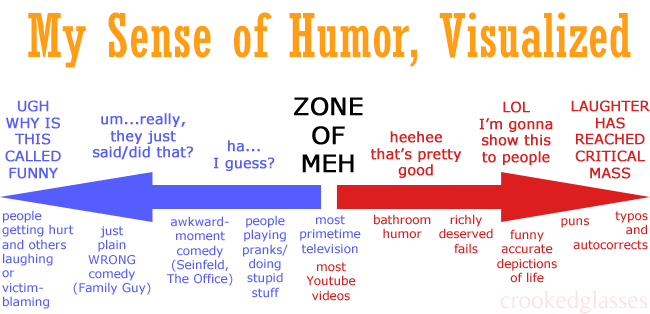
My Sense of Humor, Visualized (Infographic)

This chart is about as accurate as I could muster! I’ve been told many things about my sense of humor (i.e., that it doesn’t exist, or that I don’t laugh at things that are “clearly funny”), but as you’ll see, the “funny” side is just as filled out as the “non-funny” side! Check out the things that will make me wrinkle my brow with disgust, as well as the things that will have me making uncontrollable squeaky laughs of belly destruction. 😀

visualsenseofhumor_infograp

(And yes, I am well aware that the non-funny side includes very popular comedy styles/shows, but hey, everyone’s got an opinion :D)

Let’s Not Shame Depressed/Anxious People

Recently, I read an informative article on Forbes.com called “Mentally Strong People: The 13 Things They Avoid.” I did like the points it made about breaking out of fear and learning how to be patient…but I have to admit, part of the article irked me, too. According to this article, I am mentally weak in at least 10 different ways, and have been since childhood. Coincidentally, I have also suffered multiple lapses of depression and anxiety attacks since at least the age of 8.

Striving toward the goals on this list of mental strengths IS a task worth doing; however, this article casts some forms of “mental weakness” as a completely controllable, chosen way of life. I know better.

What Mentally Strong People Don’t Do, According to This Article

  1. Waste time feeling sorry for themselves
  2. Give away their power
  3. Shy away from change
  4. Waste energy on things they can’t control
  5. Worry about pleasing others
  6. Fear taking calculated risks
  7. Dwell on the past
  8. Make the same mistakes over and over
  9. Resent other people’s success
  10. Give up after failure
  11. Fear alone time
  12. Feel the world owes them anything
  13. Expect immediate results

My Big Problems with This List

Most of these points are valid, and can be adopted by changing your perspective and outlook to match; that’s perfectly fine. Unfortunately, there are a few points on this list that people may not be enduring by choice; I am speaking primarily of depression and anxiety. This article, I feel, goes a little too close to shaming/blaming people who have depressed or anxious thought patterns, such as the following:

  1. “Mentally strong people don’t waste time feeling sorry for themselves.” Unfortunately, when you’re depressed, your life is one big cesspool of “sorry.” Life feels pointless; you find yourself pondering the question “Why am I even here? Why do I exist? Everyone would be better off if I just died so I wasn’t taking up space.” And when depression has argued you into a logical corner like this, sometimes you have to spend half an hour mentally talking yourself into taking a shower, let alone getting out of the house and being “useful.” It’s very difficult NOT to feel sorry for yourself when you see other people being normal and having a good life, and you feel like your ability to live is broken.
  2. “Mentally strong people don’t give away their power.” When you’re depressed or anxious, you don’t HAVE any power anymore–that’s the whole problem. These mental conditions encroach on you like a garbage compactor, slowly compressing your thoughts until they tangle and crunch in on themselves. Other people’s opinions simply pile in on top of these already-twisted thoughts, adding more noise and more confusion to the mess of your life. And God help you if others are judging you harshly for going through this mess, as if you CHOSE this punishing way of life, as if you “could change if you really wanted to.” How INSULTING, and utterly unhelpful–comments like that just make the thought compactor move faster, and you’re even more powerless to change it.
  3. “Mentally strong people don’t waste energy on things they can’t control.” Yeah, except anxiety takes that choice away from you, completely. It doesn’t matter if what you’re anxious about is in your control or not–your brain is going to lock on to it and hang on like a hermit crab. The song of worry plays on and on, endlessly, drowning out most other thoughts, diminishing your appetite, and keeping sleep just barely at bay; it’s like trying to walk against a strong wind.
  4. “Mentally strong people don’t dwell on the past.” Fine and dandy, except when it’s 4 am and your brain has decided to play you a never-ending newsreel of all the horrible things you’ve done or thought about in your life. Depression brings up guilt, which in turn regurgitates your past–except that these memories always cast you as the villain, the outcast, the one who should be hated or destroyed for all the failures and mistakes, all the hurt you’ve caused. Mentally “strong” folks, how would you deal with this, when your own brain turns against you? When you’re depressed, you are mentally drowning in this, every moment, and you can’t just “think positive” or “quit thinking about the past” to fix it.
  5. “Mentally strong people don’t give up after failure.” Failure causes a certain degree of anxiety–that’s a given for just about anyone. In normal folks, that anxiety can propel them to greater achievement later. But in folks like me, who already hate and fear failure as if it means certain death, failure binds up our brains in sticky spiderwebs of anxiety, and depression plays the role of the approaching spider. A failure is one more way you’re weak; it’s one more thing to be guilty about, and depression feeds on guilt as spiders feed on bugs, sapping the will to try again–why bother, when you’re just going to fail again and prove what a waste of space you are?
  6. “Mentally strong people don’t fear alone time.” Alone time? Oh, you mean “Incessant Internal Guilt-Trip” time. Or maybe you meant “Wonder-What-Everyone-Else-Is-Doing-Without-Me” time. Perhaps even “Reasons-I-Should-Kill-Myself” time. My alone time, historically speaking, has been full of this kind of overwhelming negativity, and I’m not the only one to experience it this way–depression wraps your brain in this kind of foggy thinking. Even when you are with others, you feel pretty alone mentally, and when you are alone in reality, the negative feelings double in size, because you don’t have other people helping to drown it all out. Every thought process takes a negative turn whether you want it to or not–it’s like they’re all on railroads headed toward the pit.

My Point: “Mental Strength” May Require Professional Help for Some Folks

If you find yourself able to turn your thoughts around by reading helpful/inspiring articles, then that’s awesome. But for people like me who suffer clinical depression and/or anxiety, some of these points may just be too tough to tackle on our own. I think the Forbes article ignores that, as if all people can just fix these skewed mental mindsets on their own. (I tried fixing my depression on my own, and I ended up worse off than before.)

Think of it this way: we would not ask a cancer patient to administer his or her own chemotherapy, nor we would expect a person to perform his or her own surgery in the hospital. Why, then, does society believe that depressed or anxious people can somehow heal themselves–or that they chose to be sick in the first place? Mental strength is a wonderful goal, but for some, it may require more than just a self-help book to achieve. It may require various forms of therapy, friend/family support, medications, etc. And that’s nothing to be ashamed of.

3 Tips for Beating the Procrastination Bug

I admit it, I’m a full-blown procrastinator, even about things I actually want to accomplish (see: my novel). Sometimes, my brain just REFUSES to do anything, choosing instead to wallow in aimless thoughts, non-essential tasks…or more often, crippling worry about not getting things done. Often I rely on the sheer adrenaline rush of “THIS HAS TO BE DONE NOW” to complete the essential tasks.

I call this “getting bitten by the Procrastination Bug,” and my bug has a particularly venomous bite. The following meme I made over at Quickmeme describes it perfectly:

procrastinationmeme

But there IS a way to conquer this bug! Actually, there are 3 ways I deal with the compulsion to procrastinate:

#1: Got Small Tasks? Good. Break Them Up Even Smaller

Nothing hurts my productivity worse than looking at my to-do list and feeling absolutely daunted by the enormity of my tasks. (And by “daunted” I mean “wanting to either cry or vomit.”) One trick that works: breaking up these huge tasks into itty-bitty sections.

Now, you’ve probably heard a variation of this tip before, but I mean taking it to the next level–break the huge task down into the tiniest pieces you can imagine. (Example: my procrastination on my novel got so bad that I finally set myself up a “100-word-a-day” goal. That’s right, ONE HUNDRED words a day. Not 500, not even 300. And it worked–it got me writing again!)

The logic behind this tip: if you break your task down into things you can do in 5-10 minutes, you’ll be exponentially more likely to do them because they “feel” easier to complete. Plus, if you’re having a “brain-doesn’t-want-to-focus” day, you can complete a couple of these teeny-tiny tasks and still feel productive, which may help reduce your anxiety about your to-do list.

#2: Take Frequent Breaks (With Rewards)

If an essential task on your list is really stalling your brain out, here’s another trick I try: taking a “reward break” for every set number of minutes of work/every part of the task completed. For instance, if I write on my novel for 15 minutes, I could allow myself 15 minutes of TV, aimless Internet surfing, or reading. Or, if I complete one blog post, I could allow myself 30 minutes of gaming time or Internet.

Using the standard “work before play” mindset in this way accomplishes two things at once. First, it trains my brain to like doing the essential task; second, it allows my brain to relax and regroup for a little while before settling back down to work. Having to work on one thing for long, unbroken hours drives me nuts, and makes me less likely to complete the task quickly the next time I have to do it. If it’s associated with rewards and breaks, it makes the work easier to bear.

However, the complete “brain rest” and rewards scenario sometimes just isn’t feasible with the amount of work you have to do in a short time. For those moments, I suggest the last tip…

#3: Have a Rotating List of Tasks

Sometimes, I procrastinate because my brain just doesn’t want to settle–I hop from TV to book to Internet to game to TV to book and so on, making it hard to focus on even things that I like, much less things I have to do. I would call it “boredom,” but it’s way beyond bored; I end up too bored to sleep, too bored to eat, etc. Yet the tasks are still piling up on my to-do list, even as I struggle to marshal my brain into adulthood for a few moments.

This is one reason I have a to-do list that includes all sorts of small tasks due within a typical week–I’ve got a few physical-labor tasks (like cleaning and straightening the house) mixed in with some mental-labor tasks (writing my novel and organizing my digital files), and they are all of various difficulty levels and require different amounts of time and effort to complete. Thus, I can hop from one task to another if the first one is getting too boring or time-consuming, and I can return to it at any point to complete it. Switching tasks gives me a form of brain rest, making my brain work in a different (read: non-bored) fashion.

You’d be surprised how well this works to combat procrastination; you’re actively working on new stuff every 5 minutes or so, give or take, and so you feel instantly more productive and less aimlessly energetic. Plus, you’re likely touching on all the tasks you need to do, so you’ll potentially be getting more work done in the long run even though you’re switching around a lot.

Summary

Procrastination can be a pain, especially when you’re trying to be an adult and get things done; anxiety and lack of focus can keep you from doing what needs to be done. These 3 tips got me through college and grad school (not to mention earlier grade levels!)–I think they’ll help you, too!

Stop Shaming Others for Their Bodies!

tummy

me

What you see above are pictures of me–my belly (top left), and as full-body a picture as I could get (top right). These are unedited, not only because I have no skill with Photoshopping, but because this post is about real bodies–like yours, and like mine. My body, while not being society’s ideal, is still a real body, with its own story, its own weaknesses, and its own beauty. But many people, including me, are made to believe every day that they are abnormal, ugly, and abhorrent because of the reality of their bodies. I believe we in today’s society are still operating with a good bit of weight prejudice (the hatred, fear, and shaming of another’s body based on weight).

My Experience with Weight Gain and Weight Prejudice

As I have written about many times before (in October 2011 most notably), I have been a “big woman” since I turned 11 years old and puberty began in earnest. My body’s general shape has not changed much since then–my belly has been strangling itself against the waistline of all my pants for 16 years, and my hips and butt are still just as big as ever. It’s been hard to accept my body as being “good enough,” because I was made to feel horrible about myself, not only from advertisements but the kids I went to school with. For years, they hurled verbal and physical abuse, plus tried a few tactics that those in the military would probably call “hazing.”

Why “Fat-Shaming” and “Skinny-Shaming” Should Be Called “Weight Prejudice”

The horrible social treatment I endured, which still affects me to this day, is not the only form of weight-shaming that goes on, however. As I have grown older, I have seen how thinner women are shamed for their bodies, too–called out for their “chicken legs” and “mosquito-bite boobs” on occasion, but more often hated by bigger women because they are supposedly closer to society’s beauty ideal. Thinness carries with it its own set of health problems, too, especially if the thinness is brought on by anorexia or bulimia.

My question is: “WHY do we care so much what ANOTHER PERSON’S BODY looks like?”

Think about that for a minute. We don’t live in another person’s body. We don’t have to wash it, feed it, dress it, etc. We don’t even have to look at it if we don’t want to. So WHY is someone else’s appearance so darned important to us?

My answer: because almost all of society is infected with a prejudice about weight. We get mad when someone else’s body doesn’t look like ours, or doesn’t look like we think bodies should. Thus, we shame the person, to make sure they conform to society’s standard. It’s an old psychological trick, and it works every time, especially when the victim of such shaming is a child/adolescent or otherwise emotionally fragile.

This is the very definition of prejudice: judging someone else to be inferior because they look different. So why is weight prejudice so difficult to accept as fact? After all, it can even affect whether or not you can get a job, because employers sometimes view thin people as being “too flighty” and fat people as being “too lazy.” If that’s not discrimination, I don’t know what is.

Why This Has To STOP

Some people, by looking at my pictures, might just assume I’m another fat chick whining about being treated fairly, when what I really need to do is get off the couch and quit eating Twinkies. (This has actually been said to me, so I know people think idiotic stuff like this.) The truth is, we cannot tell much about another person’s lifestyle from their body shape. In some cases, weight packs on due to sedentary living; in other cases, weight packs on or stays on no matter how often you starve yourself or how often you exercise, because of genetics. (Skinny people can endure the same kind of frustration in reverse, not being able to gain weight no matter how much they eat.)

For those who claim they are “only concerned about someone else’s fitness” when they judge on weight: WEIGHT IS NOT THE ONLY MEASURE OF FITNESS! (Can I get an AMEN?!) Things like vital organ functions, muscle strength and flexibility, joint/tendon health, blood pressure, lymph node health, thyroid hormone levels, etc., all play into fitness. Being skinny does not mean you’re healthy, and being fat doesn’t mean you’re not healthy. (This is why shows like The Biggest Loser are so dangerous–they proclaim people “winners” for losing the most weight, when in truth “losing weight” is only one small part of the fitness process.)

We cannot keep hating on each other and judging each other when we don’t even know what other people are going through. If we do, we are simply arguing from ignorance, and we prove our social stupidity with every hateful thought and word. (I’m saying “we” here because I include myself; I have also been guilty of envying others–usually skinny women–based on their bodies.) Remember, all living bodies are in progress; you might think someone else is fat, but they might have just lost 60 pounds and be living better than they ever have. Would you want someone else to judge you like that, after having made such progress?

Bottom line: when you look at a stranger’s body, you are not seeing their medical history, and you are not their personal doctor. Thus, you have NO RIGHT to tell them that they should change their lifestyle just because you happen to be offended by their body. Fat, skinny, or in-between, there is NO REASON that we should shame each other because of weight. Quite simply, it’s not our business what someone else’s body looks like.

Further Reading

To explore the issue of weight prejudice further:

This is what a real yoga body looks like
Let’s Talk About Thin Privilege