Tag Archives: inspiration

OneWord.com: Sixty Seconds of Writing a Day

If you want a little writing challenge, or if you just feel like stretching your creativity muscle a little, then I have a suggestion: head over to OneWord.com.

What’s It All About?

OneWord.com is a unique sort of writing website. When you land on the page, it gives you some simple instructions:

“You’ll see one word at the top of the following screen. You have sixty seconds to write about it. Click ‘go’ and the page will load with the cursor in place. Don’t think. Just write.”

That’s the whole concept of oneword.com. You’re given a word and you just WRITE. Whatever comes to mind, however stupid it might sound to you, however many spelling or grammar mistakes you might make, however trite it might feel, you just WRITE for 1 minute about it.

60 Seconds is Not as Short as You Might Think

The time limit isn’t stressful, even for a person like me who hates being timed. In fact, I find that it forces me to toss aside me self-censorship filter and any other inhibitions that keep me from writing as freely as I wish to.

Depending on how much your Muse runs away with you, you can end up writing almost a paragraph in 60 seconds, or you may only have a few words to say. That’s the great thing about oneword.com; you don’t have to write a certain number of words. Just add your thoughts, write about whatever the “word of the day” makes you think of. It’s completely free-form, and freeing.

Once You’re Done, Submit Your Work!

The website times you, and at the end of 60 seconds, it offers you the option to post your writing with your name/nickname, email address, and website address. (Your email address stays private.)

You don’t have to submit your writing if you don’t want to; some days I just do the prompt without submitting, just as a little exercise. But if you do click “submit,” you’ll have an opportunity to read what others have posted about the “word of the day,” and that’s another treat in and of itself. We’ve got some great hidden writers out there, if this website is any indication!

A Real-Life Example

A few days ago, while I was preparing this post, the “word of the day” prompt was “living.” This is what I typed in as a response:

Living. Existing. Breathing. Moving forward, or at least pretending to. These days I don’t feel like I’m doing much of real living–-am I doing anything worthwhile? Heck, I’m not even making a living, but I’m still here. Maybe that means something, after all. Maybe it’s not completely useless.

Despite my mood of the day, my response had a slightly happier turn than I was expecting. And this 60-second drabble turned out a lot more poetic than has been usual for me these days. I got to tap into a writing vein I don’t get a lot of time to be in, these days, and it was fun! (Isn’t that what creative writing is supposed to be, anyway?)

Summary

Give your Muse a little boost with oneword.com’s bite-sized writing prompts. I promise you, it’ll be painless, and it might just get you out of a writing rut!

Composing Music with Sound Matrix

For composers, musicians, and music enthusiasts, then the Sound Matrix Flash game could be your new favorite Internet toy. I’ve definitely wasted more than my share of time goofing around with it! 😀

How to Use Sound Matrix


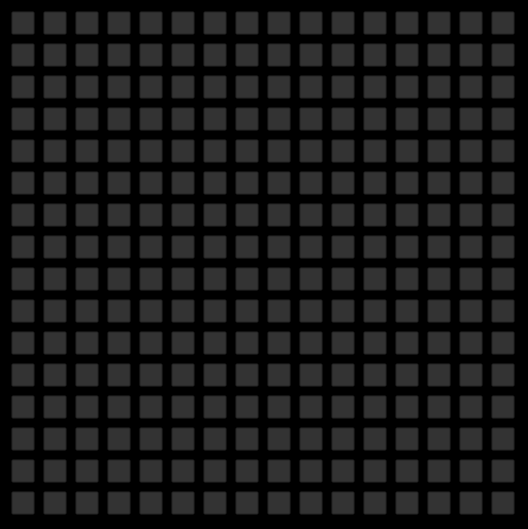
When you load up the game, you are greeted with the above blank gray grid on a black background.


Clicking any gray square on the grid turns it white; the white square will produce a tone every so often. In the above example, this white square produces a B natural approximately every 3-4 seconds, and the little white square lights up when “struck,” such that the whole grid sparkles with it. Very pretty! 😀


For those who might be interested, I came up with the complete musical scale that Sound Matrix can produce. (The uppermost squares produce the highest tones; the lowermost squares produce the lowest.) While this may not look like the most diverse scale, it can actually create quite a variation of tunes!

As for actually composing tunes, clicking squares that are an equal horizontal distance apart will give you a “beat,” which will loop every few seconds. That’s pretty much all you need to know–the rest is just experimentation, play, and happy accidents! 🙂

A Few of My Sound Matrix Compositions

These are a few little tunes I came up with while musing and playing; I had a ton more saved, but I lost them in the Great Hard Drive Crash of 2011. :/ But where those came from, there are plenty more 🙂 The following screenshots kind of serve as “sheet music” for Sound Matrix:


“Celebration in A Major”


“An E-Z Groove”


“Latin Dance in B Minor”


“Triplets in E”


“Fast Club Jam in B Minor”

Incredibox, aka “The Musical Sandbox I Can’t Quit Playing In”

Thanks to Stumbleupon, I found this awesome little Flash tool called Incredibox, which is my new “musical sandbox.” I like it so much I wanted to honor it in this week’s creativity post, because it certainly makes me feel more creative!

How to Use Incredibox


After it loads, you’re greeted with this screen, where one little guy waits to make your beatbox club dreams come true.


Click and drag one of the colorful icons to the guy’s hat, and he’ll start making a beatbox sound–there are various beatbox effects, such as bass, beats and breaks, melodies, and other vocal additions.


As soon as you add one effect, another little guy appears, so that you can keep adding effects to create your own song.


As the above picture shows, you can have up to 7 effects going at one time!


If you want to get rid of an effect, you can hover over the character making the sound and click the “X” in the box that appears.

Recording and Sending Your Tune


Once you’ve hammered out exactly what effects you like and how you want to put them together, you can click the circle button (top left) to record your song.


This is what it looks like when you’re recording–a strip appears across the top showing how long the recording is going. Maximum recording length is 30. If you need to stop the recording for whatever reason (if you misclicked or waited too long to start/stop an effect, for instance), you can click the circle button again (it becomes a square when you hover over it).


After it’s recorded, you can review it, and then save and send it via email, Facebook, and/or Twitter to your friends!


For inspiration, here’s a little tune I made and recorded using Incredibox–I call it the “Pensive Club Jam”. 😀

Give Incredibox a try and see what kinds of cool grooves you can make! I literally spent an hour the other day while writing this post playing with it…it’s addictive!

(PS: Happy birthday to me! :D)

Culinary Creativity: Twists on Old Favorite Recipes

It takes an average cook (like myself) to successfully craft regular recipes in the kitchen. (“Success” meaning that the food is edible and the kitchen isn’t burnt down. xD) But it takes an excellent cook, and a creative one, to start improvising on old standard recipes and using staple ingredients in different ways.

For this week, I thought I’d showcase 10 amazing recipes I found on Punchfork.com, all using familiar foods, but with innovative new spins. (Even more amazing? All 10 recipes suit my picky taste buds!) Get ready for some foodie inspiration!


Baked Chicken Nuggets

Cheddar Bay Biscuits

Sausage & Cheesy Hashbrown Popovers

PB&J Roll-Up Cookies

French Cheese Puffs

Chocolate Peanut Butter Cup Cupcakes

Duchess Potatoes

Chicken & Spinach Rollatini

White Chicken Enchiladas


Chicken Pot Pie Soup

BONUS!

Check out PickyPalate @ Punchfork.com to find even more creative recipes. (You have to be pretty innovative to please a picky eater!)

Today is a Good Day to Write

[Trekkie points for you if you got the Lieutenant Worf reference in the title]

Today’s post is simple but essential for all us writers to understand: any time can be writing time. The planets don’t have to be aligned just right, and the stocks don’t have to be up; it doesn’t matter if all the stuff on your desk is organized just so (unless you’re OCD, in which case it does :P).

My point is, you don’t have to wait for the perfect atmosphere and perfect setup to be able to write. In fact, if you wait for the “perfect time,” you’ll be waiting forever. Don’t hold yourself to just writing on a certain day or at a certain time of day, or just writing in one specific room on one specific desk–take inspiration wherever and whenever it comes.

This is where the old-fashioned portable notepad strategy comes into play, writing down ideas as they come to you. These days, however, the “notepad” could be a smartphone or tablet just as much as good ol’ pen and paper. However you choose to keep track of your ideas for stories, poems, and the like, make sure you note them somewhere and don’t let them float off into the ethers of your mind.

And lastly: when you DO write, think positively about your writing experience. Don’t focus on the drudgery of trying to get to some arbitrary “number of words” goal, and don’t keep thinking about how difficult this particular scene is to write. Think instead about how awesome it is to finally put this scene down in writing, after months of seeing it flash through your head.

Today IS a good day to write. Keep in mind that you’re the creator of this little world on paper (or in a digital file), and you can direct it anywhere, at any time, in any amount of words you choose.

Don’t Hate and Fear Criticism

I will admit it plainly: I don’t usually respond well to criticism. I may not rage and throw things like a child, nor do I throw temper tantrums as I actually did in childhood, but I don’t take it well. There are times where I’ve worked to put heart and soul out there on the Internet, only to see it torn to rags by the slavering opinions of others. In those instances, I’ve often just deleted the content, hiding it from further opinion…or I’ve just sat at the computer and cried. Neither response is a healthy response to criticism, yet it appears to be the first response for me.

I would venture to say that most of us probably dislike criticism; I don’t think anybody likes to admit that their work has flaws that someone else saw. But we can change our response to criticism to a healthier one, if we work at it. That’s what the following post is all about.

Step 1: Admit How You Relate to Criticism Now, and Why

Taking criticism “like an adult,” not letting it bother you, is the ideal for most of us. But unfortunately, that ideal is very, very hard to attain, especially if you can’t admit to yourself that you don’t deal with criticism well.

Like I stated at the beginning of this post, I myself struggle with it, though I thought it bothered me less these days than it did in childhood. I was wrong, though; I may be able to hide my reactions to criticism better, but I still hurt over it. So I sought to discover my personal reasons why criticism hurts me more than it should, and I came up with the following three:

My Three Reasons for Hating/Fearing Criticism in the Past

  • I am a sensitive person, far more attuned to emotions and to everyday life than most people I know. This sensitivity makes me a much better artist; others have found my music and writing to be unusually cathartic and soothing. However, being this sensitive also makes me hyper-aware of others’ opinions, especially the negative ones.
  • I am both obsessive-compulsive and perfectionistic. My flaws and failures haunt me, sometimes keeping me from sleep and normal emotional function, and I experience strong compulsions to either eradicate the flaws themselves or to punish the person who failed–myself. (Example: as a child, I struck myself on the back of the head 30 times because I made a 99 instead of 100 on a test. The memory of that almost-but-not-quite-perfect grade still makes me irrationally angry at myself, two decades later.)
  • I was bullied often and brutally by my classmates in childhood, partly because of my sensitivity and partly because of my visible perfectionism. The only way I could get my bullies to shut up? To make better grades than them, to be academically better than them. That mentality has carried forward into my adult life, in the form of being a well-prepared, conscientious, and yet overly anxious person.

What are your biggest reasons for hating and fearing criticism? Note these for yourself; really dig into your own thinking, as I have done above, and root out the basic causes. It’s surprisingly enlightening; I didn’t think my childhood experiences of bullying were still that important to my thinking, but they are!

Step 2: Acknowledge This Reaction as Human

The reasons I detailed above have shaped my art and my personality over time, in positive ways as well as negative. But to people who have harder shells and thicker skins, I am a laughable excuse for an adult. Some cynical people in my past (and my present) have labeled me a coward and a crybaby, or have laughed at my sensitivity and told me to “grow up.” Others have critiqued my most highly-polished works with a throwaway comment like “your work sucks” or “you’re stupid,” and the only comeback I can think of is “Well, YOU try it if you think you can do better!”

The thing is, I’m secretly terrified that the ones who criticize me are right. I’m scared that my absolute best efforts are not worth anybody’s time, and that no one will like them. In my mind, I associate myself deeply with my opinions and works–they are part of my self-worth because they come from within me. If they are attacked, then in a very real sense I’m being attacked. If they are found lacking, then I am found lacking by association.

To my obsessive, perfectionistic, sensitive brain, to be found lacking is a cardinal sin. But this is still a very human reaction to criticism. No one truly wants to be seen as “less than”–we all want to be the best at something, to have the admiration of others because of something we do well. Failure, in the form of criticism by others, makes us doubt our own self-worth, doubt whether we can keep doing the work that was critiqued, or even lash out at the person who dared to critique us.

However you react to criticism, whether it’s to doubt yourself, quit trying, lash out, etc., it’s a human response–acknowledge it. Know that while it isn’t the best part of your personality, it is part of it, and it doesn’t have to be a ruling trait in your personality, either. I’m finding that out for myself.

Step 3: Rethink Criticism’s Purpose

Is criticism by others really a personal “failure?” Actually…it’s not.

Think about this for a moment. When you receive criticism–and I don’t mean thoughtless, throwaway criticism, but really thoughtful and thorough criticism–haven’t you just made someone else think and feel enough to want to respond? Didn’t your words, your art, or SOMETHING in what you said or did strike a chord in someone else, even if it engendered a little disagreement?

I would say yes. And if that’s true, then how could that be failure? After all, your efforts have made someone else respond, and that someone took enough time to put together their opinions on what you said or did–you affected them, quite possibly in a positive way, by making them think.

(One side note here: when you receive critiques on your work, it’s important to sift out the people who just left you a one-line “this sucks” kind of comment. Since these people didn’t take any time to enumerate their reasons behind their opinion, who cares what they think–they are likely only jealous that you did something they couldn’t. Instead, focus your attention on those who have given you thorough critical feedback.)

This more thoughtful kind of criticism, what is generally called “constructive criticism,” can actually help you make your work even better. Of course, most of us would prefer for our ideas to be “right” or “good enough” without anybody else’s help, but just as jewels must be polished to see their brilliance, sometimes our ideas must be polished by others’ opinions and input to bring out the best that the idea has to offer.

For me, this was a difficult but necessary realization. Just because I produced a flawed work that has garnered some criticism does not mean I am unworthy of anyone else’s friendship, time, or love, as I have so often feared. Thoughtful criticism, instead, can be used to make the work even better, to bring the idea to its full flower instead of killing it. The useful kind of criticism is more about shaping and honing the work rather than critiquing the mind behind it.

So when someone else takes the time to critique our works in depth, perhaps the better response is to thank them and ask them to elaborate on what they would change, add, or delete. We get very protective and defensive of our ideas, precisely because they came from within us–but if we realize that others’ opinions are helpful to the process of creation rather than a reason to quit, our ideas and works just might be better for it.

Summary

We human beings don’t like criticism very much, especially when it’s directed at something we’ve worked hard on. But as much as we might hate it (or fear it, in my case), it can be a useful tool for us as we come up with new ideas of every sort. Perhaps that rough-cut diamond of an idea in your head is going nowhere, but with the helpful opinions and ideas of another person (or 50), that diamond might just start to sparkle. 🙂
Bead Textures: Sparkly, Pearly, or Metallic

What is “bead texture,” you might ask? Bead texture (not just how the bead feels, but how it reflects light) makes a distinct visual difference–a sparkly blue bead will catch more light and be less subtle than a pearly blue bead will, etc.

Today, I thought I’d feature a few examples of favorite bead textures I like to use in my jewelry projects, so I can draw the eye better to my necklaces’ focal points, and create lovely earrings that complement rather than detract.

Sparkly Beads: For Centerpieces and Catching the Light


Swarovski Victory Pendant


Swarovski Teardrop


Fire-Polished Beads

Metallic Beads: For Secondary Designs and Setting Off Focal Points


Shamballa beads


Casbah beads


Hematite Ovals

Pearly Beads: For “Background” Colors and Soft, Subtle Enhancement


Silver-Blue Glass Pearls


Pressed-Glass Beads


Mother-of-Pearl Melon Strand

What to Do With These Beads?

In my designs, I like to mix and match sparkly textures with pearly or metallic, to naturally draw the eye to certain parts of the necklace or earring and let the other patterns recede into the background.

The sparkliest and most eye-catching beads are generally the ones I reserve for the main focal point of the necklace, though sometimes I’ll “hide” a tiny sparkly bead in between a couple of equally-tiny metallic or pearl beads, just for a little extra interest.

Metallic beads, I find, are great for spacing apart pearl or sparkly beads–they are the “in-between” texture, since they can function as light-catching, but they can be less so if they are darker in color. Thus, they work great in just about any kind of project, no matter the length or complexity. You just need to make sure the color of the metal complements the other beads you’re using!

Though sometimes I’ll use a whole necklace of pearl beads, I generally like to intersperse them with metallic or sparkly beads, since their more subtle shimmer pairs well with the shinier textures. It seems they help set off the colors in the sparkly beads, especially if they are in the same color family.

Patterns and Project Ideas

Now that you’ve got ideas for using different beading textures together, here’s a few links to get you started on various beading projects and patterns. Happy beading! 🙂

Off the Beaded Path Project Ideas and Patterns
FaveCrafts.com Beading Patterns
KandiPatterns.com Bead Design Tool
CraftBits.com Bead Craft Ideas
OrientalTrading.com Beading Projects

Songs to Inspire the Creative Impulse

When I’m feeling generally down or just not inspired to create anymore, sometimes I use music to help me get back some of those drained creative juices. So I’ll turn on a little music to make me happy, or some music that makes me want to achieve the same kind of beauty I’m hearing. It always works–sooner rather than later, my mood is lifted and my Muse is hard at work again.

Here’s a short playlist of songs that work for me, to make me happy and excited about music all over again. Listen through and enjoy!

Songs for a Happy, Inspired Creator


Flashdance (What a Feeling) – Irene Cara


Uptight (Everything’s Alright) – Stevie Wonder


Shout – The Isley Brothers


The Touch – Stan Bush (from Transformers)


(I’ve Had) The Time of My Life – Bill Medley and Jennifer Warnes (from Dirty Dancing)


When Love Takes Over (feat. Kelly Rowland) – David Guetta


How Will I Know (Junior Vasquez Mix) – Whitney Houston


Let’s Get Loud – Jennifer Lopez


That’s the Way It Is – Celine Dion


Pyramid (Dave Aude Radio Edit) – Charice


Somewhere Only We Know – Keane

Songs to Make Me Want to Sing and Play


Bloody Tears from Castlevania II: Simon’s Quest (performed by Rey Tang on Youtube)


Lux Aurumque – Eric Whitacre’s YouTube Choir


To Zanarkand (from Final Fantasy X) – Final Fantasy Orchestra


Saltwater – Chicane


Speak Softly Love – City of Prague Philharmonic Orchestra


Radical Dreamers (Instrumental) – Yasunori Mitsuda (from Chrono Cross)


All I Ask of You (from Phantom of the Opera) – Sarah Brightman and Cliff Richard


Water World Theme (from Super Mario 64) – Koji Kondo


The Call – Regina Spektor


Before Dawn – Isaac Shepard


I giorni – Ludovico Einaudi

In Remembrance: My Music Teacher

Last Friday, my music teacher, Mrs. Myrtle Mashburn, passed away at the age of 97, having taught more than seven decades’ worth of piano and voice pupils over her long career of teaching and enjoying music.

As one of those many students, I came to the visitation and the funeral flooded with memories of my eight years spent studying piano and voice with her during my elementary, middle, and high school years. And I thought: “What better way to honor her publicly than to write about her impact on my life in my weekly “creativity” article?”

How I Met Mrs. Mashburn

This amazing lady not only taught me piano and voice, but she had also taught my dad to play the piano 40 years earlier. When I was a kid and beginning to show interest in learning to play the piano, Mrs. Mashburn was the first person my dad thought of, and we were all pleasantly surprised to find that she was still teaching piano and voice at the age of 79.

So my first memories of Mrs. Mashburn came down to me through Dad’s retellings, even before I met her officially. Dad remembered her as an energetic, encouraging younger teacher; the lady I met was simply a white-haired version of that unbeatable spirit, showing her joy in music not only by playing it herself, but by teaching others how to play and enjoy it as well.

As a girl of 10, I couldn’t wrap my mind around the fact that she was so “old” by the world’s standards, and yet seemed no older than my parents. But that was Mrs. Mashburn’s personality–the years just didn’t seem to affect her mind or her hands, even as they affected the rest of her health a rare few times. She maintained a lively (and fairly large) group of private piano and voice students every year, even into the summers, and held recitals at the end of every school year.

Favorite Memories

Mrs. Mashburn recognized from the beginning that I had a good ear for music, but when she discovered I was relying on that ear a little too much and not learning how to read music properly, she sought to fix that, working with me on really learning how each note was written on the page. Even though I disliked trying to read the notes off the page at first (it was so much slower than just hearing the music and playing it back), she reminded me that if I didn’t learn these notes, I would always be dependent on someone else to play the music for me first. “You learned to read books quickly–your parents told me–so I know you can learn to read music just as easily,” she said, without a shred of doubt in her voice.

That certainty never wavered, even as I grew up and sometimes got out of the habit of practicing as much as I should have. Another of my favorite memories comes from a practice session in which I royally screwed up a difficult piece of music, and a curse word slipped out before I was aware I had spoken. I realized what I’d said a half-second later, and in the middle of apologizing all over myself, she burst into laughter, saying, “It’s nothing I haven’t heard before! Just start back at measure 38 and go from there–it’s all right.” She was great at handling mistakes, even off the keys. 🙂

The yearly recitals Mrs. Mashburn held generated another memory; one of the youngest piano students froze up during a recital and couldn’t get past a certain part of the piece she was trying to play. She tried a couple of times, and she looked like she was about to cry, and then Mrs. Mashburn came up and whispered something to her. I don’t know what it was, but the little girl’s face brightened, and she started the piece again–this time finishing it! The situation could have been so awkward, but somehow, Mrs. Mashburn knew what to say so that she would encourage and not embarrass the little girl. It was a sweet moment, and one that brings tears to my eyes remembering it. :’)

I remember that we always had a good mix of ages at recitals–there were always students who were just beginning, some who were fairly far along but still learning, and then the about-to-graduate crowd who were already so awesome. 🙂 Though we often didn’t see each other much except for at recitals, Mrs. Mashburn always encouraged us to be supportive of each other and helpful. Even when her health began to fail (arthritis, especially), she never seemed to hesitate in taking on a new student and working with him or her to teach them the same joy of music that she felt. And believe me, each of us students understood how wonderful music could be when she taught it!

What I’ll Miss Most

In a very real sense, Mrs. Mashburn brought together a little mini-community of music students and performers, across the decades. At her funeral on Monday, two-thirds of the 100+ people present were her former students, ranging in age from early twenties to mid-seventies (at least!)–we were all bound together by the music and the life of this one woman, who had guided us in how to play music, as well as encouraging us in our own personal studies of music. I don’t know if anybody else could do what she did…she was remarkable.

I’ll miss her dedication and joy the most, though I know she’s gone back to accompany the angels in their hymns. I hope I’ve done her life credit; to be caught up in that energy and love of music, even for a short while, made such a wonderful difference in my life. Thank you, Mrs. Mashburn, for giving us all that gift. 🙂

Repurposing: Creativity at Work

When you clean out cluttered spaces, as I’ve been doing for the last four weeks, inevitably you end up finding items that you haven’t used in a while, or don’t need for their original purpose anymore.

But, instead of spending a ton of money re-buying things you think you need, you might be able to keep more of your money in your pocket by repurposing all the surprising treasures you’ve uncovered. This is where creativity comes into play–it’s an unusual outlet for creativity, I grant you that, but if it saves you money in the long run, why not try a few of these tips?

Step 1: Quick-Evaluate Every Item

While you’re cleaning out, give every item you find a once-over, and mentally answer the following questions:

  • Is it warped/broken beyond repair?
  • Is it too dirty to ever think of using it again?
  • Is it unable to be cleaned/sanitized?

These are “deal-breaker” conditions for repurposing. If it’s too broken or dirty, it may be better to just throw it out instead of wasting time trying to save it. (Trust me, sometimes it’s just not worth the effort…LOL)

However, if you run across an item that doesn’t meet any of this criteria, set it aside (preferably in a different room so you don’t accidentally throw it away) and keep working. Once you’re finished sorting clutter, come back to your gathered items for Step 2.

Step 2: What Could This Item Be?

Now for a little bit more evaluation–this time, you’re studying each item a little more closely. If you no longer want to use it for its original purpose, what could it be instead?

To jump-start your own “thinking-outside-the-box” repurposing process, here’s a couple of repurposing examples from my own cleanout sessions:

Example #1: The Towel Rack Turned Scrunchie Holder


I found this brushed-metal standing fingertip towel rack on clearance at Walmart and bought it, but it sat unused for a while…that is, until I realized I needed a way to display my hair scrunchies without having them strung all over the place.


I needed something to thread them on, something that was sturdy enough to hold them all but didn’t require me to dig through a box to find them. (This pic shows only a small sample of how many scrunchies I have…yes, I’m a child of the ’90s, why do you ask? LOL)


I’m aware that the terrible quality of this pic makes this look like a clown wig gone mad (LOL)…but this is actually how the towel rack looks with all my scrunchies threaded onto it. It works great for organization, looks nifty in the bathroom, and keeps all my scrunchies from getting lost/dirty.

Example #2: The Spice Rack Turned Perfume/Lotion Display


When I redid my bathroom organization, I ended up with a lot of perfume and lotion bottles, and nowhere to store them–or, should I say, no attractive way to store and display them. On a hunch, I went and bought this painted-metal spice rack from Walmart, noting that it had three stacking levels which left a little room for items underneath.


…And here’s the way it functions in my bathroom, holding all the perfume and lotion bottles I own. The graduated levels mean that I’m no longer trying to reach around several bottles to get to one; the bit of storage space underneath serves to tuck away countertop necessities when I need to.

Step 3: Prepare the Item for Its New Life

After you’ve figured out what you want the item to become, clean it up (dust, sanitize, etc.) and make sure it won’t break or come apart when it’s being used for its new purpose. The cleaning/sanitizing part is very important–you don’t want your “new” item making you sick! Also, if it’s got any small pieces that could pop off unexpectedly, check those and make sure those are reinforced. No need for any unpleasant surprises when you’re using your newfound item!

Once you’ve cleaned it up and made sure it’s tough enough to withstand a second life, you’re ready to put your old-new item to work! 😀

Summary

Cleaning and decluttering doesn’t have to mean that you’re throwing away everything. In fact, if you repurpose a few things as you clean and declutter, you can save yourself the trouble of having to re-buy materials in the first place. Always a good thing when you can save money and trouble!