Tag Archives: inspiration

Two Choirs, Two Different Singing Experiences

For the past couple of years, I’ve had the privilege of being able to sing with two different choirs–my local Choral Society and my church choir. But I hadn’t really stopped to think about how differently each choir affects my life, and how differently I sing in each setting. Both provide me with uplifting experiences, as you’ll see!

Choral Society: Performing with a Community of Singers

In my local Choral Society, I sing with a variety of other people in the community–some who have trained in professional solo singing, some who just enjoy singing for its own sake, some who also perform in small ensembles, some who use their voices as part of musical theater, etc. The common thread that binds us is that we all enjoy the craft of singing, and we’re all pretty great at it.

Because of this, I feel myself lifted to a higher standard of singing when I rehearse and perform with this group. I’m in the midst of lovely voices, and I have the honor of adding my voice to this. Within Choral Society, I can use my abilities to hold up the alto part, and both hear and see how our voices blend together in graceful swirls of colorful melodies (thanks to my synesthesia).

Church Choir: Performing for God

In church, I’m still singing alto with a choir, but I’m performing with a group of people who love to use music to praise God. That is our form of worship, to use our voices to tell about God’s power and grace; that is what pulls us together as a choir.

Because of this, I am less concerned with being as perfect as possible during “rehearsal” and “performance”–those two words don’t even really fit church choir, because every time you lift your voice in church, it’s just for God and no one else. Instead, I concern myself with understanding the meaning of the text we’re singing, letting that meaning move me emotionally, and allowing that emotion to be seen and felt through my singing.

And Yes, Both Experiences Are Perfectly Valid!

The best part about being able to sing in both of these choirs is that each experience brings me joy in a different way. In Choral Society, I enjoy music for music’s sake, and enjoy the process of learning, polishing, and performing choral works with others who are just as passionate about singing as I am. In church choir, I use music as a way to speak to God, reaffirming my own salvation story and experience of God every time I sing with the choir.

I enjoy both choirs, but for different reasons, and it’s a rather unique experience to have both those experiences in my life. I love that about the arts–they are so malleable that they work into every area of your life and give it a little touch of awesome.

The Creatively DIY-ed Life

For this week’s creativity post, I thought I’d showcase a selection of DIY projects. After all, there’s a lot of creative license–and a lot of fun!–in making useful items for your home and life. From little decorative items to organizational tools, from wall art to pieces of furniture, there’s literally nothing you can’t DIY…as the following slew of pictured tutorials show! (See the link below each picture for the tutorial!)

chipmunk-glove
Glove into Chipmunk
diy-masonjar-candle
Mason Jar Candle
lace-lamp
Lace Lamp
necklaceorganizer
Necklace Holder
magazine-wrapping-paper
Magazine Wrapping Paper
rose-print-stationery
Rose Print Stationery
canvascollage
Canvas Collage Quotes
tieredtrays
Tiered Serving Trays
mason-jar-planter
Mason Jar Wall Planters
upholstered-ottoman
Upholstered Tufted Ottoman
memoryboxtable
Memory Box Tabletop
outdoor-chandelier
Outdoor Chandelier
cherryblossomart
Cherry Blossom Art from a Soda Bottle
laddershelf
Ladder Shelf
bedsidetable
Bedside Table
pillowheadboard
Pillow Headboard
tendollar-potrack
The $10 Pot Rack
diy-spicepacket-organizer
Spice Packet Organizer
napkinpillows
No-Sew Napkin Pillow Covers
ribbonshelftrim
Ribbon-Trimmed Shelves
marbledglassware
Marbled Glassware
maps
Pinterest Challenge: Map Art
dryingrack
Wall-Mounted Drying Rack

For More Ideas

ApartmentTherapy.com’s DIY Showcase
31 Insanely Easy and Clever DIY Projects @ Buzzfeed.com
Best DIY Projects Ever @ CasaSugar.com
Weekend Home Projects @ BHG
DIY Projects Around the House (Pinterest board)
LifeHackers’ Top 10 DIY Home Projects
TLC’s DIY Projects and Advice
DIY Home Projects (Pinterest board)
CountryLiving’s Weekend Home Decor Projects
The Daily Green’s Best DIY Projects

A Day for Writing–Literally

A few Tuesdays back, I wrote about how the Alarmed iPhone app has revolutionized the way I do household chores, schedule blog posts, and do a whole bunch of other things. In short, it’s made me much more organized and on-time doing things. Now I have entire days set aside for things like cleaning the kitchen, tackling cluttered areas of the house, posting all the blogs for the upcoming week, etc.

But I did not mention that this app has also revolutionized the way I write…because I simply did not think of it as a “writing app” until about two weeks ago.

How did a reminder app change my writing habits? Simple: I set aside a “Writing Day” reminder, just like I set aside a “Kitchen Day,” a “Clutter Day,” etc.

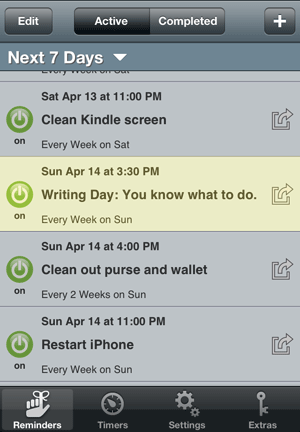
writingday This screenshot from my phone shows how Writing Day falls on Sunday every week, sandwiched in between mundane, tiny little tasks. Sunday afternoons are the times I can finally wind down for the week and recharge for the next–it’s a time of reflection, and more importantly, a time of just being able to BREATHE. No one needs my time, no one really needs me to do anything–everything for the week is done, and my time is my own. In short, it’s the PERFECT time to write.

I’ve left myself a simple instruction, too–“You know what to do.” Because I do know what to do on Writing Day–just write. I can write in my novel, I can write in a fanfic or two, I can write anything I want as long as it’s creative. That’s the only rule.

Has This Helped? YES!

This app has already helped me move ahead three pages in my novel. Though it might seem paltry, three pages is a victory, since I’ve been stuck in one place for nearly a year.

Before making a specific “writing day” reminder, I had had a hard time making time to write. It seemed I wrote all the time, either doing blog posts like these, preparing my Sunday school lessons to teach on Sunday, or writing website content…but I hadn’t really done much creative work aside from just little random bits here or there. I ended up almost burned out on writing, just not feeling like I had the energy to write anything when I had free time.

When I finally set aside a special “day” to write, boy, did that change. I’ve begun to write more on my novel, and I’ve started looking forward to Sunday afternoons as “my time,” even. Just allotting a special day of the week to writing makes me feel less anxious about accomplishing my creative writing goals, and less anxiety = more productivity. This is a HUGE change for the better. I don’t force myself to produce a certain number of words or pages when I write this way–I just relax, get rid of all my anxiety about “getting things done,” and just enjoy the process.

Making a “Writing Day” for Yourself

  • Choose a day of the week which is less busy than all the others, or which has mostly non-writing tasks. This is important–you don’t want to be mentally “burned out” on writing before you even begin.
  • How much time do you have during that day? According to your schedule, budget in a block of time to write. It can be 15 minutes, one hour, 3 hours–whatever time you have free.
  • Create a consistent reminder for yourself, either on your phone/computer as I did, or place a paper note somewhere where you will see it every day.
  • When your chosen “writing day” comes around, just write SOMETHING creative. If it’s a few words, awesome. A few lines or a paragraph? Great! A whole page, or even a bunch of pages? Amazing! Count it all as progress, because it is.

I hope this helps you get back on track with your own creative writing–it certainly has helped me!

3 Tips to Revolutionize Your Creative Writing

After having been stuck on my novel for the better part of a year, I knew I had to do something to light the spark again. I looked at all I’d accomplished so far, and I found myself asking, “How in the world did I ever get to 50,000 words, let alone 150,000, when these days I can barely be bothered to come up with 500?”

You might feel just as stuck in your own creative writing process. It may feel as though those cogs and gears will never turn again, that they are rusted into place. But I have 3 tips that have helped my own writing engine begin to turn over, and they just might help you. It doesn’t hurt to try!

#1: Write What You Really Want To

You have to give yourself a compelling reason to write again once your engine has stalled out for a while. So, if you have an idea that’s simply bursting to come out of your head, write it down. It doesn’t matter if it has anything to do with your current projects or not; write it. If it’s a very future part of your novel, several chapters ahead of where you are now, go ahead and write it–you can connect the plot dots later. If it has nothing to do with anything you’re currently trying to write, go ahead and write it anyway; it’ll help keep those creative wheels greased.

For example, I have several ideas for future chapters of my novel–let’s say these are going to appear in Chapters 14 and 16. But right now, I’m stuck back on Chapter 7 or so. Very, very annoying! But I can go ahead and write those very far-flung chapters; who knows, it may spark an idea for how to finish Chapter 7, and how to build up chapters 8-14 to those next plot points!

#2: Don’t Make Writing a Chore, Make It an Escape

When something’s a chore, it’s not very fun, is it? We dread it, but we put it on our schedules in an attempt to make us do it. Yet many of us creative writers try to mold our writing schedule into “daily writing” programs, or try to follow those “write X number of words daily” plans…and we end up hating to write, where before we had loved it.

I don’t mean to disparage such motivational programs; if they work for you, then do them gladly. But for me, such programs create more anxiety than they solve; I end up anxious about not completing the programs or following the plans to the letter. And believe me, when writing gets associated with anxiety or boredom, you’re in deep trouble as a creative writer. That’s what I’ve run into with my own novel this last year–it’s not that my novel bores me, but that the situation I’m writing is hard to write about. I’ve become so anxious about “fixing” it that I have hobbled my writing ability. Sounds ridiculous, but it happened…and it happens to many more writers, I’d wager.

So, how to break free of this? Make your writing something you do when you need to wind down, something to reward yourself with when you’ve finished a real chore, or something you do when you want to cheer yourself up. Make it an escape, like a favorite book you can’t put down, a favorite food you look forward to eating, or a favorite place you love to visit. Make it FUN again, make it the process of discovery and creation that it ought to be, instead of hedging it about with tons of rules. If you’re like me and have problems following overly structured plans, this might just spark your engine again.

#3: Let Dreams Inspire You

Have you ever woken up from an incredibly intense dream, only to have certain scenes stick with you throughout the day? How about using these scenes as inspiration for your writing? Whenever you have dreams like this, write down the most vivid scenes from the dream in as much visual and sensory detail as you can remember–then save that scene where you can find it easily. You never know when that dream scene may become fodder for a future plot detail! (Being a pack rat is okay in this case!)

For instance, I dreamed a very powerful, evocative scene for a future subplot in my novel about a year ago–I actually woke up weeping and shaking, and it stayed with me for hours. I know it will be a very painful scene to write when I put it into my book, but it will also be a point of great character development, too. So I’ve written some quick notes about it and it’s sitting in my novel file on my computer, waiting to be used alongside a few other little scraps of dreams I’ve written down. The others may never make it into the book, but they just might!

Summary

I hope these three tips help your writing engine start again. Remember, just because it hasn’t cranked in a while doesn’t mean it won’t crank ever again. Unlike old cars, our brains are never rusted!

The Internet: A Creative Crafter’s Paradise

Are you a crafter and feeling lonely or uninspired in your work? Wish you had someone to ask about how to accomplish certain pieces, how to think outside your own little box?

In that case, the Internet is your best friend. Today, I’ll showcase the websites I’ve found in my search for informative and helpful crafting sites for any and all sorts of crafters out there.

Skip to: For All Crafters | Specific Craft Sites | Buy and Sell Crafts | Craft Site Directories

For All Crafters

Community/Help Sites

Craftsy.com
WhatTheCraft
Craftster.org
FunkyFinds.com
CraftGossip.com
Craftgrrl Livejournal Community
CraftsFairOnline
BuildALittleBiz.com Blog
HandmadeArtists Forums
GetCrafty.com Forums

Tutorials

Craftgawker
TipJunkie
Instructables
TipNut.com
OnePrettyThing
HowDoesShe
Arts and Crafts @ VideoJug.com
Makezine.com Blog
TaterTotsandJello
Little Lovelies By Allison
DIYNetwork.com
TheFrugalGirls.com
DesignSponge.com

Inspiration/Ideas

ImaginativeBloom.com
Prima Marketing
MollieMakes
Craftzine Blog
Craftsnob Blog
Crafts @ Curbly.com
ShareSomeCandy.com
NorthernCottage.net
ArtisticBliss
U-CreateCrafts.com
Mayaroad – Creating Stuff
Two Crazy Crafters
TheScrapShoppeBlog
On My Desk
Supernaturale
PrimitiveCrossroads.com
Crafts @ TheDesignFiles.net

Freebies

JustSomethingIMade.com
HelloCuteness
FreebiesForCrafters
Crafts-Beautiful.com
FreePatternSite

Craft Supplies

Michaels
Joann.com Crafts
Hobby Lobby
WoodTurnersCatalog.com
ConsumerCrafts.com
FactoryDirectCraft
Blumchen.com

Craft for a Cause

Ladybird Lends a Hand
Charity Wings News
Beading to Beat Autism
Beading for a Cure

Specific Craft Websites

Scrapbooking

Scrapbook.com
CreativeMemories.com
JessicaSprague.com
A Cherry on Top
My Mind’s Eye
PaperCraftersAnonymous
Scrapbooking101.net

Papercrafts

Cubeecraft
PapercraftsMag.com
PaperCraftersAnonymous
PapercraftParadise
PaperPastime
PaperShapez
Graphic 45 Papers
ISharePrintables

Beading/Jewelry

CraftMemo
Beadage.net
BeadingDaily.com
Beading.com
Interweavestore.com Beading
BeadingTimes.com
You’ve Got to be Beading
Around the Beading Table

Edible/Food Crafts

LiveLearnLoveEat
Tastespotting.com
Edible Crafts (Pinterest)
FunFamilyCrafts.com
TheFarmChicks
EdibleCrafts.CraftGossip.com
EdibleCraftsOnline.com
EnchantedLearning.com

Stamping

Stampin’ Up!
StampingBella.com
CraftySecrets.com
Split Coast Stampers
StampingSchool.com
Stamping.CraftGossip.com
MyCraftyWorld
My Favorite Things Stamps

Fabric Crafts

Lots of Pink Here
See Kate Sew
PurlBee
Knitty.com
CrochetMe
Interweave.com
Threadbanger @ Youtube
How About Orange
HappySeamstress.com

Kids’ Crafts

The Chocolate Muffin Tree
Red Ted Art
Crafts By Amanda
Mud Pie Studio
NaturallyEducational.com
Filth Wizardry
Mia’s Craft Ideas
TinkerLab.com
No Time for Flashcards
Chalk in My Pocket
I Can Teach My Child
Childhood101.com

Furniture/Woodcrafts

SawdustGirl.com
Woodcraft.com
TheCraftyCrow.com
DIY Woodcraft Projects (Pinterest)
Woodcrafts.com
Wood Crafts (Pinterest)
CraftIdeas.info
FaveCrafts.com

Buy and Sell Crafts

SassySteals
Etsy
ArtGirlPottery
HemmaDesign
Brothers-Handmade.com
HandmadeFuture.com
Save-On-Crafts.com
StampingFools.com

Craft Site Directories

CraftSiteDirectory.com
OnlineCraftSites.com
AllCraftSites.com
CraftyTips.com

Upcycling: Transforming Useless Junk into Art/Useful Objects

Plenty of artists have been doing it–making art from trash, I mean. The Web is alive with stories of it: Vivan Sundaram’s trash photography exhibits, as well as trash-to-art-object best-of lists from Noupe and WebUrbanist. Even ordinary folks are collecting pictures of amazing art being created from junk or trash via Pinterest or other such sites, like this list over on Indulgy.

What I love most about this new-old trend in art is that it encourages all of us to recycle and repurpose old things. Too often, we think of creativity springing from an eternally new source–art’s always somehow gotta be new new new and anything old is worthless. But this trash-to-art and junk-to-art movement helps us all revision items in new ways. The movement is even trickling down to children’s art projects through sites like Kid-At-Art.com, which shows kids how to recycle trash and junk and make it into something beautiful.

But how does this trash-to-art movement translate into doable creativity for the everyday crafter/artist? Simple–by saving up materials that others would likely throw away and making/decorating gifts for others, or making and decorating useful objects for your own home.

Upcycling: Recycling and Repurposing All in One

Upcycling, as this article from Shareable.net details, gives old items new purpose, or can give items bound for the trash a new lease on life. Say you’ve got a few random old items which still have some life in them, yet they need a little spiffing up. Upcycling can work for these–giving them a fresh coat of paint and revisioning them can give them a new place in your house!

Example #1: An old train case with a top handle can be cleaned out, repainted/refinished and made into a kid’s treasure box, storage for a teen’s small electronics, or even a mobile office-supplies carrier for your car.

Example #2: An old bread box can be repainted/refinished, then mounted on the wall near the front door as a family mail sorter/key holder…or you can mount it in the living room to corral all those remote controls…or you can put it in the bathroom for small toiletry items (like nail clippers) that always seem to get away!

Or, say you’ve got some items that aren’t in the best condition anymore, that used to hold stuff but don’t anymore, or that have some pieces missing. You can still upcycle these, if you allow yourself to think outside the box!

Example #1: Coffee cans (metal or plastic) can become pencil holders, mail sorters, snack transporters, trinket hiders–soak off the label, clean out the can, and you have a new storage container for just about any small objects!

Example #2: Old VHS or DVD cases can become storage for printed-out photos, important labels, bills, or anything else that needs to be kept away from sun, water, and dust till you can deal with them. Plus, you can slip a changeable label into the outside plastic clearly marking what’s inside!

Plus, what about all those used gift wrap and cards you find yourself swimming in after the holidays, or after birthdays or other special events? Instead of throwing it all away, how about taking a few of these tips:

  • Save any like-new (read: not dented in/half-torn-up) gift bags, folding them up carefully and storing them away from dust and water; you’ll thank yourself when you need a gift bag next!
  • Save all the tissue paper and scraps of wrapping paper, too. You can shred the wrapping paper and really torn tissue paper with a paper shredder to make basket or bag filler, and any tissue paper that is mainly crumpled rather than torn up can be used to fill out the tops of gift bags, or can even be fodder for other creative projects!
  • If you like the picture on a card you’ve received, cut it out and refashion it as a gift tag, decoration for a notebook, or even frame it as art for your walls!

Summary: Upcycling is Crazily Creative!

With these ideas and more, you can make even your own junk pile transform into useful and pretty objects again. All it takes is a moment to stop and think, “Hmm…what could this become?”

Music Theory Fun, part 7: Let’s Read Some REAL Sheet Music

As a tidy ending to this series on music theory, let’s test the music-reading skills we’ve learned with a few samples of real sheet music. (Don’t worry, you can do it!)

For each piece of music, remember to look for and study the following notations–doing it in this order seems to be most helpful for me, at least:

  • Time signature
  • Key signature
  • Rhythms (how long you hold each note)
  • Notes (what pitches you hit)

Sample #1: Auld Lang Syne

sheetmusic_auldlangsyne
Image Credit: TrivWorks.com

An old favorite for New Year’s, likely one we’ve either heard played a good bit or sung. What time signature is noted on this piece? How about key signature?

(If you said “Common Time,” also known as 4/4 time, for the time signature, you’re right! That’s what that little “C” means at the beginning of the first measure, as we learned a few weeks back. Remember what 4/4 time means?)

Also, if you can’t find any key signature, don’t fret–there are no noted sharps or flats, which means that this piece is in C major. (It also could technically be in A minor, but seeing that the many Gs in this piece do not have sharp symbols beside them, it is most likely C major.)

Let’s look at the rhythms, too. Hmm, I see a lot of “dotted quarter followed by an eighth note” rhythms scattered throughout the piece, plus a lot of eighth notes strung together in pairs. What else do you see?

And lastly, let’s look at notes. For instance, how often does the note of C appear in this piece, since the piece is in C major?

Sample #2: Super Mario Bros. Theme

sheetmusic_smb
Image Credit: WiiNoob.com

Here’s a tune a lot of us gamers know! Let’s check it out and see what we can learn from its sheet music. First, look at the time signature and key signature.

(If you said 4/4 time and C major, you’re right again! As with Auld Lang Syne, there are no sharps and flats noted, but that’s a key signature in and of itself–C major.)

How about rhythms? I see quite a lot of eighth notes, but not just any eighth notes–they’re all quick little notes with some fancy-looking 7’s and something that resembles a curly brace in between them. The fancy 7 and the weird curly brace are both rests, which means that you quit playing anything for just a moment. (In the case of the Super Mario Bros. melody, you can probably hear the breath of space in between the struck notes–this makes the notes, when they are played, stand out a bit more, because there’s silence surrounding them.)

And speaking of notes, do you see a few sharps and flats scattered about, hovering right in front of notes? For instance, I see a couple of F-sharps right at the beginning, and a B-flat/D-flat pair in the second measure on the bottom line. Composers do this occasionally, sneaking in weird or cool-sounding notes to make the melody more interesting–these are called “accidentals.” Without those accidentals, this melody would be very different! What else do you see in terms of notes?

Sample #3: Over the Rainbow

sheetmusic_rainbow
Image Credit: SkyBlueMusic.com; click for larger pic in new window

Saved the hardest one for last, but this is a tune you’re still more likely to know. This is a piano adaptation of the popular tune from The Wizard of Oz, so there’s going to be some extra notes and rhythms thrown in there, but don’t let that daunt you! You can decode this just as easily as you did the others.

First of all, what is the time signature and key signature?

If you spotted those three flats right off the bat, good for you! We remember from a couple of weeks ago that to figure out a key signature full of flats, you look at the next-to-last flat in the group. In this case, what’s the next-to-last flat?

(If you said E-flat, you’re right!)

But what about the time signature? …Actually, this particular copy of sheet music does not have it printed on here. But there’s a trick to figuring it out:

rainbow_firstmeasure

  • Look at the first measure–in the treble clef, there’s a half note (held for two beats, as we remember from a few weeks ago), then there’s a pair of notes played together that are both held for two more beats. Then there’s a straight vertical line, separating the first measure from the second. (Ignore the big string of eighth notes for right now. LOL)
  • Two half-notes means four beats, so whatever this time signature is, it’s got 4 beats per measure. So we now know that 4 is the top number of the time signature.
  • And apparently, since they only had room for two half-notes in the first measure, that must mean that the quarter note is counted as one beat–which means that the bottom number of the time signature must also be 4, representing the quarter note. So this is in 4/4 time, too, even though it doesn’t have it printed!

Whew! Well, aside from all that hullabaloo over the time signature, what else do you notice about this piece? I see lots of ornamentation, lots of embellishments on the melody added in (all the messy strings of eighth notes and big chords). This technique is something my Nannie referred to as “playing the doodly-doos” (LOL), and it serves to make the music sound richer and fuller. Looks pretty challenging to play at first, but all it would take is a little practice!

Congratulations! You Know More About Reading Music!

I hope this series has given you a greater insight on reading sheet music, and perhaps even inspired you to start playing an instrument or singing. But, of course, I could not have done all of this had it not been for my own wonderful music teachers over the years, who gave me knowledge, insight, and inspiration–I can only hope I’ve passed that same fire for music on to you. 🙂

Music Theory Fun, part 6: Every Key’s Got a Relative

Talking about major and minor keys, as we did last week, inevitably brings up a question: “How do you mark minor keys’ key signatures? All we covered in the key signature lesson was major keys.”

The answer: To find out any minor key’s key signature, you have to know which major key it’s related to.

Mapping Out the Keys’ Family Tree

For every major key signature, there is a minor key which uses the exact same signature, because it uses just about the same scale (set of 8 notes). The only real difference is that the minor key scale begins and ends on a different note. When we talk about these minor keys in comparison with their similar major keys, we use the term “relative minor.”

(I’m not exactly sure why the people who created modern Western music notation chose to note minor key signatures this way, but it probably saved time and brain space. Instead of having to make 12 major key signatures, then make 12 more key signatures for minor keys, they used each key signature twice, because each major key already had a minor key that was very similar to it.)

To find any major key’s relative minor, simply go down three half-steps from the major key’s beginning note (the note it’s named after). For instance, say we’re trying to find the relative minor of C major, below:

cmajor_selected
Begin on C (the note circled in red on this graphic)…

findingrelativeminor
…and go down in pitch (to the left on this graphic) 3 half-steps. In this case, you’ve landed on A. This tells you that A minor is the relative minor of C major.

What Has This Got to Do with Key Signatures? A Lot, Actually

gmajor So, for instance, when you see the key signature for G major (at left), for instance, the ensuing music might not actually be in G major–it might be in the relative minor key instead. (What is the relative minor of G major? Remember, count three half-steps down from the original key (G major), and you’ll find the beginning note (or keynote) of the relative minor.)

Answer: Below G is F-sharp, then F, and finally E…and E minor is the relative minor of G major. E minor is thus given the key signature of one sharp.

One Important Caveat: That Pesky “Sharped Seventh Note” Again

Remember last week when I discussed that minor key scales are created by taking the major key scale, flatting the third and sixth note, then sharping the seventh–except that the “sharped seventh” is really in the same place as it is on the major key scale? Well, that comes into play here.

When you play the relative minor key, it’ll be the exact same scale as the major key it’s related to, except that the seventh note will be sharped. That change is not reflected in the key signature at all–it’s just something you have to remember. Take the key of A minor, for instance; it’s related to C major, which has no sharps and no flats. But when you play something in A minor, the seventh note is a G-sharp, because that’s just how minor key scales are constructed.

The Complete Key Signature Family Tree: The Circle of Fifths

To remember and reference all these various major-relative minor matchups, music theorists have come up with a cool little graphic called the Circle of Fifths, seen below (this was retrieved from line6.com):

Circle-of-Fifths
Names of major keys appear on the outer “ring” of this graphic, while their relative minor keys appear synced up with them on the inner “ring.” This really helps as a memory tool!

Next Week: A Look at REAL Sheet Music

Now that we know a good bit about the way music is notated, let’s see how to apply that knowledge to real sheet music. That challenge appears next Saturday!

When Your Brain Says “No” to Creativity, Try This Instead

If you’re a creative person, you know that usually the mental “juices” flow well. The ideas slide into your brain as fast as a baseball player sliding into home plate, and it seems as if nothing can stop them.

But, inevitably, there are the times you sit in front of your blank canvas, your blank craft table, or your blank Word document and just have no idea what to do. You want to create SOMETHING, but…it’s almost as if your creativity is constipated, for lack of a better analogy. 😛

What do you do? Before now, I’ve often just sat there and tried to make an idea come forth, wasting minutes (or sometimes hours) trying to be creative and feeling utterly useless. But I discovered a trick, quite by accident, that can help you get unstuck pretty quickly: doing housework.

Whaaaaat? Doing HOUSEWORK Makes You Creative?

Well, no, doing housework won’t make you a master of the arts in ten seconds flat. But it does give your brain critical time away from the arduous effort of trying to be creative. In the minutes while you’re cleaning or just straightening a few things out, your brain can relax as you focus on getting these small tasks done.

An example: the other evening, I was finally tackling the kitchen, which had become a little (read: a lot) messy. Wiping down the counters, sweeping crumbs off onto the floor for later pickup with the broom, bagging up trash, unstacking and restacking the dishwasher…I knew it all by rote, and so I could kind of zone out, not particularly thinking of anything.

I was in the middle of finishing the task, sweeping up all the crumbs and randomness on the floor, when I realized I was humming a little melody. And I didn’t have any music playing, nor was it any melody from an established song that I could recall. It seemed that in the 10 minutes since I had begun my kitchen-tidying, my brain had come up with the beginnings of a new composition, without my actively thinking about it at all.

This could have been considered a fluke, except that something similar happened a few days later while I was finally clearing the front porch of last year’s fallen leaves and other detritus. While I was bagging up the trash from the front porch area, I suddenly had an idea for a new character in my novel…it was totally unrelated to what I was doing, but it popped into my head nonetheless.

The Key Here: Relaxing/Refocusing Your Mind

Often, we say we’re relaxing, but our minds are still doing 140 on the mental autobahn. I know at least for me, trying to relax by being in a still, quiet room doing nothing doesn’t really help my brain turn off (see: my 4am actual falling-asleep-time); I lay there jittery, feeling like I should be doing something instead of laying there useless. But, somehow, when I’m doing little tasks like housework, my brain slows down a little, takes its foot off the mental gas, and actually takes a breath for once.

Try this if you feel absolutely stuck in a creative rut and have no ideas. Instead of forcing yourself to keep plugging away and getting nothing accomplished, try doing a little housework, or something less mentally intense. You might find that you clear some mental clutter away as you clean and straighten your physical environment!

Don’t Hate Your “Work in Progress”

I have a little confession to make: I’m often disgusted with my own efforts while I’m making art.

If I’m trying to design a web layout, I get frustrated if the design or the implementation just won’t align right; if I’m writing a bit of story, I get mad when I just can’t seem to script out the scene stuck in my mind. And that’s to say nothing of how I try to learn a new piece of music. I absolutely hate how slowed-down and imperfect the piece sounds if I can’t seem to play it correctly at normal speed. (As a child, I used to burst out crying and run from the room because that sound created such anxiety in me–playing it slow made every song sound stupid, and it made my skin crawl!)

This is part of my perfectionism, and I would wager that many fellow creative people go through similar emotions–the gripping fear/frustration of the physical creation not matching the mental idea. But this isn’t a healthy mindset, either for your creativity or your sanity. In fact, this mindset has kept me from a lot of my best work.

How This Actually Stunts Your Creativity

This fear, disgust, and frustration is one reason my novel isn’t published; it’s a reason that I wait so long between layout designs for my websites. I hate looking at (or listening to) a half-finished product and detesting what I see because it doesn’t match the perfection in my mind. But as much as I hate seeing the terrible, muddy chaos of a half-finished work, it’s part of the process–and it must be endured, if I’m ever going to finish anything!

For example, this week, I’ve finally begun to write on my novel again after six months of being completely stalled. As I began to write again, I wondered, “Why did I wait so long? What had me stalled?” The answer: I hated looking at my unfinished work and seeing how badly it compared to the awesomeness in my head. (Thus, this article came about, documenting my own silliness and fear; like a bad dream, the negative emotions get easier to bear if you share them.) But I lost six months of writing time just being stalled because I thought the work wasn’t worth finishing. I stunted my own creativity with my perfectionism.

Don’t Make the Same Mistakes I’ve Made!

If you’re suffering these same feelings, and you let them stop you, then you too will be stuck as I have been. Remember, nothing looks or sounds right until it’s finished, whether it’s a painting or sketch, a piece of music, a poem, a novel, anything. This is part of being an artist–being courageous enough to dig into your own work and finish it. And in fact, once your piece is finished, you end up with a much better product, because you’ve subjected it to your own criticism first, and you’re more aware of any flaws or mismatches in your work.

So, today, I encourage you to go back to an unfinished work of yours. Go back to it, and just see what you can do with it. If you have to push aside your first idea and try something new, go ahead; if you need to rework just a bit of your previous efforts to continue on with your next idea, that’s perfectly fine, too. Just don’t be afraid to dig in and get your hands dirty. I promise you, it will turn out better than you think.