The Two Basic Uses of Prayer–Yes, There ARE Two

James 5:13
13 Is any one of you in trouble? He should pray. Is anyone happy? Let him sing songs of praise.

In one simple verse, James outlines the two ways we use prayer in our daily lives–either as requests for aid or as praise for requests answered.

Most of us likely do a lot of the “praying while in trouble;” I certainly do (especially while in traffic!). In fact, that’s how praying is viewed even by non-Christians…it’s something that is done as a last resort, when it seems nothing else will work. It’s also seen as something foolish to do, or something that weak or non-rational people do, at least in pop culture. Even Christians sometimes have trouble praying when it seems there’s “nothing to pray about,” i.e., no illness or trouble to ask God for help about.

But our prayers do serve another purpose beyond that. We can also pray when we are happy, as James depicts here; our words can be “songs of praise” to God, not only for what He’s done for us, but for Who He is. If we took time every day in prayer to affirm that God is Almighty and has everything under control, how much less stressed might we be? How much less worry might we have? It’s worth thinking about, and worth praying about.

Prayer isn’t just an “In Case of Emergency” type of communication with God; it can be our daily phone call to God, a chance to catch up and talk, to tell Him how much He means to us. And if that sounds like a silly thing to do, then consider this: if the only time your family members called you was to ask you for something, how strongly would you say they valued their connection with you? Our connection to God should be considered the same way–He is our Father, after all.

9 Apps I Can’t Do Without

Since getting my smartphone, an iPhone 4S, back in November, I’ve quickly moved into the 2010s with everyone else. I can now receive email through my phone (no more waiting for an hour on dialup to load email!), text more often because it’s easier, and most importantly, make use of great apps.

But great apps for any smartphone aren’t just the social networking apps or the games, as I’ve found out. Below are the apps I’ve used to literally revolutionize my life–all of them are free, and most of them have both iPhone and Android versions!

Alarmed

alarmed This little app has transformed the way I complete tasks and keep up with obligations. I have used it so far to keep up with household chores, pet flea treatments, meetings, reminders to do small tasks, and tons of other stuff. Now my house stays cleaner, things get done on time, and Mr. Kitty stays flea-free! I find that it’s a much more organized reminder app than the onboard Reminders app for iPhone–you can see your reminders organized by day instead of the haphazard way you entered them into the app, which for me is a big bonus.

Recently there’s been a big fuss about Alarmed dropping its “alarm clock” feature, but I find that the app is great even without the alarm clocks; plus, there’s a separate alarm clock app by the same developer, so you can download that as well. All in all, a wonderful free app.

iPhone version
Yoctoville.com (developer)

Flashlight

flashlight Before I found this app, I used to trip and stumble trying to get into my house every evening. Living deep in the forest, with no outdoor lighting to speak of and lots of tree roots crisscrossing the yard, made it an adventure just trying to get into the house at all, never mind getting in without a broken ankle. With this app, which uses the flash from the iPhone’s camera to provide light, I can now see easily and avoid any obstacles.

This is a very handy thing to have, not just for navigating tough front yards, but for finding small lost objects under furniture, for changing your tire on the side of the road…you name it! You can dial the brightness up or down, and turn it off in-app when you don’t need it anymore. The other cool thing? It’s got a compass included!

iPhone version
Android version

Google Chrome

googlechrome Okay, okay, I know, what is an iPhone user doing using a mobile version of Chrome? Simple: because Safari is slow as molasses for no reason. I downloaded Chrome after a few weeks of using Safari on the iPhone, and haven’t looked back; it loads faster, doesn’t take up near as much memory (it seems) as Safari does, and I have the option to go Incognito with my tabs if I so wish. (Now if I could just make Chrome my default browser on the iPhone, we’d be ALL good to go. LOL)

Android version
iPhone version

RedLaser

redlaser For saving money, RedLaser is a great little app. Scan a barcode off any item with your phone camera, and RedLaser will tell you what the cheapest price is for online shopping and local shopping. Using this app, I saw that I could save 3 bucks off my favorite deodorant just by buying it online, and could save almost 4 bucks on cat food by buying it from a different store than usual. These days, saving a few dollars here or there is a BIG bonus!

Android version
iPhone version
RedLaser (app site)

Echofon for Twitter

echofon I never thought I’d find an app that let me access all my Twitter accounts through one interface without logging out and back in. But Echofon does exactly that–it helps me manage my Twitter accounts for my various websites, lets me know when new people have followed or mentioned me on any of them, and I can post and read Tweets as normal. It’s been a real time-saver!

(Admittedly, I don’t know if the regular Twitter app does this or not–I could never get the Twitter for iPhone app to download, so I went with this one instead. I’ve been happy with Echofon’s performance, though!)

iPhone version
Android version (beta)

BibleGateway

biblegateway For those of you who want to have a quick reference for Bible verses literally at your fingertips, the BibleGateway app (from biblegateway.com) is a must-have. I find myself using this during church sermons, when I need to follow along with the pastor’s Bible verse references (and when I need to keep myself on-task, lol). All you have to do is open the app and search for the book, chapter, and verse you want, and the verse appears within its context! You can also choose which translation you want, or you can start reading the Bible from Genesis to Revelation, all within the app itself.

BibleGateway.com App Page

ScanLife

scanlife For all those neat QR codes you see posted everywhere, here’s the scanning app I use. It scans even in low light, and not only takes you to the page the QR code leads to, but also lets you share to Facebook, see what codes other people have scanned, and keeps a history of the past codes you’ve scanned in. (You can also make your own QR code for your contact info!)

Scanlife App Page

MacHash

machash If you own any Apple products (like the iPhone), MacHash is a wonderful news aggregator for everything pertaining to the Mac brand. Pulling from several dozen Mac-news websites, it arranges them by most recent, and you can easily scroll through, reading headlines. When you find a page you like, just click on it to see a quick summary, and then go on to read the full article if you so choose.

Don’t think this sounds all that exciting? For the iPhone, at least, this app has served as a troubleshooter–for instance, I had a weird problem with the Do Not Disturb feature not turning on properly. I read a few articles, learned how to fix it, and in 5 minutes’ time the issue was resolved! Moral of the story: having a mobile news source for mobile technology can definitely be a good thing!

Download for iPhone

IMDB

imdb Being able to pull up info on movies and TV shows without having to open a web browser first? EXCELLENT. The interface for the IMDB app is clean and easy to navigate, and provides you not only with the search function for the database, but also movie showtimes near you, featured articles, and the message boards as well. Great for impromptu movie outings as well as proving your friends wrong (or right) about a movie or TV show.

IMDB.com App Page

Why Do You Want Your Own Site, Anyway?

These days, it’s very fashionable to have your own website–seems like everyone and their brother has one, like a status symbol. Whether you code it all yourself or use a site-building service, whether you buy your own domain name or have it hosted on someone else’s domain, it’s a goal for many if not all of us to have a place where we can share our thoughts, advertise ourselves, and make a name for ourselves on the Internet.

But in this flurry of “buy it, code it, design it, advertise it,” sometimes we forget the purpose behind our sites. Why DO we want a website for ourselves, anyway? A pointless website is one visitors won’t return to and we’ll have trouble maintaining, after all. So, it’s important to determine the site’s purpose before you even start thinking what domain name you want.

Site Purpose is More Important than Anything

sitepurposeinfofreshness
In this small graphic, I show how site purpose is the largest gear that drives webdesign. Your site’s topic and its relative updated-ness will all hinge on its purpose.

For instance, my blog’s purpose is to showcase articles I write about all manner of things that interest me; to that end, I chose six topics I could consistently write about without getting bored or exhausting myself, and I chose to update each topic weekly. Without first knowing that purpose, I would never have known how or what to write about. Indeed, I never did know what to write about on my old blogs, but that was before I determined a strong purpose for one. 🙂

So, how do you determine what your site’s purpose is? Simply answer two questions:

  • Is this site about me/one or more of my projects? Yes/No
  • Is this site about one or more of my interests? Yes/No

A Site about You/Your Projects: A Self-Promoting Website

Whether you’re a writer, software developer, athlete, musician, business owner, etc., a site about you or any of your projects/products/services is a self-promoting website. That is its core purpose. Navigation should be simple and direct, since all the content comes from you, and your outbound links can include friends and colleagues as well as your social networking links.

A self-promoting site is not a bad thing–in fact, it can be a major driver of business and interest. Just make sure that you’re not including content areas that do not come from you (i.e., copy-pasted from other sites), or content that you don’t really want or care about. For one, people will be turned off by copy-pasted material, and for two, your lack of care for certain content areas will show through in your writing. Think quality of pages over quantity of pages.

A Site about Your Interests: A Fansite

When a site is not really about you, but about an interest of yours, you’re running a fansite, and the purpose is to help other Internet users know about something that you enjoy. In this case, navigation will probably be a little more complicated, since you will be covering several aspects of your topic, and outbound links should include sites that cover the same topic, as well as “official” information sources.

A fansite can be done more as a hobby than as a money-maker, but if people enjoy your opinions enough and you get enough web traffic, they may want to buy ad space on your site. As with self-promoting sites, just make sure that your site doesn’t have any stolen or copy-pasted content. Also, include something unique and original based on your topic, something that makes your site stand out from other fansites, such as humorous content, opinion essays, photo edits, and the like.

Summary: Knowing Your Purpose Makes a Better Site

It really shows when someone has made a site that is focused and purposeful. It reads better, it feels easy to browse, and it’s fun to look through and gain information. Without direction and purpose, a site is likely to sit there un-updated for a long time; with purpose, both you and your audience will enjoy browsing and using your site. Start off on the right foot with your website, and determine your own purpose for your site today!

Music Theory Fun, part 4: Decoding the Key Signature

As I mentioned last week, time signatures are only one part of the important information given at the beginning of any piece of sheet music. Key signatures are the other part–they tell us what key the music is in, which gives us more information about the pitches used in the song.

First: A Few Notes (Heh) About Sharps and Flats

To learn more about key signatures, you need to know what sharps and flats are. Instead of being slang words for medical needles and shoes (or apartments, lol), respectively, in music these two words take on quite a different meaning.

fmajor This little “b”-like symbol is a flat. Whenever you see this, it means that you lower the pitch of whatever line it’s on by a half-step. In this case, the flat symbol is on the B line. Instead of playing a regular B, you would play a B-flat instead, one half-step down from regular B (the musical term for “regular B” is B-natural).
gmajor This little hashtag-like symbol is a sharp. This means you raise the pitch of whatever line the sharp is on by a half-step. In this case, the sharp symbol is on the F line. So, instead of playing an F-natural (“regular F,” lol), you would play an F-sharp, one half-step above F-natural.

You’ll see these symbols scattered around your music, adorning the left sides of notes as well as dotting the beginning of your sheet music. But their meanings do not change–flats mean lower the pitch, sharps mean raise the pitch.

The Making of a Key Signature: A Collection of Sharps or Flats

At the beginning of your sheet music, you’ll have anywhere from one to seven sharps or flats, all grouped together like this:

aflatmajor This is an example of a key signature–it tells you which notes are sharped/flatted in the piece, which tells you what key the music is in. (Musical keys are collections of 8 notes which all “fit together” to make harmonious combinations called “chords.” Each key is different, hence the need for key signatures to signal which one to use.)

Making Sense of a Key Signature

Since we know that sharps raise the pitch of whatever line they’re on, while flats lower the pitch, then we can tell which notes are altered for the particular key we’re in.

fmajor This lone little B-flat, as we learned earlier, is a key signature by itself–the key of F major. F major is kind of the “baseline” key signature for those written in flats–when you see one flat, you know it’s using the F major scale.
gmajor This lone little F-sharp indicates the key of G major–G major is the “baseline” key signature for those written in sharps. One sharp means it’s a G major scale!

For key signatures using two flats/sharps or more, there are a couple of little tricks to reading them.

Trick for Reading Flats

bflatmajor For flats, the trick is to look at the next-to-last flat in the group of flats, reading from left to right, that make up the key signature–that will tell you which key you’re in. In this case, the next-to-last flat is a B-flat, which means this key signature is for the scale of B-flat major.
eflatmajor Using the trick we just learned, which key does this key signature represent? Remember, the next-to-last flat matches the key.
aflatmajor And how about this one? 🙂 (Don’t worry–there’s an answer key at the end of this article :P)

Trick for Reading Sharps

dmajor For sharps, the trick is to look at the last sharp in the group, reading from left to right, and raise the note by one half-step to get the key. For instance, the last sharp in this key signature here is a C-sharp (it’s in the C space), so raise that by one half-step and you get a D. This means that this key signature is using the scale of D major.
amajor Using this trick, which key is this? The last sharp, raised up a half-step, will tell you!
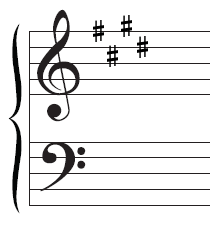
emajor And how about this one? 🙂

Even Faster Trick: Just Count the Flats or Sharps!

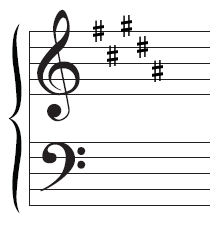
Though it’s best to know your flats and sharps well so that you can recognize them by sight, there’s a little shortcut experienced musicians use to reference various key signatures in short form. Just count the number of flats and sharps, and memorize which key goes with which number of flats or sharps.

For instance, one flat means F major, one sharp means G major; two flats means B-flat major, two sharps means D major, and so on. It really helps when you get up into the five- and six-sharp territories! 🙂

Yay! You Know How to Read Key Signatures!

With a little practice, you’ll be able to recognize key signatures as quickly as the pros do. (It DOES get easier, believe me!)

For Further Reading/Credits

Key Signatures @ Wikipedia
Clefs and Key Signatures @ LearnMusicFree.com

As Promised: The Answer Key!

fmajor
F major
bflatmajor
B-flat major
eflatmajor
E-flat major
aflatmajor
A-flat major
dflatmajor
D-flat major
(aka C-sharp major)
gflatmajor
G-flat major
(aka F-sharp major)
cflatmajor
C-flat major
(aka B major, lol)
gmajor
G major
dmajor
D major
amajor
A major
emajor
E major
bmajor
B major
fsharpmajor
F-sharp major
csharpmajor
C-sharp major
(aka D-flat major)

#1 Career Mistake, Cell Phone Sign, Puppy and Kitten, and Reusing Wooden Pallets

The #1 Career Mistake Capable People Make
And believe me, it will shock you.

Appropriate Cell Phone Sign
According to this sign, we’re all doing life right these days! LOL!

Puppy and Kitten Think They Are Related
Get ready to faint from the overwhelming cute of this video.

Don’t Throw That Old Pallet Away! 35 New Uses
Have an old wooden pallet lying around? Here are tons of ways you can reuse it!

My Favorite Clix, part 8: Checkmate Knight (White)

At only 29 points and 3 clicks of life, this little Clix figure may not seem very impressive at all. But ever since she was printed, I’ve found myself using her on many of my teams, and being very glad I did; she’s not just for ranged teams, but for any sort of team, as you’ll soon see!

checkmateknightwhite
Checkmate Knight (White), #007 out of Brave and the Bold. Image Credit: HCRealms.com.

The first thing that drew me to this figure was the low point cost in exchange for all that you get. 29 points, for a 9 attack, 2 damage, 8 range character? Not bad! These are not godlike stats, of course, but they’re fairly good, given the cheap point total. You don’t usually find these kinds of numbers under 30 points.

But combine the fair-quality stats with the powers she’s given, and you suddenly have a much more useful figure. Enhancement first click, and Outwit for two clicks more–it’s worth pushing her once if you absolutely need an Outwitter, and if you don’t, the Enhancement helps your other ranged pieces do more damage. Her Super Senses on defense do shield her from some harm, as well (though don’t rely solely on that; best to play her carefully, positioning her fairly far back since she’s got 8 range).

Sure, her defense values of 16 and 15 are a little low for tournaments these days, but these too can be worked around. You can play her as strictly an Enhancement piece, hidden in the middle of a group of shooters, and she’ll never see battle herself…or, you can position her beside a Defend piece that has a higher defense so that she gets a little extra protection. Either way, played right, she can help several of your other figures do more damage at range.

And, if you need her as an Outwitter, her 8 move will help her move more easily around the map for clear lines of sight (and she keeps 8 move for all her 3 clicks of life). That is very handy, I can tell you right now. Not only that, it’s fairly easy for a Medic to heal her, if you need to have her back on Enhancement. In fact, the only way this piece won’t work for your team is if you try to make her a first-string attacker; she’s much better off Enhancing or Outwitting from the mid- to back-field.

My Personal Recommendations

If you run a lot of ranged teams and need a little more damage output, or if you’re in need of a fairly cheap Outwit piece, Checkmate Knight White could be your best solution. With her low point cost, she’s fairly easy to fit into a team build, and her Enhancement/Outwit combo makes her versatile and useful for just about any team.

False Idols Don’t Even Compare to God

Jeremiah 10:11, 15-16
11 Tell them this: ‘These gods, who did not make the heavens and the earth, will perish from the earth and from under the heavens.’ … 15 They are worthless, the objects of mockery; when their judgment comes, they will perish. 16 He who is the Portion of Jacob is not like these, for he is the Maker of all things, including Israel, the tribe of his inheritance—the Lord Almighty is his name.”

Jeremiah, speaking the Word of God to the wayward Israelites, is very clear: the idols and gods that other tribes and peoples in the region worship are not like God–they are false. They “did not make the heavens and the earth,” and thus they will “perish from the earth,” because they are nothing like God even though they purport to be.

False idols, according to God through Jeremiah, are worthy only of mockery. Earlier in chapter 10, the prophet describes how the false idols must be propped up, dressed, and carried because they cannot actually do anything for themselves, nor can they affect the world around them. By contrast, God made the earth, the heavens, and everything within them, and He not only watches over everything He created, but has power over it all as well.

Even today, we see the truth of this passage. Praying for anything else besides God to save us or help us does no good, but praying to God can and has caused some miracles to happen. God is definitely still active and still in the business of protecting and caring for His people. This is why the false idols, the false gods that have tempted the Israelites away, do not even compare with God–they can never do what He can, can never help people the way that God can. This is why the “Portion of Jacob” (a title for God only used here and one other place in the Bible) is so much better than those other idols; He is real, and they aren’t.

Serving in the Church: A Solution to “College Student Drift”

All over America, and I would guess worldwide, Christian churches lose quite a few of their young college- and career-age members to lack of attendance. This is not a new phenomenon; this age group, the very age group I’m in, is a difficult age to reach, because many of us go away from home to college and are in a totally new environment, or we’re busy with beginning our careers. But even the churches in college towns can’t often get much steady attendance from students who attend the local college(s). I should know–my church is right near a college town, and it’s rare for more than 5 people to attend either our Sunday School class or our coffee shop fellowship meetings.

Church officials and writers have been researching and writing about this issue for a long time; one recent article I found, College Students and Church Attendance: The Facts, states that church attendance by college students falls drastically as they get farther along in their degrees. Other articles seek to explain this phenomenon: Why Students Abandon Their Faith: Lessons from William Wilberforce and Why Teens Leave the Church Upon Entering College are two examples.

Many people who examine this issue blame several factors for this phenomenon:

  • The young adults are not “strong enough” in their faith to keep attending without parental guidance
  • Higher education’s atheistic teachers/”Godless” standpoints are influencing them
  • “Worldly” influences, such as drinking, partying, or peer pressure, keeps them from going to church

I admit, all these negative influences do get in the way of faith; I would add that the heavy mental load of pursuing an education (and later a career) also keep some of my age group away from the church during these years. BUT I also believe that the church in general falters when it comes to reaching college/career-age people. It can either fail to recognize or refuse to believe that its behavior toward this age group could be pushing their young adult members away, too.

An Unresponsive, Uncaring Church: A Major Part of the Problem

What do I mean by this? Think about a child, being brought up regularly attending church. He or she grows up, moving from level to level in the children’s program and then in the youth program. But once that young person graduates from high school, there is suddenly no real “place” for them in the church. There is no dedicated “young adults’ area” in most churches, not the same way there are dedicated “children’s areas” or “youth areas.” There are likely far fewer of their church friends left in the Sunday School class they get assigned to next, since so many kids leave their homes (and home churches) and go to college somewhere far away. In short, their church experience becomes far less inviting, far less familiar, just because their age changes. It’s almost like the church forgets about them, or forgets to have a ministry waiting for them and their friends when they return home.

I saw it happen to friends during college; one of the girls on my hall was very sad upon returning to the dorm one Sunday night. I asked her what happened, and she said “I went to my home church this morning, but it didn’t feel like home anymore.” There was no “group” of people her age to meet with, no one who greeted her as if they had missed her; it was as if the church had closed their minds to her when she started college. Though she attempted to reconnect with her home church a few times, she eventually quit trying to go to church altogether by the end of the year.

I’ve felt that same sort of isolation, that same sort of “twisting in the wind” feeling, as a college and career-age person myself. What if you walked into a church, even your “home” church, and had no idea where you belong, and no one greeted you or helped you, but looked at you as if you had been judged and found lacking? Would you ever want to come back? That is what many of my age group face when they go to church–they feel like they are an unwanted presence. When the church makes a college student or young career person feel like he or she is insignificant and unwanted, they do the age group as a whole a major disservice.

It’s important to remember that not all of us are out drinking every night, partying every Friday, and having random sex with strangers, nor are we all “losing our religion” because of being taught by atheist or open-minded teachers. And not all of us are so weak in our faith that we can be torn away from the church within a few weekends of being in college. True, these influences are out there, but being rejected by the church or being shoved aside is a bigger threat to college-age faith than any of the influences I just named.

My Solution: Help Us Feel Useful and WANTED!

The best way for college- and career-age people to be included in the church is to help them begin to serve in the church, assisting and even taking over ministries which need attention.

This might seem a strange suggestion at first. Why give the charge of ministries over to people who might not even be able to be there every Sunday? Why take ministries away from people who have handled them for years?

Actually, I think this line of thinking is part of the problem.

The Church Needs Young People to Serve, and We Need to Feel that the Church Wants Us

Firstly, if young people are the future of the church, as we so often like to say, then they must have experience in helping with the church’s various ministries, so that they know how to run the church when the elders have passed away. Not trusting younger folks with any assistant positions because they’re somehow “vulnerable” and “immature” will only cripple the church in the long run, because you’ll end up with a generation or two of people who simply do not know how to run these ministries at all.

Secondly, it seems at least to me that people tend to hang on to their volunteer ministry “jobs” within the church for a long time, even refusing to have any help with it at all, because it’s somehow “their” ministry. The problem: when that person dies or leaves the church, there is no one there to take up the torch and carry it again, because no one else knows how to handle that ministry. This is a HUGE problem for church longevity, not to mention the sin of pride. (Think about it: if you can’t let go of a ministry because you believe you’re the only one who can do it “right,” then are you doing it for God, or doing it for pride’s sake?)

I am most certainly not advocating the removal of dedicated and faithful church members from their long-held volunteer posts simply because younger people want to take over a ministry–that would be no kind of reward for their years of Godly service. But, perhaps as part of that Godly service, these longstanding, mature believers could use their experience to mentor and guide younger ones. It’s not about “training your replacement,” necessarily, but about creating a legacy of service and passing it down to the next generation of church members.

College/Career Age Class: Church Assistants and a Mentoring Program in One

My suggestion is: what if the older youth had something like a “shadowing” program to learn about the various ministries of the church? By asking those who run the various ministries, like the Children’s Ministry, the Music Ministry, Outreach, Sound Booth, Wednesday Night Supper, Men’s Work Day, etc., the youth could learn more about what it takes to run those ministries. Then, they could individually figure out for themselves which one they’d like to help with.

Then, once the students reach college/career age, they could begin assisting with those ministries, and even take some of them over if deemed necessary by the church leadership. Along the way, they would be mentored and guided in these ministries and in their faith by mature believers, receiving a spiritual higher education at the same time they are aiding the church itself. Not only would such trained young people be a boon to their home church, but they might even feel confident enough to help out a church local to their college area as well because they have this past experience.

Why do I suggest this course of action? Because personally, my position as a Sunday School teacher has given me more confidence within the church, and has made me accountable. If I’m not there every Sunday, it affects others negatively, and people miss me; if I want to be a good teacher of the Word, I must be knowledgeable about it and be able to point others to interpretations of it. I am one of the rare few college- and career-age people who has stayed within the church, precisely because I feel valuable and vital to the church’s workings. And I’d feel safe in guessing that others of my age group would feel the same way if given leadership or assistant positions in church ministries.

I recognize that not all college/career-age people have leadership skills, nor are all of us necessarily the most dependable. But God gives each of us a gift to share in ministry. If a church takes the time to help a young believer develop that spiritual gift and use it to aid the body of Christ, then it’s ultimately for the betterment of that young person as well as the church they attend. And it all glorifies God in the process.

Bottom Line: Connect with Us, and We’ll Connect with You

To combat these negative influences that so many church writers speak of, the church must be a vibrant presence in a college/career person’s life. The church must welcome my age group, must be willing to mentor and nurture such believers at a time when we need our church family the most, when we need a body of believers to be a part of. I think this is one of the best ways to make the church essential and relevant to my age group. Serving and being a vital part of the church has helped me grow in my faith, and I believe it can help my whole age group come back to be part of the body of Christ, too.

Easy-to-Code Navigation that Scrolls With You: It’s Possible!

These days, navigation that follows a user down the page is a very attractive and user-friendly design. When a user doesn’t have to scroll all the way back to the top of the page to get to the navigation, and doesn’t even have to fool with clicking a “back to top” link, it’s a wonderful thing.

But it’s a little challenging for us web designers to get it done, as I discovered while researching for this blog post; there are plenty of designers looking for ways to make this happen in their own layouts, and there are just as many solutions in various programming languages.

Eventually, I just opened my trusty Notepad++ and started knocking together some code myself–and I accidentally found a very, very simple CSS solution.

Robin’s Sticky Nav Bar: The (Code) Recipe

stickynavbar

Click to see my simple “sticky nav bar” demo! (opens in new window)

To make the above page navigation work, it took about an hour of experimenting with HTML and CSS, creating a dummy layout and the like. But finally, on a whim, I stuck the following bits of code into my navbar div:

#navbar {width: 900px; height: 40px; padding: 0px; position: fixed; top: 0px; background-color: #0f00a1; box-shadow: 2px 5px #000555;}

The code in bold above is the important bit to see here; this was the magic wand that transformed my plain ol’ horizontal navbar. Once you style your own navbar the way you want it, all it takes is two code bits–“position: fixed;” and “top: 0px;”–to make it stick to the top of the page.

And, to make it centered like the rest of my layout, I made sure to put my navbar div within a container div called “wrap,” styled like so:

#wrap {width: 900px; margin: 0px auto; padding: 0px;}

The following HTML code is what I mean by “putting the ‘navbar’ div within the ‘wrap’ div:”

<div id=”wrap”>
<div id=”navbar”>
<span id=”sitename”>my dummy site name</span> <a href=”#”>about</a><a href=”#”>faq</a><a href=”#”>products</a><a href=”#”>services</a><a href=”#”>support</a><a href=”#”>home</a>
</div>
<div id=”sidebar”>
more code here, etc…
</div> (this ends the “wrap” div)

That’s really all the magic there is to it! (This design works in Firefox, IE, and Chrome; I have not tested it in any other browsers, but it seems that these three handle it identically, so I have hope that it works with all browsers similarly. If you find that this code doesn’t work in a browser I haven’t tested, let me know!)

One Small Caveat:

Fixing your navbar to the top of the page with “position: fixed” works great–but only if you don’t mind your navbar being the very topmost thing to display on your layout. If your ideal navbar is located beneath your header image to begin with, but then sticks to the top of the page when your user scrolls down, then just using “position: fixed” with a different pixel value in “top:” won’t make that happen. (Believe me, I tried–it was fail. I ended up with a navbar just stuck randomly in the middle of the page blocking the content. :/)

So, what to do if you want a navbar that will stick to the top of the page, even if it’s not at the tip-top of the layout to begin with? Well, from what I found in my research, you’re likely going to have to use Javascript/jQuery to make this more complex navbar. Here are two forum/discussion sites which explain these methods much better than I ever could.

jQuery and Javascript Methods for Sticky Nav Bars

Summary

“Sticky” nav bars are sleek, clean, user-friendly–and fairly easy to achieve with these three methods presented here. I hope at least one of these helps you with your next layout!

Music Theory Fun, part 3: What Time (Signature) is It?

Music is just not music without rhythm, without something to tell you what the beat is, and where to accent the beat more strongly. In sheet music, that job belongs to the time signature, which tells you much of what you need to know about the music’s rhythm.

What Does a Time Signature Look Like, and Where Can You Find It?

At the beginning of each piece of sheet music, you’ll find a set of numbers that look like this:

4-4time Looks like a fraction or something, but it’s not–this is the time signature.

(You’ll also find time signatures printed elsewhere in the sheet music if the rhythm has changed during a song, but there’s always one at the beginning of the song, so that the musician knows what rhythm to play, how long to hold notes, etc.)

Deciphering the Time Signature’s Meaning

4-4time In each time signature, the top number represents the number of beats in a measure, or unit of time in music. (Measures basically help divide up the music so that it’s easier to find your place.) In this case, this top number tells us that there are 4 beats per measure. The bottom number tells us which kind of note time value counts as 1 beat(remembering from last week’s lesson). For this time signature, the bottom number of 4 tells us that the quarter note is equal to one beat (4 quarters making a whole).

This time signature is known as “4/4 time,” and is the most common time signature out there. You can have any combination of note time values in one measure as long as it adds up to 4 beats. You could have 4 quarter notes in one measure, or 1 half note and 2 quarters, 1 dotted half and 2 eighth notes, etc.

It sounds like the following two examples:
Click to hear 4/4 time counted out, with beats 1 and 3 stressed

Pachelbel’s Canon in D is a good example of slow 4/4 time with beats 1 and 3 stressed.

Click to hear 4/4 time counted out, with beats 2 and 4 stressed

“Outta My Head (Ay Ya Ya)” by Ashlee Simpson is a good example of a song in 4/4 time with beats 2 and 4 stressed (really stressed in this song!).

Why Are There Two Different Versions of 4/4?

Since 4/4 is so well-known and well-used, some people “feel” the stresses of the beat coming on 1 and 3, while others “feel” the strong beats on 2 and 4. Both are valid perceptions, and both have applications in various styles of music. For instance, country and Southern gospel music often uses the 1 and 3 stresses, while much of the popular rock/pop and hip-hop genres use the 2 and 4 stresses.

Other Symbols You’ll See in the Time Signature Slot

commontime 4/4 time can also be written like this–the “C” stands for “Common,” and this symbol means “Common Time,” since 4/4 is so often used in music (especially Western music).
cuttime This symbol, looking like a C cut in half, stands for “Cut Time,” and it means the song is in 2/2 time instead of 4/4–it’s 4/4 time cut in half. Basically, this music looks like it’ll be slow, but is actually really, really fast, and you’d better hold on to your hat while playing this. XD

Other Time Signatures with the Quarter Note = 1 Beat

For practice, let’s look at a few more time signatures.

3-4time This one looks a little different. The bottom number is the same, meaning that the quarter note represents one beat, but the top number is 3–this is called “3/4 time,” also known as “waltz time.” That means that there are only 3 beats in this measure. That means you can have 3 quarter notes in a measure, or a half note and a quarter note, a dotted half note, a half and 2 eighths, etc.

This is what 3/4 time sounds like:
Click to hear recording

“Kiss from a Rose” by Seal is an excellent example of moderate 3/4 time.

2-4time In this example, the quarter note is still representing one beat of music, but there are only 2 beats in a measure–this is called “2/4 time.” You can have 2 quarter notes per measure, or 1 half note, or 4 eighth notes, and so on.

This is what 2/4 time sounds like:
Click to hear 2/4 time counted out

The children’s song “Mary Had a Little Lamb” is actually sung in 2/4 time. (To me, 2/4 sounds like a faster 4/4, at least in rhythm.)

What About When the Bottom Number is Different?

6-8time12-8time
Whoa, don’t these look different? But they can be deciphered just the same way as the others!

6-8time The top number, as we learned earlier, represents how many beats are in a measure. The top number here is 6, so there are 6 beats in a measure. The bottom number, however, is 8…which means that the eighth note represents one beat of music, instead of the quarter note.

So, in this time signature, which is called “6/8 time,” you could have 6 eighth notes in a measure, or 3 quarter notes, or 2 dotted quarter notes (worth 3 eighth notes each), etc.

Here’s what 6/8 time sounds like:
Click to hear 6/8 time counted out

“Silver and Cold” by A.F.I. is in a pretty fast 6/8 time, with beats 1 and 4 stressed.

To me, 6/8 time sounds like a slower 3/4 time, more like a swing or pendulum going back and forth.

12-8time Wow, in this time signature, there are 12 beats in a measure! And, with the 8 on the bottom, that means that you could have 12 eighth notes in a measure, or 6 quarter notes, or 4 dotted quarters, etc.

It’s not as many beats as it sounds, especially once you start hearing music in 12/8 time. This is actually my favorite time signature, because it sounds like really slow 4/4 time with extra little dance-like pulses added between each strong beat.

Here’s what 12/8 time sounds like:
Click to hear 12/8 time counted out

“Memory” from the musical Cats is a great example of 12/8 time.

Now You Know The Most Common Time Signatures!

These five time signatures that I’ve shown you today are the most commonly used in Western music. But there are many more out there, quirky and not often used. This blog post will help you understand the sheet music rhythms for about 70% of the Western music that is written these days.

Next Week: What’s All This about Keys?

Next week, we’ll learn about another important piece of information stored at the beginning of sheet music–key signatures! Just as important as time signatures, they tell you about the pitches you’re going to be using while you play.

Credits

All the recordings of beats being counted out were done by me–hence, the rather sad audio quality. 😛 Hopefully they’re useful to you in learning how different time signatures are counted out!

As for the images of time signatures I used in this blog post, they were retrieved from the following websites:
Time Signatures @ Wikipedia.org
Ultimate-Guitar.com