All posts by Robin

I'm a woman in my early thirties living in North Carolina, USA, and I have a lot of varied interests; I love creative writing, music composition, web design, surfing the Internet, thinking out loud, and gaming. And yes, my glasses are crooked. :)

We Can All Be “Dear Brothers and Sisters in the Lord”

Philemon 1:9b-16
9b I then, as Paul–an old man and now also a prisoner of Jesus Christ–10 I appeal to you for my son Onesimus, who became my son while I was in chains. 11 Formerly he was useless to you, but now he has become useful both to you and to me. 12 I am sending him–who is my very heart–back to you.

13 I would have liked to keep him with me so that he could take your place in helping me while I am in chains for the gospel. 14 But I did not want to do anything without your consent, so that any favor you do would not seem forced but would be voluntary. 15 Perhaps the reason he was separated from you for a little while was that you might have him back forever– 16 no longer as a slave, but better than a slave, as a dear brother. He is very dear to me but even dearer to you, both as a fellow man and as a brother in the Lord.

Paul writes this short letter while imprisoned in Rome for speaking the gospel (thus the phrase “prisoner of Jesus Christ”). He sends it to Philemon, a slave owner and Christian believer living in Colosse. The man Onesimus, whom Paul speaks so highly of here, was once one of Philemon’s slaves; Onesimus was stolen from Philemon, but he had also run away once, meriting the punishment of death under Roman law.

The reason Paul speaks so strongly for Philemon to accept Onesimus again is because Onesimus has become a Christian in the interim, and has helped Paul quite a bit in spreading the gospel. Paul had, indeed, found him to be very useful (which is what “Onesimus” means), and had thought about keeping the man along with him on his missions. But Paul also knew that the legal and emotional rift between Philemon and Onesimus needed to be brought to conclusion and healed. So he sends this persuasive letter to Philemon, asking him to consider Onesimus now “no longer as a slave, but…as a dear brother” in Christ, a fellow believer who could now help Philemon with the gospel message as well. (In verse 18, not quoted here, Paul also offers to pay off any remaining debts or wrongdoings on Onesimus’ record, to further clear his name.)

In doing this, Paul is not only freeing Onesimus from indebtedness to his former master; he is modeling on a much smaller scale what Christ did for us. Onesimus was freed from the punishment that awaited him–a death sentence–and instead was granted life with fellow believers…just as we believers were freed from sin’s wages of death and granted eternal life with God. Of course, Paul was not crucified for Onesimus as Jesus was for us, but the main idea remains the same: redemption can belong to each of us, no matter how deep in sin we are, because Jesus has settled our sin debt and freed us all.

Wardrobe Purge: Where to Donate?

Once you’ve selected the clothes you want to donate and cleaned and repaired them, you need to find out where to donate your clothes. It isn’t always just Goodwill that needs clothes, after all!

Caveat: Sometimes Your Donated Clothes Don’t Always Go to the Needy

Unfortunately, as I began researching this post, I discovered a couple of articles (over at ABCNews and ApartmentTherapy) that tell of a shadier side to the clothing-donation story–sometimes donated clothes don’t end up immediately clothing needy people in our neighborhoods, but instead are shipped elsewhere and SOLD for profit. (Check out CharityWatch.org to find out about charities like Planet Aid, which has been reselling its donated items instead of just “keeping them out of landfills”). Not exactly what I was intending when I thought of donating my clothes!

Solution: Donate to Vetted Charities–or Better Yet, Community Needs

So far, Dress for Success, Salvation Army, Goodwill, and Vietnam Veterans of America are all good charities for clothing donation. Additionally, you can sell items through eBay and donate to American Red Cross through eBay’s GivingWorks program.

But if you REALLY want your clothing to alleviate an immediate need, donate directly to your local community, as this Moneycrashers article says. Helping out with local church or school clothing drives, donating to local thrift stores and community outreach centers, and most especially donating to homeless shelters and missions can really help! Also, ask around in your neighborhood and see if there’s a needy family who could use the sizes and types of clothes you have–you can just take the clothes directly to their house, no middleman required!

Summary

Though donating clothes to the needy has been a little overcomplicated (and corrupted with greed, unfortunately), there are still plenty of places who will take your used clothing and directly help someone else in need. Just make sure you vet the place first so that you know your donations are going where you intended!

Oh, the Things PHP Can Do!

Since I’m largely self-taught in all things webdesign, PHP can be both frustrating and magical, a box full of wondrous tools I know neither the origin nor the use of. If you’re a newbie developer like me (or even if you’re somewhat familiar with PHP), you’d be surprised how much PHP can accomplish for your website these days:

Collecting Feedback

This article at CodeTricks.com explains how to make a really simple feedback form, which emails you comments and questions that people have submitted. (This tutorial covers both the HTML form part and the PHP part, so I find it VERY informative!)

Displaying Thumbnail Photos in a Gallery

Nettuts’ article covers one way to easily display photo thumbnails with a few lines of PHP code–much better than having to host your photos on another site, or worse, making an HTML table for your images and resizing all your images yourself. (Been there, done that :P) Scroll down to #12 on Nettuts’ article to find out more!

Making Easy Site Templates

This PHP article at About.com shows you how to use a PHP header and footer to create a site template, which you can change easily by editing the content of just those two files. (I use this trick on almost all my sites–it makes my webdesigning life SO much easier!)

Automatically Sending Mail to a Mailing List

Nettuts also covers how to use PHP to send mail to a specific list of people–who knew there was such an easy way to automate it? (Just scroll down to #8 on their article to see more on how to code this.)

Redirecting Your Visitors to Your New Page

Need to redirect your users to your new page without requiring them to click another link? Over at About.com, they show you how to use just a line or two of PHP code on a mostly-empty page to get it done! (I had no idea it was this easy! WOW…)

Creating Your Own Content Management System

This post at CSS-Tricks.com shows you how to set up a MySQL database, make a specific table for posts within that database, make a simple submission form so you can add posts, and display posts using PHP on a webpage. Basically, it shows you how to beat blogging websites at their own game! (Can be a little technical in parts, but it has links to other articles for extra explanation)

Summary

Can you believe PHP can handle all this–and more? I sure didn’t, until I did research for this blog post and realized just how much PHP can help us webmasters with our tasks. Try implementing one or more of these techniques for your site, and see how much time it can save you!

Beginner Beading, part 3: Pretty Patterns

Making beaded jewelry is not just about selecting good beads or perfecting your techniques–it’s ultimately about making beautiful jewelry with lovely beaded patterns.

I don’t claim to be a perfect designer by any means, but I know what kinds of patterns I like to see in jewelry, and that’s how I design my own beaded necklaces thus far. Here are some examples:

jewelcolorsxsilver
This necklace (which is the slightly-messed-up one from last week) displays a couple of pretty design tactics:

  • Symmetrical patterns–the necklace can be flipped left to right with no change
  • Colorful beads interspersed with neutral beads (in this case, silver) to help set the colors off
  • 3 sparkly beads used at the center of the necklace (bottom center of pic) to draw the light and the viewer’s eye

clearxpearl
A little different strategy was employed with this necklace, my first take on using white pearls in a design:

  • Vary the sizes and shapes of beads used in a pattern for visual interest in a mono-colored necklace
  • Use tiny beads to separate larger beads and make them look like they’re floating
  • Let one unusual bead be the center of a symmetrical 5- or 7-bead pattern (you see this twice in the above pic)–surround the unusual bead with more normal beads to let it take the spotlight

purplexpearl

  • Juxtaposing different finishes of beads in the same color family (here, using lavender) can add a soft effect to your patterns.
  • Creating a focal point in the center of your necklace can be just as easy as grouping 3 larger, lighter-finish beads and then surrounding them with smaller, darker-finish beads.

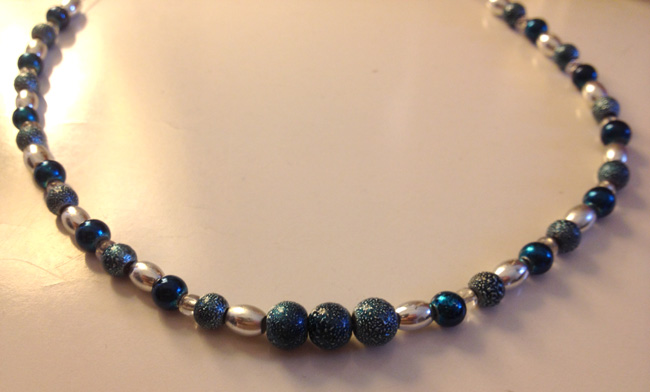
denimxsilver

  • Patterned or textured beads can add subtle flair when placed alongside smoother beads.
  • Don’t be afraid to use oblong and round beads together–oblong beads, especially in clear or neutral colors, can be used as visual “spacers” to make your colorful beads pop more.

bluexpearl
(Not sure why this necklace’s beads showed up so green–they’re actually Pacific opal beads, which are blue-green. Oh well!)

  • Use smaller beads out at the ends of your beading project, and larger beads toward the middle–that creates a “graduated” effect which looks more graceful.
  • Alternate opaque and translucent/sparkly beads for a playful pattern.

Summary

Working with symmetry, different bead textures and shapes, and colors which play well off each other can make any beaded jewelry project lovely. Try it out–just lay a few beads together on a table and rearrange them to your heart’s content. You just might come up with a randomly gorgeous pattern!

Binaural Beats, How Nerdy Are You?, Sunset-Lit Tree, and Paper Quilling

Binaural Beats
Weird ways that just hearing two different tones and beats in each ear can trigger meditative states! (I listened to an example of this…it’s REALLY relaxing in a way!)

How Nerdy Are You? (Quiz)
Warning, “nerd” in this case is defined as having interests in math/science/technology…which, while being a valid definition of nerd, is a TAD limited. And by “tad” I mean REALLY limited. (Sorry, a little English-nerd roar there :D)

Beautiful Tree at Sunset (Photo)

Quilling Paper
Find out all the great crafts you can make using this papercrafting technique!

Plains and Forests Unite, part 2: Modifications

Last week, I showed my Plains and Forests deck, naming the combos and synergies I had within the deck already. This week, I’m tackling some modifications I could make to this cool little deck–and some which I already have!

Research, then Proxy City

I did quite a bit of research on White/Green multicolored cards, using Gatherer‘s advanced search, and came up with a short list of interesting cards which I might want to fit into the deck. From those, I narrowed it down to three cards I definitely wanted to fit into the deck:

wiltleafliege Wilt-Leaf Liege is a great card just for pumping up Selesnya creatures’ P/T, but it also has a surprising defense against being discarded from your hand by another player–you can put it straight into play instead! Plus, you can’t beat a 4/4 for 4 mana, especially hybrid mana.
trostani As well as being a walking Angelic Chorus (yay life-gain), Trostani also serves to help produce creature tokens. This ability doesn’t help my deck very much at the moment, but I like her P/T–she’s a 2/5 for 4 mana, and the mana cost is balanced enough for my current mana curve. (And she’s a Dryad! <3)
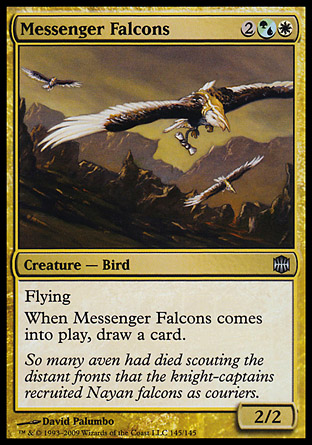
messengerfalcons Because this deck needs some more flying defense and card draw, I included Messenger Falcons. (Added bonus: Knight of New Alara‘s ability gives the Falcons +3+3, because part of its casting cost is Blue!

What I Took Out

Since I’m running a 60-card deck and want to keep it that way, I had to take out three cards from my deck:

  • Chrome Mox (because it’s always a dead card in my hand–I hate removing a card from my hand for mana, even if I can’t play it right then)
  • Safehold Duo (never gets to trigger more often than +1/+1 or possibly +2/+2 if I’m lucky)
  • Oversoul of Dusk (it’s a big stompy creature with good protections and 5/5 P/T, but…that’s about it…?)

Other Possibilities I’ve Thought About

  • Barkshell Blessing – nice boost for 1 hybrid mana, but it’s only temporary
  • Call of the Conclave – gets a creature token out–might still be useful with Trostani if I so choose
  • Voice of Resurgence – this would be SO silly with a creature token deck, but I’m not sure I want to go that direction
  • Armadillo Cloak – would be AWESOME in this deck, just can’t figure out what to replace
  • Congregation at Dawn – like Eladamri’s Call x 3, but it doesn’t pull the creature to hand
  • Ranger en-Vec – nice first strike for Selesnya, but that’s about it
  • Wilt-Leaf Cavaliers – vigilance and bigger P/T, but that’s about it
  • Ancient Spider – good, but a bit too expensive for flying defense
  • Bronzebeak Moa – runs into same problem as Safehold Duo
  • Heartmender – would be great for Kitchen Finks, but ONLY Kitchen Finks
  • Horned Cheetah – for Green/White, there is better for cheaper
  • Mystic Enforcer – works directly against Wheel of Sun and Moon, which is not going ANYWHERE
  • Juniper Order Ranger – again, like Safehold Duo, it works IF you can play creatures reliably
  • Sigarda, Host of Herons – YAY for Green/White Angel, but it doesn’t QUITE fit this deck yet.
  • Collective Blessing – it’s Glorious Anthem/Gaea’s Anthem x3, but you have to wait 6 turns…
  • Risen Sanctuary – it’s a big creature, with vigilance. That is all.

Results of These Modifications: Next Time!

In the next post about this deck (which will not appear for a couple of weeks, since I need to test these changes), I will recount how these modifications have either helped or hindered the deck’s performance. Were my instincts about these cards right, or did I only hamstring myself? Stay tuned!

Why False Idols Are So Dangerous

Jeremiah 10:5, 10
5 Like a scarecrow in a melon patch, their idols cannot speak; they must be carried because they cannot walk. Do not fear them; they can do no harm nor can they do you any good. …10 But the Lord is the true God; he is the living God, the eternal King. When he is angry, the earth trembles; the nations cannot endure his wrath.

Here, Jeremiah compares false idols, which the Israelites’ neighboring nations worship, to God–and it’s a hard-hitting analysis. Not only are the idols powerless to speak or act, unlike God, but they also can neither do harm or good–they and the customs associated with them are ultimately “worthless,” as Jeremiah states in verse 3. In contrast to God, Who is the omnipotent, holy creator, these false idols are worth no more than the earthly materials they’re made of.

Why is this distinction so important? Because the Israelites have been repeatedly lured away from God by false idols of all sorts; the Old Testament is brimming with examples of Israel’s spiritual drifting, waffling between devout belief in God and the slow leak of worldly values into worship. Jeremiah knew that if he was to reach God’s people, he had to first snap them out of their belief in all these false idols. These idols were only dragging their attention away from God, when they should have been depending on Him most.

Today, we modern Christians must battle a similar tide of worldliness leaking into our faith life every day. This problem is not just an “ancient-Israel” thing–sin and false idols are still powerfully attractive to our human natures, and so the tug-of-war between the flesh and the spirit continues. None of us are immune, not even church leaders; sometimes, we worship false idols without even realizing it (worshipping church power, money, or accomplishments, anyone?). So Jeremiah’s words speak to us, too–even though modern false idols might be amazingly sparkly, they still cannot match up to the power and love of God!

Things Zumba Dancers Think

Since I’ve been attending Zumba classes since June 2011, I’ve learned quite a bit about how much I think I can do versus how much I can actually do; I can actually do much more than I ever expected! Day by day I conquer the ailments in my feet and legs long enough to dance and have fun, and that’s the wonderful, inspirational, freeing side of Zumba.

…But Zumba would not be complete without hilarious fails and passing thoughts, either–humor makes Zumba fun, even as you wildly contemplate how long you can keep up with the instructor. Going along with the “S–t People Say” meme, here’s my take on what we Zumba dancers sometimes think while we’re moving:

  • Uh, yeah, I know how to do that move…sorta…kinda
  • I don’t think anybody saw me slip–I’ll pretend it was a new dance move 😀
  • …How do you even DO that???
  • Looking like a HOT MESS in this exercise room mirror right now…
  • I forgot I even had that muscle.
  • This is my JAM \m/ \m/
  • 30 more seconds…20 more seconds…I CAN MAKE IT
  • Ooh, ow, okay, definitely not stepping down that hard again!
  • My workout clothes should come with “Anti-Jiggle Technology” included…
  • If I had the energy of a toddler, I still couldn’t move that fast.
  • Oh, air conditioning grate, how I love you <3 yay, cold air
  • Have no idea what the singers in this song are saying, but it sounds great!
  • Step 1: Dance; Step 2: Pretend you look as awesome as the instructor while dancing.
  • Geez, how LONG is this SONG?! Seriously?!
  • This just in: sweat definitely stings eyes. Film at 11.
  • Whoops, hope that wasn’t anybody’s water bottle
  • Desperately trying not to look like a complete noob: 40% complete
  • I shook my rear so much I think it might fall off 😛
  • –Oh, wow, I just did that crazy hard move! I JUST DID THAT 😀 😀
  • That settles it, I think this instructor is a super-limber alien just pretending to be human. LOL

Making and Maintaining a Facebook Page for Your Site

Whether you’ve got a blog, small hobby website, hosting site, or anything else Web-oriented, these days making a Facebook page is nearly required for increased audience and popularity. For instance, since I made a Facebook page for Crooked Glasses recently, I’ve noticed a definite surge of interest (if not comments), and it feels as though I’m finally engaging with readers that I had been unintentionally leaving out for a long time.

Making a quality Facebook page, however, takes a little bit more effort–but once you put in a little time, you can create a polished, attractive, easily-updated Facebook presence for your site! Here’s how:

#1: Make a fitting icon and cover photo.

fbpage_iconcover
Your icon and cover photo are very important to your site’s branding–they create an instant visual impression that can often make the difference between visitors clicking to visit or hitting the Back button. With the right images, you can really make their first few seconds on your page count!

Here are the dimensions and formatting requirements for each image:

  • Cover photo: At least 900px wide for current FB layout style; it doesn’t seem to matter what height it is, but mine is about 330px. Must be JPG format.
  • Icon: At least 180 x 180px; must be JPG format.

Your icon should be fairly simple and snappy, with high contrast and easily-visible shapes, so your page can be quickly recognized in the Facebook News Feed. Your cover photo, by contrast, should be a little more “in-depth,” giving your page a “mood” and a good sense of what your site is about. (This is why I chose the simple black-glasses graphic for my icon and used a real photo of my actual glasses as the cover photo for Crooked Glasses’ page.)

#2: Come up with several unique URLs you can use for your page.

Before you actually start the FB page creation process, brainstorm several short but descriptive page names for your URL, just in case your preferred one is already taken. (For instance, I had to go with “crookedglassesblog” instead of “crookedglasses” because the latter was already taken.) Make sure that you’re happy with your URL and that it’s spelled correctly, because you won’t be able to change it once it’s selected!

#3: Fill in all your page info (and I mean ALL).

fbpage_pageinfo
Take time to fill in just about everything about your site that is appropriate, from Founded date to About section and everything in between. (Warning: the “Company Info” section, not the “About” section, is the text that will be displayed on the front page underneath the “About” heading, so make it good! Also, be sure to include your website link in Company Info so people have a convenient link to click.)

#4: Invite every Facebook friend you have.

I know it might seem a little crass to send invitations to all your Facebook friends to like your website, but you never know who might like your page if you only give them the chance! Plus, it gives your page that much wider reach as your friends and family like and share your posts with their friends. Think of it this way: you’re giving them something new and entertaining to look at and enjoy.

#5: Post every day–about anything and everything related to your site!

fbpage_postdaily Make sure you post to your site’s Facebook page every day, so that people remember it exists. Don’t think you have to just post your blog articles or site updates, either–post about things you’re planning for the site, or even just a random funny update. Remember, keep your page looking lively, and people will come visit!

#6: Share articles and posts through your personal Facebook feed.

At least two or three times a week, share some of your site’s Facebook posts, perhaps ones you want to showcase or ones you want feedback on. This reminds people who disregarded the Page invite that your page still exists, and shows them a little of what they’re missing. Also, newer friends who didn’t receive an invite can be exposed to what you’re doing on your website. It’s a win-win!

Summary

These 6 steps will help you not only build a great-looking and well-functioning Facebook page, but will also help you keep it active and user-friendly. Visitors will enjoy coming to your page and staying updated, and that’s the whole point of a Facebook page, after all!

Beginner Beading, part 2: Choosing Good-Quality Beads

When you’re just beginning to bead, as I wrote about last week, it’s hard to know what kinds of beads to choose–there are literally hundreds of different kinds available! And, as I unfortunately learned, not all beads are created equal in quality.

A Cautionary Tale: The Missing Bead

beadednecklace_example When I first started beading, I made this necklace, pictured at left, as one of my first projects. I was very, very proud of my work, especially since most of the beads hadn’t cost that much to purchase and yet rendered such a lovely result, interspersing black plastic teardrop beads with dark blue and clear sparkling crystal beads.
necklace_missingbead What I didn’t know, however, was that one of the plastic beads already had a crack in it, right near the point where the beading wire threaded through it–and one day, it cracked off while I was wearing the necklace. I didn’t notice until I got home, took the necklace off, and realized that the beaded pattern at the two ends of the necklace no longer matched (denoted by the red circles on the image at left).

Learn From My Fail: Choose Better Beads

In order to keep from losing bits off your own beading projects, here’s some tips on which beads to choose (and which to avoid):

Quality Beads…

  • Are made of glass, polished wood, or crystal-like materials
  • Have well-drilled bead holes that won’t catch on the beading wire/thread
  • Do not have bead holes drilled in thin/fragile areas (this was what made my necklace’s bead crack)

Cheap Beads…

  • Are made of plastic or rough wood/stones
  • Sometimes have coatings on them (like iridescence or big pieces of glitter) that wear off easily after being handled
  • Do not thread evenly because the bead holes are drilled crooked

Final Word to the Wise: Shop Local Bead Stores

The best places I have found for quality beads are small, local bead and craft shops, whether you buy in-store or online. Such places often simply take care of their bead stock better, storing and displaying them on flocked jewelry trays which don’t allow the beads to get crushed or knocked off easily. Plus, bead specialty stores often carry the crystal-like beads and other finer-quality stock that will give your beading projects not only a more expensive look, but a longer life. (Lastly, the shop owners can help you select just the right bead for a project!)