Tag Archives: music

Music Theory Fun, part 1: The Grand Staff

It’s wonderful being able to compose your own music or to play and sing familiar songs written by other people. Having composed music since at least the age of seven myself, I thoroughly enjoy crafting and shaping a new piece, nurturing it slowly into life on the piano keys. I also enjoy playing and singing other people’s music by ear, most often by listening to it many times from a CD or digital recording.

But what about writing all your self-created music down, or recreating others’ music from reading it off a page? That’s where music notation comes in, and where you have to make use of something called the grand staff.

The Grand Staff

grandstaff
Image Credit: Piano-Lessons-Made-Simple.com. I used this image as the basis for my example images in this post. (Thank you Photoshop for having a “music note” graphic!)

This is one of the more familiar forms of music notation, using this system of lines and the spaces between the lines.

trebleclef_bassclef
The curvy thing that looks like an “&” is called the treble clef, and it marks where all the notes that are above Middle C should be notated.

The curvy thing with what looks like a “:” out to the side is called the bass clef, and it marks where all the notes that are below Middle C should be notated.

Together, the treble clef group of lines and the bass clef group of lines form the grand staff, joined together by that big curly brace on the left side of the above image. Using the grand staff, you can write notations for any kind of vocal, instrumental, or piano piece.

Which Notes Go Where?

In this notation system, every line and space represents a note on the keyboard. The following graphic shows which notes go in the spaces, which notes go in the lines, and then which notes fall between the treble and bass clefs’ lines.

notelabels
From this diagram, you can see that the bottom space on the treble clef is where you would write an F above middle C, and the bottom line is where you would write an E above middle C, and so on. In the bass clef, the top line is where you would write an A below middle C, and the top space is where you would write a G below middle C, and so on.

To remember which notes go in the lines and spaces, here are the acronyms and memory sentences my music teachers taught me:

  • F A C E = The spaces in the treble clef, bottom to top
  • Every Good Boy Does Fine (EGBDF) = The lines in the treble clef, bottom to top
  • All Cows Eat Grass (ACEG) = The spaces in the bass clef, bottom to top
  • Great Big Dogs Fight Always (GBDFA) = The lines in the bass clef, bottom to top

In between the treble clef’s lines and the bass clef’s lines, you have more room for notation. There’s D above middle C, which hangs below the bottom line in the treble clef, and B below middle C, which sits above the top line in the bass clef…and lastly, Middle C. (I noted Middle C twice in this graphic because it can be written as part of the bass clef or treble clef–it’s kind of like the number 0, sitting in between the positive integers and negative integers in math.)

Identifying Notes in Sheet Music: A Little Self-Quiz

Using the identification chart in the last section, you can start picking out which notes are which, like in the example below:

sample_notation
What are the four notes in this sample? Click the picture to check your answers! (answers will appear in a new window)

Next Week: How Long Do You Hold These Notes?

Next time, we’ll be looking at note time values, also known as “hold this note for one beat, hold this one for four beats,” etc. This is where the rhythm part of music notation comes into play! 🙂

Making Custom Sorted Playlists, aka “Being OCD About My Music Collection”

I suppose it was inevitable–categorizing my music as heavily as I do now, I mean. Being musical and being fairly OCD…well, my labeling and listing bug got hold of my music collection and had a field day. Now, with iTunes’ playlist feature, I can make all the nitpicky little playlists I want. LOL

The Beginning: Playlists that Move from Energy to Relaxation

This “labeling and sorting” music craze of mine began with self-made mix CDs back in high school (~2002), throwing together a haphazard list of my 15-19 newest favorite songs and arranging them into a mix that somehow kinda-sorta made sense.

energetic-chill_mix
For instance, this is one of my self-made mixes from around 2006-2007 (I think), titled “A.D.D.” for its relative craziness. Nevertheless, I did try to group songs together, not by subject matter or alphabetization, but by song sound–the most energetic songs appeared first on the mix, whereas the more downtempo songs appeared last.

I did pretty much all my CD mixes this way for a long time, simply because I like listening to faster music more often and I wanted the faster songs more readily available (i.e., not having to skip a bunch of tracks to get to them). It worked well for me; as the CD played through, I worked through all the faster songs and then, if I wished, I could move on to slower, more chill stuff.

Next Steps: Chromatic Playlists (Warning: Music Nerd Alert)

But I also began experimenting with different ways to arrange playlists–take my current “New Favorites” playlist, which is arranged by musical key on an ascending chromatic scale:

chromaticscale
Before arranging this mix, I used the “Comments” column of my iTunes music library to tag each song with its proper musical key. Then, I grouped all the songs in C major or minor together, followed by C# major and minor, then D major and minor, and so on, up to B major and minor at the end of the playlist.

The natural upward progression of keys makes my inner music major happy (and provides less of a shock to my perfect pitch when switching between songs). While the songs’ subject matters often have nothing in common, it’s also interesting to see how different composers use the same key to express such different ideas.

Fun With Labels: Playlists by Subject Matter/Use

You’ll notice, however, that not only are the above songs tagged with musical key information, but with other strange keywords. That’s one of my newer labeling strategies: making playlists by subject matter.

For instance, here’s a few selections from my “Rarrrr” (angry) playlist, which is good for getting out frustrations:
rar_mix

…and a few from my “Love” playlist (which includes songs about the pain of love as well as the joy of it):
love_mix

I even have an extended playlist called “Butt Whoopin'” for those times when you’re stampeding through a video game level and need appropriately inspiring music. (It works–try it out :P)
buttwhoopin_mix

And finally, a playlist of several of the songs my Zumba class uses to work out by:
zumba_mix

Each of these playlists helps me to establish a certain mood (or, in the case of the “Rarrrr” mix, dispel it). It’s great to ride down the road toward Zumba class on Thursday nights, for instance, with my Zumba mix going, previewing so many of the cool songs I’ll be dancing to that night. I like gathering songs of the same subject matter together so that the playlist makes good lyrical sense from song to song.

For the Really Bored Hardcore Labelers: Playlists By Time Period

Lately, however, I’ve been into making playlists that focus on one particular time period of music, especially if the time period is instantly recognizable and singular in style.

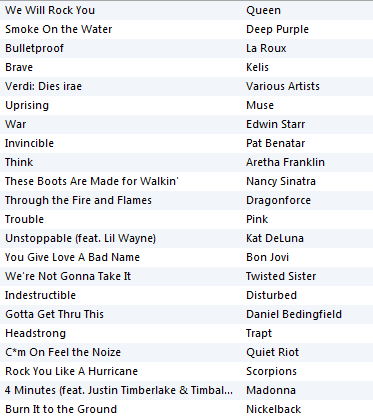
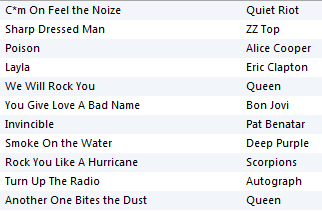
Take these selections from the two most notable “time period” playlists I’ve made thus far: Oldies and Headbangers (50s/60s pop and 80s rock, respectively):

oldies_mix
“Oldies”
headbangers_mix
“Headbangers”

When I’m in a particularly “oldies” mood, or in a particularly 80s-rock mood, I know just which playlist to select. But it’s not just about the music, but the memories attached to each song; for the Oldies playlist, it brings up memories of riding in the car with my dad as a kid, listening to the local oldies station on the radio, for instance.

Time period playlists are great for nostalgia purposes as well as musical purposes–and after all, isn’t most music created to remember events and feelings better?

How Do You Make Your Own Playlists?

Leave me your thoughts in the comments. Have any different ideas for playlists besides the ones listed here? I’d love to hear ’em! (No pun intended 😛 )

Don’t Hate Your “Work in Progress”

I have a little confession to make: I’m often disgusted with my own efforts while I’m making art.

If I’m trying to design a web layout, I get frustrated if the design or the implementation just won’t align right; if I’m writing a bit of story, I get mad when I just can’t seem to script out the scene stuck in my mind. And that’s to say nothing of how I try to learn a new piece of music. I absolutely hate how slowed-down and imperfect the piece sounds if I can’t seem to play it correctly at normal speed. (As a child, I used to burst out crying and run from the room because that sound created such anxiety in me–playing it slow made every song sound stupid, and it made my skin crawl!)

This is part of my perfectionism, and I would wager that many fellow creative people go through similar emotions–the gripping fear/frustration of the physical creation not matching the mental idea. But this isn’t a healthy mindset, either for your creativity or your sanity. In fact, this mindset has kept me from a lot of my best work.

How This Actually Stunts Your Creativity

This fear, disgust, and frustration is one reason my novel isn’t published; it’s a reason that I wait so long between layout designs for my websites. I hate looking at (or listening to) a half-finished product and detesting what I see because it doesn’t match the perfection in my mind. But as much as I hate seeing the terrible, muddy chaos of a half-finished work, it’s part of the process–and it must be endured, if I’m ever going to finish anything!

For example, this week, I’ve finally begun to write on my novel again after six months of being completely stalled. As I began to write again, I wondered, “Why did I wait so long? What had me stalled?” The answer: I hated looking at my unfinished work and seeing how badly it compared to the awesomeness in my head. (Thus, this article came about, documenting my own silliness and fear; like a bad dream, the negative emotions get easier to bear if you share them.) But I lost six months of writing time just being stalled because I thought the work wasn’t worth finishing. I stunted my own creativity with my perfectionism.

Don’t Make the Same Mistakes I’ve Made!

If you’re suffering these same feelings, and you let them stop you, then you too will be stuck as I have been. Remember, nothing looks or sounds right until it’s finished, whether it’s a painting or sketch, a piece of music, a poem, a novel, anything. This is part of being an artist–being courageous enough to dig into your own work and finish it. And in fact, once your piece is finished, you end up with a much better product, because you’ve subjected it to your own criticism first, and you’re more aware of any flaws or mismatches in your work.

So, today, I encourage you to go back to an unfinished work of yours. Go back to it, and just see what you can do with it. If you have to push aside your first idea and try something new, go ahead; if you need to rework just a bit of your previous efforts to continue on with your next idea, that’s perfectly fine, too. Just don’t be afraid to dig in and get your hands dirty. I promise you, it will turn out better than you think.

Composing Music with Sound Matrix

For composers, musicians, and music enthusiasts, then the Sound Matrix Flash game could be your new favorite Internet toy. I’ve definitely wasted more than my share of time goofing around with it! 😀

How to Use Sound Matrix


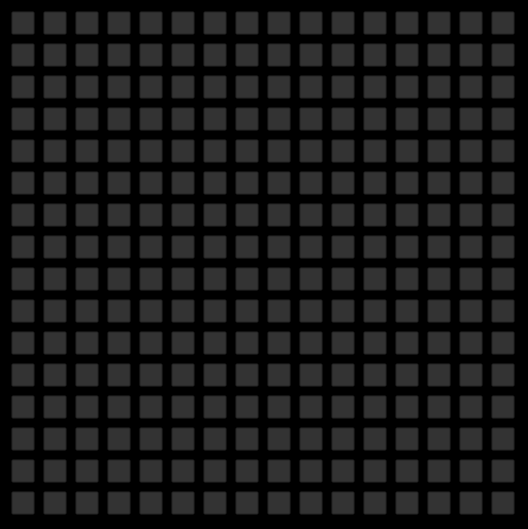
When you load up the game, you are greeted with the above blank gray grid on a black background.


Clicking any gray square on the grid turns it white; the white square will produce a tone every so often. In the above example, this white square produces a B natural approximately every 3-4 seconds, and the little white square lights up when “struck,” such that the whole grid sparkles with it. Very pretty! 😀


For those who might be interested, I came up with the complete musical scale that Sound Matrix can produce. (The uppermost squares produce the highest tones; the lowermost squares produce the lowest.) While this may not look like the most diverse scale, it can actually create quite a variation of tunes!

As for actually composing tunes, clicking squares that are an equal horizontal distance apart will give you a “beat,” which will loop every few seconds. That’s pretty much all you need to know–the rest is just experimentation, play, and happy accidents! 🙂

A Few of My Sound Matrix Compositions

These are a few little tunes I came up with while musing and playing; I had a ton more saved, but I lost them in the Great Hard Drive Crash of 2011. :/ But where those came from, there are plenty more 🙂 The following screenshots kind of serve as “sheet music” for Sound Matrix:


“Celebration in A Major”


“An E-Z Groove”


“Latin Dance in B Minor”


“Triplets in E”


“Fast Club Jam in B Minor”

Incredibox, aka “The Musical Sandbox I Can’t Quit Playing In”

Thanks to Stumbleupon, I found this awesome little Flash tool called Incredibox, which is my new “musical sandbox.” I like it so much I wanted to honor it in this week’s creativity post, because it certainly makes me feel more creative!

How to Use Incredibox


After it loads, you’re greeted with this screen, where one little guy waits to make your beatbox club dreams come true.


Click and drag one of the colorful icons to the guy’s hat, and he’ll start making a beatbox sound–there are various beatbox effects, such as bass, beats and breaks, melodies, and other vocal additions.


As soon as you add one effect, another little guy appears, so that you can keep adding effects to create your own song.


As the above picture shows, you can have up to 7 effects going at one time!


If you want to get rid of an effect, you can hover over the character making the sound and click the “X” in the box that appears.

Recording and Sending Your Tune


Once you’ve hammered out exactly what effects you like and how you want to put them together, you can click the circle button (top left) to record your song.


This is what it looks like when you’re recording–a strip appears across the top showing how long the recording is going. Maximum recording length is 30. If you need to stop the recording for whatever reason (if you misclicked or waited too long to start/stop an effect, for instance), you can click the circle button again (it becomes a square when you hover over it).


After it’s recorded, you can review it, and then save and send it via email, Facebook, and/or Twitter to your friends!


For inspiration, here’s a little tune I made and recorded using Incredibox–I call it the “Pensive Club Jam”. 😀

Give Incredibox a try and see what kinds of cool grooves you can make! I literally spent an hour the other day while writing this post playing with it…it’s addictive!

(PS: Happy birthday to me! :D)

Why AutoTune Annoys Me

AutoTune, the darling of the modern music industry–the software that can make even a honking duck sound like an opera soprano (supposedly). It’s supposed to make singers sound better and more on-key, and it does.

Well, it makes them sound more on-key, as well as fake.

Time.com and HowStuffWorks have explained AutoTune, its history, and its use within the vocal music industry to subtly enhance singers’ vocal performances, fixing the pitch where it went a little flat or a little sharp, making a rough voice sound just a little smoother, etc. This is generally accepted use to ease and shorten the recording process, which is understandable.

But, starting with Cher’s “Believe” in 1998, a lot of recording studios have not only used it to gloss over singers’ natural flaws, but also to “overproduce” the voice, making it sound robotic, unnatural. And sadly, this is the use of AutoTune that prevails today; rather than subtle editing of the voice, there are painfully obvious pitch changes that result in odd voice tambres, like nothing that ever came out of a real human’s throat.

I have perfect/absolute pitch, and one would think I’d enjoy the perfection of precisely-struck notes no matter what they sound like, but instead, it annoys me, and bothers me. I like human voices to sound, well, like human voices, and yet these days, it’s as if the humanity has been scripted out of the recorded voice, leaving something that is technically perfect but without the necessary miniature vibrations (also called “vibrato”) to give it that human touch. Though the pitch-perfect sound makes my ear happy, it sounds soulless; it has no emotion, because all the tiny variations of pitch that GIVE a sung sound emotion are gone.

Perhaps this is my years of choral singing and private voice lessons talking; perhaps I’ve simply grown used to the sound of an unedited voice or group of voices, and it’s only a preference issue. But I worry about where we’re headed as a musical society, if we keep editing out all the imperfect/human bits of music. Pretty soon, if we’re not careful, there won’t be any real humanity in music left.

Songs to Inspire the Creative Impulse

When I’m feeling generally down or just not inspired to create anymore, sometimes I use music to help me get back some of those drained creative juices. So I’ll turn on a little music to make me happy, or some music that makes me want to achieve the same kind of beauty I’m hearing. It always works–sooner rather than later, my mood is lifted and my Muse is hard at work again.

Here’s a short playlist of songs that work for me, to make me happy and excited about music all over again. Listen through and enjoy!

Songs for a Happy, Inspired Creator


Flashdance (What a Feeling) – Irene Cara


Uptight (Everything’s Alright) – Stevie Wonder


Shout – The Isley Brothers


The Touch – Stan Bush (from Transformers)


(I’ve Had) The Time of My Life – Bill Medley and Jennifer Warnes (from Dirty Dancing)


When Love Takes Over (feat. Kelly Rowland) – David Guetta


How Will I Know (Junior Vasquez Mix) – Whitney Houston


Let’s Get Loud – Jennifer Lopez


That’s the Way It Is – Celine Dion


Pyramid (Dave Aude Radio Edit) – Charice


Somewhere Only We Know – Keane

Songs to Make Me Want to Sing and Play


Bloody Tears from Castlevania II: Simon’s Quest (performed by Rey Tang on Youtube)


Lux Aurumque – Eric Whitacre’s YouTube Choir


To Zanarkand (from Final Fantasy X) – Final Fantasy Orchestra


Saltwater – Chicane


Speak Softly Love – City of Prague Philharmonic Orchestra


Radical Dreamers (Instrumental) – Yasunori Mitsuda (from Chrono Cross)


All I Ask of You (from Phantom of the Opera) – Sarah Brightman and Cliff Richard


Water World Theme (from Super Mario 64) – Koji Kondo


The Call – Regina Spektor


Before Dawn – Isaac Shepard


I giorni – Ludovico Einaudi

Songs Made Popular by the Internet

As Internet (and especially social media) have become more and more popular, music has begun making its way around the world in record time. It’s not surprising that many artists and bands now get their start via the Internet, given that it’s fairly cheap to use and promote your songs, garnering the attention of record labels if you’re very lucky.

But the Internet is also great for circulating music that makes us laugh, makes us cry, or even makes us put our hands over our ears (but not before we share it with our friends so that we can commiserate). Here below is a small playlist of some of the songs and memes that have made it big because of the Internet:


Gangnam Style – PSY

Can’t leave this one off the list! Even the radio stations in my little section of North Carolina played this dancey little K-pop tune, which also popularized the dance (and many hilarious attempts at imitating it).

Link to Video
Never Gonna Give You Up – Rick Astley

I couldn’t directly embed this video, but the link above is the original 80s song from which all Rickroll memes spawned. 😀


Peanut Butter Jelly Time

You know what time it is. (I’ve always thought this would be a great official song for preschools everywhere… XD)


This is the infamous “Leekspin” meme; image is Inoue from the anime Bleach, song is “Ieva’s Polokka” by Loituma. As addictive as it is repetitive, this little song started as a website and grew quickly to an Internet phenomenon.

Link to Game
Surrealism (from Loops of Zen) – XGamer

A user by the screenname of XGamer created this darkly ethereal tune for a Flash game called Loops of Zen, and the song went on to become just about as popular as the game.


Call on Me – Eric Prydz

Using just the chorus from “Valerie” by Steve Winwood, Eric Prydz created this upbeat little dance track, and it caught the Internet on fire soon after.


Red Solo Cup – Toby Keith

You can’t watch this video or listen to this song without snickering–it’s a hilarious (and eerily accurate) depiction of a casual party, complete with (you guessed it) red Solo cups for the drinks.


I Dreamed a Dream (performed by Susan Boyle)

We all laughed with the judges and the audience as Boyle introduced herself…and then, our jaws dropped along with everyone else’s as she began to sing. :’)


Canon Rock – JerryC

An absolutely amazing arrangement of Canon in D by Pachelbel–adding a heavy metal guitar to the graceful, liquid chords gives this placid little song a modern, rockin’ edge. 😀


Moskau – Dschinghis Khan

Nobody on the Internet seemed to know what this was or who was singing it for the longest time, but it seemed we ALL knew this disco dance song!


Numa Numa (also known as Dragostea Din Tei, by the Romanian band O-Zone)

As with Moskau, no one seemed to know the name of this song, the band’s name, or anything–we all got to know this song because of one internet user who happened to record himself singing (funnily) along with the song. 🙂


Friday – Rebecca Black

Yes, yes, I know, cringe in horror and run away from the computer screen if you must, but this song did get popular mainly because of the Internet (and because of all the parodies surrounding it, too!).


Threw It On the Ground – The Lonely Island

One of this band’s many online hits, this song is a satire of the “thug” and “gangsta” attitudes as much as it is funny for the sight gags in it.


Tunak Tunak Tun – Daler Mehndi

This Indian artist was critiqued so much for his videos starring beautiful women as dancers that he decided to play a trick on his critics; he did this song’s entire music video using only himself as all the “dancers,” with all the latest in video-editing and green-screen technologies. It soon became his largest hit because of the Internet. Funny how that worked! 😛

In Remembrance: My Music Teacher

Last Friday, my music teacher, Mrs. Myrtle Mashburn, passed away at the age of 97, having taught more than seven decades’ worth of piano and voice pupils over her long career of teaching and enjoying music.

As one of those many students, I came to the visitation and the funeral flooded with memories of my eight years spent studying piano and voice with her during my elementary, middle, and high school years. And I thought: “What better way to honor her publicly than to write about her impact on my life in my weekly “creativity” article?”

How I Met Mrs. Mashburn

This amazing lady not only taught me piano and voice, but she had also taught my dad to play the piano 40 years earlier. When I was a kid and beginning to show interest in learning to play the piano, Mrs. Mashburn was the first person my dad thought of, and we were all pleasantly surprised to find that she was still teaching piano and voice at the age of 79.

So my first memories of Mrs. Mashburn came down to me through Dad’s retellings, even before I met her officially. Dad remembered her as an energetic, encouraging younger teacher; the lady I met was simply a white-haired version of that unbeatable spirit, showing her joy in music not only by playing it herself, but by teaching others how to play and enjoy it as well.

As a girl of 10, I couldn’t wrap my mind around the fact that she was so “old” by the world’s standards, and yet seemed no older than my parents. But that was Mrs. Mashburn’s personality–the years just didn’t seem to affect her mind or her hands, even as they affected the rest of her health a rare few times. She maintained a lively (and fairly large) group of private piano and voice students every year, even into the summers, and held recitals at the end of every school year.

Favorite Memories

Mrs. Mashburn recognized from the beginning that I had a good ear for music, but when she discovered I was relying on that ear a little too much and not learning how to read music properly, she sought to fix that, working with me on really learning how each note was written on the page. Even though I disliked trying to read the notes off the page at first (it was so much slower than just hearing the music and playing it back), she reminded me that if I didn’t learn these notes, I would always be dependent on someone else to play the music for me first. “You learned to read books quickly–your parents told me–so I know you can learn to read music just as easily,” she said, without a shred of doubt in her voice.

That certainty never wavered, even as I grew up and sometimes got out of the habit of practicing as much as I should have. Another of my favorite memories comes from a practice session in which I royally screwed up a difficult piece of music, and a curse word slipped out before I was aware I had spoken. I realized what I’d said a half-second later, and in the middle of apologizing all over myself, she burst into laughter, saying, “It’s nothing I haven’t heard before! Just start back at measure 38 and go from there–it’s all right.” She was great at handling mistakes, even off the keys. 🙂

The yearly recitals Mrs. Mashburn held generated another memory; one of the youngest piano students froze up during a recital and couldn’t get past a certain part of the piece she was trying to play. She tried a couple of times, and she looked like she was about to cry, and then Mrs. Mashburn came up and whispered something to her. I don’t know what it was, but the little girl’s face brightened, and she started the piece again–this time finishing it! The situation could have been so awkward, but somehow, Mrs. Mashburn knew what to say so that she would encourage and not embarrass the little girl. It was a sweet moment, and one that brings tears to my eyes remembering it. :’)

I remember that we always had a good mix of ages at recitals–there were always students who were just beginning, some who were fairly far along but still learning, and then the about-to-graduate crowd who were already so awesome. 🙂 Though we often didn’t see each other much except for at recitals, Mrs. Mashburn always encouraged us to be supportive of each other and helpful. Even when her health began to fail (arthritis, especially), she never seemed to hesitate in taking on a new student and working with him or her to teach them the same joy of music that she felt. And believe me, each of us students understood how wonderful music could be when she taught it!

What I’ll Miss Most

In a very real sense, Mrs. Mashburn brought together a little mini-community of music students and performers, across the decades. At her funeral on Monday, two-thirds of the 100+ people present were her former students, ranging in age from early twenties to mid-seventies (at least!)–we were all bound together by the music and the life of this one woman, who had guided us in how to play music, as well as encouraging us in our own personal studies of music. I don’t know if anybody else could do what she did…she was remarkable.

I’ll miss her dedication and joy the most, though I know she’s gone back to accompany the angels in their hymns. I hope I’ve done her life credit; to be caught up in that energy and love of music, even for a short while, made such a wonderful difference in my life. Thank you, Mrs. Mashburn, for giving us all that gift. 🙂

How Webdesigning is Like Writing and Music

Since I both write music and literature outside of doing webdesign, I’ve found that the three activities are more similar than one might think otherwise. After all, they all activate my creativity, just in different ways; I play and design with pixels just like I do with notes and words.

So, here’s a little tongue-in-cheek webdesign philosophy for your Monday morning:

How is Webdesigning Like Writing?

  • Choosing just the right word for a description is like aligning each image pixel-perfectly on the screen.
  • In both writing and webdesign, the creator believes he or she has complete control over the final product, especially if working independently.
  • Both writers and webdesigners have the tendency to obsess over little details that nobody will actually notice.
  • Finding a missed typo in your writing is like finding a missed ending tag in your code–very annoying!

How is Webdesigning Like Music?

  • Little mistakes, whether in a browser or in performance, are rarely noticed by the audience.
  • Every musical performance is different, just like every Web browser renders a webpage a little differently.
  • What a listener gets out of a piece of music depends on his or her perspective and outlook on life; what a user gets out of a webpage depends on what browser and screen resolution he or she is using.
  • In both music and webdesign, no matter how many parts/harmony lines go into making it, it all renders as one beautiful whole to the audience.

Can you think of other ways that webdesign is like these art forms? What about other art forms (dance, visual art, etc.)? Leave me your thoughts in the comments! 😀