Tag Archives: music

Helpful Sites for the Budding Musician

With almost everything in life being so digital these days, it’s no wonder music rides the cyberwaves as much as it does. But there’s a huge (and I mean HUGE) gulf of difference between buying music online and creating it for others to enjoy. The online world of music creation and promotion is a broad horizon indeed…so broad, sometimes, that it’s hard to know where to begin!

Whether you prefer toying around with music in your Web browser or seriously crafting and promoting it, there are plenty of websites out there which can help you along. Here, in the following sorted lists, are the best I’ve found:

Musical Games

Carol Maker
Music Mixer
VirtualMusicalInstruments.com (try out different instruments’ sounds)
Sound Factory
A Break in the Road (this one lets you put in your own recorded sounds!)
Isle of Tune (build a city that makes music as the cars drive around…you’ll just have to see it for yourself!)

Learn How to Make Better Music

AudioTuts
SonicAcademy
MusicTheory.net
Serious-Sounds.net (especially for people who make electronic music)
Production Advice (for learning how to master your recordings so they sound their best)
What Makes “Good” Music? (thoughtful essay on making good music)
How to Write a Song @ WikiHow

Online Tools/Sites for Musicians

Scalerator (along with the Chorderator, Chord Designer, and Guitarator Toolbox :D)
BandCamp (host your music)
SoundCloud (share your music)
TheSixtyOne (share your music AND network with other artists!)
8notes.com (online metronome, blank sheet music, MIDI converters, and more!)

Create Music

UJam
JamStudio (newbie-friendly)
Soundation.com

Also, I have a roundup of free downloadable music-creation software in this blog post.

Make an Official Website for Yourself/Your Band

HostBaby
FourFour
BandZoogle
SoundFolder

Performing and Selling Your Music

GigMasters (find places to perform and get paid!)
SonicBids (connecting bands and promoters)
CDBaby (CD-making service)

For Further Reading

Check out Mashable’s list of online music sites for even more musical websites!

Two Choirs, Two Different Singing Experiences

For the past couple of years, I’ve had the privilege of being able to sing with two different choirs–my local Choral Society and my church choir. But I hadn’t really stopped to think about how differently each choir affects my life, and how differently I sing in each setting. Both provide me with uplifting experiences, as you’ll see!

Choral Society: Performing with a Community of Singers

In my local Choral Society, I sing with a variety of other people in the community–some who have trained in professional solo singing, some who just enjoy singing for its own sake, some who also perform in small ensembles, some who use their voices as part of musical theater, etc. The common thread that binds us is that we all enjoy the craft of singing, and we’re all pretty great at it.

Because of this, I feel myself lifted to a higher standard of singing when I rehearse and perform with this group. I’m in the midst of lovely voices, and I have the honor of adding my voice to this. Within Choral Society, I can use my abilities to hold up the alto part, and both hear and see how our voices blend together in graceful swirls of colorful melodies (thanks to my synesthesia).

Church Choir: Performing for God

In church, I’m still singing alto with a choir, but I’m performing with a group of people who love to use music to praise God. That is our form of worship, to use our voices to tell about God’s power and grace; that is what pulls us together as a choir.

Because of this, I am less concerned with being as perfect as possible during “rehearsal” and “performance”–those two words don’t even really fit church choir, because every time you lift your voice in church, it’s just for God and no one else. Instead, I concern myself with understanding the meaning of the text we’re singing, letting that meaning move me emotionally, and allowing that emotion to be seen and felt through my singing.

And Yes, Both Experiences Are Perfectly Valid!

The best part about being able to sing in both of these choirs is that each experience brings me joy in a different way. In Choral Society, I enjoy music for music’s sake, and enjoy the process of learning, polishing, and performing choral works with others who are just as passionate about singing as I am. In church choir, I use music as a way to speak to God, reaffirming my own salvation story and experience of God every time I sing with the choir.

I enjoy both choirs, but for different reasons, and it’s a rather unique experience to have both those experiences in my life. I love that about the arts–they are so malleable that they work into every area of your life and give it a little touch of awesome.

Choral Synesthesia

I’ve written quite a bit on my blog about my synesthesia, and how musical notes generate color in my head (back in June 2011 and more recently in August 2012). However, it recently occurred to me that my experience of choral music, in particular, is pretty different from just perceiving specific notes and note colors.

How different, you might ask? Take a look at the following illustration, which is but a poor visual representation of what I see when I hear individual voice parts singing.

descant_mercury Top soprano/descant
soprano_silver Soprano
alto_gold Alto
tenor_copper Tenor
bass_hematite Bass

I’ve been tacitly aware of this as long as I’ve been singing in choirs (late childhood). When I listened to or sung in choirs, for instance, I would see these various metallic colors as if superimposed on my vision when the sopranos would sing alone, or when the tenors would practice their part, etc. When a group of like voices sings together, my synesthetic experience does not reflect the individual pitches they hit; instead, the single metallic color seems to represent an overall “sense” of the harmony line they are building.

Hearing an entire choir together, however, is a much different experience from hearing each voice part separately. A piece of choral music is like a sculpture being built in mid-air out of mere threads of metal, always twisting, twining, and shaping into something glittering and light. Adding my voice to this lovely object, which only exists as a flickering in my imagination and looks thin enough to pop like a soap bubble, is an amazing feeling–my voice becomes one of those thin strands of metal winding into the choral sculpture.

I haven’t tested this very often with bands or orchestras, but it seems as though this is specific to choral music. Perhaps the human voice lends a special timbre to the harmony lines, which creates this awesome mental artwork in my head. (Unfortunately, I cannot produce this artwork with my hands and do it any justice, but I can at least help others imagine it with my words.)

Does anyone else experience synesthetic events like this when listening to large ensembles of voices (or instruments, for that matter)? Tell me in the comments!

The Perfect Pitch Dilemma: A Cautionary Tale

Today, I’ll confess something that’s been rolling around in my brain: At my local Choral Society practice a few weeks ago, I was called on to produce a pitch…and seemingly missed it, by a half-step. I was supposed to produce an A-flat, but I hummed a G.

Though it may seem as though I’ve lost my gift of perfect pitch, the reality is far, far more complex. In fact, the following story strikes to the heart of any artist’s worst nightmare–crippling self-criticism. It’s a cautionary tale for anybody with artistic talent of any sort.

In The Moments Afterward: Self-Accusation Galore

“Has my perfect pitch failed me at last?” was all I could think after it happened, and has been all I can think of for the past month. After all, I have lived in fear of such a moment ever since it was discovered that I even had perfect pitch when I was 13 years old. I knew it was the wrong note the second I began to hum, but I honestly couldn’t figure out quite what was wrong with it until the pianist played a real A-flat and I discovered I was humming a G instead.

God, it felt as though someone had punched me in the stomach! I missed a note?! “What do I call myself now, ‘the girl with imperfect pitch?'” I questioned myself, bitterly. Now, to some, it may sound ludicrous, but this has been a gift I’ve defined myself by, something I’ve labeled myself with. The potential loss of that designation threatened my very identity as a musician, or even as a person.

Finding the Elusive Mistake–Was It Really a Mistake?

The moment I got home, I began to quiz myself, using the keyboard down in the basement. I shut my eyes, turned around from the keyboard, and reached behind me to strike a random note; I named the note I believed it to be, then held the note down until I could turn back around and see what note I had actually struck on the keyboard.

Every time I did this, I was right on the money, no matter what octave. Then I tested myself using intervals, singing the interval between the first and sixth notes of the scale, which is considered the hardest interval to hear correctly in musical ear training. C natural to A natural? No problem. B natural to A-flat? Nailed it–I checked it with my keyboard to be sure. Every six-note interval I hummed and then tested with the keyboard was exactly correct.

Over and over again, I have tested myself, every night for the last month; it’s been one of the many reasons for my incessant insomnia. And every time, I get the notes right; it seems my perfect pitch is just fine.

…So, the maddening question remained: what happened that night at Choral Society practice?

What Could Have Caused This?

I have racked my brain for days and weeks, trying to discover the reason. I produce the correct tones and label them correctly when I test myself; why, then, would an error show up at practice? I tried to take everything into account, trying to discover the reason why I hummed a G instead of an A-flat when I KNEW it was wrong. Some of the reasons I came up with:

  • That week, I had been recovering from mild laryngitis, and my voice had not been working properly most of the night
  • Many people were talking and singing snatches of song around me, causing me to lose focus
  • I was trying to show off and got smacked down by a prideful mistake
  • I second-guessed myself too many times and ended up with the wrong note

The first two reasons were little more than excuses, to be honest; that kind of stuff has never really gotten to my ability to produce pitches before. But as I dug deep and came up with the third answer, I thought I may be onto something. And then, there was the last reason…which, as I thought of it, rang with truth, although I didn’t quite recognize it yet. I largely ignored it, and kept looking for a physical reason my pitch naming had been off.

The Answer is Staring Right at Me

Without realizing that I had already answered my question, I finally discussed this problem with my boyfriend over a late lunch one day this past week, confessing to him my perturbation and distress, my worries that I had potentially lost the ability God had so graciously gifted to me.

My boyfriend, “Logic Man” himself, attacked the problem with his calm reasoning (which is one reason I talked to him about it). He advised that the best course of action was to have someone else test me if I didn’t believe my own test results. He also said that probably no one else had worried about it like I did.

“But they all were there–they all heard the mistake!” I found myself arguing. “They all HEARD that it was wrong!”

You heard that it was wrong,” he replied. “They may not have been able to tell, and even if they could, why would they remember such a petty thing?”

“Because I’m not supposed to miss notes,” I replied, and I was beginning to cry by this point. “It’s supposed to be PERFECT pitch, not ‘imperfect’ or ‘most-of-the-time’ pitch. If it’s gone–”

“You said yourself you’ve tested your ear over and over,” he said, in that calm but firm way of his. “It’s not gone.”

That stuck with me, as I drove home and began to work on other things. I HAD tested myself, over and over, and gotten the same results–my perfect pitch manifested itself repeatedly, correctly identifying musical notes. …But I had done so in the safe confines of my own home–i.e., not in the presence of other individuals who could hear, and who could potentially critique me.

I’ve never had stage fright, to my knowledge, and I have always been confident while performing onstage, whether I’m singing, acting, or playing the piano. But an unlikely parallel flashed into my mind as I thought about this; I remembered being called on to answer a question in math class.

In math classes, I was always terrified to answer questions aloud for fear my answer was incorrect–I knew the jeers and insults I would get from my classmates if my answer was wrong. Thus, I began to get paralyzed with anxiety about my math homework, knowing I would be called on to read out at least one of the answers in class. Some days I got the whole blasted assignment–all 30 questions–wrong because my anxiety held me hostage. Yet, when I was unhurried and doing work that would not be called out in class, I answered most problems correctly.

I began to put the pieces together. I had been doubting my perfect pitch for at least two years, afraid that I was losing it due to hearing damage or sickness or whatever else. And then I was called on suddenly to check a pitch, like checking my math homework. I remembered how I second-guessed and third-guessed and fourth-guessed myself in the seconds before I produced that fateful G…and I remembered how I KNEW WITHOUT A DOUBT it was WRONG the moment I began to sing it. Instinct was veritably screaming in my head that it was wrong wrong wrong, yet by then I lacked the confidence to trust it.

Second-Guessing, Self-Doubt, and Anxiety

Second-guessing ourselves is something many of us do, even without realizing it. But it’s a dangerous, anxiety-causing practice, which worms its way into your confidence and begins to eat it away. In my case, I had been doubting my perfect pitch ability because of my second-guessing, and it had quite honestly become a source of great anxiety–living in abject, paralyzing fear of the moment I miss a note. (That might sound stupid, but as I said, this is a large part of my identity and it means a great deal to me.)

Once I started doubting myself and losing confidence in my ability, even with no proof that it was faulty, I began second-guessing the pitch names that my brain came up with by instinct. Soon, even the easiest pitches to guess became anxiety machines–“am I SURE this is the right note? Am I ABSOLUTELY POSITIVELY SURE?” I always thought.

There was the answer. Anxiety, the thing which had tormented me during all my math and some science classes, had finally attacked me on another vulnerable front: my musical ability. It had caused me to doubt things that should never have been in doubt, and in so doing had wrecked my self-confidence. “What if I’m losing my gift?” I had wondered over and over again. In that light, the fateful G seemed like a self-fulfilling prophecy, but it was really an example of anxiety holding me hostage, making me second-guess myself so much that I was kept from producing the correct answer.

The bottom line: My gift is not lost…but my self-confidence is, because of second-guessing and nothing else. Seems so little and simple, when you define it like that, but it can have a very big impact indeed, as I found out that night.

Why Do I Call This a Cautionary Tale?

I believe this kind of self-doubting anxiety can strike any artist, not just a musician, and not just people with perfect pitch like me. Self-doubt can ultimately lock away our ability to function creatively; it can make us dread making our art, or make us judge our art too harshly. We become irrationally afraid that we’ve somehow “lost our touch,” that “the Muse is gone,” that we are mere shells of the artists we once were.

My story, silly and meandering as it may sound, is a warning. If you are an artist of any sort, don’t you ever let anxious self-doubt get to you. It may seem like a small and paltry doubt at first, but if you let it grow, it will eat your confidence for breakfast and defecate depression before you know it. Soon, you’ll feel too anxious to do your creative work, to do the things you once loved…or you might find yourself making a very silly error, as I did, because you’ve second- and third-guessed yourself. If you get too anxious about your gift being gone, you might just fool yourself into believing it’s true.


Music Theory Fun, part 7: Let’s Read Some REAL Sheet Music

As a tidy ending to this series on music theory, let’s test the music-reading skills we’ve learned with a few samples of real sheet music. (Don’t worry, you can do it!)

For each piece of music, remember to look for and study the following notations–doing it in this order seems to be most helpful for me, at least:

  • Time signature
  • Key signature
  • Rhythms (how long you hold each note)
  • Notes (what pitches you hit)

Sample #1: Auld Lang Syne

sheetmusic_auldlangsyne
Image Credit: TrivWorks.com

An old favorite for New Year’s, likely one we’ve either heard played a good bit or sung. What time signature is noted on this piece? How about key signature?

(If you said “Common Time,” also known as 4/4 time, for the time signature, you’re right! That’s what that little “C” means at the beginning of the first measure, as we learned a few weeks back. Remember what 4/4 time means?)

Also, if you can’t find any key signature, don’t fret–there are no noted sharps or flats, which means that this piece is in C major. (It also could technically be in A minor, but seeing that the many Gs in this piece do not have sharp symbols beside them, it is most likely C major.)

Let’s look at the rhythms, too. Hmm, I see a lot of “dotted quarter followed by an eighth note” rhythms scattered throughout the piece, plus a lot of eighth notes strung together in pairs. What else do you see?

And lastly, let’s look at notes. For instance, how often does the note of C appear in this piece, since the piece is in C major?

Sample #2: Super Mario Bros. Theme

sheetmusic_smb
Image Credit: WiiNoob.com

Here’s a tune a lot of us gamers know! Let’s check it out and see what we can learn from its sheet music. First, look at the time signature and key signature.

(If you said 4/4 time and C major, you’re right again! As with Auld Lang Syne, there are no sharps and flats noted, but that’s a key signature in and of itself–C major.)

How about rhythms? I see quite a lot of eighth notes, but not just any eighth notes–they’re all quick little notes with some fancy-looking 7’s and something that resembles a curly brace in between them. The fancy 7 and the weird curly brace are both rests, which means that you quit playing anything for just a moment. (In the case of the Super Mario Bros. melody, you can probably hear the breath of space in between the struck notes–this makes the notes, when they are played, stand out a bit more, because there’s silence surrounding them.)

And speaking of notes, do you see a few sharps and flats scattered about, hovering right in front of notes? For instance, I see a couple of F-sharps right at the beginning, and a B-flat/D-flat pair in the second measure on the bottom line. Composers do this occasionally, sneaking in weird or cool-sounding notes to make the melody more interesting–these are called “accidentals.” Without those accidentals, this melody would be very different! What else do you see in terms of notes?

Sample #3: Over the Rainbow

sheetmusic_rainbow
Image Credit: SkyBlueMusic.com; click for larger pic in new window

Saved the hardest one for last, but this is a tune you’re still more likely to know. This is a piano adaptation of the popular tune from The Wizard of Oz, so there’s going to be some extra notes and rhythms thrown in there, but don’t let that daunt you! You can decode this just as easily as you did the others.

First of all, what is the time signature and key signature?

If you spotted those three flats right off the bat, good for you! We remember from a couple of weeks ago that to figure out a key signature full of flats, you look at the next-to-last flat in the group. In this case, what’s the next-to-last flat?

(If you said E-flat, you’re right!)

But what about the time signature? …Actually, this particular copy of sheet music does not have it printed on here. But there’s a trick to figuring it out:

rainbow_firstmeasure

  • Look at the first measure–in the treble clef, there’s a half note (held for two beats, as we remember from a few weeks ago), then there’s a pair of notes played together that are both held for two more beats. Then there’s a straight vertical line, separating the first measure from the second. (Ignore the big string of eighth notes for right now. LOL)
  • Two half-notes means four beats, so whatever this time signature is, it’s got 4 beats per measure. So we now know that 4 is the top number of the time signature.
  • And apparently, since they only had room for two half-notes in the first measure, that must mean that the quarter note is counted as one beat–which means that the bottom number of the time signature must also be 4, representing the quarter note. So this is in 4/4 time, too, even though it doesn’t have it printed!

Whew! Well, aside from all that hullabaloo over the time signature, what else do you notice about this piece? I see lots of ornamentation, lots of embellishments on the melody added in (all the messy strings of eighth notes and big chords). This technique is something my Nannie referred to as “playing the doodly-doos” (LOL), and it serves to make the music sound richer and fuller. Looks pretty challenging to play at first, but all it would take is a little practice!

Congratulations! You Know More About Reading Music!

I hope this series has given you a greater insight on reading sheet music, and perhaps even inspired you to start playing an instrument or singing. But, of course, I could not have done all of this had it not been for my own wonderful music teachers over the years, who gave me knowledge, insight, and inspiration–I can only hope I’ve passed that same fire for music on to you. 🙂

Music Theory Fun, part 6: Every Key’s Got a Relative

Talking about major and minor keys, as we did last week, inevitably brings up a question: “How do you mark minor keys’ key signatures? All we covered in the key signature lesson was major keys.”

The answer: To find out any minor key’s key signature, you have to know which major key it’s related to.

Mapping Out the Keys’ Family Tree

For every major key signature, there is a minor key which uses the exact same signature, because it uses just about the same scale (set of 8 notes). The only real difference is that the minor key scale begins and ends on a different note. When we talk about these minor keys in comparison with their similar major keys, we use the term “relative minor.”

(I’m not exactly sure why the people who created modern Western music notation chose to note minor key signatures this way, but it probably saved time and brain space. Instead of having to make 12 major key signatures, then make 12 more key signatures for minor keys, they used each key signature twice, because each major key already had a minor key that was very similar to it.)

To find any major key’s relative minor, simply go down three half-steps from the major key’s beginning note (the note it’s named after). For instance, say we’re trying to find the relative minor of C major, below:

cmajor_selected
Begin on C (the note circled in red on this graphic)…

findingrelativeminor
…and go down in pitch (to the left on this graphic) 3 half-steps. In this case, you’ve landed on A. This tells you that A minor is the relative minor of C major.

What Has This Got to Do with Key Signatures? A Lot, Actually

gmajor So, for instance, when you see the key signature for G major (at left), for instance, the ensuing music might not actually be in G major–it might be in the relative minor key instead. (What is the relative minor of G major? Remember, count three half-steps down from the original key (G major), and you’ll find the beginning note (or keynote) of the relative minor.)

Answer: Below G is F-sharp, then F, and finally E…and E minor is the relative minor of G major. E minor is thus given the key signature of one sharp.

One Important Caveat: That Pesky “Sharped Seventh Note” Again

Remember last week when I discussed that minor key scales are created by taking the major key scale, flatting the third and sixth note, then sharping the seventh–except that the “sharped seventh” is really in the same place as it is on the major key scale? Well, that comes into play here.

When you play the relative minor key, it’ll be the exact same scale as the major key it’s related to, except that the seventh note will be sharped. That change is not reflected in the key signature at all–it’s just something you have to remember. Take the key of A minor, for instance; it’s related to C major, which has no sharps and no flats. But when you play something in A minor, the seventh note is a G-sharp, because that’s just how minor key scales are constructed.

The Complete Key Signature Family Tree: The Circle of Fifths

To remember and reference all these various major-relative minor matchups, music theorists have come up with a cool little graphic called the Circle of Fifths, seen below (this was retrieved from line6.com):

Circle-of-Fifths
Names of major keys appear on the outer “ring” of this graphic, while their relative minor keys appear synced up with them on the inner “ring.” This really helps as a memory tool!

Next Week: A Look at REAL Sheet Music

Now that we know a good bit about the way music is notated, let’s see how to apply that knowledge to real sheet music. That challenge appears next Saturday!

Music Theory Fun, part 5: “Major” and “Minor” Differences

Now that we’ve learned about key signatures and pitches, we can start talking about “major” and “minor” keys in a little more depth.

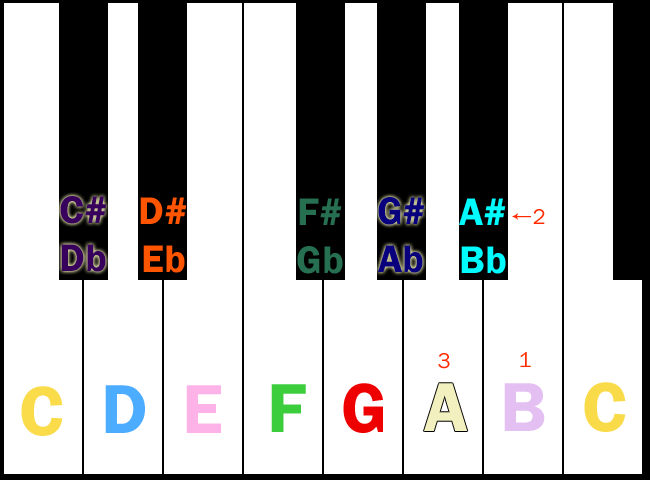
First, let’s look at a few graphics to help you visualize the “keys” I’m talking about. (I made this based on a piano keyboard, because I am a pianist and learned music theory largely by interacting with the piano. To me, seeing the notes as clearly as a piano displays them REALLY helps with learning theory.)

pianokeys
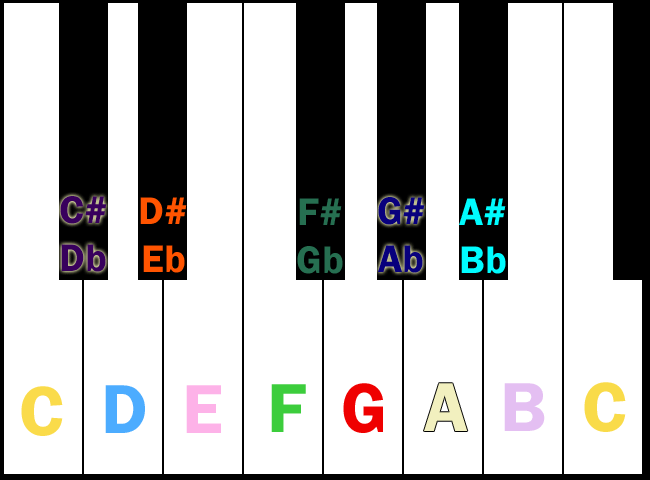
This graphic represents a small section of a piano keyboard. Here are the notes labeled:

pianokeys_labeled
There are several things to take note of here. First, see how there’s a note labeled C on the left side of the image and another note labeled C on the right side of the image? The C on the right sounds higher than the C on the left–that’s the difference. The pitch names repeat themselves, but the notes get higher going to the right on a piano keyboard, and get lower going to the left.

Second, there are black notes fitting between some of the white notes on the keyboard, and all of them are called “something-sharp” or “something-flat.” That’s going to be important later in this post!

Lastly, each of the black notes have two pitch names instead of one. This is perfectly acceptable; for instance, you can call the note between C and D either C-sharp or D-flat. It’s really just personal preference.

(Oh, and don’t worry about the colors of each note being different–this has to do with my sound-color synesthesia. I was feeling kinda OCD about making sure the colors of each label “matched” the musical note. LOL)

So, What’s So Major about a Major Key?

Last week, we talked a good bit about key signatures, and at the end of the post, I gave you an “answer key,” of sorts, showing all the different key signatures. I also identified all of them as being “something-something major.” But you probably wondered: “What does ‘major’ mean, and why does she keep specifying it?”

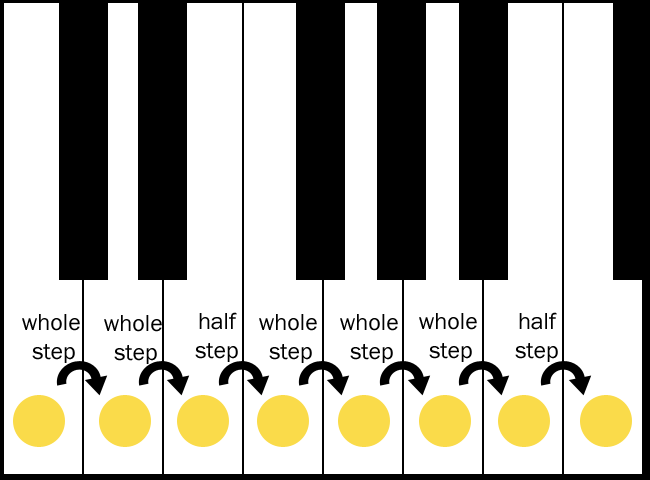
When a musician says that a song is played in a “major” key, it doesn’t mean that it’s in an “important” key–it means that the scale of the key (all 8 notes played in sequence) follows this pattern:

cmajorkey
This graphic depicts the C major scale; starting on C (leftmost note), you hit C, D, E, F, G, A, B, C. Looks pretty simple and straightforward, right?

Well, underpinning this simple sequence is a rule concerning how all major key scales are constructed, using intervals. Intervals are what I keep referencing when I say “whole step” or “half-step,” like so:

  • A half-step is the interval between two adjacent notes on the scale, such as the interval between C and C-sharp, or the interval between E and F.
  • A whole step is the interval between two notes with another note squished between them, such as the interval between C and D, or the interval between G-flat and A-flat.

So the interval pattern described for you in the above graphic has you make two whole steps up the scale, then a half, then three more whole steps, then another half. This is how all major key scales are determined–if their scale abides by this rule, they are major!

Minor Key Scales: Some Minor Adjustments to This System

cminorkey
Now, in terms of minor keys, the nice neat little system we saw earlier gets a little bit of a monkey wrench thrown in it. The above graphic depicts C minor, and there are a few differences when you compare it to C major:

  • Instead of hitting an E-natural (“regular E”), you hit an E-flat
  • Instead of hitting an A-natural, you hit an A-flat
  • B natural is still the seventh note, just like the C major, but for some reason, the seventh note is still considered “sharped” (never understood that, myself)

There is a very technical interval pattern for minor keys, but it’s very complicated. Basically, we musicians just remember that for every minor key’s scale, we take the major scale, flat the third and sixth note, and keep the seventh note in the same place.

Next Week: Every Key Has a Relative

Now that you know a little more about major and minor keys, we’re going to see how they’re related to each other, next week. (Thankfully, you won’t have to remember whose brother’s uncle’s cousin is related to whose! LOL!)

Music Theory Fun, part 4: Decoding the Key Signature

As I mentioned last week, time signatures are only one part of the important information given at the beginning of any piece of sheet music. Key signatures are the other part–they tell us what key the music is in, which gives us more information about the pitches used in the song.

First: A Few Notes (Heh) About Sharps and Flats

To learn more about key signatures, you need to know what sharps and flats are. Instead of being slang words for medical needles and shoes (or apartments, lol), respectively, in music these two words take on quite a different meaning.

fmajor This little “b”-like symbol is a flat. Whenever you see this, it means that you lower the pitch of whatever line it’s on by a half-step. In this case, the flat symbol is on the B line. Instead of playing a regular B, you would play a B-flat instead, one half-step down from regular B (the musical term for “regular B” is B-natural).
gmajor This little hashtag-like symbol is a sharp. This means you raise the pitch of whatever line the sharp is on by a half-step. In this case, the sharp symbol is on the F line. So, instead of playing an F-natural (“regular F,” lol), you would play an F-sharp, one half-step above F-natural.

You’ll see these symbols scattered around your music, adorning the left sides of notes as well as dotting the beginning of your sheet music. But their meanings do not change–flats mean lower the pitch, sharps mean raise the pitch.

The Making of a Key Signature: A Collection of Sharps or Flats

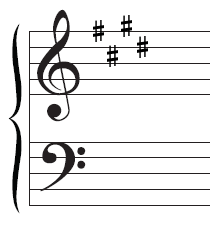
At the beginning of your sheet music, you’ll have anywhere from one to seven sharps or flats, all grouped together like this:

aflatmajor This is an example of a key signature–it tells you which notes are sharped/flatted in the piece, which tells you what key the music is in. (Musical keys are collections of 8 notes which all “fit together” to make harmonious combinations called “chords.” Each key is different, hence the need for key signatures to signal which one to use.)

Making Sense of a Key Signature

Since we know that sharps raise the pitch of whatever line they’re on, while flats lower the pitch, then we can tell which notes are altered for the particular key we’re in.

fmajor This lone little B-flat, as we learned earlier, is a key signature by itself–the key of F major. F major is kind of the “baseline” key signature for those written in flats–when you see one flat, you know it’s using the F major scale.
gmajor This lone little F-sharp indicates the key of G major–G major is the “baseline” key signature for those written in sharps. One sharp means it’s a G major scale!

For key signatures using two flats/sharps or more, there are a couple of little tricks to reading them.

Trick for Reading Flats

bflatmajor For flats, the trick is to look at the next-to-last flat in the group of flats, reading from left to right, that make up the key signature–that will tell you which key you’re in. In this case, the next-to-last flat is a B-flat, which means this key signature is for the scale of B-flat major.
eflatmajor Using the trick we just learned, which key does this key signature represent? Remember, the next-to-last flat matches the key.
aflatmajor And how about this one? 🙂 (Don’t worry–there’s an answer key at the end of this article :P)

Trick for Reading Sharps

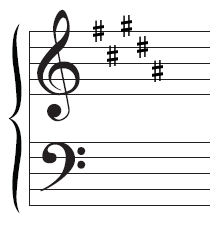
dmajor For sharps, the trick is to look at the last sharp in the group, reading from left to right, and raise the note by one half-step to get the key. For instance, the last sharp in this key signature here is a C-sharp (it’s in the C space), so raise that by one half-step and you get a D. This means that this key signature is using the scale of D major.
amajor Using this trick, which key is this? The last sharp, raised up a half-step, will tell you!
emajor And how about this one? 🙂

Even Faster Trick: Just Count the Flats or Sharps!

Though it’s best to know your flats and sharps well so that you can recognize them by sight, there’s a little shortcut experienced musicians use to reference various key signatures in short form. Just count the number of flats and sharps, and memorize which key goes with which number of flats or sharps.

For instance, one flat means F major, one sharp means G major; two flats means B-flat major, two sharps means D major, and so on. It really helps when you get up into the five- and six-sharp territories! 🙂

Yay! You Know How to Read Key Signatures!

With a little practice, you’ll be able to recognize key signatures as quickly as the pros do. (It DOES get easier, believe me!)

For Further Reading/Credits

Key Signatures @ Wikipedia
Clefs and Key Signatures @ LearnMusicFree.com

As Promised: The Answer Key!

fmajor
F major
bflatmajor
B-flat major
eflatmajor
E-flat major
aflatmajor
A-flat major
dflatmajor
D-flat major
(aka C-sharp major)
gflatmajor
G-flat major
(aka F-sharp major)
cflatmajor
C-flat major
(aka B major, lol)
gmajor
G major
dmajor
D major
amajor
A major
emajor
E major
bmajor
B major
fsharpmajor
F-sharp major
csharpmajor
C-sharp major
(aka D-flat major)

Music Theory Fun, part 3: What Time (Signature) is It?

Music is just not music without rhythm, without something to tell you what the beat is, and where to accent the beat more strongly. In sheet music, that job belongs to the time signature, which tells you much of what you need to know about the music’s rhythm.

What Does a Time Signature Look Like, and Where Can You Find It?

At the beginning of each piece of sheet music, you’ll find a set of numbers that look like this:

4-4time Looks like a fraction or something, but it’s not–this is the time signature.

(You’ll also find time signatures printed elsewhere in the sheet music if the rhythm has changed during a song, but there’s always one at the beginning of the song, so that the musician knows what rhythm to play, how long to hold notes, etc.)

Deciphering the Time Signature’s Meaning

4-4time In each time signature, the top number represents the number of beats in a measure, or unit of time in music. (Measures basically help divide up the music so that it’s easier to find your place.) In this case, this top number tells us that there are 4 beats per measure. The bottom number tells us which kind of note time value counts as 1 beat(remembering from last week’s lesson). For this time signature, the bottom number of 4 tells us that the quarter note is equal to one beat (4 quarters making a whole).

This time signature is known as “4/4 time,” and is the most common time signature out there. You can have any combination of note time values in one measure as long as it adds up to 4 beats. You could have 4 quarter notes in one measure, or 1 half note and 2 quarters, 1 dotted half and 2 eighth notes, etc.

It sounds like the following two examples:
Click to hear 4/4 time counted out, with beats 1 and 3 stressed

Pachelbel’s Canon in D is a good example of slow 4/4 time with beats 1 and 3 stressed.

Click to hear 4/4 time counted out, with beats 2 and 4 stressed

“Outta My Head (Ay Ya Ya)” by Ashlee Simpson is a good example of a song in 4/4 time with beats 2 and 4 stressed (really stressed in this song!).

Why Are There Two Different Versions of 4/4?

Since 4/4 is so well-known and well-used, some people “feel” the stresses of the beat coming on 1 and 3, while others “feel” the strong beats on 2 and 4. Both are valid perceptions, and both have applications in various styles of music. For instance, country and Southern gospel music often uses the 1 and 3 stresses, while much of the popular rock/pop and hip-hop genres use the 2 and 4 stresses.

Other Symbols You’ll See in the Time Signature Slot

commontime 4/4 time can also be written like this–the “C” stands for “Common,” and this symbol means “Common Time,” since 4/4 is so often used in music (especially Western music).
cuttime This symbol, looking like a C cut in half, stands for “Cut Time,” and it means the song is in 2/2 time instead of 4/4–it’s 4/4 time cut in half. Basically, this music looks like it’ll be slow, but is actually really, really fast, and you’d better hold on to your hat while playing this. XD

Other Time Signatures with the Quarter Note = 1 Beat

For practice, let’s look at a few more time signatures.

3-4time This one looks a little different. The bottom number is the same, meaning that the quarter note represents one beat, but the top number is 3–this is called “3/4 time,” also known as “waltz time.” That means that there are only 3 beats in this measure. That means you can have 3 quarter notes in a measure, or a half note and a quarter note, a dotted half note, a half and 2 eighths, etc.

This is what 3/4 time sounds like:
Click to hear recording

“Kiss from a Rose” by Seal is an excellent example of moderate 3/4 time.

2-4time In this example, the quarter note is still representing one beat of music, but there are only 2 beats in a measure–this is called “2/4 time.” You can have 2 quarter notes per measure, or 1 half note, or 4 eighth notes, and so on.

This is what 2/4 time sounds like:
Click to hear 2/4 time counted out

The children’s song “Mary Had a Little Lamb” is actually sung in 2/4 time. (To me, 2/4 sounds like a faster 4/4, at least in rhythm.)

What About When the Bottom Number is Different?

6-8time12-8time
Whoa, don’t these look different? But they can be deciphered just the same way as the others!

6-8time The top number, as we learned earlier, represents how many beats are in a measure. The top number here is 6, so there are 6 beats in a measure. The bottom number, however, is 8…which means that the eighth note represents one beat of music, instead of the quarter note.

So, in this time signature, which is called “6/8 time,” you could have 6 eighth notes in a measure, or 3 quarter notes, or 2 dotted quarter notes (worth 3 eighth notes each), etc.

Here’s what 6/8 time sounds like:
Click to hear 6/8 time counted out

“Silver and Cold” by A.F.I. is in a pretty fast 6/8 time, with beats 1 and 4 stressed.

To me, 6/8 time sounds like a slower 3/4 time, more like a swing or pendulum going back and forth.

12-8time Wow, in this time signature, there are 12 beats in a measure! And, with the 8 on the bottom, that means that you could have 12 eighth notes in a measure, or 6 quarter notes, or 4 dotted quarters, etc.

It’s not as many beats as it sounds, especially once you start hearing music in 12/8 time. This is actually my favorite time signature, because it sounds like really slow 4/4 time with extra little dance-like pulses added between each strong beat.

Here’s what 12/8 time sounds like:
Click to hear 12/8 time counted out

“Memory” from the musical Cats is a great example of 12/8 time.

Now You Know The Most Common Time Signatures!

These five time signatures that I’ve shown you today are the most commonly used in Western music. But there are many more out there, quirky and not often used. This blog post will help you understand the sheet music rhythms for about 70% of the Western music that is written these days.

Next Week: What’s All This about Keys?

Next week, we’ll learn about another important piece of information stored at the beginning of sheet music–key signatures! Just as important as time signatures, they tell you about the pitches you’re going to be using while you play.

Credits

All the recordings of beats being counted out were done by me–hence, the rather sad audio quality. 😛 Hopefully they’re useful to you in learning how different time signatures are counted out!

As for the images of time signatures I used in this blog post, they were retrieved from the following websites:
Time Signatures @ Wikipedia.org
Ultimate-Guitar.com

Music Theory Fun, part 2: How Long Do You Hold This Note?

Pitches, as we learned last week, are one big part of music notation. After all, you can’t write down a melody if you don’t know which notes are written where! But the other big part of music notation is rhythm–how long is each note in the melody held? That’s what we’re going to look at today.

A Note Held for One Beat: The Quarter Note

quarternote When you see this symbol (a filled-in circle with just a solid line going either up or down from it), it means that this particular pitch is held for one beat of music. This is called a quarter note.

To mimic what this sounds like, count out loud, “1, 2, 3, 4,” but only clap when you say “1.” The sound of your clap is a quarter-note long.

A Note Held for Two Beats: The Half Note

halfnote When you see that the note symbol’s circle is not filled in, like the note to the left here, it means that this pitch should be held for two beats of music. This symbol is called a half note.

It’s hard to mimic a half note with claps, so instead, try this: Count in your head “1, 2, 3, 4,” and hum through beats 1 and 2. Your hum will then be a half-note long.

A Note Held for Three Beats: The Dotted Half Note

dottedhalfnote This symbol looks almost identical to a half note–but see the little dot out to the right of it? That dot tells us musicians that we need to add half of the preceding note’s time value (how many beats it is) to the existing note. In this case, the half note is 2 beats, so the dot tells us to add 1 more beat, making it 3 beats long.

Trying the humming exercise again, count those four beats in your head again, and hum through beats 1, 2, and 3. You’ve just hummed a dotted half note rhythm!

A Note Held for Four Beats: The Whole Note

wholenote Unlike the other three notes we’ve studied so far, which were made up of circles and lines, this one looks very, very different. This donut-shaped note, called a whole note, means that you hold this pitch for four beats.

This time, when you count in your head “1, 2, 3, 4,” hum through all four beats to hear what a whole note sounds like.

Notes Smaller Than One Beat: Yes, They Exist!

Melodies are not just made up of notes that are one beat long and larger–there are plenty of note time values that are fractions of one beat. Here are two of the most prevalent “fraction” notes:

eighthnote This note, called an eighth note, is half of one beat, half of a quarter note’s length. The little flag on the top of the note helps differentiate it from the quarter note–I think of the flag as a reminder to pay attention because this note is shorter. 🙂

To hear how short this note is, count out loud, “1 and 2 and 3 and 4 and” (that’s not a typo), and only clap on the “and” that follows 1. Your clap will be an eighth note long.

sixteenthnote This little note (and I do mean little) has two flags on it, telling you that it’s different from the eighth note. This note is half of an eighth note, meaning that it is 1/4 of a beat. It’s a really quick little note, barely struck or sung before you have to stop!

Try hearing this note’s rhythm by counting out loud, “1 ee and a 2 ee and a 3 ee and a 4 ee and a.” (Looks and sounds strange, I know, but this is how us musicians count these very quick rhythms–it preserves sanity when you’re working with rhythms as short as these. LOL) As you count this rhythm, clap only on the “ee” that follows 1. This will show you how a sixteenth note sounds within the framework of “1, 2, 3, 4.”

Hooray! You’ve Learned All the Basic Notes!

If you know these six note types, you can start to understand most of the musical rhythms that are put in front of you. (There are other note types, of course, but they are not used as often.)

Next Week: Time Signatures, the Rhythmic Frames Around Songs

Next time, we’re going to look at different time signatures–they affect how music is measured, which beats are strong, which beats are weak, etc. Pitches and rhythms fit within time signatures like paintings fit in frames, providing a basis for a melody you can dance or clap to. 🙂