Tag Archives: inspiration

What IS Creativity, Anyway?

I’ve written a lot of articles on this little blog about creativity and creative pursuits. But I got to thinking one day, as I was writing, working on websites, humming my own music, and otherwise engaged in the process of creativity; I wondered, “I know I create all the time–I’ve done it since I was a kid. But WHY? What IS creativity, anyway?”

Creativity is one of the slipperiest words I’ve ever tried to define. I have such an intrinsic knowledge of it–creativity is, quite simply, in everything I do. But describing exactly what that impulse is and why I choose to pursue it is VERY difficult. Nevertheless, here are the definitions and descriptions I have come up with:

Creativity: The Desire to Make Something that’s Needed

One part of my creativity stems from seeing a need for something out in the world, and wanting to apply my talents to that need. I started making super-informative fansites back in the early 2000s because I had seen a string of cookie-cutter “fan” sites whose content was all copied and pasted from each other; I felt that our fan communities needed something better, something more in-depth, and so I took it upon myself to create the kind of site I was looking for.

My writing also falls into that category–when I write something, it’s partially because I have not seen a piece of writing like it before. I write stories and poems in part because the tales and emotions contained within me filter through my experiences and my mindset, creating something unique and yet still relatable (well, most of the time, LOL).

Creativity: The Urge to Nurture Something into Being

Another part of creativity is the almost-primal urge to just MAKE something, something that’s just yours, born of your mind. In that way, it seems like procreation; you’re affirming that your brain cells, your mind, your SOUL is alive with every word you write, every brushstroke you paint, every note you strike. I experience this with every art form I work with, from singing in choirs to writing my novel and my music, from creating websites to even making my own crafts. Everything I make has my own stamp on it; every idea in my head needs effort from me to come out, and that effort is joyful because it has MEANING and I can actually focus on it. Creativity literally gives meaning to things that might not have much meaning otherwise.

Creativity: The Need to Show Others Your Original Self

Lastly, I believe creativity is about self-expression–not just expression of the self’s effort or expression of the self’s needs, but about explaining what kind of person I am. Much of my music flows from this idea; each melody and each lyric is strained and purified through my perceptions, and when I play my original songs I am literally baring a piece of my internal world, even if it doesn’t seem like it. Especially these days when so much is negative in our world, a good-sized dollop of creativity seems like a needed taste of hope–it’s a way of saying “Hey, I’m over here–I’m a person too, with loves and needs and dreams.” (Sometimes, especially early on, I used my creativity to ask whether I was a good enough person or not; now, I use my creativity to show how I’m good enough. It works both ways.)

Are There Other Explanations of Creativity? You Tell Me!

These are my own personal definitions of creativity, but I’m just one creative person speaking from one mindset–what are your definitions? Tell me in the comments!

Crazy, Funny, and Just Plain Weird: Experimental Music

Music is not just about melodies, rhythms, and harmonies, nor it is only about songs that sound “pretty.” Sometimes, you just have to push the boundaries of what most folks think of as “good music” to develop something wildly original.

That’s what experimental music is all about–using standard musical techniques in the pursuit of comedy, combining music and visuals together for a new experience, remixing songs or melodies together to create new melodies, and even arranging random “non-music” sounds into music. Take heart: if the music you make fits into this category, you’re in great company! Here are a few examples, gathered from around the Internet:

Videos


This whimsical remix of songs from the Disney film Mary Poppins is oddly catchy!


Experimental choral madness, indeed! How can random sounds be music? When they are arranged like this!


John Cage, arguably the 20th century master of experimental music, offers this musical experience, recombining, rearranging, and composing this piece out of many different types of harmonies from other songs.


HILARIOUSLY weird video (and really addictive little dance tune), featuring comedian Ken Shimura’s character “Baka Tono-Sama.” “Ai~n” translates loosely to “Did I Do That?!” (1990s Steve Urkel, anyone?)


2:15 of strange electronic music and even stranger bovine visuals.


SILLY He-Man music video…must be seen to be believed. (If this isn’t experimental music applied in a comedic audiovisual way, I don’t know what is!)


Haunting and ethereal–“weird” in the best way!

Non-Video Sound Clips

Pop Danthology (SoundCloud)
Cool mashup of all sorts of pop songs from 2012–revisioning music in a really cool way!

Mythic Morning: Choral Works II
Collection of Danish composer Per Norgard’s avant-garde, post-modern choral music.

Malaysian Composers: Leong Yoon Pin
As of this writing (October 2013), this online radio showcases Leong Yoon Pin’s experimental instrumental music.

More Weird Music Resources

John Cage on Experimental Music
Experimental Music: Wikipedia Article
FreeMusicArchive: Experimental Music
Weird Music History (because today’s music is yesterday’s experimental sounds!)

Beginner Beading, part 3: Pretty Patterns

Making beaded jewelry is not just about selecting good beads or perfecting your techniques–it’s ultimately about making beautiful jewelry with lovely beaded patterns.

I don’t claim to be a perfect designer by any means, but I know what kinds of patterns I like to see in jewelry, and that’s how I design my own beaded necklaces thus far. Here are some examples:

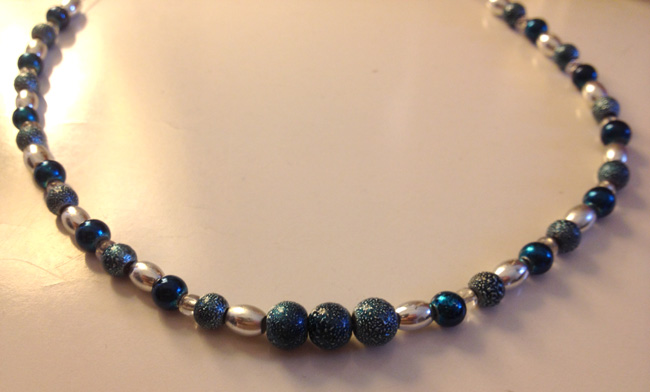
jewelcolorsxsilver
This necklace (which is the slightly-messed-up one from last week) displays a couple of pretty design tactics:

  • Symmetrical patterns–the necklace can be flipped left to right with no change
  • Colorful beads interspersed with neutral beads (in this case, silver) to help set the colors off
  • 3 sparkly beads used at the center of the necklace (bottom center of pic) to draw the light and the viewer’s eye

clearxpearl
A little different strategy was employed with this necklace, my first take on using white pearls in a design:

  • Vary the sizes and shapes of beads used in a pattern for visual interest in a mono-colored necklace
  • Use tiny beads to separate larger beads and make them look like they’re floating
  • Let one unusual bead be the center of a symmetrical 5- or 7-bead pattern (you see this twice in the above pic)–surround the unusual bead with more normal beads to let it take the spotlight

purplexpearl

  • Juxtaposing different finishes of beads in the same color family (here, using lavender) can add a soft effect to your patterns.
  • Creating a focal point in the center of your necklace can be just as easy as grouping 3 larger, lighter-finish beads and then surrounding them with smaller, darker-finish beads.

denimxsilver

  • Patterned or textured beads can add subtle flair when placed alongside smoother beads.
  • Don’t be afraid to use oblong and round beads together–oblong beads, especially in clear or neutral colors, can be used as visual “spacers” to make your colorful beads pop more.

bluexpearl
(Not sure why this necklace’s beads showed up so green–they’re actually Pacific opal beads, which are blue-green. Oh well!)

  • Use smaller beads out at the ends of your beading project, and larger beads toward the middle–that creates a “graduated” effect which looks more graceful.
  • Alternate opaque and translucent/sparkly beads for a playful pattern.

Summary

Working with symmetry, different bead textures and shapes, and colors which play well off each other can make any beaded jewelry project lovely. Try it out–just lay a few beads together on a table and rearrange them to your heart’s content. You just might come up with a randomly gorgeous pattern!

Beginner Beading, part 2: Choosing Good-Quality Beads

When you’re just beginning to bead, as I wrote about last week, it’s hard to know what kinds of beads to choose–there are literally hundreds of different kinds available! And, as I unfortunately learned, not all beads are created equal in quality.

A Cautionary Tale: The Missing Bead

beadednecklace_example When I first started beading, I made this necklace, pictured at left, as one of my first projects. I was very, very proud of my work, especially since most of the beads hadn’t cost that much to purchase and yet rendered such a lovely result, interspersing black plastic teardrop beads with dark blue and clear sparkling crystal beads.
necklace_missingbead What I didn’t know, however, was that one of the plastic beads already had a crack in it, right near the point where the beading wire threaded through it–and one day, it cracked off while I was wearing the necklace. I didn’t notice until I got home, took the necklace off, and realized that the beaded pattern at the two ends of the necklace no longer matched (denoted by the red circles on the image at left).

Learn From My Fail: Choose Better Beads

In order to keep from losing bits off your own beading projects, here’s some tips on which beads to choose (and which to avoid):

Quality Beads…

  • Are made of glass, polished wood, or crystal-like materials
  • Have well-drilled bead holes that won’t catch on the beading wire/thread
  • Do not have bead holes drilled in thin/fragile areas (this was what made my necklace’s bead crack)

Cheap Beads…

  • Are made of plastic or rough wood/stones
  • Sometimes have coatings on them (like iridescence or big pieces of glitter) that wear off easily after being handled
  • Do not thread evenly because the bead holes are drilled crooked

Final Word to the Wise: Shop Local Bead Stores

The best places I have found for quality beads are small, local bead and craft shops, whether you buy in-store or online. Such places often simply take care of their bead stock better, storing and displaying them on flocked jewelry trays which don’t allow the beads to get crushed or knocked off easily. Plus, bead specialty stores often carry the crystal-like beads and other finer-quality stock that will give your beading projects not only a more expensive look, but a longer life. (Lastly, the shop owners can help you select just the right bead for a project!)

Beginner Beading: Getting Into the Game

There are a LOT of beading tutorials out there for us beginners…but many of those tutorials expect you to already know quite a bit about the terminology and tools of beading, as I discovered when I began doing some research for this post. If you’re truly a beginner, this can be VERY confusing!

So, for this article, I wanted to help introduce beginning beaders to the lingo and the important tools for making beaded jewelry, as well as giving some bead storage tips and showcasing a couple of basic video tutorials. Let’s begin!

A Few Terminology Tips

jumpring
Image source
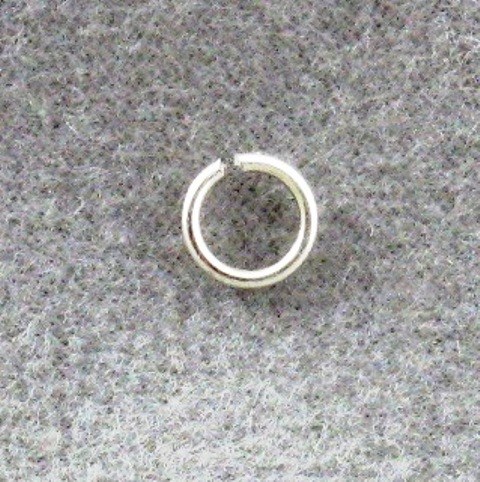
At left, this is a jump ring, used for connecting clasps to jewelry as well as other more complex beading tasks. These can be pried apart and squished back together pretty easily with the right beading tools.
clasp-types
Image source
Jump rings and necklace clasps (like the ones at left) are two types of jewelry findings. Findings are generally the metal or plastic bits that are the foundations of any beading project. (Other examples of findings are headpins for making drop earrings, crimp beads for stopping a bead string from moving around on the wire, spacers for keeping beads a certain distance apart, etc.)

See more examples of findings at the following websites:
Fire Mountain Gems
Brightlings Beads
JoAnn.com

Beading Tools

Every beader needs the following tools for even the most basic of beading crafts:

roundnosepliers
Image source
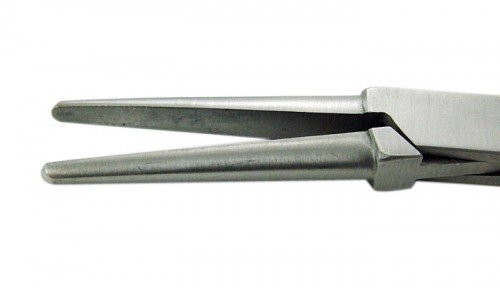
These kind of pliers, often called “needlenose” or “round-nose” pliers, help you hold delicate projects without squishing them, and also help you twist beading wire for various looks.

flatnosepliers
Image source
Additionally, you’ll need these kind of pliers, called “flat-nose pliers,” for squishing jump rings back together, affixing clasps, and all sorts of things.
crimpingtool
Image source
These are called “crimping pliers” (or are just referred to as a “crimping tool”); these can help you hold slippery projects (with the spot marked “F”), and they can also mash down things like crimp beads in the spot marked “E”.
wirecutters
Image source
And lastly, this little tool, called a wire cutter, is immensely helpful when you have excess beading wire at the end of a project!

Bead Storage

beadstorage
Image source
You can go and buy storage cases specifically designed for beads if you’ve got a craft supply store in your area. BUT, if you don’t, you can also use fishing tackle boxes (get the clear ones with small compartments) or weekly pill boxes. (Also, you can get creative and repurpose some little containers you have lying around the house, such as baby food jars or empty spice containers. Just make sure the lids of your containers close tightly!)

Video Tutorials: Attaching Clasps and Ending Necklaces


How to Attach a Lobster Claw


How to End a Necklace

Further Reading: Beginner Beading Tutorials

Choosing the Right Size Beading Wire
Beadaholique: YouTube Playlist of Beading Tutorials
Making-Beaded-Jewelry.com

Make Your Own Comics with ToonDoo!

If you’re like me, you’re a bit of a frustrated artist–you have great ideas for art and cartoons, but everything you try to draw looks like a kindergartner did it while hyped up on sugar.

For frustrated or accomplished artists and cartoonists alike, there’s ToonDoo, able to help even the most inept of us make cartoons like the following:

Procrastination

How to Use ToonDoo

You need to sign up for an account before you can use ToonDoo–sign up for a Personal Public account (they have large Private accounts for schools to use as well). Once you do that, you can click “CREATE” at the top right of the page, and it will take you to the ToonDoo Creator. Choose the comic strip layout you’d like, and you can begin! (I chose the traditional three-panel strip, but they have dozens to choose from!)

toondoo-creator
(Click for full-size pic in new window)

Lots of windows and toolbars await you! The ToonDoo button at top left allows you to open and save comics; the rest of the buttons on the top bar give you shapes, scenes, figures, props, text and more to work with.

toolbar_bottom
At the bottom, you have lots of adjusting tools to make objects smaller or larger, rotate and flip them, make them different colors–even give characters different emotions!

prop-window
characters-window
Hover over each of the buttons on the top toolbar to see all your options, then click on the one you want.

adding-scenes
Add a background–you can choose Indoor, Outdoor, even Fantasy spaces!

shrinking-props
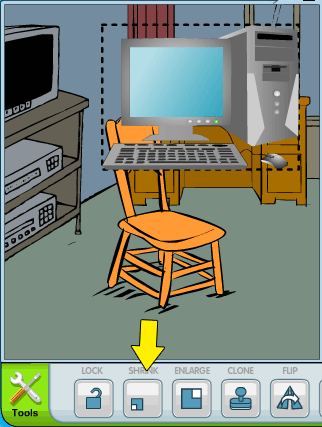
When you add props, you can shrink or enlarge them as needed–just select them with your mouse and then click the “Shrink” or “Enlarge” buttons on the bottom toolbar.

flipping-props
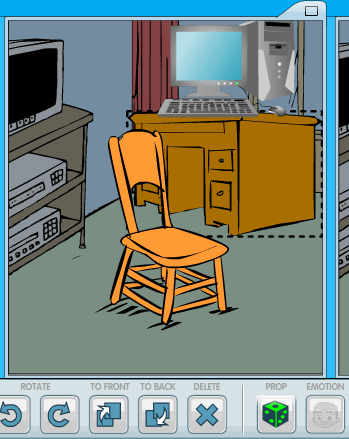
Or you can flip them horizontally if you need them in a different position. Select the prop you want to flip, then click the “Flip” button!

turning-props
You can even turn props to be at a different angle–check out how the desk is turned from the previous picture. Select the prop you want to turn, and then click the Prop button (looks like a six-sided die) several times to see all the different ways the object can be presented.

adding-text
You can also add text and characters in the same way, using the top toolbar to select what types you want, and using the bottom toolbar to fine-tune the positioning and presentation. (Sorry I didn’t get a screenshot of the “adding characters” process–I got kinda carried away making my comic :D)

Once you’re done with your comic, make sure to click the ToonDoo button at the top left of the screen and select “Save;” this will let you put in your comic’s title and tags. Then click Publish! (Important: Wait until you get a confirmation message that “your comic has been published” before navigating away from the creator page.)

Give this a shot if you’ve got a spare 15 minutes–see what you can come up with!

The Oldest Song in the World

How old is the traditional Western music scale? Well, according to the discovery of “the oldest known song” on a few clay tablets in the Middle East, it’s a lot older than musicologists once thought! Check out the videos below to hear this haunting melody from 1400 B.C.-era Syria:


The Oldest Known Melody (lyre portrayal)

And here’s a MIDI version of the tune:

The Oldest Song in the World (MIDI version)

The first person to translate this song, Prof. Anne Kilmer, discovered it in 1972 after years of research and work on clay tablets unearthed in Syria during the 1950s. One of the tablets, written in the Hurrian language, contained complete words, music, and performance instructions; she found that it was a religious hymn to the moon god’s wife, Nikal, and was likely sung with accompaniment provided by a harp. Many people have since recreated it using modern musical notation and instruments, as the first embedded video above demonstrates.

This discovery changed much in the study of music history; it proves that “Western” music scales predated ancient Grecian culture, which was previously thought to be where modern music got its start. Amazing, huh? (And even more amazing, we can actually experience a tune from so long ago, hearing it just as its original listeners did!)

Further Reading

Amaranth Publishing Article
The Oldest Song in the World: WFMU’s Beware of the Blog

Shower Time = Creativity Time

Some of my best ideas have occurred to me during the time I spend sudsing up every day. I don’t know if it’s the rushing water around me, the sensation of getting clean, or just the fact that it’s probably the first time in hours that I only have one task to concentrate on. Whatever the reason, I sometimes end up with a breakthrough idea, or a new way to study the problem I’ve been grappling with for days.

But how do you harness this time for your own creativity? Here’s what helps me:

#1: Turn on Autopilot

You know how to shower–you know what needs to be scrubbed, what needs to be rinsed. So you can allow yourself to act on autopilot…just let yourself think about whatever comes to mind. If you end up singing a little melody you’ve just come up with, great! If you finally figure out how to organize your kitchen, woot! It’s all for the better. Every idea is a victory, no matter how small it might seem to someone else.

#2: Talk Out Your Idea

You might think it’s weird to talk in the shower, but don’t worry about it–people sing in the shower, so why not talk? Talking (or softly muttering, if need be) puts your thoughts into more coherent form, instead of your ideas being stuck to some giant mental spiderweb of frustration. If you have a hard time keeping your thoughts on track (like me), this trick can really help you stay focused.

#3: Write It All Down ASAP

Once you’ve hammered out the idea mentally and/or verbally, don’t forget to write down everything so you don’t forget it. You don’t need anything fancy for this–you can just start keeping a notepad and pen in a drawer in your bathroom for such occasions. (Just don’t let the notepad get wet!)

Summary

These 3 simple little tricks have helped me use my shower time not just for cleansing and relaxation, but for brainstorming as well. Why not give it a shot? You might find that your creativity benefits from a shower, too!

Repurposed: Jewelry Organizer

After the success of displaying all of my wearable necklaces and dangly earrings with a pretty little jewelry tree, I felt pretty confident about finding all the jewelry I had when I wanted to wear it.

Well, I felt confident, that is, until I realized I didn’t have a good place for the tiny earrings and my rings, not to mention the long hair chopsticks that wouldn’t fit in my hair notions organizer. Then my enthusiasm dulled a bit.

I was at a loss for a little while, mostly because I didn’t have room on my dresser for a large jewelry box (thus the reason for the tall and narrow jewelry tree). Nor did I want a fully-enclosed jewelry box, which would keep me from seeing everything at once and make me have to dig through a box to find things. In my experience, if I can’t see it, I won’t wear it, sad to say.

So I searched around for an easily-organizable, highly-visible solution to my jewelry problem–and found it in an unlikely place!

Small-Item Desktop Organizer, Given New Purpose!

jewelry_stored Meet my solution to my “small-jewelry” problem–a desktop organizer originally meant for paper clips, thumbtacks, pens, and the like! (You might not be able to tell from the picture, but it is about half a foot tall and a little narrower than that width-wise.)

My earrings are stored in the four clear compartments (one of which my thumb is on in the picture); my rings are in the little tray up top, and my large hair notions are in the back, stored like pens in the upright holders. This puts everything out in easy reach and easy view, and it looks sleek and classy to boot!

jewelry_empty What really sold me on this little organizer is that the clear plastic compartments all swing out for easy access, enabling me to use all the storage space without having to worry about “losing” any items back where I can’t reach it. Having four compartments like this has helped me sort my jewelry to my OCD heart’s content, too!

Also, I like the fact that I can store my rings out in the open, as well as my large hair notions. I don’t have to open any drawers nor fool with any fancy ring holders–they’re just there, ready to be picked up and worn!

jewelry_spreadout
This picture shows just how much jewelry I can fit in this little organizer, and yet still have it sectioned out. Now my earrings aren’t getting tangled up with rings and brooches–yay! And my large hair notions aren’t lying forgotten at the bottom of a box anymore–double yay! 😀

To Buy This Organizer

The organizer pictured can be purchased at Walmart.com for $3.47. Additionally, if you’d like one in all black, this one, also at Walmart.com, is $6.73. And, if you want a larger organizer in this style, I found one with eight swing-out compartments and two top trays at Walmart.com for $13.81.