Look at What God Has Done–And Can Do Again!

Nehemiah 7:4a; 66-67
4 Now the city was large and spacious, but there were few people in it, and the houses had not yet been rebuilt. 5 So my God put it into my heart to assemble the nobles, the officials and the common people for registration by families…

66 The whole company numbered 42,360, 67 besides their 7,337 male and female slaves; and they also had 245 male and female singers.

In this selection of verses, Nehemiah depicts the massive company of Israelites which had come back from being exiled in Babylon. Thanks to King Cyrus of Persia, who had conquered Babylon, the Israelites were free to go back to Jerusalem to rebuild their temple and their capital city. For the king, it was a gesture of goodwill; for the Israelites, it was a fulfillment of God’s promise to His people. After 70 years, they were FINALLY home, just as He had said through His prophets!

The city of Jerusalem, however, had to be rebuilt for people to be able to live in it again; the Babylonians had done quite a number on it when they had rampaged through. Now that the Israelites were home, it was time to get to work. But now, they all recognized that without God, they would never have gotten home in the first place–Nehemiah 8 retells how the people worshipped with new fervor as Ezra read the Law to them, dramatically rededicating themselves to God.

These days, God is still doing great works for His people; He can take untenable situations and dissolve the troubles as if they never existed, and He can open doors that you thought were welded shut. BUT! It takes trusting God first. He waits for you to trust Him and give Him the problem you’ve been worrying and crying over, and THEN the miracles begin to happen. Even if the miracle you need takes a long time to unfold, trust that God has the situation in perfect control, as always. Know that He is with you just as He was with the Israelites, even while they languished in exile!

The Jackhammer in My Brain: Is This Adult A.D.D.?

For years I’ve dealt with a strange brain issue which I thought all people had–the need to switch tasks frequently. Some days it is worse than others; some days I can stay focused on a task for an hour or two, and some days I ricochet around between five different tasks in as many minutes. But for certain, long periods of time focused on one solitary task is nearly impossible for me these days.

I’ve noticed, while suffering this, that there’s an almost physical sensation along with this need for frequent task-switching. I can best describe it as “the jackhammer in my brain.”

Wait, WHAT?

This description is about as accurate as I can get. When I’m having one of my “bad focus” days, I will begin work on a task, and about five minutes later, I start feeling a slight vibration (not quite physical, but just about) on the nape of my neck. It starts off soft, like a gently purring kitty, almost but not quite breaking my concentration. If I’m determined enough, I can ignore it.

But then, after about 10 minutes, the brain “vibration” becomes stronger. Now no longer a purring kitty, the vibration is more like a cell phone on Vibrate. And after a few more minutes, it’s like a blender on “Puree.” And after that, if I’m still on the same task? The “jackhammer” begins–an entirely concentration-breaking vibration, along with the obsessive thought that “if I don’t stop what I’m doing RIGHT NOW, I am going to go CRAZY.” In desperation, I switch tasks…and the jackhammer stops, blessedly, for about 15-20 minutes.

Again, this isn’t an actual physical sensation, but it is as annoying as a physical sensation or a sensory experience. When I’m desperately trying to complete tasks, this keeps me from being able to deeply focus on anything, and I end up feeling horribly restless, bored, and frustrated.

Is This Normal? Well, It’s Normal for Me

For a long time, I thought this was how everyone operated, especially when I was younger. After all, I could lose myself in a good book pretty easily as a kid, but I found that tasks which required a lot of mental effort/concentration were difficult to stick to (such as piano practice). Only when the task became fun or easier could I accomplish it in one fell swoop–for example, I rarely managed to practice piano until I began composing my own music in sixth grade. This manifested in various ways throughout my childhood; I would have two or three toys out to play with at once and switch between them, and would always take a book to the table when I ate by myself because I needed something else to focus on besides food.

Through elementary and middle school, this didn’t bug me so much during school hours, but during high school and college, I increasingly had to fight to control this jackhammer effect to stay on task. Eventually, I came up with the “rotating task list,” which provided me with up to 10 options of tasks to switch to, should I become mentally jackhammered while trying to complete one. That is a strategy I still employ; as I compose my blogs for the week, I often have all 6 blog files open at once, so that I can switch between subjects if my brain gets too “buzzy” to concentrate on one particular subject.

But most recently, I’ve found that paying extended attention to even enjoyable things is difficult. While watching movies or TV shows at home, my smartphone is never far away, promising me something constructive to do with my hands; during Sunday morning worship, the backs of my church bulletins get filled with doodles, or I’m on my smartphone again. Even when I WANT to pay attention, the “jackhammer in my brain” takes over within minutes, demanding that I switch tasks. Sometimes the need to switch almost makes me physically nauseous.

Physical Causes Don’t Seem to Explain It

I’ve tried finding the causes for such strange behavior on my own, but most of my investigations seem to lead to dead ends. For a while, I thought I was just tired, because I’ve increasingly found sleeping to be just as difficult as paying attention for long periods of time. My brain just never wants to settle–I have to thoroughly exhaust my body before my brain will finally wave the white flag and allow me to sleep. And, once asleep, I often wake up every hour on the hour, because I feel simply bored of sleeping. (How is that even POSSIBLE? I’ve heard of insomnia, but this is ridiculous…)

But even with a full night of rest (which usually requires medication to achieve), there are still some days that the jackhammer in my brain refuses to let me watch favorite TV shows, complete Sunday school lessons, or write my novel for more than 5 minutes at a time. I don’t have any physical tremors that I know of, though I do have severe neck and shoulder tension which has required chiropractic care to resolve. Additionally, I suffer all sorts of headaches, and so I’ve wondered whether a silent migraine may be to blame. But a silent migraine lasting weeks at a time?

Having been a very physically active child, and now having to be a more sedentary adult because of my lower body injuries, might have something to do with it; perhaps I’ve still got all that energy pent-up somehow. But if I have all that energy, shouldn’t I be able to direct it to completing tasks instead of frittering it all away in the aimless junk I do trying to get my brain to stop buzzing?

Mental Cause: Anxiety or Adult A.D.D.?

Failing to find a physical cause thus far, I’ve begun to wonder about both anxiety and adult A.D.D. I am a worrier, but even when I’m not really worried about anything, my attention can often wander. It seems as though my brain constantly changes the channel on me, searching for mental stimulation and incessantly pestering me when I refuse to give it the most stimulating fare possible. I constantly have to have something to do with my hands when sitting somewhere; I must be actively taking information in, otherwise, I get the horrible jackhammer sensation again. (Sitting still is also very difficult for me; as well as having a jackhammered brain more often than not, I also fidget like crazy and trot my leg, even while I’m in an enjoyable situation. It’s REALLY weird.)

Anyone Else Had This Happen to Them?

The “constant-channel-changing” brain phenomenon has often been associated with A.D.H.D. or adult-onset A.D.D., at least in casual conversations I’ve had. I don’t have any scientific basis for it, though, so I’m left to wonder what it is that makes my brain reasonably cooperative on some days and rebounding around in my skull on other days. I’m wondering if anyone else has experienced this kind of brain weirdness and can recognize these symptoms. Am I just strange? LOL!

Crooked Glasses’ Upcoming Facelift: 3 Things to Learn

(LOL, y’all are probably thinking “IT’S ABOUT TIME!!!”)

For the last month or so, I’ve been spiffing up things behind the scenes, slowly getting things ready for a big new redesign of this little blog. As long and hard as I worked to get this original layout working, I realize it’s got a few usability problems, and I wanted to address those in the new version.

Such is the life of a webdesigner–we are always updating, always in the process of refitting so that our sites move with the Web and keep up with user demands. So, this week, I thought I’d use my current layout thought process to illustrate this point, and reveal how we webdesigners think out our design choices and put together good-looking yet usable layouts.

First: The Layout Mockup

First, I’ll give you a preview of how Crooked Glasses will look soon:

blog_full
(Click on the picture to see the full size in a new window)

3 Things I Changed for the User’s Sake

I’ve kept the color scheme basically the same, since I was happy with it and no one has yet reported any visibility or usability issues with it. However, there were 3 big issues I wanted to resolve with this facelift:

A Sticky Navigation Bar

blog_navbar
Ever since I did this blog post about an easy way to “stick” your navigation bar to the top of the page, I’ve been in love with the idea…so in this redesign, I incorporated a sticky navbar, for ease of navigation and a cleaner page look overall. Plus, it takes away the huge header image and collapses my site branding into a much more compact and tidy space.

Both these changes help readers get to my content faster without being bombarded with excess information or having to scroll up and down the page to find things. The more obstacles I can remove for the reader, the better for their stress levels–which means happier visitors!

Better Font and Lines Spaced Farther Apart

blog_linespacingfont
You know how your teachers always ask for your papers to be in Times New Roman and double-spaced? It’s not to make your paper twice as long–it’s for readability. I realized that in my original layout for this site, I had not taken line spacing into account, and as a result, awesome writing ended up looking like “Great Walls of Text” on people’s screens. Plus, the Arial font made body text run together more often than not, even when I was reading my own work! FAIL!

To combat that, I not only chose a larger font size and different font (Garamond 16px), but I spaced the lines 22px apart on the page. It’s not quite double-spacing, but it’s far enough apart to make each line distinct on the page. And with the new font choice, words don’t run together as easily, either. After all, if I’m writing a blog, I want users to be able to read what I’ve written as easily as possible!

Awesome New Sidebar

blog_sidebar I got to thinking as I designed this layout: “I don’t want a sidebar that’s trying to do too much.” Admittedly, I filled my original layout’s sidebar with a TON of stuff, like a tag list, category lists, blogrolls, recent tweets–it was all happening up in the sidebar region, and it looked overstuffed after a while. But the stuff that should have been in the sidebar, like a welcome, proper attention paid to the blogroll, etc., was tucked away on WordPress pages. Not my smartest moment as a webdesigner, I’ll admit. But that’s the great thing about webdesign–there’s always “Undo” and “Backspace.” ๐Ÿ˜€

So, with this sidebar, I’ve included a welcome, put up a blogroll, added the “Brought to you by” links, and called it a day. (With the last choice, I eliminated the need for a footer altogether!) Plus, I spiffed up the FAQ page so that it would indeed answer any and all common questions about me and about this blog. This will keep the sidebar from looking so cluttered and stuffed with text, so that it doesn’t distract from the star of the show–my content!

Summary

Good layout redesigns take time and thought, as well as a critical eye turned toward your own designs. As I’ve illustrated, you have to first point out what’s not working in the design you worked hard to craft, and then take steps to fix those problems so that the site works and reads better.

I’m very excited about this redesign, even though I dread the process of trying to placate WordPress to accept another layout; the last time was rife with much fist-shaking at the computer screen and words I’m trying to stop saying. xD But if these changes will help readers take in my content more easily, it’s ALL worth it!

Don’t Have a Steady Hand for Drawing? Don’t Let That Stop You!

If you are an artist (or a frustrated artist) who lacks a steady hand, fear not: you can still draw even without a perfectly controlled hand! How do I know that? Because you’re not the only one who has difficulty with this–many artists do! And it’s not something that should stop you forever; it is something that can be mastered, often with just a shift in your thinking.

Lack of Confidence in Art Skill -> Shaking Hand -> Lack of Confidence in Art Skill

I used to believe that I was a terrible artist, because of one thing: my trembling hand. Unsteady hands have plagued me for as long as I can remember–I can remember even before entering kindergarten, I had a hard time drawing a perfectly straight line, even when I concentrated really, really hard.

My experience in subsequent art classes in elementary school only confirmed what I already knew: I couldn’t draw anything well, because my lines weren’t clean and sharp-looking like I wanted them to be. I could only sit and marvel at my classmates who could produce beautiful visuals without shaky lines everywhere.

But there was a slight problem with my thinking, as I discovered much later on. Well, let me rephrase that: there was a HUGE problem with my thinking. I considered myself a terrible artist because of my unsteady hand, so I was not confident while I held the pencil or pen; because I was not confident, I always concentrated way too hard when I drew, and ended up with–guess what?–shaking, quivering lines. A vicious cycle!

Though part of my trembling hands may be heredity, I certainly wasn’t helping matters when I focused so hard on trying to draw a straight line. I kept noticing that whenever I was just dashing off a quick little doodle, a drawing I didn’t care about, my lines WERE clean and sharp. It seemed like the less I cared about “getting it right,” the more often I in fact did “get it right!”

A Possible Cure: Just Draw, Don’t Worry

For anyone else who’s struggling with an unsteady drawing hand, the biggest piece of advice I can give you is to just draw. Act as if whatever you’re working on is just a carefree doodle, just a random little piece of art rather than something that has to be absolutely positively right. (I found that thinking this way helped get rid of a lot of my hand’s quivering, because I wasn’t holding the pencil SO HARD trying to get everything right.)

Having confidence in your skill, even when you think you’re not “good enough” to be observed yet, is important for any art, not just drawing. Keeping your judgment separate from the creative process is key. Don’t worry about how it looks on the page, don’t worry if that line looks out of place–just draw for the sheer joy of the art. Reshaping your thinking can be the first step toward becoming a better artist!

Additional Help for Unsteady Hands

If your confidence in your drawing skill is fine, but you’re still having a little trembling getting in the way, check out the advice on this thread over at ConceptArt.org. From moving your shoulder and entire when you draw (instead of just your wrist and hand), to practicing large cursive handwriting to improve coordination (not kidding, it helps!), these artists give a lot of ideas on how to steady your lines!

Life-Changing Reads, Best Entertainment, The Ultimate Staircase, and Free File Converter

18 Great Reads that Changed My Life
From improving your blog to changing your life, from making friends (and keeping them) to life wisdom for teenagers, here are books you might be missing out on!

The Best Kind of Entertainment
Hint–it comes in every big shipping box. ๐Ÿ™‚

Climb Up, Slide Down–The Ultimate Staircase
I need this staircase, but then again, I’d never get off the stairs if I had it…LOL

Online-Convert.com
Free online file converter for audio, images, ebooks, even archives and documents!

Unusual M:TG Creature Types, part 1: Sphinx

With all the popular decks built around ubiquitous creature types (such as Elves, Fairies, Merfolk, Elves, Angels, Goblins, Elves, Zombies, Clerics, and did I mention Elves? LOL!), many of the other, less-printed creature types can go by unnoticed. As a direct result of both number of creatures printed and “the new hot decks” being played to death in tournaments, most MTG players don’t often get to dig into these rarer creature types (which is what spurred this new series of blog posts).

Thus, I begin my “Unusual Creature Types” series with a personal favorite rare creature type: the Sphinxes!

What Do the Sphinxes Do?

sphinxofthesteelwind Basically, the Sphinx creature type is Blue’s answer to Angels. Sphinx of the Steel Wind, at left, is as close to Akroma, Angel of Wrath as you can get (all that’s different about her abilities is what colors she’s got protection from, and the lifelink instead of haste).

Aside from flying like Angels, however, the 27 Sphinxes printed so far in M:TG operate very differently from their White counterparts. Sphinxes provide a lot of card draw, offer a fair amount of synergy with artifacts, and have neat mechanics where you can name a card and then do something cool with that information (like Isperia the Inscrutable’s ability, seen below). Otherwise, Sphinxes can manipulate cards, shuffle and search libraries, mill opponents, or glance ahead at the top card of your deck.

The cheapest Sphinx so far is Vexing Sphinx, at 3 mana; the most expensive Sphinxes are 8 mana (both Sphinx Sovereign and Sphinx of the Steel Wind cost this much)–the mana curve is very similar to Angels. Primarily, Sphinxes are Blue, but a few splash in White and Black; they feature huge power and toughness (but, unlike Angels, their toughnesses are often larger than their powers). Sphinxes can definitely handle combat, but only a few of their number actually deal with boosting P/T or are given combat-centric abilities such as vigilance.

Overall, Sphinxes are a really interesting addition to Blue; they take the Angels’ basic combat numbers and add card draw and manipulation to the mix. I like ’em–how about you?

Other Examples of the Sphinx Creature Type

vexingsphinx isperiatheinscrutable
sphinxofmagosi ceruleansphinx
windreadersphinx sphinxsovereign

(Images of cards retrieved from MagicCards.info)

Further Research: Complete List of Sphinxes in Magic: the Gathering

Gatherer Search: Sphinx

Gearing Up Our Godly Character

Ephesians 6:16-18

11 Put on the the full armor of God so that you can take your stand against the devil’s schemes. 12 For our struggle is not against flesh and blood, but against the rulers, against the authorities, against the powers of this dark world and against the spiritual forces of evil in the heavenly realms. 13 Therefore put on the full armor of God, so that when the day of evil comes, you may be able to stand your ground, and after you have done everything, to stand.

14 Stand firm then, with the belt of truth buckled around your waist, with the breastplate of righteousness in place, 15 and with your feet fitted with the readiness that comes from the gospel of peace. 16 In addition to all this, take up the shield of faith, with which you can extinguish all the flaming arrows of the evil one. 17 Take the helmet of salvation and the sword of the Spirit, which is the word of God.

18 And pray in the Spirit on all occasions with all kinds of prayers and requests. With this in mind, be alert and always keep on praying for all the Lordโ€™s people.

In this passage, Paul describes the Christian life in warrior’s terms, being in “full armor” against all the evil influences that this world can bring to bear. This is not about going forth and conquering in the name of God, but about defending one’s own soul.

First, Paul cautions that “our struggle is not against flesh and blood;” our fellow humans are not the real enemy when it comes to battles of faith. (Would that modern political parties understood this!) Instead, our attention should be against the “rulers,” “authorities,” and “powers of this dark world”–in essence, Satan and more “spiritual forces of evil.” Spending more time defending against spiritual attack and less time attacking other humans will make us all readier for the faith battle ahead.

Next, Paul breaks down what “the full armor of God” means:

  • the “belt” of truth, holding up other parts of the armor;
  • the “breastplate” of righteousness (God’s righteousness, not ours), defending our soul;
  • feet fitted with “readiness” from the gospel, enabling us to act decisively and prayerfully;
  • the “shield” of faith, a usable defense against the world’s influences;
  • the “helmet” of salvation, guarding our minds from corruption;
  • the “sword” of the Spirit, giving us the spiritual tools we need to combat negative influences against us.

Notice that all these attributes–truth, righteousness, readiness, faith, salvation, and the Spirit–are all parts of the Christian character. Not only that, but Paul’s descriptions of “Christian armor” closely mirror Isaiah’s descriptions of the Messiah’s symbolic armor. Our best defense against the world’s evils, then, is to be of Godly character, acting, speaking, and being as much like Christ as possible. (This does not mean that the Devil will stop attacking us: far from it! But when he does attack, we’ll be ready.)

Lastly, verse 18 reminds us of the most important part of wearing the “armor of God”–prayer. If we don’t stay in contact with the One who has blessed us with such armor, we will find ourselves fighting a losing battle. And, as Paul says again in the last half of the verse, we should be praying for each other, too!

In total, these verses show us how to live more God-centered lives, and depict how each value is crucial to building Godly character. For certain, acting and speaking in Christian ways every day is not easy, but with the right “battle gear,” we’re more able!

You Might Be Wearing Too MUCH Anti-Perspirant

Shocking title, isn’t it? How can you wear TOO MUCH anti-perspirant?

Well, I thought it was impossible, too, until I investigated a clothing problem and was astounded at what I found.

The Problem: Dark, Stiff “Pit Stains” on Every Shirt I Own

For years, I’ve struggled with it–having what appeared to be dark “pit stains” on all my tops. Not a very ladylike look, I assure you! No matter how much anti-perspirant I put on, no matter how little I sweated, all of my shirts seemed to end up like this:

antiperspirant_stain
And this is one of the nicer-looking shirts, too. I’ve got a light green shirt (which I can’t locate at the moment), which has underarms stained a dark brown color. Disgusting!!

However, it occurred to me recently, as I was taking my laundry out of the dryer and bemoaning again the fact that all my shirts were like this, that the stains were not exactly just “stains.” These spots were stiff, almost cakey, and no stain remover seemed to touch them, even before they had hit the dryer one time. “If this was just sweat,” I thought, “why did this stuff not ever wash out?”

I scratched an exploratory fingernail along the seam of one of the more offending-looking shirts, and came away with a nail-ful of semi-solid gunk–gunk with a distinctly shower-fresh scent, which I immediately recognized. It was my anti-perspirant! The gunk on my shirts smelled nothing like sweat at all!

The Test: A Control Group of New Shirts

Since I was due for some new shirts anyway, I decided to try something revolutionary: wearing the least amount of antiperspirant possible while wearing these new shirts. Instead of my usual 8 quick swipes per underarm (I kid you not), I now went for a leisurely, thorough 1 pass per underarm, making sure to cover all the skin I was supposed to with medium pressure. For each new shirt, I used this technique, and made sure to wear all the new shirts as much as possible, laundering in between wearings as usual.

I have done this test over the last two months, and I’ve noticed something. The new shirts, while being made of the same material and being worn in the same weather as the older ones, have NO so-called “pit stains.” None. Whatsoever. At all. And the old shirts had developed stains very quickly, even with routine washing!

The Hypothesis: Some “Pit Stains” Might Actually Be Antiperspirant Stains!

This is my hypothesis, then (which needs a few more tests to prove for certain): all that antiperspirant I used to wear just rubbed off on my clothes and caused a cakey buildup, which discolored and stiffened the fabric over time. When I wore so much of the product, it actually worked against the result I was trying to achieve, which was dry, stain-free pits.

I’ve also noticed that with my new regimen of using less antiperspirant, I seem to sweat a little LESS. It seems that overusing the product makes it less effective (because it’s just caked on and can’t absorb, I suppose).

So, if you’re struggling with pit stains as I was, you might try using the “one thorough swipe” method of putting on antiperspirant/deodorant, and see if that helps the buildup stop. (Also, the folks over at HowToCleanStuff have a few suggestions for removing such buildup from clothing, and a thread on MetaFilter discusses more options.)

I hope this helps someone out there avoid new “pit stains” and get rid of the old ones!

An Unexpected Font Resource: Pinterest

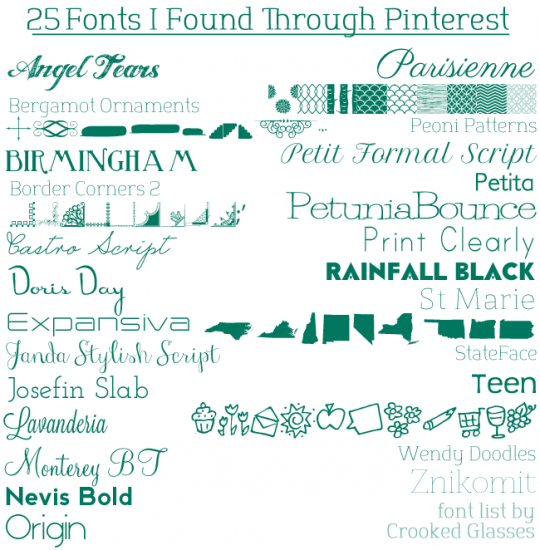
Most of the time, Pinterest is a happy mish-mash of clothing, wedding planning, gadgetry, home decor, and humor. But, as I recently discovered, there are also pinners sharing their favorite fonts–it’s a fairly well-hidden resource for not only the crafters and bloggers among us, but for us webdesigners, too!

Below is a selection of free fonts I’ve discovered through Pinterest thus far:

25fonts_pinterest

Font Download Links

Angel Tears
Bergamot Ornaments
Birmingham
Border Corners 2
Castro Script
Doris Day
Expansiva
Janda Stylish Script
Josefin Slab
Lavanderia
Monterey BT
Nevis Bold
Origin
Parisienne
Peoni Patterns
Petit Formal Script
Petita
PetuniaBounce
Print Clearly
Rainfall Black
St Marie
StateFace
Teen
Wendy Doodles
Znikomit

Want to find more fonts? Check out my Pinterest font board, “Fontalicious!”
fontalicious

Writing In-Character Dialogue: 3 Tips

When I’m writing a story, whether it’s my novel, a short story, or even a fanfiction, sometimes there are moments where I struggle with writing the correct dialogue for characters. Sometimes it feels like I’m stuck trying to put the correct sentiment into words that the character would actually say.

This can be a major stumbling block for all writers, especially if you’re writing a longer work in which you feel like you’ve used up all your “characteristic lines” already. But when I get stuck like this, the following list of brain tricks has helped me get on with writing great dialogue:

#1: Read the Dialogue Out Loud

You wouldn’t believe how well this simple little trick works for most dialogue problems. Just say the lines out loud–even mimic how this character’s voice sounds if possible. When you hear it out loud, does it sound like something he or she would say? Is there a word or two that sticks out as “wrong” in tone or word choice? Say it several times if you need to, revising in between each time as necessary, until you feel it’s “right.”

#2: Compare These Words with Other Sentiments This Character Has Expressed

When you’re dealing with a very problematic piece of dialogue, sometimes it helps to compare other bits of the character’s speech from other parts of your written work. How does this line compare with some of the other dialogue you’ve written? Is it too similar, or too different? (Both can be problematic: you don’t want to directly copy what you wrote before, but you don’t want it to be too out of character, either.) Sometimes all it takes is the simple change or deletion of one word or one phrase to make the line fit better with the character, without parroting what was said in earlier chapters. Again, multiple subtle revisions help.

#3: Imagine The Other Character’s Reactions

If the line seems mostly right, but it’s still bothering you, try this: imagine how the other characters in the scene would react. Would they recoil in shock? Would they nod and keep going along as if everything’s normal? (Of course, you also have to decide whether you want the other characters to be shocked or not shocked by what this character’s saying.) This can help you determine whether the dialogue is “correct” for this character or not–you’re basically envisioning the scene in which this dialogue takes place, so it helps you figure out whether it belongs in the context of the situation or not.