Promoting Your Blog: Don’t Forget the Little Guys

Writing posts, for bloggers, is often the easiest part of blogging (and that’s not saying much). Beyond writing, even beyond designing your own layout, there’s the question of promoting your little blog so that others can see the articles you labor over. Most promotion involves exchanging links with other blogs.

Most blogging experts will tell you one way to promote your blog this way. I, however, have a couple of divergent points to add, based on a few realizations I’ve had over the last few months.

What Others Say: Ally with the “Big Guys” Only

The blogging “experts” will tell you to promote your site by joining forces with the bigwig bloggers in your field–doing a Google search, for instance, for other blogs on your topic will likely bring up the most widely-known sites, as the following picture illustrates:

webdesignblog
Checking out and sending blogroll requests to each of these sites is a valid strategy to follow, since even just the top three results pictured here provide you with a lot of link fodder.

There are additional strategies, such as the ones put forward by incomediary.com and postplanner.com, but most of them advocate purely making strategic alliances with larger, more popular blogs to get your “foot in the door,” so to speak.

What I Say: Ally with “Little” Bloggers like Yourself, Too

My two cents: Don’t get so worked up chasing after the “popular crowd” of bloggers that you end up forgetting about other beginning bloggers like yourself. Build up community with other small-time bloggers who are posting great articles, too.

Now, admittedly, you may not get the automatic prestige that you would from a link on a more popular writer’s blogroll. But you’ll get something a lot more worthwhile: credibility, humanity, and the reputation of just being a nice person to know, which counts for more than it seems. Our reputation as writers and as human beings is worth far more than a few links on somebody else’s site!

So how do you build community between fellow bloggers?

  • Share links to fellow bloggers’ posts on your site; perhaps even set aside one blog post a week for just links to others’ posts, like my buddy Paula does over at Geeky Shopaholic Blog.
  • Write up a post about another blogger’s site, whenever you can–give them a little extra publicity and a personal review of their site. Be honest and complimentary…and don’t forget that all-important link! (I did this for my friend Jenny’s blog, GeekyPosh.com, back in January of this year.
  • Comment on other bloggers’ posts, as often as you can. This gives them encouragement–it shows them that people are reading, which is an awesome feeling! (And don’t be afraid to share a different opinion–state it politely, and you lay the groundwork for others to share theirs, too. An active comment thread is a happy comment thread!)
  • Click through fellow bloggers’ blogrolls often to find new blogs you’re interested in.
  • Invite bloggers to be on your blogroll, instead of waiting for them to send you invites.

IMPORTANT: I’m not saying give up on allying with the bigger blogs in your category–not at all! Just don’t forget the little guys (and gals) who are trying just as hard as you are. Support each other, and who knows–you all might end up being part of the “big blog” network yourselves!

Summary

Promoting your blog does not have to be a soulless, businesslike act–in fact, if you do it right, you can feel more like you’re part of a writing community instead of feeling like a lone voice in the wilderness.

This takes dedication and commitment; I’m certainly not doing it right yet (and I rarely have the Internet connection to do so with any regularity). But I can at least take the time every week to link to great posts by my fellow writers–and that’s a great place to start!

Fixing a Flat (Character)

As I’ve been writing my novel, I’ve been developing characters to hang like ornaments along the continuing plot threads I’m working on. Unfortunately, there have been a few “ornaments” that ended up more two-dimensional than three-dimensional–they were characters which somehow lacked humanity, even as hard as I tried to inject it into their dialogue and actions.

Well, they lacked humanity, that is, until I figured out a little more unconventional way to think about the situation.

The Problem: A Flat Not-So-Minor Character

This post all started as I was writing the most recent episode in my novel, which involves a female character who behaves very nastily toward my hero pretty much all the time. The nasty behavior was just fine–it worked well in the subplot and I was okay with it overall. But as I kept writing and revising, I kept thinking, “Even I don’t understand why this character is behaving this way…and I’m the one writing her!”

This character lacked humanity, the three-dimensional nature I was looking for, because her actions were not understandable. She was just a really flat character, which would have been okay if she didn’t appear quite so much in these few chapters of the novel. But since she was in a lot of scenes, so to speak, I wanted to make sure the character was worth reading about. (In some cases, the conflict between this character and my hero was almost boring because of this!)

The Solution: Getting Into Her Head

I struggled with this for several days…until one night, it hit me, as I kept asking myself “why would this character behave this way?” That was the answer: I needed to see the novel’s events–and my hero–from this character’s perspective! I needed to understand her thought process, her logic, her worldview.

So I quite literally flipped the script on myself, and began to study the unfolding plot through this character’s eyes. How would she view my hero’s introduction to her world? How were her actions and reactions based on her past experiences? More and more details and explanations emerged, as I fleshed out a possible backstory…suddenly, she became a lot more realistic and believable.

My English-professor boyfriend says that what I did was a bit of Deconstruction literary criticism on my own novel, as I imagined the story from several vantage points rather than staying solely focused on my hero’s point of view. Taking the time to develop this character’s backstory and mindset, even though she isn’t a major villain, helped me understand her better and present her as a believable, human character. (I certainly like developing her dialogue more now, even if she is a bit stuck on herself!)

Summary

If you’ve got a character who just doesn’t seem “real” enough in your book or short story, try getting into the character’s head, developing their life story a little bit, enough to where you can understand where they’re coming from. Who knows–you might just get a whole new perspective on your own story, and write a better character to boot!

The Understanding Love, Eskimo Kitties, Volcanic Island Pic, and How to Start a Successful Business

Poem: The Understanding Love
Understanding is more important than just seeing…

Eskimo Kitties
All bundled up into little furry capsules of cute.

Photo: Mountainous Volcanic Island

5 Top Tips to Starting a Successful Business
Learning from your failures, listening as well as talking, and keeping it simple–3 of the 5 tips to becoming an entrepreneur. Learn more behind the click!

Unusual MTG Creature Types, part 3: Griffins

As part of my “unusual creature types” series, I’ll be reviewing the Griffins today. I started off this post believing that Griffins were merely uglier, stronger Birds, but as you’ll see, I soon found out how wrong I was about them!

What Do the Griffins Do?

divinggriffin First and foremost, the Griffins are flying combat creatures, as expected, and quite a few carry vigilance and/or first strike as well. They are mostly 2/2, 2/3, or 3/2 creatures (though there are a few Griffins with larger powers or toughnesses than that), which make them fairly strong contenders against other flying-based creature decks.

But aside from their combat prowess, the Griffins have another feature: possessing some of the most random and unusual creature abilities. Here’s just a sampler of some of the stranger abilities within the Griffin creature type:

  • Pay a snow land to gain first strike
  • Sacrifice to deal 3 damage to target attacking/blocking creature
  • Can be recast from exile
  • If no enchantments are in play under your control, the Griffin dies
  • Bounce back to hand to return another Griffin from grave to hand
  • Sacrifice to destroy target black creature
  • Gets a +1/+1 counter for each damage you were dealt from an opponent’s source

In essence, many of the Griffins carry abilities from other colors into White, since most of the Griffins are White, with only a few exceptions (a few Blue and one Red/Green/White). It makes them an interesting creature type to play in a Tribal deck, and makes them also suitable for playing in more generic White or multi-color decks as well.

With a mana curve running from 1 to 6 mana, most of them hovering around 3 or 4, the 33 Griffins printed so far in M:TG can make a pretty solid White creature-based deck. Give them a try–they’re a very different flavor from Birds!

Other Examples of the Griffin Creature Type

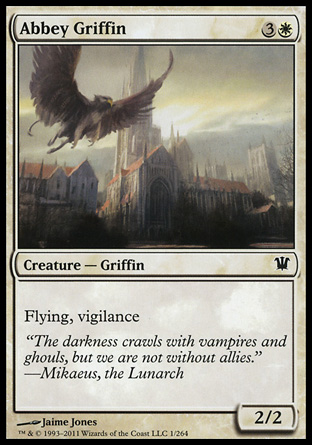
abbeygriffin azoriusfirstwing
darajagriffin misthollowgriffin
mistmoongriffin peregrinegriffin
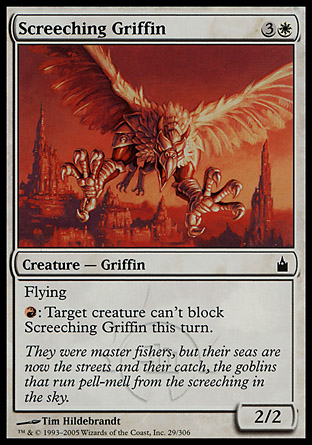
screechinggriffin zuberigoldenfeather

(All card images retrieved from MagicCards.info.)

Complete List of Griffins in M:TG

Griffins: Gatherer Search

Hospitality to Strangers: Part of the Christian Life

Hebrews 13:1-2
13:1 Keep on loving one another as brothers and sisters. 2 Do not forget to show hospitality to strangers, for by so doing some people have shown hospitality to angels without knowing it.

Here, we see a clear directive for Christians as the last chapter of Hebrews begins: show love even to strangers by showing them hospitality. In doing this, you will treat them as “brothers and sisters,” even if they are no blood relation to you, and even if they are unbelievers.

Some might ask why this is a key part of the Christian life. The simplest answer I can give is to relate it to Matthew 25:40, in which Jesus says, “I tell you the truth, whatever you did for one of the least of these brethren of mine, you did for me.” Any time we do something for our fellow man, we are serving Jesus, both figuratively and literally. When we are willing to give of our time and effort as well as our money to help someone else, we are showing them mercy and grace just as God first showed it to us–and we are pointing the way back to God.

A Memory of Showing Hospitality

I remember when I was about five or six, my family was in a drive-thru line at the KFC in Gaffney, SC, getting lunch. A painfully-thin man in ragged clothes stood near the drive-thru line as the cars circled around, begging at each car’s open window. His face looked so desperate as he approached our car, and Dad rolled down the window to speak to him–it turned out he didn’t want money, but just food.

Mom and Dad had a quick conversation after the man had begged for food, and then Dad went on through the drive-thru; I remember being surprised how much food Dad was ordering. There were two big boxes of food handed out the window to us, and then Dad looped back through the parking lot, driving up beside the man to hand him one of the boxes, stuffed almost to bursting with food, and a large drink.

The desperation on the man’s face turned to relief and joy, and he wept, saying “Thank you, thank you! God bless you!” I saw the tears in Daddy’s eyes in the rearview mirror, and even as little as I was, I understood that they were happy tears. Mom was just as moved, sniffling as we slowly pulled away.

This memory is the first thing I thought about when I read these Bible verses. God puts people in our paths for a reason, whether it’s for us to serve them or for them to provide for one of our needs. As the writer of Hebrews says, “Do not forget to show hospitality to strangers, for by so doing some people have shown hospitality to angels without knowing it.” We didn’t know the man, but my parents knew he had a genuine need, and knew that they could fulfill it. And in times since, we have been the grateful recipients of timely mercy gifted by someone else who saw our need.

Serving other fellow human beings spreads the message of God far better than anything else we could ever do–and this goes both for the people who benefit from your service and for the people who witness it. For myself as a young child, seeing this modeled in front of me was a powerful message about selfless service that I have never forgotten to this day.

My Big Problem: Worrying that I’m Not Good Enough

Officially speaking, I should be a high achiever in adult society. After all, I performed very well all through school (from kindergarten up through grad school), and I have natural talents scattered throughout the arts and technology. Why, then, am I still at home at age 28, having been unemployed for almost 4 years?

Part of it I can blame on the lack of jobs in my fields around home. My skills in creative writing, music, and web design/development don’t seem to be in much demand around here; retail workers, nurses, and industrial workers are more needed. Plus, I’ve had a plethora of health problems which have kept me from working (not least my crippling headaches which have made even “fun stuff” impossible–more about that in a later post).

But there is another part of this that up until last Sunday, I had completely failed to acknowledge. Despite my skills and knowledge, I lacked one important thing to make me a self-starting dynamo: faith in myself. And that, more than anything, has kept me not only unemployed for years, but sick and depressed as well.

The Epiphany

Sitting in church on Sunday, August 11th, I listened as our pastor told us exactly what God demands from us–utter trust. “But sometimes,” he said, “we are too stubborn to depend on the plans God has for us…or we are too fearful of where those plans will lead.”

I sat in the pew, silently angry with that statement. Where had all of “God’s plans” left me so far? Waiting 4 years for the right job opportunity, one that I actually had the skills for? Trying to write a novel that I wasn’t even sure would have an audience when it was finally finished? Making music that it seemed only I would ever fully enjoy, playing away at my keyboard in the basement? I was such a useless human being! Why had I even been made, if this was all I was capable of?

And then, a thought that was most definitely not my own burst like a bubble into my mental stream of self-hate: “You are capable; I made you that way. You just haven’t trusted Me yet.”

In that instant, anger turned to tears; I wept the rest of the sermon, as if each tear were a frustrated prayer, prayers I thought God had put off indefinitely. That one thought, which I firmly believe was a thought from God, had started a cascade of new understanding.

What God’s Little Nudge Was All About

Like I said, by all outward appearances, I should be a very successful person; not only do I have a lot of skills, but I have dreams and ambitions. I daydream about the reception my first novel will get from the public (in these daydreams, it’s always overwhelmingly positive). I think about performing onstage as a solo pianist and singer, in some unnamed auditorium full of family, friends, and fans. I plan for a future in which the money raised by these creative efforts goes toward repairing my parents’ house (the only house I have ever called home), tithing to my church, and preparing a beautiful wedding at long last for myself and my boyfriend.

But in some part of my mind, all these dreams have been reduced to just that: dreams. Increasingly, I have come to believe that I don’t have the skills to make these things come to fruition.

I wasn’t always this way: I remember sharing my talents joyfully with others, and seeing the happiness I brought to their lives by doing so. I am a pleaser, and am happiest when my works give joy to others. But my first foray into the working world soon quashed that idealistic spirit. I learned, shatteringly, that sometimes my best would just not be enough, as I struggled to teach middle-school Language Arts and found myself overwhelmed by the mental workload, demanding time schedule, physical strain, and emotional toll of the job. My hat is off to teachers everywhere; I attempted the job, thinking I would make easy work of it because I was “so skilled,” and I simply could not do it–I nearly committed suicide just to escape it.

What I had not realized until last Sunday was that the scars of teaching school had never healed; indeed, they had spread infection into every last bit of my spirit. Because of my massive failure in teaching, I had learned not to trust my own instincts about the quality of work I produced. Even as I confidently told others that I simply wasn’t made to teach and that I would soon find my “place” in the world, the doubts snuck in: “What if I’m no good at ANYTHING anymore? What if I’ve lost my touch at absolutely everything?”

Subsequent attempts to work resulted in failures as well; I got a retail job that I had to quit after a week because my legs swelled and bruised so badly I could barely walk. Not to mention the webdesign job I got, in which I gave the customer every chance to veto any design components, and I presented the person with the finished product only to hear “Can you design it all again? This isn’t what I want.” It seemed, at least in the working world, that my efforts would be either frustrated by my own disabilities or pooh-poohed by the people I needed to please. It all began to feel absolutely hopeless.

As silly as it may sound to those who have never suffered depression, anxiety, or just plain ol’ self-doubt, these thoughts and situations began to cripple me mentally. I stopped applying for jobs because the massive lists of required qualifications intimidated me. I quit sharing my music with others for a long time, because I thought it “probably wasn’t good enough for anyone else to hear.” I even quit writing on my novel for almost a year; “after all,” I thought, “who’s going to want to read a book like mine? It’s so different from everything out there–it’ll probably never sell anyway.” And I kept writing my blog here, but every week I went without comments from readers left me more and more desolate. Was anybody even reading? Was it even worth it to continue anymore?

This horrible little merry-go-round of self-hatred was what God was trying to free me of that Sunday morning. In fact, He’d probably been trying for a lot longer. But on Sunday morning, I finally heard Him, and the merciless round-and-round in my head stopped at last.

Where Do I Go from Here?

“So what do I do with this?” I found myself wondering, after the bulk of this very blog post had crystallized into an understandable form. “Now that I know to depend on God, where do my dreams and ambitions fit into that?”

I’ve prayed about it quite a bit over the last week, and here is what I’ve come up with:

  • Quit trying to do everything myself out of pride. I need a support system, full of people who understand what I’m trying to do and can help me do it better. (And I also need to actually listen to their advice instead of being offended that they’re offering me advice.)
  • Quit pre-disapproving my efforts before I show them to someone else; I need to give someone else a chance to observe them before I haul off and hate on myself for “not being good enough.”
  • Quit being afraid to share my efforts because someone else might steal them. God gave my talents to me, not to hide them or hoard them, but to use them for His glory. It’s not about me anyway!
  • Quit being afraid to attempt things which I’m not sure I can do. The worst anybody can tell me is “No” or “Try again.”
  • Quit being afraid! THIS most of all!!

So, from today forward, I will seek to connect with people who are professionals in all my fields of talent, people who know the business well and can guide timid little newbies like me. After all, I know that God will lead me to the right people, if I will only step forth in a prayerful decision.

This really terrifies me, to be quite honest; I’ve become so withdrawn and isolated that stepping outside this shell feels like putting my toe out into a frozen wasteland. But I have to, if I’m ever going to “make anything of myself”–if I’m ever going to actually live my life instead of being scared of it!

(I hope my story will help others break out of their own merry-go-rounds of self-defeating intimidation and depression. Let me know in the comments 🙂 )

WordPress “Easy Mobile Layout” Plugins: YIKES

These days, more and more people are viewing blog content through mobile means–our phones and tablets have largely replaced our laptops when it comes to simply taking in content. We bloggers must keep pace with these demands when possible; after all, visiting a site and having to re-zoom in to see the text every time you open a new page can be an off-putting hassle. (Take it from me, I’ve run into this annoyance factor even on my own blog!)

But what if you don’t have the time to develop either an app or a mobile-friendly version of your site? The solution seems to be simple: use a mobile layout plugin! It’ll build your mobile design automatically!

Since I am running a self-hosted WordPress installation on my blog, I looked up WordPress plugins which create mobile-friendly layouts. The following is what I discovered while investigating 3 of the most Internet-viewed “popular” plugins…and it’s shocking, to say the least.

WPTouch

Free or Paid: Both options available, but the paid “Pro” option appears to have better tech support overall.

Brief Reviews: Most people get what they’re looking for–a quick, usable mobile layout with a little customization. However, the free version seems to have some issues, especially with themes giving a “too many redirects” error or not serving menus properly to mobile devices. Upgrading to the Pro version apparently fixes this for some users. Check out more reviews on the WPTouch reviews page.

More Information: WPTouch by BraveNewCode

WordPress Mobile Pack

Free or Paid: Free

Brief Reviews: Lots of bad reviews about this plugin not working properly, messing up blog databases, and and being almost impossible to install. Looks like you’d better steer clear of this one…check out more reviews here.

More Information: WordPress Mobile Pack

Mobile Website Builder for WordPress

Free or Paid: Paid

Brief Reviews: This one looked very, very promising–the best of the three I reviewed, in fact!–until I read about all the ads that the plugin puts all over your site, which are very difficult (if not impossible) to remove. Couple that with the fact that this plugin apparently hosts the mobile version of your site on a DudaMobile web address, and this doesn’t seem as strong a contender as I first thought. Check out more reviews here.

More Information: Mobile Website Builder for WordPress by Dudamobile

Conclusion: You’re Really Better Off Doing It Yourself

If you can believe it, this post started out as a way to let people know about great plugins to simplify the process of making our blogs mobile-friendly. Sadly, after considering all the reviews, I can’t in good faith suggest any of these–it’s not worth risking all your hard work just to save time on developing your own mobile-friendly layout. (Of course, this is just my opinion, but after reading about the database problems some of these plugins created, it’s kind of given me the willies about it all!)

I’ve written a few articles here before about developing mobile-friendly designs–these will be helpful no matter whether you want to develop a mobile app, make a separate mobile site, or build a responsive layout that adjusts to all sorts of browsers.

5 Wonderfully Weird Musical Instruments

As many traditional instruments that exist in worldwide music, from violins to gamelan gongs, from timpani drums to shakuhachi flutes, there is an even wider world of musical instruments out there–the gorgeous and strange, the “wonderfully weird” combinations of music and sculpture into fantastic (and playable) pieces of art.

OddMusic.com chronicles many strange and beautiful instruments from around the world. Here is just a small sample of these inspired creations:

theremin

Theremin

If you’re a fan of classic 1950s sci-fi films, you’ll recognize the theremin’s spooky, slightly warbly sound. Played with two hands that never actually touch the instrument itself, the theremin uses electrostatic fields around its double antennas to create that unsettling tone. Move your hands within the two fields to control the pitch and volume of the sound, and soon you’ll be expertly weirding your friends out. (Note: the theremin was and still is actually still being built and played today in music outside of film soundtracks. There are actually “thereminists” that play professionally, because the instrument can be used to play actual melodies as well as provide a few spine-tingling notes.)

More about the Theremin at OddMusic.com

rumitone

Rumitone

The Rumitone is a musical instrument you can get into–literally! Like a cross between church bells and a playground sculpture, the variously-sized hollow metal cylinders whirl slowly around the player as he or she strikes their sides with mallets, creating a soft wind-chime-like sound. The player can also blow across the tops of the cylinders or bow across them for different sound effects. Playing the Rumitone is as much a dance as it is a musical performance, melding audio and visual into one lovely, ethereal experience for the viewer/listener.

More about the Rumitone at OddMusic.com

didjbodhran

Didjbodhran

Who ever thought of combining the traditional Irish bodhran drum with an Australian didjeridu (also spelled didgeridoo)? Barry Hall, the inventor of this hybrid instrument, did! You can play it as a drum with hands or a small stick, as the bodhran is played, or you can blow into the side of the circular hollow frame of the drum to produce the haunting low tones of the didjeridu. Or, if you want to get really fancy, you can do both at the same time, combining melody with rhythm in one handheld instrument!

More about the Didjbodhran at OddMusic.com

windform

Windform

Whenever you need a 20-foot-long horn, look up the windform–the Australian sculptor Garry Greenwood created this musical sculpture completely out of leather, and it’s perfectly playable! (The flared end of the horn kind of reminds me of a phonograph… :D) It may not sound much different from a regular big horn, but it’ll be a new experience to play a horn that’s as long as a boat!

More about the Windform at OddMusic.com

sea_organ

Sea Organ

You won’t be able to pick this instrument up and take it with you, but you can sit on the shore in Zadar, Croatia, and listen as the ocean water itself plays this cunningly crafted set of stairs. Designed and built by Nikola Basic in 2005, the air holes in the top step of the sea organ take in air as the waves push it toward shore, and the hidden set of pipes underneath the stairs produce soft, breathy tones tuned to work together even while played randomly by nature. The random nature of the notes evokes an orchestra tuning up before a concert, and the notes perfectly accompany a peaceful day by the water.

More about the Sea Organ at OddMusic.com

More Weird Musical Instruments

Explore the rest of OddMusic.com’s Weird Musical Instruments Gallery and find your next favorite sound. Who knows, you might even want to seek out and play some of these instruments yourself!

Where No Child Left Behind Went Wrong, Gift-Buying Flowchart, The Truth About Artists, and Splashup

Where No Child Left Behind Went Wrong
The much-despised No Child Left Behind law is further explored here. As I experienced firsthand during my school career, NCLB focused too hard on test scores and not enough on real knowledge and skills. What IS classified as “real knowledge and skills?” Find out in this article!

Gift-Buying Flowchart
Keep this in mind for birthdays and holidays both!

The Truth about Artists (and Performers) of All Types
Look closely at this image and you’ll see what I mean!

SplashUp
What a neat Web-based image editing tool!

Unusual MTG Creature Types, part 2: Orc

Continuing my foray into obscure M:TG creature types (begun last week with Sphinxes), here’s one that I bet many modern players haven’t even heard of: Orc. For that matter, many old-school Magic players probably don’t remember Orcs, either. But, as I’ll demonstrate, Orcs aren’t necessarily a forgettable or useless creature type–actually, they have some useful abilities!

What Do Orcs Do?

orcishveteran With only 20 creatures in the entire game bearing the “Orc” creature type, Orcs are a rare and interesting side of Red. Not quite as efficient as Goblins, Orc creatures are often used as support cards for general Red decks rather than being used in a tribal deck of their own. In fact, the most prevalent of Orc abilities is a hindrance–many of them cannot block creatures power 2 or greater, and some have conditional abilities to attack or block based on the color or number of creatures attacking or blocking.

But going beyond Orcs’ handicap, they provide a risk-based control strategy, just like Red likes it. Many Orcs allow you to sacrifice something on your field (a creature, a land, an artifact, etc.) to deal damage, get a P/T bonus to your creatures, or other bonuses. Others deal damage merely by tapping, and some sack themselves to deal damage or destroy lands. There is even an Orc that allows you to look at the top 3 cards of any player’s library (take that, Sensei’s Divining Top!).

Several Orcs are just 1 red mana to play, and the most expensive are Orcish Squatters and Sek’Kuar, Deathkeeper, both at 5 mana. (Mana isn’t necessarily an issue for the Orcs, but since some of them sacrifice land, it’s better that they cost relatively less.) This feature allows them to fit into generic Red decks with a little more ease.

Overall, the Orcs printed thus far offer Red decks some much-needed utility; they aren’t necessarily meant for combat, since most of them are 1/1s or 2/2s. But including a few Orcs may just enable your Red deck to do more control and resource management than it has before–you just have to be willing to take the risk!

More Examples of Orcs

orcishspy orcishlumberjack
orcishcannoneers ironclawbuzzardiers
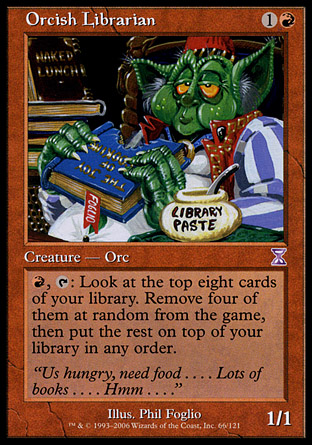
orcgeneral orcishlibrarian

All card images retrieved from MagicCards.info.

Further Research: Complete Orc List

Find the complete list of Orcs on Gatherer: Orc Search