A bit of editing, a new image, and another explanatory link brings this City of Heroes post up to par. The game might be dead for now, but the strategies outlined here could potentially work for any MMO!
Redo: God is Omniscient, and Yet Close By
This post from the Book of Jeremiah is spiffed up and better explained as part of Redo Week. Click and enjoy!
Redo: Rediscovering the Library
Better focus, some more pertinent links, and a good bit more comprehension–that’s what this redo of my post about libraries looks like. Read on to find out not only how the use of libraries have affected my life, but what the future of libraries might be!
Redo: A Jungle of Strange Words: My Forays into PHP and MySQL
Getting this post ready for Redo Week involved scrubbing out the rambling and rather unhelpful prose and replacing it with helpful advice. Now, my “for newbs by a newb” PHP and MySQL post will help new Web programmers out much more!
5 Lovely (and Simple!) Beaded Ring Tutorials

Handcrafting beaded bracelets and necklaces is more well-known now, thanks to Pinterest (and the Internet in general)–but the craft of beaded rings is just now beginning to appear more often on craft blogs and pinners’ boards.
What I love about these rings is that even though they’re made with beads and wire, they still look delicate and pretty, just like I like my jewelry to be. (The last one, the wire rosette, doesn’t have beads but is actually my favorite!) Read through, grab your ring sizer and ring mandrel, plus some beads and wire, and pick your favorite to try!
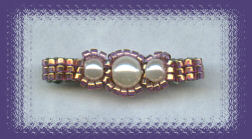
Tutorial from RubysBeadwork.com
This tutorial involves bead sewing and a little bit of knowledge of various stitch types, but it’s still pretty simple, and it makes a great, vintage-looking piece!

I love how classy the single bead looks when wrapped around with silvery threadlike wire. Who would ever believe this could be so simple?

Tutorial from The Cheese Thief
The delicate clusters of white pearlescent beads in this “8-petal flower” ring have gotten away with me. Be still my beading heart. 🙂

This tutorial makes a fully-beaded ring (band and all)–easily customizable with different colors of stones, though this blue/white/silver combination is already lovely.
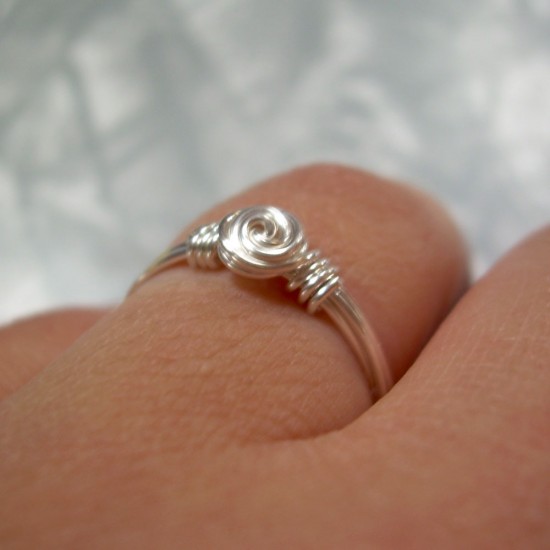
Tutorial from McFarland Designs
Ooooo SHINY! Even though this one doesn’t technically have beads on it, it does still require beading techniques to make. Swirls of shining wire wrapped around each other form a tiny rosette (which I’m tempted to make and use as a handmade engagement ring!).
What Do You Think?
Which is your favorite? How would you customize one of these designs for your own? Tell me in the comments!
Myers-Briggs Test Analysis, Baker Cat, MMO Asteroid Game, and Public Speaking Tips

Socionics.com: Myers-Briggs Personality Test Types
More about the Myers-Briggs personality tests, and what it REALLY means to be Extrovert, Introvert, Sensing, Intuitive, etc.
Baker Cat! (GIF)
Oddly soothing… 🙂
“MMO” Asteroids
Use the cursor keys to move around (up and down go forward and backward, left and right arrow keys turn your ship; space bar fires pellets at other ships). See how long you can survive this crazy game! (Fun fact: this game was created as an April Fools’ joke for would-be MMO players, but has stuck around as a neat little timewaster!)
7 Speaking Tips that Beat “Pretend Your Audience is Naked”
Want to really make a great speech? Be passionate about your subject, tell your audience a story, repeat your most important points…and try the rest of these seven tips!
What No One Tells You About Collectible Gaming

Collectible gaming–buying plastic figures and/or cards to play in games with others–is a fun pastime for quite a lot of people, myself included. But there are a few things about the hobby that I didn’t quite understand before I got into it:
You will end up with “extras” that you can’t sell for any money, period.
No matter how seldom you buy stuff for the game, no matter how much you try to sell instead of trade, you will ALWAYS end up with extra figures or cards that nobody seems to want, not even on eBay or gaming-specific trading/selling sites. There are two ways to deal with un-sellable extras: set aside a box in your closet for them and forget about them, or give them away to new players who need to build up their collections. (I’d personally recommend the second way, given that nice veteran players gave me a lot of extras when I first started playing Magic and HeroClix, and I’ve kept some of those cards and figures to this day.)
Storing your collection so that it won’t get damaged will become somewhat of an obsession in itself.
Take it from me: once you’ve spent actual money on your collection and/or acquire something you REALLY want, you’ll be invested in taking care of it. This often means buying special padded miniatures boxes to keep your figures from getting damaged, card sleeves and/or toploaders for valuable cards, etc. Not only that, you have to be concerned with keeping your collection away from sunlight (fades everything), water, dust, and excessive heat (the latter especially with plastic/rubber figures, which can and will begin to soften in hot cars). (As OCD as all this might sound, it’s worth it if you ever want to sell or trade these items later–Near-Mint and Mint condition items sell or trade best!)
You will never be “done” collecting unless you cut yourself off cold turkey.
Admittedly, this is how collectible games stay alive–always creating new stuff for us to collect. There’s always one more figure to complete a set, one more card we don’t have. But this can be quite a strain on the wallet…and on the arms and back as you struggle to move your collection! Once you start collecting, if you’re deeply involved in it, you won’t ever be quite done fleshing out your selection of figures and/or cards, unless you set goals of routinely upgrading and cleaning out your collection to only keep the stuff you play and enjoy. Which leads me to my last point…
Your collection can reach ridiculous sizes in a very short time.
Without regular pruning (and heck, sometimes even WITH regular pruning), your gaming collection can swell to fill a room corner, a closet, a room, or even your whole house (I’ve seen it happen!). Even if you’re trying not to buy new stuff, purely trading out old for new, your collection can take over your living spaces quite easily. (See: my “gaming shelf” in my closet, which is so shamefully overflowing that I’m not even taking a picture of it, LOL) If you want your collections to be enjoyable yet contained, you have to be really proactive about containing them!
What Do You Think?
Have I accurately described a collectible gamer’s life? Let me know in the comments!
The Reset Button for Your Spirit

Psalm 42:11
11 Why, my soul, are you downcast? Why so disturbed within me? Put your hope in God, for I will yet praise him, my Savior and my God.
Out of a section of psalms about being delivered from strife and oppression comes this verse, the refrain of Psalm 42 and 43. Though the speaker of this psalm is beset by enemies, he also knows where his hope should be placed–in God, the only One who has any power to save and protect. This refrain reminds him to keep his faith in God even when his very soul is disturbed and afraid.
As modern Christians, it’s tempting to think that once you’re saved, you should never have any doubts or problems again, that somehow Christians aren’t supposed to have times that try their faith. But the reality is that every Christian will face trials in their daily lives, and some of those trials are frightening, uncertain, and even dangerous. Fright, uncertainty, and danger do not exactly bolster our faith, especially not in a world that tells us we ought to be emotionally self-sufficient anyway and not “bother anyone” by talking about our troubles.
This verse, this refrain, shows us that even the most Godly of people (like the writers of this psalm) needed an occasional reminder–a reset button, if you will–that God was with them, that God had it all under control. To admit that you need God to still your worries and revive your faith does not mean you’ve lost your salvation; in fact, in that most humbling of moments, you are closer to God than ever, willing to trust Him completely. When we try to struggle on without God, we will inevitably falter, but when we “put our hope in God” in the scariest moments, we reset our faith and regain the serenity we need.
We Aren’t “Crazy,” We’re Humans, Too

Imagine if the following six phrases were spoken to people suffering from physical ailments and injuries:
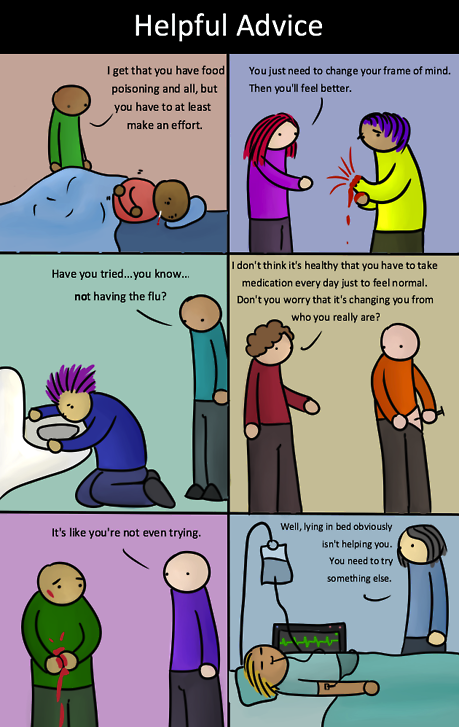
image source and one discussion of this image
This webcomic is funny because we think of it as ridiculous–who would ever invalidate someone else’s suffering like this? Who would ever deny that a person throwing up in the toilet needs treatment? Who would ever question that a person in the hospital needs to lie down and rest?
And yet we do invalidate others’ suffering, when it comes to mental illnesses.
What People Have Actually Said To Me About Mental Illness
Here’s just a sampling of what I’ve heard over the years, as a sufferer of depression and anxiety:
- “Ugh, God, you’re talking about that mumbo-jumbo again” (meaning my recent Facebook status about depression)
- “Let me just play psychologist here for a minute–don’t you think that your depression comes from feeling entitled because you were never encouraged to work for anything?”
- “Well, I just think all that stuff [mental illness] is a scam to get drugs to sell on the street. They ain’t dying, so why else would they try to get medications?”
- “Anxiety, huh? Well, when I was a kid, we had things to worry about like when food was gonna get put on the table next. What do you even worry about?”
How Is This Kind of Talk Reasonable at All? It’s Not
Would we talk to cancer patients this way? Would we talk to people with physical, measurable illnesses this way? No, and why not? Because we believe them–we can easily see the symptoms for ourselves. Mental illnesses rarely have this same level of validation–there isn’t a visible rash, nor injuries (except in self-harm cases), and our suffering is described in feelings. Thus, many people pass off mental illness as laziness, whining, or attention-getting, as this Huffington Post article describes.
Here’s the bottom line: Mental illnesses exist, as these 10 artists and writers have proven, and they DO cause suffering and pain which requires treatment. Frankly, at this point in my life, I am quite done with people who act as if those of us with mental illnesses are faking or exaggerating. People who choose to believe that mental illnesses are exaggerated, brought on by lifestyle choices, or are otherwise “our fault,” have obviously never had a mental illness and therefore don’t have the knowledge to argue about whether it exists or causes real suffering. If getting rid of depression and anxiety was as simple as “thinking positive” and “sucking it up,” I would have been clear of it years ago. As it is, I’ve battled both since I was at least 8 years old (I’m 29 now).
How to Properly Support People with Mental Illnesses
There are plenty of opponents of proper mental illness treatment out there, but there are just as many people who would like to help but just don’t know how. Either they are fellow sufferers, or they feel powerless in the face of this looming darkness and struggle that their loved one is caught in.
Wanting to help someone with a mental illness is a noble cause, but we are not born knowing how to support someone like this. From my personal experience, here are helpful and non-helpful things to say and do for your loved one/fellow sufferer:
|
Helpful Words
|
Non-Helpful Words
|
|
Helpful Actions
|
Non-Helpful Actions
|
Closing Thoughts
I don’t know if we’ll ever find “cures” for mental illness, nor do I know if we’ll find the causes of it in my lifetime. But I do know that continuing to devalue the suffering of people with mental illnesses will only further the stigma and keep people from seeking treatment. Mental illness happens; we are not “crazy” or permanently broken, we are fellow human beings, and it’s time we were treated as such. Proper support now may mean your or your loved one’s survival later.
How to Learn a Web Language

Knowing how to develop websites in various languages (HTML, CSS, JavaScript/jQuery, PHP, etc.) is great. But getting that knowledge is more difficult than it sounds for a lot of us.
Take me, for example. I’m self-taught in all things webdesign, only getting help on a few things here and there to figure out HTML, CSS, and bits of PHP and JavaScript. But there’s a definite limit to what I can effectively teach myself with a few random Google searches and online tutorials. I thought I had hit that limit when I tried to learn JavaScript in full a few years back–no matter what I tried, I just couldn’t seem to piece my shards of knowledge into actual working code. It all felt way too technical and mathy for this word-loving brain of mine.
That is, it felt too tough until I started approaching it like an actual language.
JavaScript = French?
I thought back to my high school French classes (my first exposure to the French language). Well, more specifically, I focused on how my French teacher taught us:
- She didn’t expect us to come in there on Day 2 and be able to converse in perfect French; she taught us vocabulary and parts of speech first, a unit at a time, learning the names and labels for things (“maison” = “house,” “citron” = “lemon”, etc.). Often, she translated sentences for us to show us the connections between words.
- Then, after we learned a unit of vocabulary, she showed us how to use the vocabulary in basic sentences: “Je veux un citron” (I want a lemon), “Je vais a la maison” (I’m going home). Usually, this step involved us writing sentences down and checking it for correctness via homework and tests.
- The final step in learning the words we were taught was using them in actual conversations and/or letters with other students. We were actively using what we’d been taught, and it got us used to how the various parts of speech we had learned were put together to communicate. (There was also a lot of laughing involved as we stumbled over pronunciation or word order, but at least it was practice!)
So I wondered: would the same principles apply to learning JavaScript, or in fact any Web programming language?
Short Answer: YES! And Here’s How to Do It!
These principles do work for teaching yourself a new Web language (or learning it from a friend/along with a friend). Here’s how it works:
- Step 1: Read all the examples of your chosen Web language that you can find. First, read tutorial websites that break down exactly what each “word” (tag, term. etc.) in the web language means (W3Schools is good for this). Then check out actual code snippet sources (see end of article), since code snippets are basically programming examples of working code. (Remember to read the comments on each of the code snippet posts, too, since programming wizards often suggest fixes or updates!)
As you read each snippet, think: “How did they make this work?” Search up any terms you don’t recognize right away, and see if you can understand how the programming language is arranging things to work.
- Step 2: Find a code snippet you’re interested in working into your site and start tinkering. If you find one that kinda works the way you want it to, but you want to change it up a bit, even better–that’ll give you more practice! Try implementing some simpler code tricks first so you don’t daunt yourself, and if you get stuck, ask a web developer friend for help, or post a polite question or two on code forums (see end of article). (Make sure to keep a copy of the working code in reserve at all times so that if you ROYALLY screw up, you can always copy/paste it back in place of your work and start over. Learn from my fail.)
- Step 3: Once you’ve had success with implementing others’ designed code that you’ve tinkered with a little, try writing your own code from the ground up. Again, start simple (and I mean very simple), and ask your web developer friends for help if you get stuck or are having trouble debugging. This will give you ground-level experience with developing in the new language, and you can more easily pinpoint where you’re having problems.
Don’t Forget the “Conversation” Part!
It’s very tempting to try to learn a new Web language in isolation, but languages thrive on communication. Of course, we don’t actually speak Web languages in everyday conversation, but asking other more experienced developers about their work in a particular language can REALLY help you get over hurdles and stay updated. (For instance, a Web developer buddy of mine is teaching me JavaScript at the moment, and I am learning so much more than when I tried to learn it alone.)
You may choose to meet in person or work over the Internet, but whatever you do, cultivate helpful professional connections with other developers; it really helps to have a human touch with this rather impersonal-seeming subject matter.
Further Reading
Study Aids
Webmonkey Code Snippets (HTML, CSS, JavaScript, API)
CSSFlow (HTML5, CSS3, Sass)
CSS-Tricks (HTML, CSS, PHP, JavaScript, jQuery, WordPress, htaccess)
JavaScriptSource
PHPSnips
Code Help