All posts by Robin

I'm a woman in my early thirties living in North Carolina, USA, and I have a lot of varied interests; I love creative writing, music composition, web design, surfing the Internet, thinking out loud, and gaming. And yes, my glasses are crooked. :)

Knowing God vs. Just Knowing Scripture

John 5:39-40

39 You study the Scriptures diligently because you think that in them you have eternal life. These are the very Scriptures that testify about me, 40 yet you refuse to come to me to have life.

Here, Jesus is answering the Jews who are arguing with and persecuting him because of all He’s been doing (working on the Sabbath, identifying Himself with God, raising the dead). All the way back to verse 19, Jesus constructs a counter-argument against the Jews’ position, but verse 39-40 is the crux of it. These Jews have been studying the Torah and the prophetic writings for centuries, and yet now that the Messiah has come, they refuse him, instead turning back toward the Law as if it alone will save them.

This fallacy, of believing that just knowing the Scriptures and being “good enough” will save you, is what I call the “Pharisee fallacy.” Even today, people study the Scriptures but forget to trust Jesus with their salvation; they think, perhaps, that they have to be “good enough” first for Jesus to save them, so they immerse themselves in the Word of God. Being in the Word is great; forgetting to friend-request Jesus somewhere along the way isn’t so great.

Knowledge of the Bible can’t give salvation in and of itself; knowledge of the Bible and believing in Jesus, Whom it foretells and describes, is what salvation is about. To know God, you must both read about Him and allow Him to be in your life.

Why Twilight ISN’T a Complete Waste of Paper

Note: I am not and will never be a Twi-hard, but I am vested with a Bachelor of English degree, and am highly qualified to teach Language Arts up through high school.

There’s a lot of negativity surrounding the Twilight book series–most people seem to think it is a waste of time, a teenybopper’s read, perhaps, rather than true engrossing or enlightening fiction.  And for most people, Bella Swan is a huge Mary-Sue character (a character created more as the author’s fictional avatar rather than a character in her own right).

I admit, the book series was an interesting and yet not filling read for me, rather like eating cotton candy for dinner.  But I was 24 when I picked up the series, as a way to know what my middle-school students were reading, since almost all my students, male and female, were reading and enjoying the series.  If I had been 14 instead of 24 when I read Twilight, I would be a Twi-hard, and I freely acknowledge that.

Bella = Me at 14

Why would I have been a Twi-hard as a teen?  Because I WAS Bella Swan at 14.  I thought very little of myself; I considered myself to be nobody spectacular, nobody worth anyone else’s time.  I had unrequited crushes galore, a very unhealthy body image, and supremely low self-esteem.  These are all the things that Bella Swan suffers from, as a character.  I would have resonated with her like a plucked guitar string, at 14.

Hermione & Bella: Both Valid Pictures of Humanity
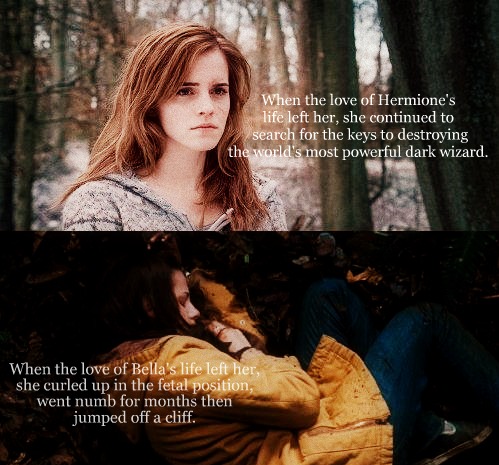

Image from Come Closer…Can You Hear It?

This recent viral image comparing Hermione and Bella brought this whole issue up for me, comparing the two female characters and heavily implying that Bella is a terrible female role model for young girls.  I disagree wholeheartedly.  Hermione depicts the heroic female; Bella depicts the depressive female.  BOTH are human, BOTH are realistic, and BOTH are necessary for young women to see, even if the latter is painful.

Yes, women and men ARE capable of being superhuman enough to push aside sloppy unwanted emotions, just like Hermione.  But we are also capable of wallowing in grief for years and doing highly irrational things, just like Bella.  To glorify the former way of living life and vilify the latter is to tell our children, “You have to be superhuman and smiling and wonderful ALL THE TIME, and do everything JUST RIGHT, or we won’t love you anymore.”  When we trivialize suffering in any form, we trivialize the human lives who are going through it. 

Suffering and its aftermath are natural to human existence, and every person reacts differently to it.  I had so many people tell me to “just think positive” while I was suffering depression this last time around, and their insensitive advice slapped me in the face.  “If it was that darned easy, I would have done it already,” I thought.  Sometimes, it’s just not possible to pull yourself out of the black tar pits of depression.  Sometimes, you just want to end the dim blankness of your life by finding a convenient cliff, as Bella tries to in New Moon. More important than Bella’s suicide attempt is the rush of support she gets afterward, and her willingness to finally accept that support instead of further isolating herself. THAT is what young women of today must see: that real people must support each other and accept support from others, not try to battle out their problems all alone.

Twilight: Not Just About Love, but About Depression (and Surviving It)

No, it’s not healthy to live your life as Bella does in much of the series, especially in New Moon.  Speaking of which, that book has the clearest and most cogent picture of depression I HAVE EVER SEEN IN LITERATURE.  Those pages with just the month names on them?  I’ve LIVED months like that, in the 16 years since I first began suffering depression myself.  I’ve LIVED like that, where nothing seemed to matter except the fact that I had no boyfriend, or the one I loved did not return my love, and time was nothing to me.  Real humans, at every stage and age of life, go through emotional crises just like Bella’s fictional one every day.  I bet either Stephenie Meyer herself or someone close to her has experienced depression–that’s how accurate the description was.

Bella’s story, as self-pitying and crazily emotional as it is, proves that you can rise from feeling like you’re nobody to becoming somebody, simply by discovering your own strengths and working to build on them.  By the end of Breaking Dawn, she has more confidence in her abilities, and her ability to mind-shield saves the lives of those she loves.  She does not start out as heroic as Hermione, but is encouraged to become heroic over the course of the four books.  She conquers depression slowly, painfully, and with a lot of help from family and friends, just like real depression sufferers do.

Bella as a Picture of Realistic Human Insecurity

Bella may not be a strong character emotionally, but she is perfectly human; she is insecurity personified, and haven’t we all been insecure at one time, especially in our teenage years?  To repudiate her character is to repudiate our own human suffering as a valid part of growing up.  We all went through our whiny years, our emo years, perhaps.  To pretend we’ve always been as strong as we are now is to LIE to ourselves.  Bella, by being a weak, unstable, and uncomfortable heroine, reminds us of where we’ve been, or perhaps where we are; she evolves slowly into a character faintly resembling Hermione, whose strength, stability, and confidence reminds us of what we can become.  Most of us, however, are stuck between the two archetypal extremes, and there is no shame in that, either.

We Don’t Need to Get Rid of the Bellas in Our Society

I don’t like much of the negative commentary about the books, mainly because the trash-talking transcends the books and begins railing about the concept of REAL PEOPLE who behave like Bella and how worthless they are to human society (focusing on Twi-hards young and old).  This is dangerous territory, full of logical fallacies, and it threatens to turn us into a modern Sparta, getting rid of the “weak” ones.  As if the “strong” ones are the only humans who deserve to live! 

I’m one of the weak ones, and I freely admit it.  I am not emotionally strong, not #1 at anything, and I’m certainly not unbreakable.  I whine, I retreat into myself when I’m sad, and I suffer out loud.  Sorry if that makes me unworthy to live in the anti-Twilight superhuman world, where everyone’s happy and smiling and wonderful at absolutely everything, and never have pain or suffering of any sort (at least, not any that they would be willing to ADMIT). 

But I do contribute art and help others, because I’m sympathetic and sensitive.  I serve a purpose.  That sensitivity makes me a much more generous and caring person as much as it makes me weaker to pain and emotional upsets. I’m worth something even if I’m not a shining hero.

The Bellas in our society may not be the most uplifting people to be around all the time, but they also balance the strong and silent types.  Bella’s character structure proves that even though humans can feel weak, they are able to change and grow like the organisms they are, and become stronger over time.  Where I come from, it’s called “growing up.”

Conclusion:  Twilight Serves a Purpose

It may not be the best literature ever produced, technically speaking.  Heck, maybe it was written for money more than love.  And for certain, it’s not a super-challenging academic read.  But it serves a purpose: it is a highly-relatable story with a central character who is more human than most critics would ever attempt to acknowledge.  And it is a story of how an everywoman becomes something slightly more, which is along the lines of just about every Disney Princess movie ever made.  We all want to feel that we are bound for something a little greater than what we are now; the Twilight series lets us realize that just as much as the Harry Potter series or any other literature out there. The series gives hope to those who might be ready to jump off a cliff, like Bella.

End Note for Those Who Aren’t Convinced

If you still think the Twilight series is a waste of time, nobody’s forcing the books into your hands.  Let those who enjoy it do so, without judging them; if you feel that you can write better and more fulfilling literature, then do so, and market it so that other people who want to read more enlightening literature may enjoy it. There’s a place for all books in today’s literary world, and a place for all preferences.

And if your kids like the book series and you don’t approve of them reading it, talk to them about why you believe it’s not appropriate. Combat the negative influences that you see in the book by actually interfacing with your children and showing them books to read that you believe to be better for them.  Whining about how “society/literature/TV/music/etc. are going to trash” isn’t solving anything. You must make the choices that you believe are responsible for YOUR life, and through that action start the change you would like to see.

10 Newbie Design Mistakes

We’ve all done it, at one point or another. Out of ignorance or out of a need to hurry up and get a page published, questionable design choices slip out onto the Internet.

Most of what I’m going to reference in this article is stuff I’ve done knowingly and willingly, either because I didn’t know any better or because I thought it “looked cool.” (Animated GIFs…oh, so very cool. *cough cough cough*) In either case, I didn’t research my design choices well enough; I should have been going to other people’s websites to see what they were doing, or at least reading web design articles to find out best practices.

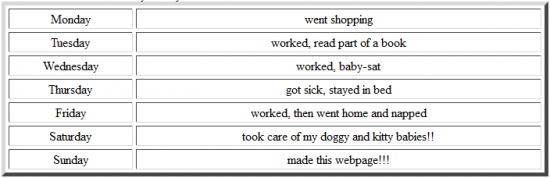
To best show off these problematic design choices, I decided to combine them all in a terrific cacophony of web design. I call it…the “Really Bad Page.”. Click the link, and try not to wail with despair.

The Bad Page’s Features

“Times New Roman” font style

Times New Roman, especially in this web 2.0 age, is very “default” and uninteresting on a webpage, since it is the default font when no font is specified in a CSS style. This makes the website look uncared for and un-updated.

All centered text

Centered text does not always “balance out” how your text looks. In this case and in many others I’ve seen across the internet, centered text is just hard to read and looks awkward on the page.

Thick borders around your tables

I used to love how thick-bordered tables looked on a page…but then again, that was back in 2001. 😛 The bordered table might be okay for true tabular data, but not for random information; it now just looks junky.

Animated GIFs (especially for an “Email Me” link)

Animated anything on a page these days tends to make your page look too young and kiddy. It can really de-professionalize a look. (If that ain’t a word yet, I’m making it one, because it works. 😛 )

No padding/margins in your divs

See how the table runs right up against the links? This is caused by no padding or margins used in the divs. Everything within the div expands out as far as it can go, and when there’s no padding there, it just makes your content look messy and harder to read.

Narrow left-aligned layout

Most users are used to seeing wide center-aligned layouts nowadays–itty-bitty left-aligned layouts are a visual shock, and may not display well on larger-resolution monitors (i.e., they will look too small).

Too much white used in the background

I’ve been guilty of this from time to time, but using white as a background color can look too “empty” if there’s not a lot of content on the page, like my sample page.

Using low-quality images (especially JPGs)

A JPG, or any image, that’s of this low quality looks unprofessional and makes it hard to tell what the picture’s subject even is. See other examples of low-quality JPGs on SixRevisions, Ransen.com, and PanoHelp.com.

Too-wordy link descriptions

Who wants to click on a link that takes several lines to describe? When you have a lot of words in your link text, it makes it look very messy and unkempt.

2-dimensional and square design

A website isn’t printed on paper, but this design looks like it could be printed out very easily. There’s very little visual interest at all, and no deviation from the invisible straight-sided square/rectangle box.

Next Week: Turning the Look from Newbie to Pro

Next week, we’ll be looking at 10 ways to make your page look professional. Never be tormented by centered Times New Roman text again! 😛

Luxe Beauty Products from L’Occitane

I recently had the pleasure of testing a couple of beauty products from L’Occitane, a beauty, haircare and skin-care brand from France. Having heard the company’s name in positive reviews, but never having bought any of their products for myself, I had no experience with their product line until I received an offer to do a sponsored post/product review on my blog. I jumped at the chance to do an honest review for a couple of their products, and I’m very glad I did!

The Products I Tested

I tested the Shea Butter Ultra Rich Face Soap and the Mini Pure Shea Butter tin, both part of L’Occitane’s natural skin care line.

Review: Shea Butter Ultra Rich Face Soap

Since I had oily, acne-prone skin as a teen and still have occasional acne even now in my late twenties, I wasn’t sure how the shea butter face soap would work out. Boy, was I (pleasantly) surprised! Not only did its lather smell good and feel rich and smooth on my face, but my skin felt moisturized even without putting any of my regular moisturizer on. (My skin has gotten drier and much more sensitive as I’ve gotten a little older, so the moisture was welcome, and surprisingly well-received by my usually finicky facial skin.)

Also, a few days before trying this soap, I had suffered an attack of eczema all across my cheeks, which are drier by nature anyhow. An hour after using the Shea Butter Ultra Rich Face Soap for the first time, I felt my cheeks and discovered that the rough patches of skin there felt less prominent than before. Though the soap alone did not completely take away the eczema, it seemed to make my medicated eczema cream absorb and work better–by the evening, the rough patches were GONE.

Review: Mini Pure Shea Butter Tin

For being as small a tin as this is (only .26 ounces!), a dab really will do ya. This pure shea butter is smooth and even on any skin you apply it to, and is in the cutest and handiest travel-size tin you could ever want for your purse or luggage.

I usually hate lotions and creams because of the motor-oil-slick feeling I get on my hands afterwards. But, after warming the tin of balm gently between the palms of my hands for a few minutes, as directed by the packaging, I applied some of the shea butter from the Mini Pure Shea Butter tin to my cuticles and a couple of rough calluses on my fingers. Within 30 minutes, I noticed a velvety difference. The balm felt soft and silky, did not leave a clingy, filmy feeling, and enhanced the natural shine of my nails. (And as of this writing, the calluses on my fingers are less noticeable!)

I’m also wearing a fairly thick coating of the shea butter on my lips as I write this post, and I cannot quit rubbing my lips together to feel how smooth they feel. I typically suffer from cracking, peeling, and bleeding lips on most occasions, and have tried many lip balms and creams; after just one full night and day of wearing this balm, reapplying as needed, I have seen the peeling slow down dramatically, and the cracks do not seem as red. (Not to mention that I used this same balm to tackle a stubborn callus on one of my littlest toes–it has many uses!)

The Bottom Line: Try L’Occitane

From what I can tell by testing these two products, the L’Occitane brand’s glowing reputation is well-deserved. Take it from someone who’s very picky about her beauty routine–this company makes quality products!

Find Your “Style,” and Revel In It

What defines you as an artist? Is it the short poetry you write about random objects? Is it the monochromatic shades you use to define a mood around the subject of a painting? Do you use dance to show the fluid motions of air and water in human form? Or do you design websites that stun with only beautifully-chosen fonts on the page?

No matter what art you choose to do, if you try to stray too far from the things you love to do most, you will find yourself easily running out of steam. Stretching your creativity too far, into things you don’t particularly like creating or thinking about, will inevitably lead to the well of creativity drying up for a while.

Making “Fresh” Art Doesn’t Mean Trying to Be Someone Else

Artists should not be bullied into doing art that isn’t natural for them. Take a musical artist who is encouraged to “find a new sound” because his/her old sound is “tired.” If that “new sound” differs too much, the musician may not feel as connected to his/her music as before, leading to a less inspired sound. The same could happen to a painter who is told he/she needs to change the style and approach to painting–too far away from the natural style, and the subsequent paintings could end up looking and feeling like so much tripe.

Trying new things in art is great–it stretches your creative “wings,” and can allow you to become a better and more experienced artist. But that evolution and exploration must be a natural process. Artistic style evolution cannot be forced along by anyone’s good intentions, not even our own.

Art: A Growing Process, Not a Personality Change

For instance, I’m a little bit different composer and poet than I used to be. I used to write long tirades of poems going on about my inner life, school, and the junk I was going through; now, I write shorter poems about the life going on AROUND me. I used to write huge, long piano solos, and now I write piano/vocal music, mainly Christian in theme.

And yet, this evolution was not forced. It happened gradually as I grew up. No one shouted over my shoulder and told me I “shouldn’t be writing this way” or “shouldn’t make music like that.” I was allowed to grow as an artist naturally, by both my parents and my musical instructors, and I feel that this made me a much more balanced experienced artist later.

Experiment With and Explore Your Chosen Art, but Stay True to Self, Too

As artists, and as friends of artists, we have to be similarly supportive and understanding of our own works as well as others’. Being creative means we allow ourselves to try new things without fear of rejection, either self-rejection or others’ rejection, just to see if it works. Heck, at least half the art I do starts out as a silly experiment, something along the lines of “Hey, never tried this, wonder if it works? Ah, what the hey, give it a shot.”

But we should never pursue “different” and “new” art so far that it becomes alien to what we believe in and what we love. I cannot compromise my taste for symmetry, lovely blended shadows, and flowing, lyrical melodies, not even long enough to make a little money, because if I tried my hand at sharp, angular, and irregular art, it would feel fake. It isn’t my style, and it would show.

So, even though the sharp, the angular, and the irregular modern art are “all the rage” these days, I stick to what I love and what I can do best. I may never shock anybody or create headlines with my music and my writing, but since it is in my natural style, it will be better art.

Summary

Your art is your own, and don’t worry about it not being “the current style” or “what anybody’s looking for.” Create it first for yourself, to reflect your own tastes, and you might just find more people drawn to it for its authenticity.

I Like Your Flaws, Hallmarks of Felinity, Cat vs. Hair Dryer, and Binder Clips of WIN

I Like Your Flaws
If only we could all love our own flawed selves as much as the speaker of this article loves another human being with flaws…

Hallmarks of Felinity
As a cat owner/lover, I can tell you that all these comic strips are TRUTH and nothing less. LOL!!

Cat vs. Hair Dryer
Speaking of cats…watch this cat fight an epic battle with hot air. (very giggle-inducing)

Binder Clips as Cable-Wranglers
I would have NEVER thought of this, but it works (just tried it!)

Choosing a Gaming Machine

Since I’m now in the market for a new gaming computer, I’ve been pricing models from all over–but more importantly, I’ve been looking for the functionality I need. I want a computer that can play City of Heroes without any graphic hiccups or performance slowdown; I also want one that handles longer sessions of gaming without harm. I know that if it can handle gaming, it can handle everything else I want to do with ease.

Knowing the number of people daily who are in the market for such a computer as I am, I thought I’d share some of my search tips and discoveries.

Beginning Your Search: Learning System Requirements

First, find the website(s) for the particular game(s) you’d like to play on your new computer. You’re looking for a page called “System Requirements” or something similar, something that tells you what kind of graphics card, hard drive, and processor are recommended to play your game. (You can also do a search for “[your game] system requirements” if the game website doesn’t have that info readily available.

Make a note of each game’s mininum, recommended, and maximum requirements, and then compare requirements across all the games you want to play. (Some games may require you to have a stronger processor than others, and some may need a better graphics/video card than others.)

Figuring Out Which Components are Strictly “Better” Than Others

If you’re like me and not exactly up on which model numbers mean better quality, you’re going to have to do some internet research to find out which version of each component is the best.

For instance, City of Heroes lists a couple of graphics cards on its system requirements list. Since I don’t know how those compare to any of the computers on the market, all I can do is compare the model numbers to that listed for any computer I’m looking at. Then, I have to find out from the various companies’ product lists whether the computer’s onboard graphics card is the same as or better than the one listed in the system requirements, or vice versa.

What to Look For/What to Skimp On

When you’re looking for a gaming computer, I have found that you should search for excellent quality in the following areas:

  • RAM: The more gigabytes of RAM you have, the faster your gaming will perform. Having a good quantity of RAM is more important to gaming than hard drive speed.
  • Hard drive speed: The faster your hard drive is, the faster your game will load initially, but this is not quite as important. (It is important, however, if you plan to do other things with your computer besides game.)
  • Dedicated graphics card RAM: For gaming performance, it’s recommended that the graphics card have its own store of RAM to work with, as well as the computer’s general RAM. Having had a computer with dedicated graphics RAM, I can tell you that it makes a wonderful difference in how the game looks and performs. Integrated graphics cards…just don’t. My second laptop’s motherboard was MELTED by an integrated graphics card–I gamed with it too much and too long.
  • Cooling vents: A gaming computer’s internal parts will generate lots of heat while providing you with the most awesome experience it can muster. It needs a lot of vents to get rid of that heat, otherwise it will overheat and even melt some of the components!
  • Processor: Having a processor that can run multiple things at once is a must for gaming. You don’t want to go for lots of RAM and cheap out on the processor–the processor is the computer’s true brain, its hardest worker.
  • Visual display: You don’t want to have a dingy or colorless display after you’ve spent all this money getting great components elsewhere. Make sure your monitor is up to the task of displaying all this gaming awesomeness.

However, there are some computer features that don’t have to be super-upgraded for gaming performance. You can quite feasibly skimp on the following:

  • Laptop battery life: If you’re gaming with your laptop, you likely won’t let it run without plugging it into the wall, so you don’t need to worry quite so much about battery life.
  • CD/DVD/Blu-ray drive: Unless you plan to install a lot of older CD-driven games, you probably won’t need a high-powered optical drive.
  • Number of USB ports: Especially for online gamers, the number of USB ports is not as important. Take this into consideration only if you use a lot of flash drives or external hard drives at one time.
  • Appearance of computer: The glossy finish or bright color won’t matter as much as performance will!

But Wait, You Haven’t Told Us Brand Names to Buy!

Nope, because each brand has seemingly an equal amount of fans and haters. Choosing a “brand” of graphics card or processor, etc., doesn’t seem to be the most important–it’s choosing the type of functionality you want first, and then finding the brand that most people seem to get good results from (and which fits in your budget).

Lastly: Read Reviews and Talk to People

Before you up and buy a computer, make sure you read all the online reviews, positive and negative, and also talk to people who own either the exact model you’re looking at, or a similar one from the same company. Listening to the opinions and experiences of others will help ensure that you’re buying a reliable and well-made computer for your gaming pleasure.

Parceling Out Church Responsibility (Without Anger or Tears)

1 Chronicles 24:3-5

3 With the help of Zadok, a descendant of Eleazar, and Ahimelech, a descendant of Ithamar, David separated them into divisions for their appointed order of ministering. 4 A larger number of leaders were found among Eleazar’s descendants than among Ithamar’s, and they were divided accordingly: sixteen heads of families from Eleazar’s descendants and eight heads of families from Ithamar’s descendants. 5 They divided them impartially by drawing lots, for there were officials of the sanctuary and officials of God among the descendants of both Eleazar and Ithamar.

In this selection, David, Zadok (one of his high priests), and Ahimelech (the son of his other high priest) go about dividing up the duties of priesthood between the “sons of Aaron” (Moses’ brother, selected as high priest of Israel back when Moses led them).

Note that this division of ministering duties is not accompanied with a verse describing how the priests whined and cried about not getting the job they wanted. Neither are the descendants of Ithamar grumbling and rabble-rousing about not getting as many leadership positions for their families. Instead, everybody takes their appointed job with no recorded hint of trouble.

If only modern Christian churches could divide labor and appoint people like this. Unfortunately, these days we Christians can come down with serious cases of hurt pride (or sometimes inflated pride that gets suddenly deflated), and before you know it, a church squabble has started. We all want to serve the Lord, but some want to serve Him very loudly and very publicly, and get praise for themselves in the process.

Churches have to work together to combat this. The members must be unafraid to voice their (tactful) opinions, and the leaders must listen and make impartial decisions based on what is best for all members, not just what will please one or two “influential” people. After all, every member wants a genuine worship experience; why not work together to make sure that happens? Being willing to serve God, even if we serve Him in ways we didn’t expect or in ways that don’t get recognition, should be our motivation.

The Random Language I Speak

Made-up words seem to run in our family. From my grandfather’s description of a car accident as “kaloom-bam-boom” to my parents’ word for the bits of sock fabric that always get left on the carpet (“sock doobies”), I guess I get the “creative words” gene honest. English is more fun when you can invent words, I believe. 🙂

Nevertheless, it always surprises people when one of my made-up words pops out of my mouth during a conversation. And I’m usually embarrassed by it at first–somehow, I fear I’ll get sent to the loony bin for some of the random stuff I come up with! But we always end up laughing about it.

Therefore, I will be brave and share some of the random language I speak, so that you, too, may LOL. 🙂

Made-Up Words and Family Slang

From My Dad’s Side

  • “kaloom-bam-boom” – a huge accident or fail of some sort (doesn’t have to be car-related).
  • “scooter-pootin'” – moving around continuously
  • “buke” (“bu” pronounced like “boo”) – to have an accidental bowel movement
  • “buuck” (not a typo) – to gag, especially over nasty-tasting food
  • “lamm” – to strike repeatedly and forcefully. “He’s just lammin’ that nail, ain’t he?”
  • “Big Ike” – overconfident person
  • “floof” – to suddenly fall flat on someone or on an object
  • “sherp” – to knock one’s feet out from under him (imitating the sound of such an action)
  • “sugarpoot”/”sugars**t” – an affectionate pet name for a child (why? I have no idea)
  • “asslin’ around” – wasting time, procrastinating (very descriptive 😛 )
  • “rhino”/”rhinoceros” – a big butt (like mine, lols)
  • “june around” – try to get a lot of things done as quick as possible
  • “tooters” – feet
  • “blomp” – to walk with slow and heavy steps
  • “braish broom” – yard-cleaning broom made of twigs, also used for the occasional whooping
  • “mazoozalum” – Grandma Daisy’s pronunciation of “mausoleum”
  • “klunk-plink-plink” – Nannie’s opinion of some pianists’ choppy playing styles
  • “pipe-stem legs” – very thin legs

From My Immediate Family

  • “moosh” – to kill or maim an insect; to massage.
  • “goopie” – a tiny, gross object, usually on the floor (bit of chewed food, unidentifiable sticky stuff, etc.)
  • “nidgy” – itty-bitty raveled thread (pill) on clothing
  • “fuzzbunny” – small ball of lint, usually ends up everywhere

My Own Made-Up Words from Childhood

  • “wootburgers” – strictly better than just a side of wootsauce.
  • “cubbyhouse” – a kid-size plastic or wood playhouse.
  • “giggling” – my kidlike pronunciation of “wiggling”, for whatever reason
  • “steamin’ alligator” – somebody who’s doing stuff just to tick me off
  • “beat-buttin'” – a particularly harsh (and usually deserved) whoopin’

Jim-ese

Since my great-uncle Jim was deaf and read lips, he often tried to speak the words he read others saying; he also made unintentionally hilarious commentary on how others spoke, as well.

  • “lotha” – translation of “nothing.” But “lotha” became synonymous with even less than nothing in our family. If you have nothing, you have zero, but if you have “lotha,” you don’t even have zero, if that makes any sense. LOL
  • “blellup” – believed to mean something like “hogwash”. Might have been Jim’s translation for “bulls**t”, but we’re not sure.
  • “jhi-jhi-jhi-jhi-jhu!” – only said to a baby, in “baby talk” voice. Like “goochy-goochy-goo.”
  • “rihbun” – pronunciation of my name.
  • “Jhalopy” – pronunciation of the city name “Shelby.”
  • “Gaffaley” – pronunciation of the city name “Gaffney.”
  • “Boola Sha-prings” – pronunciation of the town name “Boiling Springs.”
  • “mih-mih-mih!” – (said very quickly) brusque or angry talking.
  • “bipbipbipbipbip” – fast talking, a cigarette bobbing up and down in between someone’s lips as they talk, or never-ending talking.
  • “Bih…bih…bih!” – slow and deliberate talking (usually describing Grandma Daisy with a lip full of snuff)

Does Your Family Have Any Funny Made-Up Language?

We can’t be the only ones! LOL! If this post reminds you of some of the funny language in your own family, tell me about it in the comments.

Road-Tested (and Robin-Tested) WordPress Plugins

As a blogger on dialup, I don’t have a lot of connection speed to test plugin after plugin. Instead, I spend a good bit of my time researching good plugins on WordPress help sites, and asking other WP bloggers what they personally use. Once I know the general community’s opinions and issues, as well as the opinions of closer blogging friends, I can then know whether the plugin is right for my own WP setup and needs.

In the process of all that research, vetting, and questioning, I have found 6 plugins that really help Crooked Glasses be all it can be, in the midst of all the other plugins available. I highly recommend each of these, as they have all made my blogging life much easier.

Akismet: Worth Its Weight in Data

Akismet, to be fair, came already installed when I loaded WP on my own server. But I have been so pleased with how it targets spam that I recommend everyone who hasn’t signed up for an Akismet API key to do so. (This is a completely unpaid statement on my part–I just really like the plugin because it works.)

Akismet plugin download page

Yet Another Related Posts Plugin (YARPP): Reaching Into My Archives For Me

Despite being named “Yet Another” related posts plugin, YARPP is the only one of the three “related posts” plugins I tested that worked for me. Not sure if it was operator error, faulty installation, or non-working programs on the other two, but YARPP came through with flying colors.

At the end of each single post, now, I have links displayed to other posts similar enough in content, without ever having to lift a finger. THAT is such a help, much more than I ever imagined. Now I don’t have to do huge, link-laden Glassics posts unless I just want to!

YARPP plugin download page

Wordbooker: A Way to Connect My Blog with Friends and Family

Thanks to Wordbooker, which automatically posts newest blogs to my Facebook, my close friends and family can now read my blogs with ease. This actually means a lot to me, to know that real-life people are reading my works and they can comment on Facebook about them.

(Wordbooker’s plugin updates do tend to unhook the link between my FB and Crooked Glasses, but all you have to do is go into the plugin’s settings and re-connect with Facebook, which takes about 5 minutes even over dialup.)

Wordbooker plugin download page

AddThis: Making Tweeting/Liking/Sharing SO Much Easier

AddThis, like many of the sharing plugins, has a tweet button and a like button–but it’s also infinitely customizable by adding other specific-site share buttons to your lineup as well (like Foursquare and Pinterest).

I also like that it tells you how “viral” your links have gone through being shared (via your Dashboard)–though Crooked Glasses hasn’t gone all that viral yet, I know that the potential is there and I’ll be able to track its progress.

AddThis plugin download page

Tweet Old Post: Tweeting from the Depths of My Archives

This wonderful little plugin digs back into my archives and auto-tweets older posts about every 3 or 4 hours, even when I can’t be online due to having to keep the phone line clear (or when I’m feeling sick/headachy, which is often these days). Thanks to this plugin, my older posts have a chance to get some Twitter love, and my blog’s Twitter presence stays fresh and updated.

This plugin and the aptly and funnily-named plugin below are likely the ones I have to thank for my Twitter following…just saying.

Tweet Old Post plugin download page

(Special Honors) Just Tweet That S**t: It Does What It Says!

Like Wordbooker does for Facebook, this plugin auto-tweets links to my newest blogs. It helps so much to have this automated, since I can’t always be online and logged into Twitter when my blogs go live.

The reason this plugin gets a special honor? Because I tried several auto-tweet plugins before this and none of them would authenticate correctly with Twitter. I was about to tear my hair out trying to find an auto-tweet plugin, and NONE of them would do it…but this one did!

Just Tweet That S**t plugin download page

Summary

If you run a WordPress blog and are looking for plugins to help your spam problem, link to older posts, auto-post to social media, or make sharing easier, I would highly encourage you to install these 6. I have found them to be reputable, without spam and without hassle. Amazing how a single plugin can change your blogging life!