All posts by Robin

I'm a woman in my early thirties living in North Carolina, USA, and I have a lot of varied interests; I love creative writing, music composition, web design, surfing the Internet, thinking out loud, and gaming. And yes, my glasses are crooked. :)

Should My Designs Be Deep and Wide?

shouldmydesignsbedeep
I’ve been designing websites now since 2003, and I’ve seen quite a few web design fads go by. At one time, left-aligned, horizontally “skinny” designs (barely 500 px wide) were the trend; then, it was horizontally- and vertically-centered larger background graphics, with an iframe floated atop them.

Now, as more and more computers are coming equipped with wider screens, I’ve seen more designers widening their designs to 1000 pixels or more–something I would have never seen coming back in the 500-px days. Some layouts are so wide that you have to scroll sideways if you’re on an older monitor.

Since I like to design sites that are accessible to as many monitor sizes as possible, I’ve found myself wondering if I should follow suit with the current “wide design” trend. Since widescreen monitors have become so popular, should designers now build wider layouts for their websites?

Wider Layout: Pros

More space to fit content “above the fold”
You can fit much more content on a wider layout, since you have space not only for text-based content, but for multiple sidebars full of widgets, photo thumbnails, video previews, playlists, etc.

Content is more spaced-out and readable
Since wider layouts use more of the screen space, your content can expand a little; more white space makes it much easier for users to read and enjoy your content, since it isn’t all crammed together.

With more space, you can use larger layout images
Wider layouts can mean bigger graphics–you can create huge background images and float your content on top of them, or experiment with many different images joined together to create a collage effect.

Wider Layout: Cons

People with smaller monitors have to scroll sideways
In the hunt for more and more horizontal space for web content, people with older monitors are going to be left out. Narrower screens will force such users to scroll sideways to see all your content (VERY annoying), and not everyone is going to upgrade to a new monitor just to view your site.

Page can take longer to load
With all this awesome media-rich content, users could be stuck waiting for your page to load a little bit longer, especially on slower connections (like mobile users–more on that below).

  • Not mobile device-friendly
    Widescreen layouts are definitely NOT mobile-friendly–and much before now, you would have needed to make a separate mobile layout so that you didn’t leave your on-the-go users behind. BUT…there is another solution.

    Responsive Design: Those With Wide Screens See a Widescreen Layout!

    A design that shrinks and expands with differing screen resolutions (also called “responsive design”) is the new way to support all your users’ screen size needs. But it actually has its roots in a design practice I learned back when I first started in webdesign.

    In the early to mid-2000s, 800px x 600px was the standard screen resolution, though some people had upgraded to a larger 1024px x 768px resolution. Many of my fellow webdesigners fixed this problem with “alternate layouts”–they made one layout sized for 800 x 600 viewers, and another for their 1024 x 768 viewers. Then, on their splash pages (entrance pages which have gone the way of the dodo bird), they had simple links for you to click to go to each design.

    Today’s responsive design, with its automatic “resizing” to visitors’ screen resolution, is the best way to get a “widescreen” feel for users whose screen resolutions can make the most of it. Yet it also doesn’t lock out smaller screens–it’s an automatically customized user experience, one that was heralded by the “user choice” model of the mid-2000s.

    Summary

    Widescreen layouts don’t have to be just “widescreen” anymore–with responsive design, you can make a layout that satisfies most every visitor’s viewing needs. It’s a lot more backend work, but it’s definitely worth it!

  • Journals in Verse: My Personal Poetry

    journalsinverse
    I’ve been writing poetry since I was a very little girl. Some of my earliest verses were composed on a summer vacation when I was about 7 years old, studying the motion of the waves against the beach as doubtless so many other poets before me had done. I was inspired by the fluid rocking motion of the water, and how it left the beach looking swept and clean, so I jotted down a little poem about it.

    What I Used to Think Poetry was About

    Poetry indeed served as a welcome diversion from other subjects like math and science, but I didn’t do a whole lot of it during elementary school. From what I learned in school, you simply had to write poetry in a very specific way for it to be considered “art.” I toyed with the idea of becoming a poet when I was older, but I certainly didn’t have the patience to sit there and rhyme ending words, or to make each line be the same length with the same beats as its predecessors. It seemed like a lot of work–and it ended up sounding a lot less inspired and beautiful–when I tried it, at least.

    Poetry: Not Merely Meter and Rhyme

    But the hangups I had about “appropriate” poetry style all but evaporated in middle school. I began to need a way to talk about the despair and anger I was feeling, without writing too directly about it and getting angry all over again. So I just wrote, breaking my poetry’s lines wherever it felt “right” to break them, choosing words only for their biggest emotional impact.

    This poetry, in a real sense, became my journal entries. As I worked with fitting my emotions into a small space of verse, my feelings and problems became concentrated and yet refined. Other people could relate to what I had written, but it didn’t hurt me quite so bad to read it as it had hurt while I was writing it all out. It was quite like getting a splinter out of my finger and showing the sliver of wood to other people–it was painful poetry, but it was good because it was so raw.

    I wrote this type of self-discovering poetry all throughout high school and well into college, and even some into graduate school. Much of that poetry probably shouldn’t really be shown to anybody now, since my style has evolved as I have grown up (not to mention my mindset). But the art form served its purpose–each poem helped me stay in control of my emotions, storing them in a paper jar, like storing fruit by canning it. And, I can reopen the jars at any time and re-experience my life at that moment.

    Poetry as An Old Faithful Friend

    As my life has become brighter, especially with the advent of my current relationship and my continued work on my novel and my music, I find myself less likely to lean on poetry’s shoulder, writing mainly life-observing poems rather than inward-looking poems (though I can still wring the tears out of a piece of paper if I’m in a mood to do so!). I use poetry now as an occasional journal entry, a way to immortalize a moment rather than a way to work out a problem. But I know that I can always write out my problem in verse; just like a faithful old journal, the art form of the poem waits for me to write.

    How to Start Writing Poetry for Yourself

    Though I’m sure the poetry purists out there are probably recoiling in horror from this post, I still recommend approaching poetry as an art form you can USE rather than as an art form you have to produce “just so.” If you let others’ guidelines for writing poetry become rigid rules, you can actually stifle your own creativity before it ever has a real chance.

    That’s why I’m not suggesting any specific rules or regulations. Rhyme if you want to, make it rhythmical if you want to, but feel free to explore the edges of the art form, too; discover the line where speech becomes poetry, where words become art. Write what you really feel and think, and worry about refining it later, if it even needs refining. The world may not need another perfectly measured and rhymed work of art–but it does need your thoughts.

    Random Dancing, Video Game Irony, Switcheroo, and Do Nothing for 2 Minutes

    randomdancing
    Those Who Were Seen Dancing (Quote by Nietzsche)
    Moral of the story: if people ever say you’re crazy, just say you’re dancing to inaudible music! 😀

    Ironic Situation (Webcomic)
    Funny (and accurate) comic about video games and acceptable versus non-acceptable content.

    Switcheroo (Pics)
    This photographer asks the subjects to do a “switcheroo”…with funny results!

    Do Nothing for 2 Minutes
    How long can you go without needing to touch your keyboard or mouse?

    The Art of the Expensive Combo

    expensivecombo
    In Magic: the Gathering, I gravitate toward late-game awesomeness. Forget quick and easy combos–I want something that takes several turns to set up, so that I can savor the win when it becomes unstoppable. The idea of building an invincible combo one unassuming card at a time is so much fun.

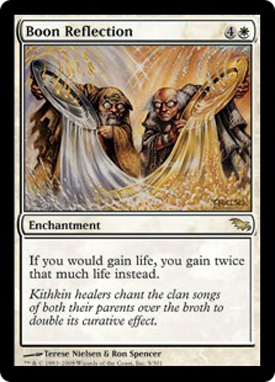
    This tendency certainly hasn’t dimmed or vanished in recent years. One of the recent decks I’ve been working on is basically a combo deck involving Sanguine Bond and Boon Reflection.

     
    The epic–and expensive at 10 mana–combo

    I LOVE This Idea…

    These two card effects blend beautifully, making my opponents lose double life every time I gain life. I’ve actually been able to use two Whitesun’s Passages to defeat somebody in one turn with that combo on the table.


    With Boon Reflection on the table, you gain 10 life instead of 5. Two of these played while Sanguine Bond’s out, and you’ve just made your opponent lose 20 life… 😀

    …But It Took a Lot of Work to Get Here

    However, just because a combo works beautifully in your head doesn’t mean that it will ever come to fruition. I worked on my Sanguine Boon deck (as I’ve come to call this particular combo deck) for almost a year before it really got off the ground, because I couldn’t draw enough mana to play all the combo pieces when I needed to play them. Either that, or I couldn’t even draw the combo pieces at the right time. Since it’s a deck that involves enemy colors working together, I knew it would be difficult, but I didn’t expect it to be impossible.

    So, I ended up chatting with one of my friends about this conundrum I was having, forgetting momentarily that he was quite knowledgeable about many of the cards and strategies available to Black. I was (admittedly) venting about my frustration with the deck, and after a few thoughtful moments, he said, “Hey, you ever tried Dark Ritual or Demonic Tutor in that deck?”

     
    These cards solve two problems: having enough mana and getting the card you need at the right time.

    I hadn’t. Truth be told, I kinda knew the cards existed, but I hadn’t really paid attention. Black has never really been “my color” in M:TG, so I didn’t know the color inside and out like I know White and Green. His question made me ask myself: why am I not using Black’s support cards to get my combo, anyway?

    Making This Expensive Combo Run Right at Last!

    I realized then that I had been relying completely on the luck of the draw with this deck. I had built the deck with only Sanguine Bond as the main Black card, and had not used Black’s wealth of searching cards (also called “tutor cards”) to get the cards I needed into my hand. When you have an expensive combo like Sanguine Bond and Boon Reflection, you need both the actual cards to play AND the available mana to play it, fast!

    The addition of Demonic Tutor and Dark Ritual has helped Sanguine Boon become a truly winning deck in the games since then. The Black components (deck-searching and mana generation) helps all the White components be able to gain their life and defend life points long enough to get the combo in play. Once Sanguine Bond and Boon Reflection are both in play, White takes over and begins to kick butt by gaining life (a LOVELY strategy if I’ve ever heard of one!).

    Moral of the Story

    Don’t put aside the idea of a combo just because it takes too much mana to pull off. There are plenty of cards in M:TG to support even the most expensive of combos, if you’re willing to look outside your comfort zone!

    God Is, Has Always Been, and Always Will Be

    godishasalwaysbeen
    Psalm 90:2
    “Before the mountains were born, or you brought forth the earth and the world, from everlasting to everlasting you are God.”

    Our minds cannot even comprehend how long God has been around, as this verse describes in poetic terms. To Christians, God is the Creator of the world–He has always existed and will always exist (“from everlasting to everlasting”). In a social landscape that is always tilting back and forth as people struggle for power, on a planet that literally shifts underneath us and erupts above us, in a universe that is slowly but surely spreading apart, God is the constant in our lives, a source of strength, comfort, and wisdom.

    This verse occurs within a psalm that not only shows God as eternal Creator, but also quick to act justly when we disobey, much like a parent. When we are small children, we often think of our parents as having always been around, and we fear their punishments and obey their rules. God is a much more expansive example of divine parenthood to us–we are His children, even if we have strayed, and while He punishes us for deliberate disobedience, He is also forgiving, as the best of parents forgive their children for the mistakes they make. God’s forgiveness, compassion, and love are intertwined with His wrath and justice; He guides our lives, as He has always done for humanity, and as He will continue to do.

    Sheltering Branches

    shelteringbranches

    overhanging_tree
    I love the thick green of forest leaves in late spring and summer. Somehow, it feels as though the very air is thicker with life than it is in the barren, cold winter; birds hop along branches, and squirrels scurry up tree trunks to hide in the foliage. The delicate beauty of each thin leaf combines with its brethren to make a soft silhouette of shade on the grass, promising rest and relaxation.

    Maybe it’s my inner hippie coming out, but forests have always felt sheltering to me. It surprised me to learn, while I was studying for my English major in college, that in literature, forests have often been used as the sites for sorcery and evil being afoot, such as in Young Goodman Brown. I guess it’s because my house is planted square in the middle of a large forest that I’ve always viewed forests as places of rest and safety. The screen of leaves, tree branches, and trunks fully obscures my home from the road, generally keeping us safe from robbers and trespassers. Sinuous branches arching over parts of the driveway and house may present a slight danger during ice storms, but for much of the year, they provide welcome respite for all sorts of little animals (and tired humans returning from shopping trips!).

    tree_hanging_over_water
    I’m the kind of person who will drive down the road, sight a particularly beautifully-shaped tree, and stop and take a picture of it; I’ll do the same for lovely vistas of foliage allowing just hints of sunlight to pierce through to the ground. What I love most is that trees and forests aren’t just beautiful, but useful–when I’m taking refuge from the sun under a pretty tree, it feels sometimes like I’m being watched over and protected. Other people seem to think the same thing, albeit unconsciously; when looking for a parking spot in the summer, the spots with trees shading them are usually taken first!

    Even though trees might besmirch our cars with their sap, overly shade our front lawns, or even threaten our houses when they die and begin to lean, I still think they provide a restful counterpoint to human life. You can’t just stop and watch a tree grow, and yet they are in constant cycles of growth, as their rings tell us. They are perpetually still and yet vibrantly alive in the same moment, like a person in meditation. We spend our days rushing around for sustenance and shelter and comfort; they derive their sustenance and comfort from the ground underneath, and provide us with a little of the same.

    Photos belong to: IPadWalls.com & The.Rain.Man’s photostream.

    Puzzling Through PHP, part 1: Give Variables a Value

    puzzlingthroughphp1
    PHP is a strange animal, as I’ve noted before. And, since most of my webdesign and development experience is self-taught and I’ve mostly worked with front-end design in HTML and CSS, PHP has been more of a frustrating puzzle than a new horizon in my coding skills.

    Because of this, I’ve run into a couple of PHP fails in my attempts to teach myself this new language. That story follows!

    Problem: Can’t Search My Own Database

    I couldn’t understand why my variable-laden code for a simple database search wasn’t working, since I had gotten the majority of the code off a fairly reputable PHP code website, and I thought I’d input all the variables correctly. But the code continued to return an error, saying that the database was not “a valid result resource.”

    Debugging with a Good Friend

    One of my good friends is a computer programmer by nature, and though he knew little of PHP at the time, he was able to express one of the fundamental truths of PHP in a way I could understand it. “Basically, PHP sounds like a function-based language,” he said. “You tell it things to do–functions–based on the variables and values you give it.”

    What this meant to me: if the variable isn’t right, or you haven’t got a way to give the variable any value, you’re in trouble! Certainly I had already run into that problem when I was trying to make the PHP code search the MySQL database; the darn thing just wouldn’t budge, and now I knew at least one reason why.

    Solution: You MUST Be VERY Specific When You Work with PHP

    Once I finally understood that I had to give PHP a variable’s value before I could ask it to make that variable jump through flaming hoops, one of the main problems in my searchable database became clearer: somehow, one of the variables that related to the database was not being given a correct value. Otherwise, what else could be making the database an “invalid result resource?” (We eventually discovered that the database connection itself was to blame–I had mistyped ONE comma as a period, and the whole code had gone bonkers as a result.)

    It may seem like common sense to people who have already mastered PHP and MySQL, but for a non-mathematical person who would have preferred to leave variables back in algebra where they belong, it was a very tough hurdle to jump. Even realizing this small piece of information was a victory.

    Whenever you work with a highly technical language like PHP, remember that it is unforgiving of most errors. Double- and triple-check your code, testing it often, to make sure your changes actually work. And please, for the sake of your eyeballs and blood pressure, make sure your database connection works so that your database variable has a proper value!

    Next Up: The Triumphant Fixed Database

    Thankfully, this wasn’t the end of the story! Head on over to Part 2 of this article to see how we transformed this broken database script into a functioning one! (Samples of PHP code, oh my!)

    For More Info:

    PHP Variable Explanation @ W3Schools.com (low-tech explanation)
    PHP Variable Explanation @ PHP.net (high-tech explanation)

    A Twist in the Web: Complex Subplots in Simple Storylines

    atwistintheweb
    In the last few sessions of writing my novel, I’ve found a cool little subplot that I wanted to work with more in the storyline. It is a much more complex and dark subplot than the larger story it’s couched in, but I’m finding it to be surprisingly interesting and driving.

    Why This Works: It’s a Little Shock of Mystery

    Overall, my novel up to this point has been fairly straightforward, focused on one character and that character’s impressions and perceptions of the world. The lightness and relative simplicity of this larger storyline seems to set off this little shadowy gem of a subplot quite well–the smaller subplot is more other-focused, more about the wider world around the main character, like a glimpse out a window.

    I somewhat planned this and somewhat didn’t–I knew that this subplot’s initiating event would happen, and I wanted the story to be more other-focused at that moment, but I wasn’t sure how I was going to achieve that until I began to write it. Then this subplot began to emerge from my fingers, seeping into my keyboard and into the Microsoft Word file, and I began to marvel at what was being created. It was a sudden touch of mystery in an otherwise fantasy/Christian-fiction story, and it just WORKS. 😀

    The great part about this is that it helps break up any monotony that might have formed for readers thus far. And there are a few more complex subplots to be written as well before this first novel of mine ends. It certainly is a twist in the story’s web, but it makes a very neat little pattern all its own, and I like it!

    How to Introduce a Twist in Your Own Stories

    No matter what size your story is, you can give your readers the same interesting turn in a story’s plot without having to make the whole story “suspense/mystery.” Here’s a couple of tips:

    • Place your twist in the middle of a particularly peaceful scene or section of the story, giving your plot a bit more texture (like the surprise of crunchy peanut butter in a PB&J sandwich).
    • Whatever you decide to write as your “twist,” reveal it slowly–don’t give all the information to the reader at once. I find that writing my “twist” subplot works best if I intersperse mentions of it in between other, lighter parts of my novel, giving my readers time to wonder about what’s really going on.
    • Try writing your “twist” subplot from the perspective of a new character, or maybe one of your minor characters you haven’t developed much yet. (You may not end up including this in your story, but it will be good background information and will force you to view this subplot with a different character’s perspective!)

    Philosophy Encyclopedia, Great Gatsby Game, Surprise Raisins, and Desktop Wallpapers

    philosophyencyclopedia
    Internet Encyclopedia of Philosophy
    Peer-reviewed encyclopedia of philosophy, online!

    Great Gatsby Game
    Love Super Mario World for SNES? You’ll love this funny internet version, modded into telling the story of the early 20th century novel The Great Gatsby. Goombas are butlers, Hammer Bros. become strangely fashionable men, and your guy throws his hat instead of fireballs!

    “Mmm, Chocolate Chip Cookies…wait…UGH!” (Rage Comic)
    I have experienced the truth of this comic SO many times in my life. LOL

    Wallbase.net
    A well-organized desktop wallpaper resource.

    Resident Evil DBG: Alliance

    residentevildbgalliance
    Resident Evil: Alliance works as a standalone game box or as an addition to the Resident Evil: DBG basic box. I’ve played Alliance as both its own game and as a addition, and I have to say, it offers some pretty amazing cards to amp up your Basic box.  12 new character cards (some revisions of existing cards, and some totally-new characters) await, as well as some awesome new game mechanics.

    New Rules: Partners

    The Alliance box brings with it a totally new envisioning of the Resident Evil game–playing with two characters instead of one. You get two Character cards, usually at random, at the beginning of the game, and you choose one to be your Main and one to be your Partner, playing both characters together. Your Partner is basically another character to use when you Explore, and another pair of hands to hold a Weapon or two; whenever your Partner character takes lethal damage, however, he or she is removed from the game completely, and you continue on with just your Main character, who respawns one turn after death as usual.

    Who Leads When Exploring the Mansion? You Decide!

    Whenever you Explore, you declare one character to be the leader, but both characters help Explore with their weapons. The only time this matters is if one of your characters has a special effect that specifies that it happens when he or she explores. For instance, Ada Wong’s Level 1 “peek” ability specifies that it can only happen when she is the one to lead an exploration; thus, you must declare her the leader if you want to use that ability. Your leading character does not have to be your Main character.

    Attaching Weapons and Other Cards to Your Partner

    You can attach up to 2 weapons or action cards to your Partner unless otherwise indicated. This is a wonderful asset–the act of attaching a card to your Partner gets it out of your deck, and it can be a constant weapon that you don’t need to Reload onto every turn. Best of all, any cards attached to your Partner character cannot be removed, except by your choosing to replace it, or a small number of specific game effects. For instance, there’s a Zombie that removes the highest-costing card from your Partner if you didn’t kill it with exactly 35 damage, and there’s an Action that makes everyone else discard down to 1 card or less on their Partners.

    New Cards

    There are several new weapons and actions, lots of them able to be abused, such as Gathering Forces and the Flamethrower. My personal favorites so far, however, are as follows:

    Quirk of Fate: like Ominous Battle in that it allows you to Trash a card from your hand, plus you get an Action back and get to draw a card. Drawback: you can’t Trash Quirk of Fate out of your deck once you buy it (unlike Shattered Memories), making it a dead card late-game.
      Russian Assault Rifle & Signature Special: X Ammo required, X damage cost. The RARs can only be filled with a max of 20 ammo for 20 damage, and the Signature Special has a max of 60 damage. But these are both awesome, since you fill them with just as much ammo as you have available and that’s exactly how much damage you deal.
    Star-Crossed Duo: attached to your Partner, this gives them +10 damage if they are the ones leading the Explore. Helps out more than you might think! You also get +2 cards and +1 Buy when you first play this on your Partner.
    Fierce Battle: Have somebody else in the game draw 1 card, and you draw 4 cards. Absolutely awesome with a deck full of Russian Assault Rifles and the Signature Special, and/or with the new Jack Krauser–you have the possibility of drawing tons of ammo and rifles to feed said ammo into!

    For More Information

    Images courtesy of: BoardGameGeek.com’s Resident Evil DBG: Alliance page.