All posts by Robin

I'm a woman in my early thirties living in North Carolina, USA, and I have a lot of varied interests; I love creative writing, music composition, web design, surfing the Internet, thinking out loud, and gaming. And yes, my glasses are crooked. :)

Image Poetry, Cute Gastly, 9 Things for 90s Kids, and JustPaste.it

imagepoetry
Rather the Dew on the Window…
A photographed poem in burning words–literally!

Gastly, Except Not So Ghastly
For Pokemon fans–you remember the Ghost Pokemon Gastly? Well, what if Gastly became…not so ghastly in appearance?

9 Things Us ’90s Kids Realize Now, Part 2
An article about my childhood years, talking about it as if it’s ancient history? Whaaaaaat?

JustPaste.It
Now you can copy and paste info directly to a URL and share it with others…no HTML coding required!

Bad Dice! Bad!

baddicebad
Usually, I have horrible dice rolls while playing HeroClix. Lady Luck, I think, would rather have a good ol’ fashioned hair-pulling scrap in the ladies’ restroom with me than be my friend. Say I need a 5 on my pair of 6-sided dice to succeed–I’ll usually roll a 4. I need anything but “snake eyes?” Guess what I roll.

Why Do the Dice Hate Me? Several Possible Reasons

I’m not sure why I am so prone to bad dice rolls. Sometimes I think it’s how hard I throw the dice, or how tentative I am about rolling them. I tend to go “bowling for Clix figures” if I roll them too hard, or send the dice rolling off the table and away. Thus, I often hold and roll them very, very carefully so that they land just right. Perhaps this extra care is not good for my luck.

Also, I’ve often wondered if it’s the actual temperature of the dice–if the dice are cold to the touch, I have found that they will somehow roll better for me. If I’ve sat there holding them in my hand for a while, they get “hot” and start rolling badly. This might have something to do with the nature and quality of the plastic used to make most of my dice, but I’m not sure. All I know is that I’ve rolled far more double-sixes and single-sixes at the beginning of a game of HeroClix than I do at the end!

How I Try to Fix My Bad Dice Rolls

Many Clix players have posted on a topic about influencing dice, trying to get around their own runs of bad luck playing Clix, so I’m not alone in this. The primary way I get around bad rolls is to build in a lot of Probability Control for my teams, so that if I have a bad roll or two, it doesn’t have to “stick.” My habitually bad dice rolls are the #1 reason I play Destiny, Jason Blood, Jinx, Saint Walker, etc.!

Secondly, I try to roll the dice against something solid, either a box on the table or actually dropping them into a box lid, so I don’t worry so much about damaging figures or dice rolling off the table. (I find it helps if you don’t roll directly across the HeroClix map–those nasty little “hills” and “valleys” made by the map folds get my dice every time, turning a 5 into a 1 in a heartbeat!)

Lastly, I switch dice often (testing out the “cold” versus “hot” dice theory), and about 60% of the time, it works. (It’s probably still a placebo effect, but it just FEELS good to put aside a pair of dice that seem to be malfunctioning!)

I’m not sure if any of these fixes really get around my bad luck or if I’m just staving off my Crit Misses for later (LOL)…only time (and more games) will tell! But for now, it eases my mind just a little so I can get back to playing a good game of Clix. 🙂

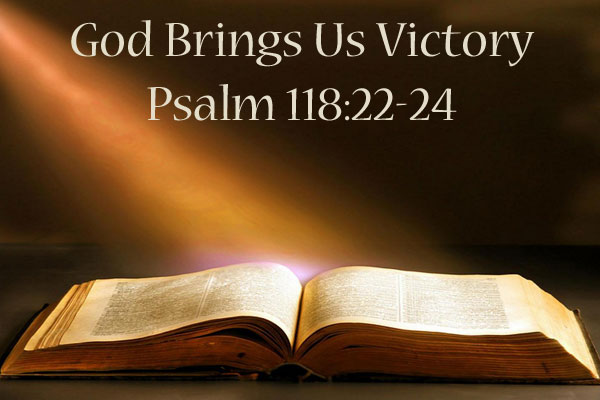
God Brings Us Victory

godbringsusvictory
Psalm 118:22-24
22 The stone which the builders rejected has become the chief cornerstone; 23 this was the LORD’s doing, and it is marvelous in our eyes. 24 This is the day the LORD has made; we will rejoice and be glad in it.

The whole of Psalm 118 shouts about victory during long suffering, of God’s goodness in times of anguish. These verses specifically tell about the nature of the victory–most likely, according to my NIV translation, the “stone” mentioned in verse 22 references the king of the Israelite nation, who has been ridiculed by other neighboring kings, but is protected by God through his faith. (Other Biblical interpreters through the years have also interpreted the stone to mean Israel itself, a nation that was disdained by other nations in the area.) Whichever reading of “stone” you take, this is a most joyful trio of verses, acknowledging that the king or nation which had been so scorned by man has been lifted up through God’s will, and given grace.

Think of how this applies to our lives. Other humans may look at us and scorn us, but God has a special purpose for each one of us–perhaps we will be the “cornerstone” of our chosen field of work someday, or the “cornerstone” of a loving family or close-knit group of friends. We just have to trust in God to bring us through times of adversity.

Even when we are at our weakest, feeling surrounded and scared, like the Israelites were before this joyful day, God is still there for us, and will bring us the victory we need. He may not bring us the victory we necessarily think we need, or the victory when we want it, but it will be perfectly timed and placed in His plan for us. Indeed, every day we live is a day the Lord has made for each of us, and the highest praise we can give God is to “rejoice and be glad in it.”

Designing for Mobile Devices

designingformobiledevices
Are you stuck on how to create a good-looking and functional mobile device layout for your site? Then you’re not alone–when you’re trying to design for a much smaller screen than you ever thought possible, it can feel as though you’re trying to cram your entire website into 480 pixels of space!

However, we independent designers can take cues from social media sites; Facebook, Twitter, and other sites manage to maintain their site’s “look,” while still making their design appropriate for a mobile device. How do they do that? Read on to find out!

Think small for site logo and content

Instead of doing a huge background image or a great big header image with your site name, a simple icon and text declaring your site name should be enough for a mobile design. Better yet, use CSS to style a text version of your logo so that mobile users don’t have to wait to load a weirdly-sized image.

Also, when designing how your content should display, imagine a space about 300-400 pixels wide, and about the same in height. Your content must fit comfortably within that space, in big enough font that mobile users can read on their small screens.

Choose text and background colors that contrast well

When someone is using a mobile device to view your website, you don’t want them having to squint and turn their phone every which way trying to read your content. Make it easy on your users’ eyes! Using a white background and black text is a classic choice, but feel free to choose any one very light color and one very dark color to use.

Use icons rather than text

Whenever possible, change out text links for icons. Not only is it space-saving on your smaller mobile-friendly designs, but it is also less tiny text to read, which will lower your users’ frustration level drastically. (Also, make the icons big enough to tap!)

Make your page easy to tab through using down arrow key

For those who have touch-screen smartphones, they will be able to scroll down with a swipe of their fingertip down the screen. However, you also want to make sure that your non-touch-screen mobile users can use the down arrow on their phones to “scroll” efficiently. Don’t crowd too many links or pics on one mobile-friendly page–that’s just more for the down arrow key to highlight. (This brought to you by a former non-touch-screen user)

Summary

With these tips, you can make a compact, easy-to-read, functional mobile design for any site. It might look a bit bare-bones on your big screen, but trust me, your small-screen users will thank you!

Poems: Kernels of Art

poemskernelsofart
I absolutely love the flexibility of poems; they’re like jars of emotion, containing poignant reveries, painful wounds, and powerful joys. But beyond this humble art form’s ability to adapt to any emotional range, it can also inspire the other forms of art (both performance and exhibition) to their highest expressions. Surprisingly, poetry can touch all other forms of art in the following ways:

What Poems Can Do

  • They can become songs by simply attaching a fitting melody and chord progression to the words
  • They can spark photography, paintings, or drawings; the imagery in a poem can lead a visual artist to create what he or she has “seen” in her mind from the poet’s words
  • They can imply a dance rhythm with word choice and stressed beats; a simple recitation can be done as a rhythm piece alongside interpretive movement
  • They can create a theatrical scene in the reader’s mind; the pathos in a poem can be expressed again through dialogue, or if the poem is itself a dialogue or monologue, it can be directly translated to the stage
  • They can inspire a longer work of fiction or non-fiction; a simple ten-line poem can create a character strong enough to warrant more writing about

I love this about poetry–it creates a sort of network between art forms. It’s fluid, malleable, and yet strong enough to support just about anything you put into it, which makes it both approachable for newbies and versatile for experienced creators.

So, have you ever tried your hand at poetry? If you haven’t, now is a great time to try!

Poetry, Sound Matrix, Procrastination is Fun, and Grooveshark

poetrysoundmatrix
Do not stand at my grave and weep
Beautiful poem by Mary Elizabeth Frye, often read at graveside services. Read the history of the poem here.

Sound Matrix
Make your own sparkly music with this Flash game! (You’ll see what I mean…pretty visuals AND cool music!)

Procrastinationisfun.com
The name says it all…this is apparently my life’s motto. xD

Grooveshark
Listen to streaming music free! 🙂

Dice Wars

dicewars
This Risk-like Flash game has been both a favorite addiction and a source of frustration for me for the last several years. Even though your opponents are computerized and the dice rolls are random, there is plenty of room for strategy and plenty of ways that the game can change up, every time!

Basic Rules and Gameplay

You start out as the purple player in this game, and you get a random number of dice allotted to you, automatically spread out for you over 2 to 5 spaces (at least in my gameplay). (If you don’t like the number of spaces or dice you’re given, you can hit “No” when the game asks you “Do you play this map?” and it will give you another scenario.)

Each round, every player on the map tries to take over other territories from other players. To attack, click your space, and then click the adjacent space you want to try to take over. If the attacker’s dice roll exceeds that of the defender’s dice roll, the attacker gets that space (very Risk-like). With every space you gain, you get access to another die at the end of your turn; those dice are applied randomly to the spaces you control when you click “End Turn.” Luck and chance determine where your extra dice will be placed, so you have to play carefully to outlast your opponents.

The dice stack up on your owned spaces, from 1 measly die all the way to 2 stacks of 4 dice each (the highest you can go). I refer to dice stacks in-game by how many dice are in them–for instance, the 2 stacks of 4 dice I refer to as an “8-stack,” and the 1-die spaces are 1-stacks, etc.

A Typical Game

The following is a funny PowerPoint I put together to show a typical game of Dice Wars, almost turn-by-turn, with funny and real written commentary. My commentary was not recorded audibly because I want this site to be PG-rated. 😛

dicewars_typicalgame

Strategies

How Many Players?
I’ve found that I play best in a game with 7 other players, because I like to build my dice empire from the ground up rather than rely on the game to give me either a greatly stacked-up territory or territories of one- and two-dice stacks each. With 7 other people, you can easily take over the smaller territories and then camp out, waiting for the big guys to thrash each other while you build up and build up.

When To Attack and When to Hold Back?
Generally, you can attack an enemy territory and win it if you have a number of dice equal to or greater than what they’ve got defending that territory. For instance, you wouldn’t want to try attacking an 8-stack with a 2-stack, because you have no chance of winning those odds. But you could attack a 4-stack with a 5- or 6-stack, easy. You might not get it, but the chances are greater that you’ll take that territory over.

Turning Your Flank
In most cases, turning your weakest flank to the enemy is a bad idea. Where possible, move your strongest defenders (your 6-, 7-, and 8-stacks) to be your new borderlands–this can be accomplished with some creative arrangement, taking over territories carefully so that you have a smooth line of big dice stacks moving across the map.

Never leave a 1- or 2-stack open where an enemy can just stampede in, unless you’re like me and like to leave a small hole for your enemies to fall in. In my PowerPoint, I left a 1-stack of mine right beside a larger stack belonging to an opponent. That opponent attacked my 1-stack and took it over, but it freed me up to attack back with my 6-stack that had been inaccessible and unusable before. Sometimes, you can tempt opponents to push their luck, and they end up spending down their 8-stack into a much more manageable 5- or 6-stack, which you can then take over with a free 8-stack of yours adjacent to it.

To Play the Game

Play Dice Wars

For More Information

Dice Wars @ JayIsGames.com

No One is a Foreigner to God

nooneisaforeigner
Numbers 9:14
An alien living among you who wants to celebrate the Lord’s Passover must do so in accordance with its rules and regulations. You must have the same regulations for the alien and the native-born. (NIV)

Of course, God is not talking about asking one of the “little green men” to come and share Sunday dinner, but is speaking of any foreigner who wishes to celebrate with the Israelites. God stipulates throughout the first five books of the Old Testament (the Pentateuch) that foreigners, or aliens, must be treated in the same fashion as the native-born, and here again He emphasizes that inclusiveness. Even in the Old Testament, God was not just a God of one nation or of one race; if someone wanted to worship Him, all they needed to do was follow the rules and they were welcome.

My NIV translation notes that God still requires the foreigners to be circumcised to represent the covenant, but that they are welcome to share in Passover once that is complete. Since Christians do not always follow the circumcision rite, this may seem confusing to Christian readers. However, it is my belief that we can uphold this part of God’s Word by allowing anyone to fellowship with us if they express a genuine desire to learn more about God.

As this post’s title says, no one is a foreigner to God; He knows each and every one of us, even if we have not made the free will decision to be a Christian yet. Throughout the Pentateuch, God makes it clear that He doesn’t want us humans to worry so much about nationality, ethnicity, place of birth, gender, or anything else that separates us from a potential believer. We make so much fuss about “white churches” and “black churches,” “old-people’s churches” and “young-people’s churches,” etc., that sometimes we forget to reach out to people who may be different from us. We must remember that each person we meet is a child of God and deserves to know more about Him if they want to know.

5 Real Social Coping Strategies

5realsocialcoping
We all cope with society in various ways. Some of us use our smartphones to avoid conversations with strangers; some of us prefer the Internet to face-to-face communications. We are individuals roaming through a sea of more individuals, and most of us actively try to avoid threats and pass the time as peacefully as possible.

I’m certainly one of those who avoids conflict and threats as much as possible. I don’t like to be in or near fights; conflict makes me VERY uncomfortable. Thus, I find myself using certain coping strategies to make myself a non-threatening individual, to dissuade people from trying to harm me, and to maintain friendships. These are not entirely selfless strategies; I often do these things to keep my own sanity (or what I have left of it) more than anything.

Below are the social strategies I find myself using all the time, to maintain my social role as a “helper” and a non-threat.

#1: Saying “sorry” all the time

I’ve done this for so long that it’s become an instinct. Any time anything happens, whether it’s really my fault or not, I end up saying “sorry,” either to express regret or to express compassion. The slightly twisted reasoning behind it: if I say “sorry” enough, people might understand that I commiserate with them, and thus are more inclined to see me in a positive light later on.

#2: Being helpful

If I help someone, I boost them up–as well as boosting my own feelings of self-worth. Helping that person may also lead to them having a positive memory of me, making them less likely to harm me or act against me in the future.

#3: Being emotional

Though it seems counter-intuitive, this is also a coping strategy. I had to dig a while in my consciousness for this reasoning, but from what I’ve been able to gather, becoming overly emotional means that others are moved to help me calm down, forgetting for a moment their own gripes with each other. (I have actually done this quite often in situations where a group needs to pull together to make it through–I somehow express the stress of the rest of the group, and we end up becoming a more solid unit as a result.)

#4: Forgiving quickly (or at least saying that I have)

If I forgive quickly, I am perceived as somehow a “better” person–though I confess sometimes that I can’t forgive as easily as the words spring to my mouth. (That’s a hard thing to realize about myself.)

#5: Staying quiet when I have a minor complaint

I don’t like to make a “big scene” and will stay quiet rather than being assertive. Reason: I don’t want to be seen as a nag or as a bothersome person.

What I’ve Learned from Exploring My Coping Strategies

All of the above strategies focus around others seeing me as someone they want to be around, someone they want to help, and someone that they look on with favor. This is related heavily to my experience of severe loneliness early in my school life, which shaped me more than I wish to admit. My way of dealing with threats, usually in the form of another person who is more aggressive, is to make sure they do not perceive me as a similar threat. Only then can I have some semblance of peace, since I have maintained harmonious relationships with them.

Summary

Coping strategies are the unconscious tricks we all use to maneuver in society, but sometimes they don’t always function the way we intend. One reason I posted this is because I have to dig into why I act the way I do in order to change the malfunctioning strategies–for certain, I can’t go around the workplace crying every time I feel threatened!

Learning about our inner emotional workings is a freeing and somewhat disturbing experience, one that has helped me get a better handle on who I am and who I am becoming. Try it for yourself–what’s really making you act the way you do in certain social situations? You might just learn something really interesting about yourself in the process!