Tag Archives: strategy

The Lowbie’s Survival Kit

For anyone who’s ever made a new City of Heroes character after weeks of playing a high-level character, you know what I’m talking about when I say “the lowbie blues.” Suddenly, you’re playing a character who can’t just zip across a zone in no time, and who can’t just charge into any battle and come out alive on the other side. Lowbies are so named because they are low in levels…and low in just about everything.

I’ve built a lot of characters, and every time I build a new one, I have to remember that I’m not quite as kick-butt as usual. Lowbie characters, especially those under level 10, suffer from the following:

  • Lack of quicker travel powers; Sprint is pretty much it
  • Inventory size restrictions (not being able to carry as many items with you)
  • Not being able to travel everywhere as safely–sometimes parts of Atlas Park are too dangerous to travel alone
  • Fewer attack/defense powers
  • Less hit points/strength

To offset your lowbie’s limitations, I have assembled a Lowbie Survival Kit full of helpful hints (and links to help you learn more).

Use a Booster Pack Travel Power

To help you travel through zones faster (and get to usually-unreachable areas) without having to wait for your typical travel power pools, booster-pack travel powers like Ninja Run, Beast Run, and Steam Jump can help you get around. Ninja and Beast Run both provide extra ground speed; Steam Jump provides 30 seconds of almost-flight time with every usage.

Each of the Booster Packs associated with these powers cost real money, but since they give you the travel power on every character you have (and will ever build), it benefits you in the long-term to buy the packs. You can get Ninja Run by buying the Super Booster IV: Martial Arts pack; Beast Run is available through the Animal Pack, and you can get the Steam Jump power through the Steampunk pack.

Lastly, the free Temporary Power Jet Pack can help you fly if you can’t get hold of the Steampunk Booster Pack.

Enhance All Your Powers with Training Enhancements

Lest you think that Training Enhancements are a waste of your hard-earned influence, let me tell you that at low levels (especially under 10), TEs are great for boosting your powers just enough to get you through. I notice a real difference in gameplay strength when I don’t enhance my lowbies at all, or don’t upgrade their enhancements when they level up.

Be sure to put an enhancement in every power slot you get–it will help your character out so much in the beginning. You can always replace the TEs with real Enhancements later, but they will help you live more successfully through the tough first levels.

And if the prices of TEs are a little rich for your blood, you can search on Wentworth’s to see if anyone’s selling them for a little cheaper, as well as using AE Tickets to purchase them (or selling off items at Wentworth’s so you can afford them).

Shop the Paragon Market for Extra Storage Space

As of issue 21, the Paragon Market is officially open, and is useful for spending your Paragon Points to gain access to game extras.

You can get lots of goodies like extra Character Slots and Respec Tokens, but what will be most helpful for lowbies is to increase your item storage space on your character. Upping the number of Enhancements, Recipes, Salvage, and Vault storage spaces on all characters will help your lowbie out more than you think–suddenly, you have ROOM in those expandable pockets again!

And don’t forget the XP Booster…gives you +25% XP for an hour. Not bad for a lowbie trying to level quickly!

Find and Use Temporary Powers for Attacks, Buffs/Debuffs, and Healing

Craftable Temporary Powers often drop off defeated enemies, as well as being sold through Wentworth’s–check your Recipes section (alongside your Salvage, Inspiration, and Enhancement storage windows) to see if you’ve gotten any Temporary Power recipes.

Temp Powers can be attacks, diversionary tactics, healing/rezzing aids, and even debuffs. The better the power’s effect, the less charges you get, generally. See the full list of buildable Temp Powers, below:

Attacks

St. Louis Slammer (close-combat, 30 uses)

Gabriel’s Hammer (close-combat, 30 uses)

Revolver (ranged, 30 uses)

Envenomed Dagger (ranged, 30 uses)

Hand Grenades (ranged, 18 uses)

Plasmatic Taser (ranged, 24 uses)

Divert Enemy

Ethereal Shift (make yourself un-targetable for 30 seconds, 5 uses)

Backup Radio (call in a special pet to help you fight, 5 uses)

Smoke Flash (distract and Placate foes for a little bit, 10 uses)

Stun Grenades (disorient foes for a little while, 20 uses)

Healing/Rezzing

Med-Pack (heals 1/4 of your max hit points, 10 uses)

Recovery Serum (boosts recovery rate for a short time, 5 uses)

Resuscitator(rezzes an ally, 10 uses)

Buffs & Debuffs

Kinetic Dampener (increases your defense against Smashing and Lethal damage, and improves Energy resistance; # of charges unknown)

Jet Pack (lets you fly for 30 seconds; # of charges unknown)

Power Analyzer Mk III (view Foe Combat Attributes to know what kind of damage they’re weak to; 20 uses)

Use Available In-Game Storage Besides Your Own

If you’re not in a supergroup and don’t have access to salvage racks, enhancement tables, and inspiration holders, then the Vault Reserve and Wentworth’s are going to be invaluable to you.

Vaults are located in Atlas Park, Kings Row, Steel Canyon, Talos Island, and Pocket D. You only start out with 3 spaces in your Vault at level 1, which is why I suggested earlier that you may want to spend Paragon Points to get more storage space early on. But even if you don’t amp up your storage space prematurely, it’s a great way to hold just those few extra items you don’t want to sell yet but don’t have room to keep. (And Vaults are only for Salvage items, not Enhancements or Inspirations, fyi.)

And if your Vault is absolutely slam full of Salvage, or if you have a bunch of Enhancements and Inspirations you need to hold on to, you can actually use your Wentworth Auction Inventory to hold items temporarily. All you have to do is drag and drop the item from your storage space into the Wentworth window to store it, and then don’t put a listing price.

Wentworth buildings are located in Atlas Park, Kings Row, Steel Canyon, and Talos Island–incidentally, almost everywhere there are Vault Reserves. Like the Vaults, you only have a few auction inventory spaces in lowbie levels, but even 1 or 2 spaces can help you hold that Inspiration or Enhancement you don’t have room for.

Play AE Missions and Shop the AE Building

In the Architect Entertainment building, you can play user-created arcs, win tickets (just like at old-school arcades!), and turn those tickets in for in-game prizes. For lowbies, those prizes constitute pretty much a one-stop shop.

With enough tickets, you can buy Salvage to sell at Wentworth’s (or use to build your Temporary Powers), medium and large Inspirations, and even Training and Origin Enhancements, which you likely wouldn’t be able to get at other Stores because it wouldn’t be safe for a lowbie to travel there yet. (Not to mention that money/influence is usually at an all-time low for lowbies.)

These three categories of items are great buys for lowbies, because you can largely pick and choose what you want (except for common Salvage–your choice is randomized). You can also skirt the higher fees for these items at Wentworth’s doing it this way.

(You can also buy all kinds of Recipes at the AE Building, but you’re likely better off trying to buy them on Wentworth’s for influence rather than using AE tickets.)

Empower Your Lowbie Self with Long-Lasting Buffs

Empowerment Buffs are available only to those lowbies who are lucky enough to be in a supergroup with an Empowerment Station. But if you fall into that category, remember the Empowerment Station as a fast and relatively cheap way to get a long-lasting buff.

You only need 1 or 2 pieces of specific salvage to get any of the buffs, whose requirements differ depending on if you’re using an Arcane Station or a Tech Station. Each buff lasts much longer than an Inspiration–more along the lines of Mystic Fortune or Secondary Mutation. You can get buffs that help you with everything from your Run Speed to your Fire Resistance, from your Hold Resistance to your Knockback Increase. Very helpful for little heroes, who could use the extra help!

Summary

These tips on surviving your first few levels, from your gameplay to your in-game amenities, should help you get a good start in City of Heroes. Take it from one who’s been in the “lowbie zone” many, many times–it is a little inconvenient at first, but tips like this make it much easier.

Item Management, Item Schmanagement!


Picture credit: Resident Evil Wikia
For players of the Resident Evil deck building game, Item Management is generally considered an “oldie but goodie,” since it was part of the original Core Set.

Item Management lets you Trash out one Ammo card from your hand and get an upgraded one in your Discard pile to replace it. You can upgrade from a 10-Ammo card to a 20, from a 20 to a Treasure card (provides only 30 gold), or from a 20 to a 30, or from a Treasure to a 30.

It’s one of the only cards that deals specifically with upgrading your Ammo/Gold supply, which is the primary concern for players–once you get your Ammo/Gold in place, you are set up well enough to buy the Actions and Weapons you need to Explore the Mansion safely.

However, there is more to using this card in your strategy than would be apparent at first read. Here are the pros and cons of Item Management:

Pros

  • Does a fair job of automating the upgrading-Ammo process
  • Doesn’t Trash out of your deck upon use, so you use it as often as you need it

Cons

  • Uses up your one default Action per turn
  • Does not interact well with Buying Ammo at the same time you’re Upgrading–you can end up flooding your Inventory with Ammo, like giving an engine too much gas
  • Slows down other Buying action because you have to Trash out Ammo from your hand to use it, leaving you poorer the turn you use it

Item Management Op-Ed: It’s Not as Effective as Other Methods

I have never been able to get Item Management to work well for me. It does not upgrade Ammo as fast as, say, using your regular one-Buy-a-turn and Shattered Memories or Quirk of Fate together; with those cards, you can buy one upgraded Ammo while Trashing out one or two lower-Ammo cards. This thins your Inventory and gets you better Ammo totals per card.

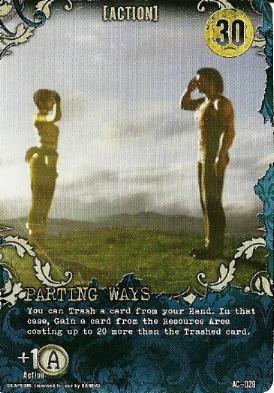
Item Management also does not work as well as using Ominous Battle, which Trashes out one card from your hand after it draws you 3 cards and gives you 10 Gold, nor does it work better than Parting Ways, which Trashes out one card from your hand and Gains you another that costs up to 20 Gold more. Parting Ways, however, is best used for Weapons, since Ammo cards exceed the cost limitations (most Ammo cards upgrade by increments of 30 rather than 20).

From what I can tell, Item Management requires two things to work: one, you must keep a consistently small Inventory, and two, you actually do have to Buy a bit of upgraded Ammo here and there. If you keep trying to change out 10s for 20s instead of 20s for Treasure or 20s for 30s, you’ll be stuck at low Ammo and Gold totals long after the other players are set up. (Trust me, I’ve played plenty a game like that! Frustrating–you’re basically stuck in Neutral for half the game.)

I don’t like the card much because it makes me play on a tightrope of buying JUST ENOUGH Ammo without buying too much. I never know when to stop, and it really screws with my gameplay. But my boyfriend loves Item Management and wouldn’t be without it–somehow, he makes it work. I think it’s the small Inventory size and careful Buys that do it for him.

Why Use It?

This is what I’ve been wondering–with Shattered Memories, Quirk of Fate, Ominous Battle, and Parting Ways available, why bother with Item Management at all?

Possible Ways to Make it Work

All I can see that’s good about Item Management is that you automatically upgrade your Ammo with one Action, rather than doing an Action to Trash out a card and then Buying another one. But it must be handled very carefully, as I noted earlier.

It also works better if you can Buy two Item Managements for your Inventory–having only one in your Inventory simply does not come up often enough to be solely responsible for your Ammo upgrading.

The way I see it, use Item Management if you have a way to do an Action-replenishing Action first (like Reload, Umbrella Corporation, or even Parting Ways/Quirk of Fate if you have to). Then, you aren’t shortchanging yourself on Actions, and you can help yourself out a little bit with card draw, weapon replacement, and/or Inventory-thinning.

Summary

Item Management is not my favorite card, personally, but there are ways you can still use it in the game–players can and do make effective strategies with it. Try it and see if you can master this more difficult of Actions in your next Resident Evil DBG session!

Thanksgiving Special: Loops of Zen

While you’re in your tryptophan-induced haze after mounds of turkey, dressing, and more sweet potatoes than you could ever want to see in a year, why not enjoy a game? Loops of Zen is that odd combination of rest and challenge–a peaceful yet thought-provoking game.

Gameplay

It looks and sounds fairly basic and simple: get all the curves, lines, and wavy pieces to link together into a shape that leaves no loose ends exposed. Not all lines need to be connected to the SAME shape–i.e., you could have random curves forming two separate circles and still win the level. To connect the various pieces together, you’ll have to turn them 90 degrees at a time with just a click of your mouse, until the game is satisfied that there are no loose ends remaining.

This, however, is more challenging than it seems, as you get fields of random lines and curves looking something like this:

Somehow, you have to make order out of this chaos. And it CAN be done–just click around, explore various ways to connect the pieces together.

I find that it’s something like a curvaceous form of Tetris, without the time limit. It takes time to plot your next moves, to turn pieces to their best advantage. You may have to form several different shapes before you hit on just the right one, and Loops of Zen does not penalize you for that. It only counts how many levels you completed, not how long you took to beat each level. (I love that about this game!)

A Sample Game in Progress

Below is a series of three pictures showing how I progressed in solving one of the game’s many svelte puzzles:


This is what I started out with. Hmmm…well, there’s a tackle-able mess at bottom right, let’s get that shored up first. But what can I turn to connect all those wonky pieces at top left?


Well, that got some of the randomness from the other side of the picture out of the way. I still have the wonky lines at top left, though.


Kinda looks like two aliens sitting and having a conversation, now! XD But what am I going to do with that random curve at top middle, and that random straight line at bottom middle? Not to mention the “arm” off the left “alien guy” shape. LOL, this gets funnier by the minute!

Bonus Section: The Music

Loops of Zen is kind of unique among Flash games in that it has an absolutely beautiful and appropriate song as its background. The song, “Surrealism” by XGamer, was an instant favorite of mine as soon as I played the game the first time. Its darkly flowing chords in F-sharp minor provide the perfect ambient-trance backdrop for this game, and it’s one of the reasons I enjoy this game so much.

Summary

If you want a Flash game that is utterly different from everything currently out there, I strongly suggest you check this out. It will make you think, and yet it is relaxing, too…perfect for an afternoon with a full belly and a comfortable chair. 😀

Play the game: Loops of Zen

Resident Evil: Outbreak

As the second official expansion set for the Resident Evil deck building game, Outbreak has a lot to live up to; its immediate predecessor, Alliance, set the bar pretty high for cards added to the game’s repertoire. And in most respects, Outbreak does not disappoint.

New to Gameplay: Infection System

Gameplay has not changed very much from the way the Base Set and the Alliance box play…except for one big addition: the Infection system.

Basically, every turn you do not Explore the Mansion, you receive one Infection Counter, in the form of face-down cards dealt from the Infection Deck (new to Outbreak). You can also get infection counters from creatures you happen to face within the Mansion, from other players facing creatures, or even as a side effect of someone playing a card. There are a few ways to get rid of Infection counters, but a whole lot more ways to accumulate them.

When you get 10 Infection counters, you take all the facedown cards you were dealt from the Infection Deck and add them to the deck you’ve been building since you started the current game. You officially become an Infected creature yourself at this point, and all you can do is attack the other players until the game ends.

The Infection System: Pros and Cons

Pros: Makes the game go a lot faster; makes for different levels, challenges, and styles of gameplay (i.e., struggling to keep yourself uninfected, actually trying to defeat the Mansion, or getting completely into the role of the Infected creature and taking out the other players).

Cons: Can’t get rid of counters as easily as you can accumulate them; one more thing to worry about in-game; distracts from original purpose of game; makes characters die a lot faster because you almost have to explore every turn.

My verdict: Infection system is not fun to play, because I like being able to have a decent weapon before I’m forced to explore the Mansion, and I hate having to focus precious game time on getting rid of those stupid counters. But for those who enjoy a faster gameplay or want something different from a typical deck building game, Outbreak does just that.

Amazing New Cards

I like this card especially for the “draw 3 cards” thing…but it’s fun to get 2 free actions, too. Can help you start an Action chain just like Reload did in the Base set.
This is THE way in the Outbreak box to Trash things out of your deck. Also great for Buying stuff without using up your Buy for the turn!
Not a joke card, by any means. You CAN now shoot stuff for mega damage, and it gets better when played at night. I like the situational boost, and I can only imagine the ruckus that the Base Set’s Jill Valentine would cause with this thing. See, she can reach the point where she keeps Explosives weapons instead of having to Trash them after every use, so… 😀

Imagine these two paired with The Merchant (Base Set), or with Gathering Forces (Alliance). Mwahaha. So much card-Gaining action…and SO much damage potential.
Yes, you get +1 Explore (usually, I hate that). But if you draw an Infected creature that is 20 or less health, you can put it back on top of the Mansion. And look–it’s a FREE 10 damage! Take that, Combat Knife.

To Learn More

Resident Evil DBG Wikia (source for Stun Rod and Samurai Edge images)
RE DBG: Outbreak on BoardGameGeek.com

Play Like a Spider (No Spider-Sense Required)

Weird article title, right? What does it mean to “play like a spider,” anyway?

Well, if you play any games with me, it means to play like me–camp out, build up, and wait. Like web-building spiders, who weave a complicated web of sticky silk and then wait at one corner for a hapless insect to blunder into it, I construct my Magic decks and my HeroClix teams with the same long-term win in mind. I don’t rush aggressively forward; I wait for you to come to me, and get yourself hopelessly stuck with your own aggressive tactics. I may not win within 5 turns, but give me enough time, and I will succeed in at least immobilizing and tying down your force.

Why Bother with This Slow Strategy?

Spiders are not one of the most feared creepy-crawlies for no reason. They can bite, they get even humans stuck in webs (ugh, especially when it’s dark and all you can feel is the sticky silk across your face, hands, or arms)…and they seem pretty ruthless. But faced with a large boot heel or even a rolled-up magazine, they’re useless. In fact, their strategy works best against creatures similarly sized to them.

It may seem worthless to “play like a spider,” since most competitive gamers act as the boot heels and rolled-up magazines of the Magic and HeroClix world. But in a casual and/or multiplayer environment, spider-style play provides a new and creative way to interact. Instead of heavily focusing on “WIN WIN WIN within 5 turns,” you can sit back and socialize with your gaming friends for the first few turns, as you build up slowly. You then have time to observe how everyone else plays, compliment others on their strategy–generally create an atmosphere of camaraderie within your group.

It’s a little more laid-back style of gaming, and yet you still have your own strategy to build up, turn by turn, at an unhurried pace. Get enough of your defenses in place, and you can chat in relative peace. That is, until someone messes with you and disturbs your web.

The Steps of a Spider Gamer

  • Don’t mess with anybody unless they mess with you.

    This is of paramount importance–spiders who are actively building their webs aren’t seeking prey yet. They have to wait until their web is finished (or at least mostly finished) before they can catch anything. Likewise, your first turns are better spent building up your defenses, not making enemies. Identify your strongest opponents and observe their playstyles, yes. But do not provoke them. Time enough for that later.

  • Once they do mess with you, begin your offensive strategy.

    Sounds odd to only launch counterattacks, but it’s actually a very efficient strategy. Once the web is disturbed, spiders launch themselves at their prey and go after them relentlessly. As a spider gamer, you have to act similarly. You wait until they have extended themselves, and then start going after them, make them run scared for a few minutes. If you’re playing one-on-one, this is important to gain back some ground (especially if you didn’t have all your defenses in place yet); if you’re playing multi-player, this is an important show of force, so that everyone else at the table knows that you indeed can strike back, and hard.

  • Build in lots of support for yourself, and several ways to retreat if you have to.

    Like spiders, who build multiple ways to escape if their prey is too strong for them or is too big, spider gamers have to include lots of long-term support into their strategies. In Magic: the Gathering, life-gain, counterspells, graveyard recurrence, creature-kill spells, and high-toughness creatures are ways to keep yourself afloat in tough circumstances; in HeroClix, including lots of Probability Control, Support, Outwit, flying characters, and high defenses can help your team go the distance. Retreating into defensive mode (not attacking and building up your defenses again) is important if you’re facing a lot of aggression–you’ve got to keep yourself alive, even if it means losing the offensive advantage for a few turns.

  • If you have to retreat, make it very difficult for anybody to come after you.

    Spiders often retreat into trees, behind objects, or anywhere else that makes it hard to kill them. If you’re going to be a spider gamer, you have to think similarly when you need to build back up after a hard turn of battle. Make sure you’ve got enough things to defend you, and that it won’t do any good for anybody to come after you for a few turns, and then quietly put your strategy back together. (A strategy that falls apart at the slightest touch is not enough for a spider gamer–it’s got to be solid enough to hold up for the long-term.)

    I do this a lot by building in tons of life-gain and Support–people get done battering down my life total or my HeroClix figures, only for me to gain the life back or heal up my characters again so that all their work has been undone! It flusters your opponent(s) and can give you the time you need to build back up.

  • Rest, recharge, and wait for the others to combat themselves to exhaustion…

    This is my favorite part of spider strategy…waiting for the others to thrash themselves tired. Most often, especially in a multi-player game, the two most aggressive gamers at the table face off against each other and spend most of the time tearing at each other’s throats, leaving the rest of us alone. This is the perfect time for a spider gamer to build back up–do just a couple little things during your turn and be relatively unobtrusive, allowing the attention to focus on the more aggressive players. Like real spiders, who wait for their prey to get completely stuck before moving in on them, spider gamers can wait for their traps to spring on their opponent’s turn and not do a whole lot otherwise.

  • …then come in and mop, mop, mop.

    Once the more aggressive gamers have fought each other enough and overextended their resources (and their life points), it’s time for the spider gamer to step out and start mopping up the mess. Half-dead HeroClix figures and Magic players with no blockers to defend themselves are easy targets for the spider gamer, and it gets some of the threats off the board before they can start building themselves back up.

    Yes, I know, this strategy is often called “cherry-picking,” getting the last hit on somebody when someone else did all the work…but it’s about the only way for a spider gamer to stay alive. Waiting until the enemy is at half-strength or less is how a spider gamer survives, just like a real spider won’t mess with a hornet or a grasshopper until the insect is thoroughly entangled in its web.

The Point of Playing like a Spider

Those who practice spider-like gaming are allowed to be more talkative and sociable during gaming. Even if you’re not making the most kills or crushing the most people, you are surviving, which means you’re still in the game and you’re doing something right. I like the idea of actually talking to other players, hanging out with them as opposed to just beating them into the ground, and spider gaming lets me do that. Plus, I’m still using a deadly strategy, even if most people don’t recognize it. (The right attitude is key…never, never let on how dangerous you really are until it’s too late. XD)

I’d challenge any gamer who’s never tried playing slow, steady, and spiderish to try it. It’s a very different flavor and mindset from the typical “5-turn-win” aggressive or control-based strategy, and yet it can still win…if you have the patience and the support built in to succeed in the long term.

A New Take on “Green Lantern Tank”

Green Lantern what?!

Actually, “Green Lantern Tank” refers to a once-popular HeroClix strategy, best explained in this HCRealms forum thread.

The idea behind the original GLT (lol, quite unlike a BLT) is to surround a strong, flying Green Lantern figure with lots of supportive characters, such as figures with Enhancement (for ranged damage), Probability Control (for rerolls), and perhaps some Perplex and Outwit thrown in there as well for extra pwnage. The Green Lantern figure was most often equipped with the feat card called Trick Shot, which enabled a ranged character to attack from range without worrying about characters, hindering terrain, or Stealth.

Most famously, this was done, as one of the forum members says, with the Veteran Hal Jordan Green Lantern figure. But other GL pieces could do this as well. The two prerequisites for this: The GL figure had to be able to fly, and it had to have the Green Lantern Corps team symbol on its base, seen below:

The reason the team symbol was so important? The GL team symbol means that the character can carry up to 8 adjacent, friendly, grounded figures with it when it moves. Basically, the GL piece could “hide” behind its grounded buddies, keeping it safe from both ranged and close attack, while being able to fire off attacks using the Trick Shot feat, and it could move around the board carrying its 8 buddies with it–a very mobile, highly-efficient, and dangerous team.

And Then, They Nerfed It

Nerf: Verb. Meaning “to dull down the effectiveness of, to soften the damaging effect of.” And yes, it’s related to the Nerf ball.

The GLT strategy was effectively nerfed when game developers took Trick Shot and other feats out of the modern Clix environment–suddenly, Hal Jordan was trapped in the middle of his 8 buddies with no way to fire out from behind them. Also, they introduced a movement penalty for carrying characters. A flying figure who can move 10 squares on his/her own could no longer carry a friendly grounded character for 10 squares–he/she can only go 8. This really reduced the “run-and-gun” strategy for the GLT, and it seemed as if the strategy was dead.

It’s Not Dead, Just Sleeping

Trust me to find a way to revive an old, decrepit strategy. Well, maybe not totally revive it, but repurpose it. One gamer’s trash is another gamer’s treasure!

I discovered the wondrous power of the Green Lantern team ability one day while talking Clix strategy with my boyfriend. Being a Mystics player, I had a ton of wildcard pieces, many of them Legion of Superheroes figures (i.e., flying wildcards); I’m also a hardcore swarm strategist, liking to play many smaller figures instead of just a few large figures.

That day, I’d been trying out a new strategy, using the 37-point Rookie Invisible Woman piece as a central figure. R Invisible Woman’s 18 defense with Defend meant that she could share her 18 defense with up to 8 people around her. I had a lot of little ranged and close-combat pieces that were strong attack characters, but had very low defenses (Veteran Shi from Indy, anyone? That 15 defense made me SAD, even if it did come with Super Senses!).

Thus, I sought to protect my strong attackers by letting them borrow Invisible Woman’s 18 defense; I surrounded Invisible Woman on all sides with friendly figures. Invisible Woman enabled Shi and other small stealthy attackers to survive for the whole game, and Shi and her pals protected Invisible Woman, whose 6 attack and 6 move would be harmless to just about everyone.

I loved the strategy–it was defensive and stealthy and unexpected and it was chock-full of characters. But there was one problem with it.

“Wish there was a way to move my teams quickly and carefully into position,” I said to my boyfriend as we ate a quick dinner. “I mean, Sue (Invisible Woman) has to be protected on all sides as soon as possible, otherwise the strategy folds. But aside from having a few flying characters, I can’t figure out how to transport a whole team at once.”

“Ever heard of the Green Lantern team ability?” my boyfriend said, ever a fountain of Clix knowledge.

I had heard of it, but since most of the figures who carry that team symbol are way expensive for my tastes (over 100 points), I had largely dismissed it from memory. “Oh, yeah, that…I remember the symbol, but what does it do?”

“It allows a flying character to carry up to 8 friendly, adjacent, grounded characters,” my boyfriend replied.

And my memory leaped into my mental wildcard stash, coming up with all the Legion of Superheroes pieces I favored. No, they weren’t particularly strong by themselves, but if you could Wildcard to Mystics, surely you could Wildcard to Green Lantern team. The seed of the idea sprouted and grew vigorously, and I grinned. That was the key to moving my high-defense, stealthy, unexpected team. Nobody would expect a Legionnaire, of all things, to come flying in with 8 of her friends!

Refining the Strategy

Once I had the main idea, I sought out pieces that had similarities to Invisible Woman–I already knew that just using a wildcarded-Green Lantern piece in the center could be possibly more effective than just having that piece fly in Invisible Woman and 7 other friends. If I could find a wildcard who had Stealth and Defend like Invisible Woman, I would likely be set.

The best match I found came from my own Clix box–Experienced Umbra, 56 points, a flying Legionnaire. With 9 move, 9 attack, 17 defense, and 3 damage first click, she was enough to ward off attacks, and with Stealth, Force Blast, and Defend, she was exactly what I needed for wildcard fodder.

Now to find a cheap-enough Green Lantern piece. Since I don’t like playing figures over 100 points (unless they’re REALLY amazing and worth every point), I struggled finding a Green Lantern piece I could live with. But finally, due to some good searching, my boyfriend and I found two figures that fit the bill. Experienced Jade, 92 points from the Legacy set, and Rookie Green Lantern, 81 points from the Cosmic Justice set, worked very well for what I needed them for (mainly wildcard-fodder), and they were both good fits for my collection. I could improve their defenses if I needed to by incorporating Invisible Woman, and their attacks could be fixed with Perplex. (Of course, with the recent Green Lantern pieces that have been released in the Fast Forces and Gravity Feed packs, I could also get my hands on some more (and cheaper) pieces if I needed to. These just happened to be the first I got.)

Trying It Out

I have played this strategy several times and really enjoy how it works. It’s great for getting a large team into position (try using 2 Green Lantern team pieces for those really large-point-value games!), and it’s ideal for getting hurt pieces up, up, and away from the danger. I used Rookie Green Lantern in tandem with Exp. Umbra in one 500-point game, and ended up surviving the game with 11 of my 22 pieces intact, sitting atop Elevated terrain that was 3 squares by 4 squares–perfect for my team to hide out on and heal, and hard for my enemies to approach.

Defensive GLT is also good for moving more than one supportive piece at a time (like repositioning your Perplex, Prob, and Outwit so they can see better). Using E Umbra to move Destiny, Harley Quinn, and Abbey Chase around, while still providing them with a 17 base defense, is very, very efficient when you’re working with large teams and limited actions.

I don’t find that the -2 to movement is all that encumbering with GLT. You can always Perplex up the movement value if you absolutely need those 2 extra squares and you have the spare Perplexes to do it. Alternatively, you can use the feat Contingency Plan to heighten the movement by a maximum of 3 if you have a Leadership/Mastermind character on your team. Or, you could just use a wildcard flier that has a larger movement value to begin with: many of the Legionnaires have 10 move, such as Dawnstar, Triplicate Girl, and Karate Kid.

The best figures that work with this build are small-point-value figures with good defensive abilities and solid attacks. Having Stealth and/or Energy Shield/Deflection is great; so is having Combat Reflexes, Impervious, or Invulnerability. If you have more luck with Super Senses rolls than I have, Super Senses is also a good choice, but that 33% chance to dodge doesn’t always cover one’s posterior as well as one might hope.

Choosing a good Defend piece is also important–you want to protect that source of good defense with great offense, but you don’t want your Defend piece to be absolutely useless if your opponent breaks through the offensive wall. And don’t forget Support, Prob, Outwit, Perplex, and Telekinesis! Having at least one representative of those powers is always a good thing with swarm.

Weaknesses

Like the more offensively-based GLT, defensive GLT is weak to Pulse Wave attacks (the Defend won’t matter). Energy Explosion is a little more difficult to pull off against this team, because of how much Stealth I incorporate (especially on the side of the 3×3 GLT “box” that faces the enemy. Stealth plus high Defense values = I scoff at Energy Explosion. If you don’t have Stealth on your side, at least put in some Energy Shield/Deflection to jack up your Defense value 2 more points higher at range. (Oh yeah, Jason Blood is sitting on a 20 defense at range. YEEHA.)

A good close-combat rush is a winning tactic against a defensive GLT that has overbalanced on range pieces. That’s why I always include a Mockingbird, Vet Psylocke from Armor Wars (Stealth and Combat Reflexes–SURPRISE!!), or even a good Cheetah for a little 11 attack Blades. Shi from Indy functions as both a range and close-combat piece, too, which makes her a good choice for defensive GLT. Make sure not to use too many range or too many close-combat pieces–try to intersperse a few close-combatties in with your pew-pew-pew squad.

Hey, Wait a Minute, Why Don’t You Have a Team List?

Because I don’t build off keywords. I use a more “toolbox” approach to playing Clix–a piece has the ability I need at the point value I can afford, so I play it. That said, I have literally dozens of Clix pieces that could suit this strategy. GLT, in my opinion, is a min/max-friendly format, but it also encourages innovation and creativity, using pieces that lots of people call “bad” to win big. (Ever seen a 30-point Checkmate Black Knight deal 5 damage at range and emerge from the game unscathed? Yep, I did it–with 2 Enhancers, 1 Probber, and Invisible Woman in the background!)

Summary

Unlike the Green Lantern Tank of gamer legend, my “defensive” Green Lantern Tank strategy is not necessarily a game-winner. However, it will stretch your boundaries of what makes a “good” team, and might just make you rethink how you play. One thing’s for sure, the Green Lantern team ability is not just for running-and-gunning anymore!

The Maddening Efficiency of Poison Counters

As a Magic player for several years (since 2004), I have made a name for myself among the local groups by playing a distinct “life-gain” style of play, also known as “stall.” I gain life and prevent damage in most of my decks, and do mainly combat damage as a win condition; this allows the other player to play their strategy, but most of the time they cannot actually do me any lasting damage. In my eyes, it’s a win-win, because I get to play my strategy without being overly worried about my life total, and they get to see how their deck plays in extreme long-game, with plenty of time for joking around and socializing in the process.

However, a not-so-new mechanic that was revived in Scars of Mirrodin threatens this easy and relatively carefree way of playing. It’s called poison counters.

Poison Counters Before Scars of Mirrodin

In the 1994 Magic set Legends, the first cards dealing with the “poison counter” effect were printed. Poison counters were a new way to win or lose the game–if a player accumulated 10 poison counters, they automatically lost the game, no matter what their life total was. It was, in a way, a second type of life total, even though the creators of the game still refuse to acknowledge it as such.

From 1994 to 1997, Wizards of the Coast worked with poison counters in several of its sets. Expansions such as The Dark, 4th Edition, Chronicles, Homelands, Alliances, Mirage, Visions, and 5th Edition each had just a few cards sprinkled in that concerned poison counters. Within these sets, poison counters were generally dealt directly by creatures, usually with wording such as “When [card name] deals damage to a player, that player gets X amount of poison counters”, not always matching how much damage the creature dealt.

Because of the fairly scant number of cards dealing with poison counters, it was somewhat difficult to incorporate into an entire deck strategy. Thus, the mechanic did not see a whole lot of play after these sets faded into memory.

Poison Counters Since Scars of Mirrodin

Fast-forward thirteen years, to 2010–the release of Scars of Mirrodin, and the introduction of a very new and quite deadly mechanic: infect. This new mechanic combined the effects of two other fairly good mechanics, “poisonous” and “wither,” into one super-powered game-changer for any creature.

With the advent of infect, previously small one-drop, 1/1 creatures with very little prowess to their name could become killing machines in their own right. They could wither away the opponent’s creatures, but they could also give undefended players a poison counter. And once given one poison counter, opponents were then susceptible to a mechanic called “proliferate,” which allowed the proliferate-wielding player to “choose any number of permanents and/or players with counters on them, then give each another counter of a kind already there,” according to the official rules reminder text.

This substantially increased the playability of poison counter strategies. With so many new infect creatures and so many new proliferating spells and permanents, it was suddenly viable–and suddenly very deadly, not just to tournament players, but to the global Magic-playing population.

My Beef with Poison Counters

Even though most of Magic’s developers don’t want to believe that poison counters represent a second type of life total, they are. They represent a 10-turn clock in the background of the game, which is completely at the mercy of the other player, especially thanks to infect and proliferate. What’s more, they are a life total that to date, players have only two ways to change:

  • Leeches, a card from the much-maligned set Homelands, gets rid of all poison counters on a target player, and transfers it to damage to the regular life total instead;
  • Melira, Sylvok Outcast, from New Phyrexia, prevents its controller from getting poison counters, and directly counters the infect keyword and its -1/-1 effect on creatures.

Damage, I can deal with easily–it’s called Holy Day and Fog. Loss of life, I can spring back from; Life Burst and Beacon of Immortality for the win. Poison counters? With only two cards in the ENTIRE GAME to counter this strategy and take back control of my own poison counter total, it’s a very small chance that I have those cards and can make them work in one of my existing decks, or build a new deck with them in it that makes any kind of cohesive strategy.

Furthermore, poison counters are a death stroke to my typical gameplay style of “casual, slow and steady, more joking than playing.” I can’t have fun and be casual when I have an uncontrollable clock of counters going in the background the entire game. I’m forced into running scared the whole game, trying to outrun my typically Standard-format opponent with Vintage-format decks that just were not made to counter this kind of strategy. It feels like I’m taking a timed final exam that I didn’t study for. I hate being timed, especially when I don’t control the clock and don’t have the right resources or knowledge to finish the test of skill.

I thought Magic was supposed to be a game, but poison counters have changed the whole face of it. If the game developers are truly trying to make Magic into a purely competitive, cutthroat game, then they’re succeeding–they have just taken a major step toward stamping out Casual Play once and for all. Yes, it’s a great mechanic; it’s effective, and it forces people to play quickly and powerfully. But it’s far too competitive for those of us who use Magic and other GAMES to relax and have a good time with friends.

Warning, This Gamer’s Climbing onto Her Soapbox!

To me, poison counters represent everything that’s wrong with Magic these days. Yes, I know, I sound like an old fuddy-duddy, waving my proverbial cane about and muttering “Well, in MY day, WE didn’t HAVE no stinkin’ poison counters and tournaments!” But it’s true–Magic has grown exponentially more competitive as the mass of Standard-playing customers has increased in size, and the game developers seem to be pandering more toward this aggressive, tournament-winning style of play.

Now, I’ll freely admit, I don’t think I’ve ever won a Magic tournament, because the deck styles that I most enjoy playing are meant more for multi-player games and extreme-long-game setups. (In multi-player games, I’m liable to win without anybody realizing how powerful I’ve become until it’s too late. In one-on-one games, I am wiped off the map before my first combo piece is on the board.) But I LIKED playing casually and playing multi-player. I LIKED just playing silly combos that only affect me and create a hilarious situation, like being able to gain 64 life off a single Life Burst because of Boon Reflection and having 3 Life Bursts in the graveyard. Gaining astronomical amounts of life doesn’t hurt anybody else, and it’s hysterical to watch.

But with most of the local gamers I know going over to the “dark side” of strictly tournament play, my favorite style of playing is nearly extinct. Everyone is either playing the more aggressive mechanics and more recent formats, playing me one-on-one and wiping the floor with me, or taking me down with poison counters that I can’t control. As my blog title says, poison counters (and mechanics like it) are maddeningly efficient. They’re maddeningly efficient at making me and other casual players like me quit the game entirely, because it’s no longer fun–it’s a gun fight, and I came equipped with a butter knife.

How Can We Defend Against Poison Counters?

Well, now that I’ve said my piece about how Magic seems to be going all uber-competitive, how can players work around these annoying little poison counters?

Besides using Leeches or Melira, Sylvok Outcast, there ARE ways to defend against getting poison counters, as listed below:

  1. Blocking any and all Infect creatures. Make sure the creature you block with has a larger toughness so that it can survive the -1/-1 hit!
  2. Removing or destroying Infect creatures and Proliferating permanents. Disenchant, Naturalize, Doom Blade, Swords to Plowshares, Path to Exile, Shock, Lightning Bolt, and Shriekmaw are just a few cards off the top of my head that can help this cause.
  3. Countering Infect creature spells and Proliferating permanent spells. Blue always has an answer for everything.

Even a primarily Vintage player like me can find ways to use the above strategies to protect myself from poison counters. After all, I play big-toughness creatures as a rule of thumb, and I also enjoy pumping my little creatures to stronger power and toughness to overcome my opponent, so I do have at least the ability to block the infect creatures. I also run a good deal of creature removal and enchantment/artifact destruction in most of my decks, so I can get rid of permanents that could proliferate what poison counters I have. And while I don’t run a lot of Red, Blue, or Black, I can occasionally Shock and Bolt some of the smaller infect creatures if I have to.

It is important to note, however, that not every deck can encompass these strategies. For those of us who build decks and rarely change them because they work so well, it’s annoying to have to change out some parts to a well-oiled machine just because of one mechanic. But if you want to survive in today’s Magic: the Gathering, you sometimes have to sacrifice the beauty of a well-designed Vintage- or Legacy-format strategy in order to build “what works” against the mechanic flavor of the month. “What works” may not be exactly your cup of tea, but it will give you a better chance to win, and perhaps a chance to have that fleeting, mythical experience called “fun” again.

More About Poison Counters and Player Discussions of Strategy

From wiki.mtgsalvation.com:

Ways to Remove Poison Counters? @ TappedOut.net
Need Help Preventing/Removing Poison Counters @ MTGFanatic.com
Complete list of cards that directly deal with poison counters @ Gatherer

Pikmin

If you ever wondered “Isn’t there a way that I can lead an army of cute little creatures to help me do stuff?”, then the Nintendo Gamecube game Pikmin is definitely for you. Released in 2002 and again in 2009 for the Wii, this little real-time strategy game is like nothing you’ve ever played before.

Concept

You play as Captain Olimar, a lone spaceship pilot on his way back home after a long vacation. Unfortunately, the ship is struck by a passing asteroid and plummets to the surface of a nearby planet. Olimar is safe, but his ship is in pieces–30 pieces, to be exact. And this is a very, very big planet, and he is an itty-bitty little guy. Not to mention that the planet’s atmosphere is poisonous to him; he’s only got 30 days of breathable air in his spacesuit!

He bemoans his fate onscreen, as he ambles about the skeleton of his beloved Dolphin, assessing the damage. And then, he catches sight of what appears to be a growing carrot, a few feet away. He pulls experimentally at the stalk, only to uproot a bright red living creature, carrot-shaped, but definitely not food!

The little creature, which Captain Olimar names “Pikmin” after his favorite brand of carrots back home, clings to him, in need of protection and leadership. It turns out that in the immediate crash site area, there are several more sprouts; there are even some random numbered red pellets, which, when fed to the Pikmin’s apparent mothership (nicknamed “Onion” by Olimar), produces even more sprouts. These new Pikmin are just as loyal and clingy as the first Pikmin Olimar uprooted; it seems he now has a commandable and expandable army on his hands.

Basic Gameplay

Once you discover the Pikmin, you (as Olimar) lead them into battle and into ship part recovery, fighting off the natural Pikmin-eating creatures in order to get to the far-flung parts. A number of Pikmin then carry the recovered part back to the Dolphin, restoring its functions piece by painstaking piece. Upon evening falling, Olimar and the Pikmin both must leave the surface of the planet, since there are more dangerous nocturnal creatures about which could eat both the Pikmin army and Olimar as well.

In-Game Exploration

As the Dolphin is put back together, it can rise up higher in the atmosphere and seek out more parts in different places. You end up visiting five different areas in all.

Different parts you recover also help you in-game–once you get the Whimsical Radar, for instance, you can locate lost Pikmin on your map, whereas before you have to go whistling madly through all the areas looking for them.

Pikmin Types

Red Pikmin, the first type you discover, are fire-resistant and somewhat stronger, but slower. The slimmer Yellow Pikmin can carry and place explosives, and can be thrown higher into the air to retrieve hard-to-reach stuff–they also move the fastest. Blue Pikmin can swim and are medium-build, making them fairly good at fighting and moving quickly.

It is a good idea to build up your Pikmin army as quickly as possible, using the carcasses of creatures the Pikmin have defeated, as well as the scattered Pikmin pellets. Remember, let the red Pikmin carry the red pellets, yellow carry yellow, etc.–you will maximize your Pikmin sprouts in this way, because the pellet colors match the Onion they go back to.

Carrying Objects

Each portable object you come across in the game, whether it’s a ship part or an enemy carcass, needs a certain amount of Pikmin to carry it. The number will appear as the bottom half of a fraction floating above the item, with the number of Pikmin currently trying to carry the item appearing as the top half of the fraction. For instance, an item labeled “29/30” needs one more Pikmin to be lifted; an item labeled “2/2” is being carried by just enough Pikmin; an item labeled “30/20” is being carried more quickly because there are 10 more Pikmin to share the load.

Game Time and Sunsets

Your time in the game is divided up into 30 days, lasting about 13 minutes each (except the first “day”, which lasts until you find the Dolphin‘s engine). At sunset, make sure all your Pikmin are accounted for–if they are not actively walking with you or put up in their individual Onions, they will be lost to the nocturnal beasts when sunset arrives.

Multi-Tasking with Pikmin

You can multi-task with different groups of Pikmin recovering different objects at the same time. A popular way to do this is to work with one group of Pikmin to get one item, then assigning only as many Pikmin as are needed to carry the item back to the campsite, while you go forth and start working on retrieving the next. Be careful doing this, though–if you have not cleared the path back to the campsite of all enemies, the unsupervised Pikmin can be ambushed and killed.

Unnecessary Parts

Not all the ship’s 30 parts are necessary for the Dolphin to be able to take off and give you a successful game ending. There are 5 unnecessary parts, listed below:

  • Space Float
  • UV Lamp
  • Nova Blaster
  • Massage Machine
  • Secret Safe

List gleaned from the Ship Parts page on the Pikmin Wikia site.

Hidden Ending

If you get 29 of 30 parts, a new, final area will open up, which is full of challenges for your experienced Pikmin fleet. Getting through most of the stage is fairly easy after having gotten through all the other challenges of the game…until you get to the “final boss,” a huge, fat yellow caterpillar/slug thing called Emperor Bulblax, which sounds less like a critter and more like Dulcolax’s evil twin drug.

Defeating this horrible creature is one of the most frustrating endgame experiences I’ve ever had. I threw one of my poor yellow Pikmin into Bulblax’s mouth, just like my Nintendo Power guide said to do…and then watched in horror as the fat thing rolled over and killed my 99 remaining Pikmin in 2 seconds. I was about 14 at the time, so I had a nice little fit and swore never to play that level again. XD

Instead, after retrieving 29 of 30 parts, my Pikmin force is generally treated to several days of ego-boosting whooping up on local wildlife and making more Pikmin. The Secret Safe (the part that Bulblax guards) ain’t worth so much loss of life, in my opinion. BUT…beating Bulblax is the only way to retrieve it. So if you’re a completionist, go for it–just keep your Pikmin away from his girth and hungry maw, is all I have to say.

Consulting the Perfect Pikmin guide might help you towards this goal. (Hmmm…maybe I’ll finally avenge those martyred Pikmin after all!)

Summary

Pikmin is one of my all-time favorite games (despite its inherent challenges). It involves leadership and organization, nurturing little life-forms, and striving toward a goal of survival for everyone involved. It might look like a kid’s game, but trust me, it’s as tactical and strategic as you want to make it!

Read more about the game: Pikmin @ Wikipedia.com

Strategy Porting, part 3: Playing by Proxy

strategyporting3
As part 1 and part 2 of this gaming strategy series will attest, I’ve been trying to “port” in a strategy from the Yu-Gi-Oh! trading card game to Magic: the Gathering. This has not been an easy process, but I’m continuing to work on finding matching cards and strategies that will work within M:TG’s color wheel of White, Blue, Red, Black, and Green.

If you’re following this process, you inevitably reach a point where you know generally what you want in the deck and you’re ready for a test run. But before you start buying or trading for actual physical cards, you need to make sure the items you’re getting will actually end up in the deck. That’s why I suggest the following practice of proxying your deck-in-progress.

Testing Your Strategies with Proxies

Okay, okay, I know, “proxy” is a bad word to most “serious” (read: competitive) Magic players. But for those of us who don’t win Standard tournaments (and/or buy lots of cards) on a regular basis, using proxies can be remarkably effective at building and testing new decks. It lets you test the strategies first to see if they even work for your deck!

Paper Proxies

hedroncrab_proxy At their most low-tech, proxies can be as simple as cutting up a sheet of paper to make small slips that you can write the card name and effect on, like my craptastic Hedron Crab proxy at left. Paper-proxied decks (decks with paper copies of cards, whether it’s printed out or written out by hand) are generally not allowed in tournaments, but they are great for testing out your new deck in a casual setting.

(WARNING: don’t ever print high-quality proxies and try to sell them as the real card–you will definitely end up with mad customers, and possibly the game designers could sue you! I use proxies strictly for deck testing, and trust me, nobody wants my quick-made, scrawled-handwriting paper proxies. XD)

Virtual Proxies

If you don’t want to go the paper-and-pen route with your proxies, you can also build a virtual deck on a service like LackeyCCG, which is a free program you can use to build decks and test against a “dummy player,” or even a real online player if you wish. (Be warned, it’s a jungle of occasionally mean competitive players out there!)

This kind of service is pretty good, but I still prefer to test my decks in real life against another player. If you like to speed-test your decks more and prefer not to use a deck until you’ve thoroughly tested it, however, LackeyCCG and its ilk could be just right for you.

Summary

Proxying is a great way to try out cards without having to invest the money in them just yet, which is key for porting in an old strategy to a new game. Give it a try, and see how this can help you create your new-old deck!

Strategy Porting, part 2: The Card Hunt

strategyporting2
In my introductory post about strategy porting, I talked about wanting to port one of my old Yu-Gi-Oh! decks into Magic: the Gathering–specifically, I wanted to recreate a very control-based deck that worked around getting a bunch of Flip-Effect monsters into the graveyard so that Shadow Ghoul and Chaos Necromancer could be bigger attackers.

This has proven to be much harder than it first seemed. 😛

Problem #1: No Flip-Effect Creatures in Magic

The Morph mechanic does exist in M:TG, but for what I want the creatures to do, there’s not really any Morph cards that do the effects for any kind of reasonable cost. Plus, the ability of Flip-Effect monsters in Yu-Gi-Oh! to block an attack and THEN have an effect go off is hard to replicate in Magic anyway.

Problem #2: No One Color Does It All

If you want “destroy creatures” and “sacrifice creatures” effects, you look to Black. If you want “return creatures to owner’s hand” and “mill top four or five cards,” you look to Blue. If you want “sacrifice this creature to gain a bunch of life,” you look to White. See where I’m going with this?

With Yu-Gi-Oh!, you don’t have to worry about being able to play your creatures with specific colors of mana. This enables you to have a toolbox-style deck like the one I’ve assembled. But with Magic, if I want to have a deck that is able to play what it needs to play, I have to make sure I’m not running a crazy five-color deck where I’ll never get the amounts of mana I need.

Problem #3: Might Not End Up Being the Same Kind of Deck

While the surprise effects of a Flip-Effect monster in Yu-Gi-Oh is almost impossible to match in Magic, there is something that does match the surprise factor: instants. Casting an instant in response to another player’s attack can give the same net effect as a Flip-Effect monster.

However, if I start building the deck with all instants and sorceries instead of creatures, the strategy won’t be quite the same. No longer will I be able to amass a creature-filled graveyard and mow down people with the Magic equivalent of Chaos Necromancer, Mortivore. Instead, it will be almost a creatureless deck…not exactly what I intended.

Some Light at the End of the Tunnel

I agree, there are problems with porting a strategy…but there is hope. Going through the card database available on Gatherer, I was able to find at least some cards that matched up to what I’d like to replicate from my old deck. A partial list appears below, sticking to Blue and Black as the main colors of the deck:

Creature-Destroying Creatures

  • Blind Zealot
  • Shriekmaw
  • Necrite
  • Wall of Corpses

Creature-Destroying Spells

  • Bone Splinters
  • Chainer’s Edict
  • Witch’s Mist
  • Wretched Banquet

Creature-Bouncing Creatures

  • AEther Adept
  • Barrin, Master Wizard
  • Man-O’-War
  • Waterfront Bouncer

Creature-Bouncing Spells

  • AEther Spellbomb
  • Peel from Reality
  • Unsummon
  • Seal of Removal

Card-Milling Creatures

  • Hedron Crab
  • Cathartic Adept
  • Merfolk Mesmerist
  • Riddlekeeper

Card-Milling Spells

  • Brain Freeze
  • Vision Charm
  • Horrifying Revelation
  • Memory Sluice

Damage-Preventing Creatures

  • Fog Bank
  • Cephalid Illusionist

Damage-Preventing Spells

  • Darkness

Life-Loss/Direct Damage Creatures

  • Bile Urchin
  • Death Cultist
  • Blightspeaker
  • Cabal Archon

Life-Loss/Direct Damage Spells

  • Ebony Charm
  • Geth’s Verdict
  • Misery Charm
  • Hideous End

Card-Drawing Creatures

  • Sage of Epityr
  • Hapless Researcher
  • Drowned Rusalka
  • Alchemist’s Apprentice

Card-Drawing Spells

  • Accumulated Knowledge
  • Brainstorm
  • Visions of Beyond
  • Thought Scour

Life-Gaining Creatures

  • Deathgreeter
  • Child of Night
  • Vampire Nighthawk
  • Gutless Ghoul

Life-Gaining Spells

  • Douse in Gloom
  • Plunge into Darkness
  • Devour Flesh
  • Crypt Incursion

How to Do a Search Like This for Yourself

  • Search out the abilities you need, narrowing the focus by colors, then type of card.
  • If you’re trying to build within a certain format (such as Standard, keep set printings in mind as you search.
  • Be open to new ways to include an effect (such as finding life-gain in Black rather than White).

On to Part 3: Playing by Proxy!