Tag Archives: gaming

Gotham City Strategy Game

If you’ve ever played HeroClix or other miniatures games, you know that you’re playing against one or more opponents, winning points by defeating their pieces. But what if the miniatures game had less to do with actual combat and more to do with resource management, strategic placement of figures, and leveling up to become stronger?

That is the main challenge behind the Gotham City Strategy Game. Part tongue-in-cheek role-playing game, part miniatures game, this is a situation in which the players are major Batman villains, each struggling to reign over the 12 blocks of Gotham City–but not without some intervention from Batman!

Point of the Game

Be the first villain to hit Level 10 (to be the most powerful villain in Gotham City).

Playable Characters

  • The Joker
  • The Penguin
  • Two-Face
  • Killer Croc

Each of these characters is represented by a Heroclix-style plastic figure, called a “SwitchClix” piece because the figure can be removed and placed on a HeroClix dial. (Batman is also a part of this game, but he is not a playable character.)

Game Resources

As a Batman villain, you have various tools at your disposal to attempt your takeover of Gotham City. They are:

  • Threat: These tokens, labeled with a gun, are put down to take control of various blocks in Gotham City. The different villains begin the game with various numbers of Threat tokens available, and you can get more as you level up.
  • Money: These green tokens are mainly used to buy Henchmen, which help you gain and keep control of city blocks. How much money you start out with depends on your villain.
  • Information: These yellow tokens are mainly used for moving your figures (your Villain and his Henchmen) around the map. How much information you begin the game with depends on your villain.

Every Player Starts Out With:

  • Their villain’s plastic figure
  • 5 Villain Ability cards, which are chosen one by one as you level up
  • Their villain’s Player Screen, a stand-up piece of cardboard which has all your pertinent information on how to level up the character. As you play, you hide your money, information, and available Henchmen behind this screen.
  • The number of money and information tokens appropriate for his/her character.

Playing the Game, Turn by Turn

As one of Gotham’s villains, you must first establish your villainous presence in the city by taking over city blocks, and then maintaining and growing that presence to level up your villain. To level up, you must meet various goals within the game (for instance, one goal might be to have 5 information tokens, or to control 3 city blocks, etc.). The Criminal Plot cards, dealt out at random from a common deck until every player has 5 cards in hand, help you gain resources, attack other villains, and meet those goals.

To start the game, the player with the most speeding/parking tickets goes first; if there’s a tie, the person with the most recent ticket goes first. Then the game flow goes clockwise from there.

Every turn, you follow this procedure:

  1. Check to see if you can level up one (or more) levels–sometimes you can jump ahead 1 or 2 more if you’ve met all the conditions at the beginning of your turn!
  2. If you leveled up, check to see if you got any benefits from that level, such as being able to gain a Villain Ability.
  3. Play at least one Criminal Plot card from your hand (more about those below).
  4. Hire a Henchman if you have the money and inclination to do so.
  5. Spend an Information to move some or all of your figures anywhere on the map if you wish.
  6. Draw a new Criminal Plot card to replace the one you played this turn.

The Criminal Plot Deck

Criminal Plot cards look like this:

criminalplot_income criminalplot_batsignal

On the top half of the card, you’ll generally have a stipulation reading “The ruler of [a named city block] gets this block’s income,” like the one on the left above. When you play the card, whoever controls that city block gets that income, which could be Money (green icon) or Information (yellow icon). It works out great if the named block is one you control, so that you can gain the income from it, but if not, don’t worry about it too much. (On some Criminal Plot cards, like the one at right above, you’ll see a Bat-Signal icon on the top half of the card–instead of someone gaining Money or Info off the card based on controlling a city block, you have to draw a card from the Batman deck instead.)

On the bottom half of each Criminal Plot card, you’ll see a game effect described. If you want to activate that effect, make sure to pay the appropriate costs listed, and then you’ll receive the effect. If you end up with a Criminal Plot card you just can’t use or don’t want to use, you can simply discard it for either two Money tokens or two Information tokens. This counts as “playing” it.

Remember, Batman’s Watching!

I mentioned the Batman deck above–this is where the game introduces a neat little twist. Not only do you have to defend your villainous territory against other villains, but you also have to contend with Batman being a vigilante hero and messing up some of your grand plans!

When a Criminal Plot card involves a Batman card, you never know what will happen; you could end up knocked down a few pegs, or you could mess up another villain’s progress. Who knows, Batman might even end up “helping” everyone…it all depends on what Bruce Wayne feels like doing that day! (Note: Of all the villains, Two-Face is the only one who can manipulate the Batman deck–with one of his Villain Abilities, he can look at the top two cards of the deck and choose one to draw.)

Which Character Is More Your Style?

The Penguin The Joker Two-Face Killer Croc
“Crime boss” mindset–let others do your dirty work while you build up.

Has the easiest time gaining Money and Information, but starts out with the least amount of Threat tokens. If played right, Penguin wins every time; if played wrong, Penguin loses every time.

“Prankster” mindset–toy with Batman (or other players) as you wish.

Does okay gaining Money, Information, and Threat, but not as quickly as other characters. Joker is more about setting up and thinking ahead than big splashy game effects every single turn.

“Manipulator” mindset–undoing other players’ work while advancing your own agenda.

Can gain Info and Money almost as well as Penguin, but it’s more chance-based (fittingly). He is the only one who can manipulate the Batman deck and lower the numbers of other players’ Threat tokens in a zone.

“Harasser” mindset–throwing a monkey wrench into everyone else’s plans through combat.

Starts out with the most Threat tokens, but typically has a hard time building up Money and Info. He can move around more freely than any other character, so combat is easiest for him.

For More Information

BoardGameGeek.com Reference Page
Gotham City Strategy Game Category @ HeroClix.com
Preview of Gotham City Strategy Game @ WizKidsGames.com

3 Ways to Break Out of a Gaming Rut

It happens to us all, even with games we absolutely love. Sometimes, you just get TIRED of a game…it doesn’t seem to have the same level of challenge and fun that it used to. Whether the game is on a disc, online, or played on a tabletop, sometimes we just lose interest–it seems we’ve conquered everything.

But wait! Before you sell off that game disc, close out your online account, or trade away all the game pieces, take a moment to rethink. You might not be “done” with the game–you might just need a new perspective on it.

Perspective Change #1: Observe How Others Play

Once you’ve been playing a game for a long time, you can get set in certain ways of playing. You might set up your item inventory the same way all the time, or you might play certain card combos in exactly the same way. All that sameness is very comfortable, but it can also be…boring.

To start shaking up your gaming experience, simply watch other people play the game, and take note of how they do things differently from you. This works even better if you’ve lent them your game/game pieces–for instance, how do they play that Heroclix piece differently from you? What can you learn from their approach? Just taking time to appreciate another’s gaming style as opposed to your own can help you feel less bored about the game.

Perspective Change #2: Try Something New in the Same Old Game

I’m quite guilty of choosing the same character or same playstyle all the time, especially when it comes to fighting games. It’s hard for me to learn a different character’s fighting style when I’ve gotten so used to mashing X for a jump attack or A and B together for a super-punch, and so on. But choosing a different character or playstyle can be just the ticket to refreshing your interest in the game–you just have to be willing to be a “newb” again.

What do I mean by “being a newb?” I mean starting with a playstyle you’re not familiar with at all–trying something completely off-the-wall, something that goes against your traditional choice. It might be difficult at first, but think of it as a new challenge in an old game. (For instance, if you have only played Red decks in Magic: the Gathering, how about trying a Blue or White deck?) Also, ask other players for advice as you try new things; it’s not a cardinal sin, and you might just revive their interest in the game, too!

Perspective Change #3: Teach a Newbie

Not all of us are natural teachers, but you can at least demonstrate the game to a person who’s interested in playing. Show them your favorite parts of the game–if it’s a video game, show them your favorite area of the game, or your weapons/items of choice, for instance. Tell them why you enjoyed these bits of the game so much, and what drew you to these items, etc.

As you show the new player these game features, take time to observe their reactions, and really listen to their questions. For them, this is all uncharted territory–it’s all new and exciting! Allow this attitude of discovery to rub off on you; see your old “boring” game through their eyes. Who knows, they might discover something new about the game or point out a challenge you never knew was there. Remember the old adage about “seeing things with fresh eyes?”

Summary

Gaming ruts don’t have to last forever! With these tips, you might just find a whole new gaming experience hiding underneath all that boredom. Give them a shot!

Flipping Cards Like Burgers: The Transform Mechanic

One of the more recent mechanics introduced in Magic: the Gathering is the “Transform” effect–if you’ve gotten any cards that have both front and back faces printed with a Magic card, then you’ve seen cards that behave like this. They can seem difficult to learn, but as you’ll see in the following article, there are just a few simple rules:

How Do You Play Transforming Cards?

villageironsmith ironfang

Above, you see Village Ironsmith and Ironfang, which are two sides of the same card. When you have a Transforming card in your deck, you start out by playing the side of the card marked with the “sun” symbol face up. (Note that the “moon” symbol side doesn’t have a mana cost, so you couldn’t just cast it directly onto the battlefield anyway.)

Next, check the rules text of the card to see what conditions would trigger the card to be Transformed. In Village Ironsmith’s case, it’s when no spells were cast last turn. Then the card is flipped over to reveal the moon side of the card–and Ironfang comes into play!

Note that when two or more spells are played while Ironfang is face-up, the card flips back over to be Village Ironsmith again. There are some cards which can transform back and forth during the game, and there are some, like the pair of cards below, which cannot transform back and forth:

cloisteredyouth unholyfiend

Cloistered Youth, seen above at left, can be transformed into Unholy Fiend, but Unholy Fiend cannot transform back into Cloistered Youth. Just watch the rules text when you’re playing a Transforming card, to make sure you’re playing it right!

Other Important Rulings to Know

  • Transforming cards are officially called “double-faced cards” in M:TG lingo. This just refers to the actual card itself, not any game effects.
  • When a double-faced card is in your hand, just pretend the moon side of the card doesn’t exist if someone has to look at your hand, or you have to reveal cards from your hand, etc.
  • When one side of the card is face-up on the battlefield, the other side’s information doesn’t count.
  • If you Enchant or Equip a Transforming card with an item, or if you put any counters on it, those effects stay with the card even when it transforms. (YAY, no wasted spells!)

More Examples of Transforming Cards

The Transform mechanic is not limited to creatures or to certain colors–there are many types and colors of cards that reference Transformation or take part in it! Green gets quite a few Transformers, for instance (no Optimus Prime, unfortunately :P). Plus, artifacts, planeswalkers, and even an instant or two get in on the action, as seen below:

chaliceoflife chaliceofdeath
garrukrelentless garruktheveilcursed
scornedvillager moonscarredwerewolf
moonmist  

For Further Information

Transform Mechanic Article @ Wizards.com
Transform Official Rulings and Knowledge Base @ MTGSalvation Wiki
MagicCards.info (where I retrieved the card images for this post)

Pitching City of Heroes to Google: You Can Help!

After the hubbub last fall over the closure of City of Heroes, most people outside the City of Heroes playerbase (and many people in the former playerbase, for that matter) probably think that the #SaveCoH movement is dead.

Not so.

In fact, a relatively new part of the #SaveCoH movement, called “Task Force Hail Mary,” is gathering steam over on the CoHTitan Forums (see details in this forum thread). They are in the process of pitching City of Heroes to Google, following up a tendril of interest from a contact of Mercedes Lackey’s within Google.

Now, before you scoff at your computer screen or utter a cynical “That’ll never work,” please realize that everyone involved knows this is a long shot. But if enough people send letters to Google supporting this idea, perhaps we can make enough waves and draw enough attention to the game to make Google or another company interested in picking it up. After all, what’s the use in rolling over and playing dead when we are most certainly not dead yet?

How You Can Help

What the Task Force Hail Mary needs now is letters–real, paper letters, telling Google how much you enjoyed City of Heroes, how unique a game it is among MMOs, and how it could bring Google positive press and profit (as well as a permanent place of affection in the playerbase’s collective heart). Be heartfelt but also grounded in reality, acknowledging that the company needs to profit from this move just as much as the players need to.

When you have written your letter, send it on to:

Jeson Patel
Engineering Manager
Google Inc
Google Mountain View
1600 Amphitheatre Parkway
Mountain View, CA 94043

This is the original contact within Google who was interested in seeing a City of Heroes pitch. You may also want to send your letter to Jamie Rosenberg, Vice President of Digital Content, using the same mailing address.

A Final Note

Since one of the posts I made about City of Heroes garnered some negative opinions about the game, as well as shaming comments about people who wanted to save the game, I will go ahead and say this: if you don’t care about the #SaveCoH movement or are glad that the game was shut down, then please do not post. Every gamer is allowed his or her opinions, and the #SaveCoH movement is no different. If you believe we are silly for trying this, if you think the game was stupid and isn’t worth saving–we simply don’t want to hear it, and any such derogatory responses will be deleted from the comments. As I said before, we know this is a long shot, but if we do not try, we will indeed be “playing dead” when we are not dead at all.

Split and Merge: How They Really Work

Recently, a new way of playing multi-figure bases has been given life in HeroClix: the ability to Split the multi-figure base into its composite characters, or to Merge two or more characters into a multi-figure base.

This new set of rules gives quite a bit more team flexibility and options, especially with all the Duo and Trio figures floating about, but along with those options comes a slew of rulings questions. So, today, I thought I’d bring to light some of the stickier points about Split and Merge rules, to make it a little easier to understand.

(Note: Each of the following rules questions and some of the answers appeared on HCRealms.com. The answers have been checked by and expanded on (if necessary) by an official HeroClix judge [also known as my awesome “rules lawyer” boyfriend :D].)

First, The Official Rulings

Split: Give this character a power action if it has no action tokens. Replace this character with one or more qualifying characters each from a different entry listed on this character’s character card. The qualifying replacement character(s) must have either qualifying name and total no more than this character’s point value (unless those characters previously used the Merge ability to be replaced by this character). Replacement character(s) are assigned an action token and can’t be given an action this turn. Replacement character(s) begin a number of clicks from their starting line equal to the number of clicks from this character’s starting line. This ability can’t be countered.

Merge: When this character is adjacent to other friendly characters that each represent one distinct qualifying character listed on a Duo character’s character card and all of them have no action tokens, give this character a free action to replace all of them with that Duo character, the same number of clicks from its star ting line as this character. The combined point value of the qualifying char acters must be equal to or greater than the point value of the Duo character (unless that Duo character previously used the Split ability to be replaced by these same characters). The Duo character can’t use the Split ability this turn. This ability can’t be countered.

Question #1: Which Click Do Split Characters End Up On?

So let’s say I want to split the 400 point Avengers Prime after he had taken 5 clicks of damage. So when I split him, Thor, Cap and Iron Man all begin on their fifth click, right? What if I started at the 300 point starting line? If Avengers Prime had 5 clicks of damage, would Iron Man, Cap and Thor start on their 5th click or their 8th click (since Avengers Prime’s 300 point dial begins on click 4)?

CORRECT RULING: It is from the starting line you started with. So if AP had taken 3 clicks of damage, they should be 3 clicks from their starting line no matter which points version you used. So Cap, Thor, and Iron Man should all be 3 clicks from their starting line.

Question #2: What If Splitting a Multi-Figure Base Would KO One of the Individual Figures?

What if I split Avengers Prime but realize one of three he splits into doesn’t have enough life to survive the split? Meaning, what if Avengers prime has taken 8 clicks of damage and splits and Captain America only has 6 clicks of life. Does Cap get KOed or would the split be declared invalid?

CORRECT RULING: Cap would be KOed–IF you chose him as one of the figures you would split Avengers Prime into. If you did want to split Avengers Prime and they were too beaten up for one of your figures, you are not required to split into that character.

Meaning, if A.Prime has taken 6 clicks of damage and is on “click 7” and the only Captain America you brought with you is HoT Cap, which only has 6 clicks of life, you are completely able to split A.Prime into just an Iron Man and a Thor as long as those 2 still meet the requirement of being costed = to or less than A.Prime.

Question #3: When Merging Figures on Different Clicks, Which Click Does the Multi-Figure Base End Up On?

Let’s say I have an Iron Man on click 3, a Cap on click 4 and a Thor on click 1. The three merge together – so which click do I put Avengers Prime to?

CORRECT RULING: Whichever one was given the free action to use Merge, their click number would be used. So if Cap was given the free action, Avengers Prime would be on click 4; if Thor was given the free action, then Avengers Prime would be on click 1.

Question #4: Do You Have to Specify Beforehand Which Characters Your Multi-Figure Bases Will Be Splitting Into?

When I go to an event, do I have to declare which Iron Man, Thor and Captain America I will be using for the splitting or can I bring a big baggy full of Ironmen, Caps and Thors and mix and match depending on my opponent? I feel like it is the former but I feel like I have to ask.

CORRECT RULING: You need to have your replacement figures specified before the game starts. However, how many figures you are allowed to have specified as “replacements” may vary by event rules, game shop house rules, or personal preference (if playing a casual game). (See Question #7.)

Question #5: Do All Merging Figures Need to be Present In Order to Merge into a Multi-Figure Base?

CORRECT RULING: While there are 3 figures represented, I see nothing in the rules that all 3 need to be present to use themerge ability. All that is required is that the character using the action be adjacent to the other qualifying character and their point value either be greater than the duo or have been split into those characters previously.

Example 1: 400 point Avengers Prime is on click number 8. A.Prime uses Split and turns into FCBD Thor on click #8 and CW201 Iron Man on click 8. Those 2 figures are equal to 400 points combined and meet the requirements of the split.

Example 1B: In the same game, Iron Man has used Regen and ended up on click 4, and has been cleared. He is adjacent to FCBD Thor on click 8 who is also without an action token. Iron Man takes the free action to use merge. As their point costs equal 400, they can merge into Avengers Prime at 400 and would be on click 4. Later in this game, A.Prime could split into a Captain America if one is present

SO A.Prime has another layer of complexity because it has 3 qualifying characters where most duos only have 2. This gives them a huge level of variety in what they can accomplish and turn into at any given point. (It’s also probably why they limited the “sideboard” because there could literally be hundreds of combinations of those 3 characters in Heroclix.)

Question #6: Do You Have to Use Exactly the Same Figures to Split and Merge Into Each Time?

Obviously I get the [basic concept of Split and Merge]. Thor & Herc (300 points) split into Thor (125) and Hercules (131) legally because 131+125= 256. Those two can rejoin even though 256 is less than 300 because of the exception. You just can’t start with the two and merge unless you have a 256 point Thor & Herc duo.

Here’s the sticky part: What defines “same character?” I know if you split Batman & Robin into Bats and a 40 point Robin, you can’t then grab a different 17 point Robin to glue back to Bats, unless Bats is at least 121 points. But how does this work with those characters merging and splitting with other people?

CORRECT RULING: You could merge Batman with a different Robin to form the Duo again, but you would still have to meet the requirements to be able to go back to the 138-pt base. Those requirements: if you’re going to split, choose figures of lower or equal points to the duo’s point total; if you merge, the characters have to equal or cost greater than the duo, unless they’ve already come from the duo before.

Question #7: How Many Figures Can You Have “Waiting in the Wings” to Split Into?

CORRECT RULING: Your force can be limited to just how many replacement characters can be waiting on the sideline. The rule book itself does not require a specific number, just like it doesn’t require a specific number for your build total. But the HeroClix Tournament standard will be 2 per 100 points of Force with a maximum of 12 characters.

Rulebook Article for Replacement Characters

(Note: Most players around my local shop have never heard of this “2 per 100 points” rule…to be sure you’re building your force right, ask your local shop’s HeroClix judge or shop owner about what they would prefer players to do for each tournament. Also, keep your ear to the ground for more rulings news about this point.)

Question Sources

Forums Post for Questions 1-5
Forums Post for Questions 6-7

Favorite Magic Cards, part 3: Permanents

I enjoy playing permanents in my M:TG decks, certainly much more than playing one-turn-only spells–I like game effects that continue on past one turn, that help me build up strength, life points, etc. The following twelve cards help me toward that long-term-survival goal:

angelicchorus
Angelic Chorus: Finally, a reward for playing the creatures with huge toughnesses! Indomitable Ancients, anyone?
boonreflection
Boon Reflection: Because gaining single-digit totals of life is paltry. 😀
pristinetalisman
Pristine Talisman: Hmm, tap it to not only get a mana, but gain a life. Fun with Well of Lost Dreams. xD
quietdisrepair
Quiet Disrepair: This is one of those cards you can use to destroy your opponent’s enchantment or artifact, or use on your own stuff to gain a free 2 life every turn. It’s a win-win!
scourgeofthenobilis
Scourge of the Nobilis: Firebreathing and lifelink, together in one creature enchantment!
shieldoftheoversoul
Shield of the Oversoul: I admit it: I play this because of the indestructible ability. Makes Green stompy creatures that much funnier.
steelofthegodhead
Steel of the Godhead: The combo of lifelink and unblockability is AWESOME.
storycircle
Story Circle: Because the Circles of Protection, as cool as they are, are only situational. THIS one covers the board.
sundroplet
Sun Droplet: Because it’s hilarious to watch your opponents grimace as you get back all the life points they knocked from you, one turn at a time.
testofendurance
Test of Endurance: I love this win condition so much I have a deck built around it.
wheelofsunandmoon
Wheel of Sun and Moon: The #1 way to survive a mill deck’s onslaught. Also funny in a deck that draws a lot of cards–this way, you don’t accidentally deck yourself!
worship
Worship: Just never block with your last creature, and make sure you have a way to quickly put out another creature on the fly, and you won’t have to worry about dying from combat damage!

Favorite Magic Cards, part 2: Spells

Building off of last week’s post about favorite creatures, this week I’m focusing on favorite spells in Magic: the Gathering. This list is much, much shorter, because I don’t play a whole lot of spells–I usually play permanents more than anything. But these eight cards have made the list:

dawnglowinfusion
Dawnglow Infusion: Epic life-gain for Green/White.
dwellonthepast
Dwell on the Past: Not only do I love the art for this card, but the ability to bring back 4 cards from the graveyard for 1 mana is very attractive.
holyday
Holy Day: Also known as “how to completely frustrate your combat-heavy opponent for one turn.” 😀 (I also like Fog and Darkness for the same reason.)
kindle
Kindle: This card’s strength ramps up over time–eventually you’ll be able to do 5 damage for 2 mana. And if your opponent is using Kindle also…well, the damage can get pretty silly. 😀
lightningbolt
Lightning Bolt: Simple. Effective. Classic.
lightninghelix
Lightning Helix: Being able to do direct damage to a creature or player, PLUS life-gain? YES PLEASE!
rootgrapple
Rootgrapple: See how this says “destroy target noncreature permanent?” That means this card can destroy LANDS. Treefolk have Land Destruction. Awwwwwww YEAH.
safewrightquest
Safewright Quest: Being able to search for a Plains on first turn is POWERFUL. This one card helps the mana flow in about 90% of my decks.

Favorite Magic Cards, part 1: Creatures

Ever since I started playing Magic back in 2005, I’ve had a growing list of creatures that are just plain favorites to use in decks. Maybe it’s because I like using the creature type, or maybe it’s because they’re just plain GOOD for how much mana you invest in them. Whatever the reason, the following creatures are and probably always will be standouts for me:

akroma
Akroma, Angel of Wrath: An old favorite for her slew of abilities.
avatarofhope
Avatar of Hope: I love the big toughness and “able to block any number of creatures” ability.
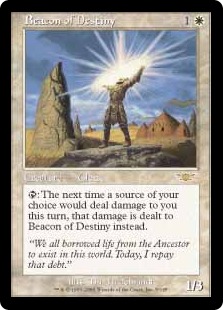
beaconofdestiny
Beacon of Destiny: Redirect all damage to this creature, no matter its source? Why not?
belovedchaplain
Beloved Chaplain: Protection from creatures for two mana. Not bad!
courierhawk
Courier Hawk: The 2 toughness and vigilance is more help than it seems!
dawnelemental
Dawn Elemental: Flying 3/3 that can’t be killed by damage…WIN.
dawnstrider
Dawnstrider: A creature which can Fog when you Spellshape. What an unexpected bonus!
empyrialarchangel
Empyrial Archangel: A defensive instead of aggressive Angel. Me likey.
elvishpiper
Elvish Piper: Makes playing the huge-mana-cost creatures actually worthwhile!
essencewarden
Essence Warden: Because Green needed quick, creature-based life-gain, too. LOL
exaltedangel
Exalted Angel: One of the first Angels with lifelink, and even more fun with the Morph ability.
grizzledleotau
Grizzled Leotau: A Green/White creature with a huge toughness…which costs only two mana!
indomitableancients
Indomitable Ancients: Because a 10 toughness for 4 mana is just hilarious.
jenaraasuraofwar
Jenara, Asura of War: A multi-colored Angel for only 3 mana (gasp!), with the ability to get more P/T over time.
jhessianinfiltrator
Jhessian Infiltrator: I love the low-mana-cost Unblockable damage, especially in Green.
krosancloudscraper
Krosan Cloudscraper: Admit it, swinging for 13 with one creature is pretty hilarious.
prideoftheclouds
Pride of the Clouds: Love the artwork; plus, this is one cat that likes fighting alongside the birds!
skyhunterskirmisher
Skyhunter Skirmisher: White so rarely gets double strike, and this is flying double strike at that!
timberprotector
Timber Protector: I’ve built a Treefolk deck. ‘Nuff said. 🙂
wallofhope
Wall of Hope: This is hilarious to play on your first turn, because of the defense/life-gain combo.
yavimayadryad
Yavimaya Dryad: Absolutely need a Forest? She’s got you covered. Need to give the other player a Forest so that your creatures can Forestwalk? She’s got that, too.
yavimayaenchantress
Yavimaya Enchantress: Funny with Blanchwood Armor, Gaea’s Anthem, and the like. 😀

Image Credits

All card images came from Gatherer.

I Called It! HeroClix Gets a Pink Power Color

Back in June 2012, I wrote about ideas for introducing pink as a new HeroClix powers and abilities color. Well, as of a few weeks ago on HCRealms, the new 2013 Rules and PAC (Powers and Abilities Card) was revealed. Apparently, someone at Wizkids was on the same wavelength as me–future figures will have pink as an available power color.

Pink Powers and Abilities

Quoted from the official forum post:

Pink Speed Sidestep: Give this character a free action; it can move with a locked speed value of 2.
Pink Attack Precision Strike: When this character makes an attack, it can’t be evaded, and the damage dealt can’t be reduced below 1 or transferred.
Pink Defense Invincible: Half of damage dealt to this character is ignored. (Note that the rules state you can only apply one game effect that reduces or ignores damage, so Invincible does not combine with damage reducers)
Pink Damage Empower: When an adjacent friendly character makes a close combat attack, this character modifies that adjacent friendly character’s damage value by +1.

What Does This Addition Mean for the Game?

With four new standard powers available for all future HeroClix figures, I believe this will help the game’s standard powers better reflect superheroic abilities from the comics. I can easily see a Batman or Robin figure with Sidestep, for instance, or an Iron Man with Invincible.

Furthermore, all these new abilities even out the strength of others. For example, I can make great use of a figure with Precision Strike–finally, the game has an answer to Shapechange, Super Senses, AND Mastermind, which isn’t Outwit! And I love the fact that adjacent close combat characters will finally be able to enjoy the same damage-boosting benefits that adjacent ranged characters have had for so long; this makes the close-combat game a lot more playable.

Of course, opinions are divided on this newest addition to the Standard Powers and Abilities (see the “Pink Powers? This will ruin Heroclix” thread on HCRealms). Personally, I think we will all be a little more reconciled to the idea when the first truly kick-butt figure with any pink power is released–I think seeing a highly-valuable figure with these powers will make it “official,” more so than this announcement does.

What’s Your Take on the New Pink Powers?

Tell me about it in the comments!

More Info

“2013 Rules and PAC are up” HCRealms thread

How to Tell How Old Your M:TG Cards Are

Most of us Magic: the Gathering players began our collections with a fairly random assortment of cards, a mix of the most current booster packs plus some donated cards from other players’ collections. Because of this, sometimes it can be hard to know exactly what value your cards have, or even what set the cards are from in some cases.

So I compiled this handy little guide, with the help of my awesome boyfriend (who’s been playing Magic since Revised came out), to help all of us know what sets some of those unidentifiable “old cards” come from. Who knows, you might be sitting on a small fortune and not know it!

For these illustrations, I used the card “Healing Salve,” which was printed from Alpha all the way through 8th edition–it shows how the early sets changed and varied.

limitededitionalpha-2

Alpha

  • Heavily-rounded corners (compare to modern card and see the difference)
  • Black borders
  • Big rules text
  • No copyright date
  • No set symbol
limitededitionbeta-2

Beta

  • Normal rounded corners (same as modern-day cards)
  • Black borders
  • Big rules text
  • No copyright date
  • No set symbol
unlimited-2

Unlimited

  • White borders
  • Normal corners
  • Big rules text
  • No copyright date
  • No set symbol
revised-2

Revised

  • Card colors look lighter overall–light print run
  • Smaller rules text
  • White borders
  • No copyright date
  • No set symbol
4thed-2

4th Edition

  • Copyright 1995 on the bottom of the card
  • White borders
  • No set symbol
5thed-2

5th Edition

  • Copyright 1997 on the bottom of the card
  • White borders
  • No set symbol (except for the Chinese release which had a Roman numeral V)
classic6thed-2

6th Edition (aka “Classic 6th Edition)

  • Set symbol: VI (but see note about early set symbols and card rarity, below)
  • White borders

Chronicles Reprints

The set called Chronicles, which was released in July of 1995, was a set made up entirely of reprints from older sets–a mega Core Set, if you will. However, for each reprinted card, Chronicles used the card’s original set symbol instead of the Chronicles official set symbol.

The only difference between an original printing and a Chronicles reprint? The border color. The original sets all used black borders; Chronicles used white. See the example below:

legends
Original Legends printing
chronicles
Chronicles reprint

The Chronicles reprints are worth less, usually, than their original-print counterparts. Be wary if someone claims to be selling original prints of these cards–check the border color before you buy it at top price!

Set Symbols and Rarity

Unlike modern sets, many older sets either did not have set symbols at all, or only had a black set symbol for all cards, no matter what their rarity. In June 1998, Wizards of the Coast released the set called Exodus, which introduced the color-coded rarity system: black for common, silver for uncommon, and gold for rare, as seen below:

exodus_symbols

Be sure to look up the real value of older cards with no color-coded set symbols–what everyone else thinks is a “common” card (because of its black symbol) may in fact be a rare!

Useful Resources/Credits for Card Information

Gatherer (card images)
EssentialMagic.com’s Card Sets List (some set information)
CrystalKeep.com’s Symbols List (Exodus symbols)