God Says “Act Like You Got Some Sense!”

Deuteronomy 32:28-31
28 They are a nation without sense, there is no discernment in them. 29 If only they were wise and would understand this and discern what their end would be! 30 How could one man chase a thousand, or two put ten thousand to flight, unless their Rock had sold them, unless the Lord had given them up? 31 For their rock is not like our Rock, as even our enemies concede.

In this passage, which is part of Moses’ song to the Israelites near the end of his leadership, Moses warns Israel to stop straying from God. Israel has waffled back and forth between worshipping other deities and worshipping God, and in so doing has become a very lost and divided people, even by the end of Moses’ tenure. (The Book of Joshua and Judges, next up in the Bible, show that this behavior continues even after Moses’ warning.)

God sounds pretty harsh all the way through this song, which might be understood better as a verbal warning from on high. But He’s warning the Israelites that if they don’t shape up and start following properly, He’ll have to show them what life is like without His blessings and protections. (Verse 30 shows one particular vision of combat with other nations without God’s protection.) Yet even the enemies of Israel acknowledge that the Israelites have a God Who is stronger and more powerful than theirs (verse 31).

All too often, we too forget how powerful God is in the pursuit of our rather self-sufficient lifestyle. We, like the ancient Israelites described here, sometimes act like a “nation without sense” or “discernment;” we don’t realize how our lives always rest in God’s hands. God often takes a backseat to other things in our lives, regarded more like a last-resort, “Break Glass in Case of Emergency” deity. But God does not want that kind of treatment, any more than our parents like to be treated like human ATMs or gift machines. He wants us to walk with Him, just as He wanted the ancient Israelites to do. That’s what Moses’ whole song is about.

Sometimes, We Christians Don’t Act Very Christlike

I catch myself doing it sometimes, and you’ve probably caught yourself doing it too. Judging, gossiping, disapproving, or feeling superior to someone else…and much of it happening within the church, supposedly a haven of compassion, forgiveness, and love.

As one who has spent time both outside the church and inside it, I find this puzzling, but not surprising. We’re all humans, after all, and we make mistakes; we get irritated at each other, say things we shouldn’t, and let darker emotions lead us to make snap decisions about others. But too often, we Christians often act as if we never sin in this manner (because that’s what it is: sin). Instead of forgiving, loving, and showing compassion to other believers within the church (or to nonbelievers outside it), we sometimes show off a more judgmental, self-righteous, and downright isolationist attitude.

Problem #1: Pride

For instance, heated arguments in the church can crop up over the most petty things, like “who gets to direct this ministry,” “what music we worship with/don’t worship with in this church,” “what kind of decorations to use/not use,” etc. And more hurt feelings (and subtle grudges) result from this than we care to admit. We all want recognition for what we’re doing for the church, but sometimes the pursuit of that recognition can obscure the reason WHY we’re doing it.

Sometimes I just want to scream, “What does it matter, as long as it’s for God?” And then I catch myself wanting a solo in the next choir special. It happens to us ALL, even if we’re trying our best to live as God would have us live. Pride and the desire for recognition/praise is a human thing, but I believe it must be battled, especially in the church where our primary intent is to praise God.

Problem #2: Judgmental Thinking

We’ve all thought it at one time: “So-and-so doesn’t belong in MY church. They aren’t like me at all.” There’s that one person whom you just don’t feel comfortable around, who just gets on your nerves. Maybe they’re too casual and loud with their worship, or maybe they look you up and down as if they’ve just judged you and found you lacking. Maybe they don’t dress “right” for church (read: not the way you dress), or maybe they seem like they want to turn the church into a rigid political institution with God just kind of thrown in there somewhere.

When we feel uncomfortable around others, we tend to judge them more harshly. It happens to me just as it happens to other Christians; there have been times when people have said stuff within the church and it just crawls all over me. I wind up thinking, “How can THEY call themselves Christian? How dare they! I’M certainly more Christian than they are!”

And there’s the problem. When we start comparing others to ourselves and finding them lacking in comparison to us, we’ve taken our attention completely away from God. When we focus on how much WE’RE holy and how righteous WE are, we utterly forget to worship God because we’re too busy worshipping ourselves. That’s where judgmental thinking really comes from, and it’s an insidious little thing that creeps into everyone’s mind at some time.

Problem #3: Isolationism

Have you ever noticed that we Christians can function as a rather insular group? Sometimes it feels, at least to me, as if churches are less like worship centers and more like exclusive social clubs, where you have to have a special password to even get in the door, and when you get in, everybody is divided up into little cliques that don’t really talk to each other.

I agree that it is important to surround yourself with other Christians, especially if you’re new to the faith, so that you don’t fall back into sinful lifestyles and habits. But sometimes we go a little too far to the other extreme, even refusing to talk to or hang out with people because they “aren’t Christian,” as if being in the presence of nonbelievers will somehow “taint” us.

Jesus Himself caused a little controversy when He went to eat with Zacchaeus the tax collector (Luke 19:1-9). People begun to rumble about Jesus “[going] to be the guest of a sinner” (NIV translation). But Jesus, in this instance and many others, went to people who didn’t necessarily believe in Him yet, breaking bread with them and being with them. And most often, His very presence among them and His serene, compassionate attitude changed their hearts. Why, then, do we Christians sometimes act as if we’re too “holy” or “righteous” to go among nonbelievers, when the Son of God was not afraid to do so?

Coming from my own experience, I believe that most of the answer lies in our human desire for comfort and familiarity. Doing things that are new and challenging requires courage and deep-rooted security in oneself, and I can definitely say I lack that in most areas of my life. I don’t feel qualified to verbally witness to others, for instance, because I can’t quote chapter and verse off the top of my head (I had to take quite a while to look up the passages I just referenced in the last paragraph, for instance). And I’m sure I’m not the only Christian who has these secret fears; sometimes we don’t reach out to nonbelievers because we are afraid of rejection, anger, or being caught without knowledge.

However, the other side of the issue must be addressed, too–when we have already judged someone else harshly for being a nonbeliever, we are more likely to be unfriendly to them. Is that what Jesus would have us do? I can tell you from personal experience that some of the harshest people I’ve ever been around have also been very rigidly Christian–so rigid in their faith, in fact, that I thought they would splinter apart if they moved a fraction of an inch. They were hard to get to know and harder to talk to about faith; everything I talked about, it seemed, met with a disapproving glare or frown. Is it any wonder less people are interested in Christianity, if this is the only face of Christianity they ever see?

Jesus’ example, however, shows us all that sometimes all we need to be is compassionate and approachable. Shyness or visual signs of disapproval can only further isolate us as Christians from the world. I’m not saying we go to every rough-and-tumble bar, knock a few back, and end up falling out of our own faith practice, but we do need to go where people need to hear about Jesus, and we do need to share about Jesus in a personal, gentle manner. And, after all, who are we more likely to be friendly with–a stranger who doesn’t talk to us at all, a stranger who stares daggers at us, or a stranger who smiles, talks and laughs with us?

Summary

I think these three big problems really hurt the Christian church and its perception in the secular world, as well as hurting worship and feelings between believers. Pride, judgmental attitudes, and isolationism are hard to root out–believe me, I know, since I’ve been trying to expunge such behavior from my own life. But I truly believe we as Christians will be better examples of Jesus’ teachings if we strive to be as forgiving, compassionate, and loving as He taught.
Design Manual Review: “The Web Designer’s 101 Most Important Decisions”

101decisionsbook
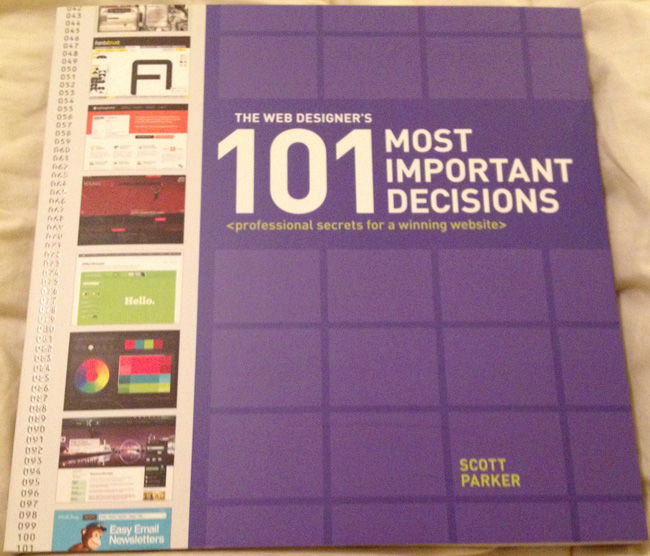
The Web Designer’s 101 Most Important Decisions, by Scott Parker.

While browsing at the bookstore the other day, I came across this little gem hidden behind other books in the Web Programming and Web Graphics section. I ended up buying it, and after reading it through I can safely recommend it as a great all-around introductory web design manual.

It’s not just a book about layouts and graphics, though it covers that. It’s also not just about programming and coding, though it discusses both those topics as well. This book literally covers every part of the webdesign process, from planning and programming your site to launching and promoting it. Here’s a very small sample of topics which Parker offers pointers on:

  • planning before developing a website
  • what kind of programming languages are available
  • keeping content both brief and informative
  • the great “vertical navigation vs. horizontal navigation” debate
  • modal windows, the new and slightly less annoying pop-up window (this was news to me)
  • giving clear site error messages
  • making stylesheets that are disabled-friendly and mobile-friendly
  • effectively connecting with users via blogs, forums, and social media pages
  • promoting your website with business cards and flyers (sound old-fashioned? It ain’t!)

…and there is a TON more stuff that I haven’t even mentioned. Seriously, this is only the tip of the iceberg.

The book is organized into 11 chapters, of which each topic covered takes up a page or two, and each page is graphically organized to be easy to browse through and scan. It’s also fairly easy to find pages again if you need to look something up, so it’s not just a book you read once and give away–it’s a book you keep around for quick reference.

Though this is definitely not a step-by-step manual on how to code an HTML page, how to set up a Facebook page for your site, or how to create a layout in Photoshop, it does introduce you to all these concepts and more, as well as giving you keywords to aid in your search for further information. Kinda wish I’d had a book like this when I started web design back in ’03! 😀

The Funny To-Do List: Motivate Yourself with Laughter

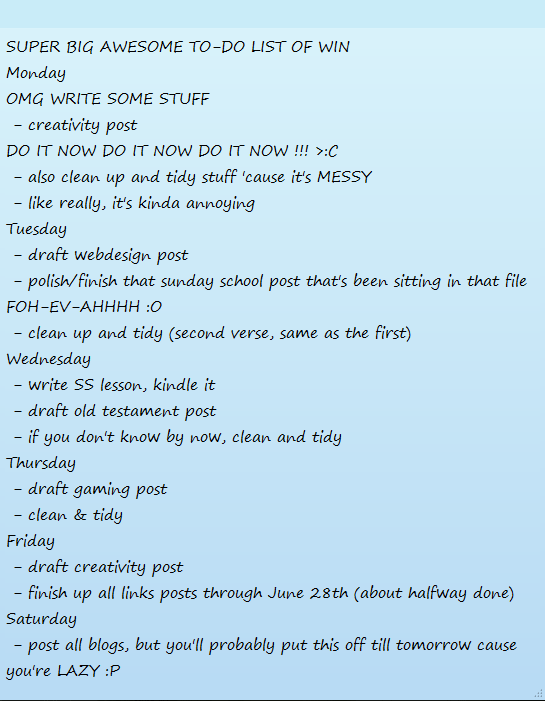
The following little beauty sits on my computer desktop, courtesy of the Sticky Notes desktop gadget; it contains my to-do list, which I update every time I turn the computer on (about twice a day).

Nothing in the following to-do list is faked; this is my real to-do list from this past Monday morning. I had a deadline–I was rushing to finish my creativity post, so that was top priority. How I drew attention to it, however, is the subject of this post.

funnytodo
Yep, this is pretty much how crazy my to-do list is on a daily basis. I note all the stuff I have to do, but I don’t just list it–I use my creativity and jazz it up a little. I type in emoticons and all caps, make inside jokes with myself, and otherwise write stuff that makes me laugh when I next look at the list.

Sometimes I’ll even include a few mild, funny insults to myself, especially if I’ve been procrastinating on a task that really needs doing (see the Saturday entry at the bottom of the list). Why? Because sometimes you need a kick in the rear to get started on a task, and better it comes from you than someone else, right? LOL

Some might see this as overly childish or time-wasting, but I disagree. Before this, I tried writing a “grownup,” plain to-do list, and guess what? Nothing got done; I felt depressed just looking at it. Nowadays, I try to include as much LOL in my to-do as possible. Mary Poppins was right–a spoonful of sugar DOES help the medicine go down. (Or, in this case, a spoonful of LOL helps the to-do list get done.)

So, if you’re finding yourself stuck on your to-do list with little inspiration to get anything done, you might want to try throwing in a few inside-joke funnies, drawing a silly emoticon face, or prodding yourself along with some anti-procrastination jokes. Who knows? You too might start off your Monday morning with a laugh!

The Problem with the World, Supermodels Without Makeup, Orisinal Games, and OneStopPlus

The whole problem with the world is…
Philosophical quote by Bertrand Russell.

Supermodels Without Makeup
Amazing how “normal” most of these supermodels look without makeup, isn’t it?

Orisinal Game/Media Archive
Browse and enjoy all the whimsical Flash-based fun found here!

OneStopPlus
All types and styles of plus-size clothing, all on one website.

My Favorite Clix, part 3: LE Sue Storm

When my then-good friend (later boyfriend) showed me how to play HeroClix in September of 2007, he helped me build a team out of his collection to play my first game against him. I picked out the Limited Edition Sue Storm–I didn’t know much about her, but I already liked her 19 defense, which I could already see was rare among Clix figures of her point cost (49).

I already liked high defenses in the other games I played, so it didn’t take me long to gather some high-defense figures in Clix, and Sue was one of the first I got when I could. She was one of my first favorite Clix pieces because of that fantastic 19 defense, and she’s still quite playable today.

A Little Bit More about Sue

le_suestorm
LE Sue Storm, #205 out of Fantastic Forces. Image Credit: HCRealms.com.

With Stealth, Barrier, and 19 defense first click, it’s a good bet Sue won’t be targeted or damaged easily, even with today’s higher attacks. And even if she does get hit, her defense drops slowly, point by point (until her last click when it drops two points). Pair this with her Flight ability, and she’s a solid taxi for grounded friendly characters, as well as a darn near immovable block if you need to keep enemy characters away from wounded friendlies.

Now, most people pooh-pooh the back half of her dial, and some don’t think much of her offensive abilities in general. But I wouldn’t be so quick to judge. Her 9 attack and 2 damage up-front can be good in a pinch if you need her as a second- or third-string attacker, and Outwit or Perplex can always make her shot easier. Don’t underestimate that Incapacitate and Energy Shield/Deflection on her back-dial, either–I’ve had LE Sue Storm be the last to survive of my team on next-to-last click, and still be making fine shots at my opponent’s banged-up team.

LE Sue Storm’s Heyday: The Wildcard ATA Teams

I admit it: back in the days before they outlawed wildcards being able to copy Alternate Team Abilities (ATAs) completely, I ran a pretty nasty little Wildcard Fantastic Four team with LE Sue Storm as its centerpiece. With the Fan Four ATA worded as it was then, wildcards could copy Sue’s 19 defense without ever having to be close to her. Thus, I had a team full of Shrinking Violets, Timber Wolves, Iron Fists, and Spider-Girls, all with a quite maddening 19 defense. (It was much funnier if the wildcards all had Super Senses. Either you missed ’em because you didn’t hit a 19, or you missed ’em because I rolled Super Senses. Mwahaha. LOL)

These days, that kind of team is no longer valid; you now generally play a Wildcard Fan Four ATA team like a Defend team, surrounding Sue with your wildcards so they can borrow her defense while they attack. You also have to pay 5 points from your team build cost for using the ATA on a “Wildcards & Sue” team. Still useful and successful, though not as mobile as the old one. (The old one was rather broken, I’ll admit. This one’s more fun for player and opponent both.) I actually like this new build pretty well, because surrounding Sue with little Wildcards who are both protected by Sue and guarding her is FUNNY.

My Personal Recommendation

If you love Stealth pieces, and love pieces with high defenses, then this Sue should be in your collection. For 49 points, you won’t find another 19-defense Flight piece that has this kind of team support (like Barrier and Incapacitate) built in. She’s a great addition to any long-game Clix player’s arsenal.

Paul’s Guide to Being a Serene Witness

Acts 19:8-10
8 Paul entered the synagogue and spoke boldly there for three months, arguing persuasively about the kingdom of God. 9 But some of them became obstinate; they refused to believe and publicly maligned the Way. So Paul left them. He took the disciples with him and had discussions daily in the lecture hall of Tyrannus. 10 This went on for two years, so that all the Jews and Greeks who lived in the province of Asia heard the word of the Lord.

In this passage, Paul has visited Ephesus and is doing missionary work there, preaching about Jesus and sharing the various truths of the gospel with the Ephesians. Here, we see that a few people become resistant to Paul’s message and disparage it. Yet, rather than sit there and verbally duke it out with the few resisters, Paul simply leaves them, and takes his discussion elsewhere (namely, the “lecture hall of Tyrannus,” who was likely a philosopher or teacher of rhetoric of the day).

This does not mean that Paul was angrily giving up on these people, nor that they “won” the debate somehow. Instead, Paul knew that any angry argument with these resistant people would only obscure the message for others, and would degrade the quality of his witness. There was no point to argue with people who were only interested in shouting him down.

But notice that Paul doesn’t leave Ephesus entirely. He still has daily discussions with people who are interested, and the discussions seem to be open to anyone and everyone. He is preaching to both Jews and Greeks (both people of Abrahamic descent and people of other ancestry); he is presumably speaking to anyone who is interested in learning the gospel, and no one is left out. And Paul stays in this same location two years more doing this, so that everyone hears at least something about the gospel, and those who are interested can come and find out more if they wish.

To me, Paul’s open sharing of the gospel, staying away from conflict and instead inviting peaceful discussion, is what we as Christians should aspire toward. Too many times, modern Christians make headlines because they act too confrontational and angry, and in fact that is the way many nonbelievers see Christianity–as an angry, self-righteous faith, quick to judge and even quicker to condemn. Just as indignant confrontation would have only muddled Paul’s message in Ephesus, such negative communication can only damage us modern Christians and keep others from ever wanting to hear our own stories of how God has worked in our lives.

Any time we talk about Jesus with someone, we should make it as serene as possible, being willing to share our own experience and answer any questions the other person/people may have. Not everyone will want to hear our message, and that’s okay; they can make the choice for themselves, just as we did. Accepting and respecting their choice, whether it’s to listen or to walk away, is part of our job as witnesses for Christ. And, just as Paul did, we can continue to share our testimony and our understanding of the gospel elsewhere if need be.

Getting Fit the RIGHT Way, part 6: Wrapping Up With Encouragement

To conclude my series on getting fit and staying fit, I want to offer encouragement, and a few final tips for your own fitness quest:

#1: This is a Lifestyle Change

When you begin your fitness quest, remember that this journey is full of steps toward a better lifestyle. This is not a diet you will only adopt for 90 days, nor only an exercise goal you’ll hit in a year. All of the steps I’ve outlined in previous posts are new habits and routines to adopt so that you can lead a healthier lifestyle.

Don’t think that you can just go back to your old lifestyle after you’ve lost however many pounds or inches. To go back to your old lifestyle is to go back to your old weight and your old level of fitness. Do you really want to do that to yourself, when you’ve come so far already?

#2: This is Not Impossible

I admit, some of the “healthy lifestyle” routines and habits are difficult to adopt at first, and you end up craving your old life quite a bit, especially if you’ve overwhelmed yourself with a ton of changes. That’s why I suggest changing one or two little things at a time, so that you can slowly shift your lifestyle over the course of years. If you feel that a certain lifestyle change is impossible, break it down into possible goals, and achieve them one at a time.

For instance, to start on my “healthy eating” goal, I shifted from sugary sodas to flavored water six years ago, and now I couldn’t imagine going back to drinking all those drinks I used to love. (Though I still have random Cheerwine cravings…LOL) At first, I thought I’d hate it and would never be able to stick to it, but by removing every soda from the house and choosing to drink only tea or water when dining out, I found that slowly the craving for sugary drinks went away. I’m nowhere near eating “healthy” as most people conceive of it, but that choice of water over soda is one important step toward it.

#3: If You Mess Up, It’s Not the End of Your Quest

So you broke down and had a slice of cheesecake…or perhaps 4 or 5 slices. Does that mean that your fitness quest is over and you might as well give up?

Absolutely not. And actually, it’s perfectly okay to have a treat once in a while. Just make sure that that cheesecake, or those hot wings, or whatever tempts you, is purely a “once-in-a-while” treat. Take time to fully enjoy it, savoring the experience, and then continue with your regular diet again. (I have to use this trick with chocolate chip cookies–I allow myself two a week as part of my regular diet, but if I end up eating more than that, I just factor that in as next week’s allotment and move on.)

This goes for exercise, too. If you miss two or three days of exercise, pick it right back up the next day, or the next week, and continue on as if nothing has happened. In my early days of Zumba, I would sometimes miss a couple of classes in a row because of terrible nerve-ripping headaches and joint soreness. But I always knew there was next week’s class that I could return to. Soon, as my joints got better and my headaches were treated, I missed less classes, until I was attending regularly.

The point? Don’t give up on your goal just because you got off-target for a few hours (or a few days). Fitness is something that is maintained, not gained and then kept forever. It’s a constant process, which can be put down and picked back up at will.

#4: Think of How Much Better Your Life Will Be

When we’re first trying to get fit, we think of all we will lose–access to our favorite foods, less time to enjoy our favorite TV shows, etc. But to change your thinking, think instead about all the things you can’t do right now because of your fitness level, and how much you want to get back to doing them.

For instance, I had to quit basketball–and pretty much every other physical activity (even running)–because of all the joint injuries I suffered in college. When the doctor says “your knees and ankles can’t take high-impact activities,” it means everything high-impact. And for years I felt stuck by that; every exercise I tried hurt, and felt like the worst kind of punishment.

But now, thanks to getting a little more active in Zumba class and staying with it for a year and a half, my knees and ankles are more capable. Just last week, I walked around the entire outlet mall near my hometown, a feat I have not been able to do in seven years because of joint pain. I was a little sore the next day, but not bedridden like I would have been even 3 years ago.

It might be a small victory to some, but to me it meant I am actually returning to normal life as a young woman ought to experience it. I don’t feel like I’m in a body that’s over 70 years old anymore. That’s my point; if you stay with your fitness quest, you can regain physical abilities that you thought you’d lost forever. Physical capability through fitness is something many people take for granted, but when you lose it, you realize how important it is!

Further Reading

Here are a few other articles I’ve written about exercise and fitness, to keep you more informed. May you be successful and happy as you start your fitness journey!

Making Custom Sorted Playlists, aka “Being OCD About My Music Collection”

I suppose it was inevitable–categorizing my music as heavily as I do now, I mean. Being musical and being fairly OCD…well, my labeling and listing bug got hold of my music collection and had a field day. Now, with iTunes’ playlist feature, I can make all the nitpicky little playlists I want. LOL

The Beginning: Playlists that Move from Energy to Relaxation

This “labeling and sorting” music craze of mine began with self-made mix CDs back in high school (~2002), throwing together a haphazard list of my 15-19 newest favorite songs and arranging them into a mix that somehow kinda-sorta made sense.

energetic-chill_mix
For instance, this is one of my self-made mixes from around 2006-2007 (I think), titled “A.D.D.” for its relative craziness. Nevertheless, I did try to group songs together, not by subject matter or alphabetization, but by song sound–the most energetic songs appeared first on the mix, whereas the more downtempo songs appeared last.

I did pretty much all my CD mixes this way for a long time, simply because I like listening to faster music more often and I wanted the faster songs more readily available (i.e., not having to skip a bunch of tracks to get to them). It worked well for me; as the CD played through, I worked through all the faster songs and then, if I wished, I could move on to slower, more chill stuff.

Next Steps: Chromatic Playlists (Warning: Music Nerd Alert)

But I also began experimenting with different ways to arrange playlists–take my current “New Favorites” playlist, which is arranged by musical key on an ascending chromatic scale:

chromaticscale
Before arranging this mix, I used the “Comments” column of my iTunes music library to tag each song with its proper musical key. Then, I grouped all the songs in C major or minor together, followed by C# major and minor, then D major and minor, and so on, up to B major and minor at the end of the playlist.

The natural upward progression of keys makes my inner music major happy (and provides less of a shock to my perfect pitch when switching between songs). While the songs’ subject matters often have nothing in common, it’s also interesting to see how different composers use the same key to express such different ideas.

Fun With Labels: Playlists by Subject Matter/Use

You’ll notice, however, that not only are the above songs tagged with musical key information, but with other strange keywords. That’s one of my newer labeling strategies: making playlists by subject matter.

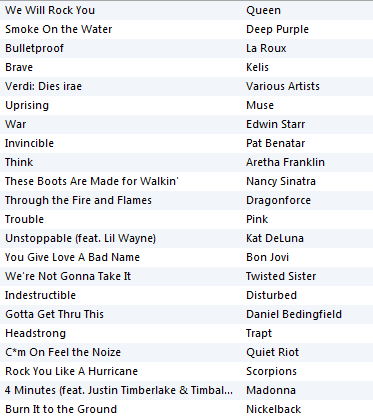
For instance, here’s a few selections from my “Rarrrr” (angry) playlist, which is good for getting out frustrations:
rar_mix

…and a few from my “Love” playlist (which includes songs about the pain of love as well as the joy of it):
love_mix

I even have an extended playlist called “Butt Whoopin'” for those times when you’re stampeding through a video game level and need appropriately inspiring music. (It works–try it out :P)
buttwhoopin_mix

And finally, a playlist of several of the songs my Zumba class uses to work out by:
zumba_mix

Each of these playlists helps me to establish a certain mood (or, in the case of the “Rarrrr” mix, dispel it). It’s great to ride down the road toward Zumba class on Thursday nights, for instance, with my Zumba mix going, previewing so many of the cool songs I’ll be dancing to that night. I like gathering songs of the same subject matter together so that the playlist makes good lyrical sense from song to song.

For the Really Bored Hardcore Labelers: Playlists By Time Period

Lately, however, I’ve been into making playlists that focus on one particular time period of music, especially if the time period is instantly recognizable and singular in style.

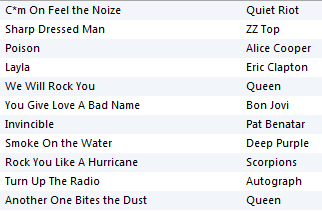
Take these selections from the two most notable “time period” playlists I’ve made thus far: Oldies and Headbangers (50s/60s pop and 80s rock, respectively):

oldies_mix
“Oldies”
headbangers_mix
“Headbangers”

When I’m in a particularly “oldies” mood, or in a particularly 80s-rock mood, I know just which playlist to select. But it’s not just about the music, but the memories attached to each song; for the Oldies playlist, it brings up memories of riding in the car with my dad as a kid, listening to the local oldies station on the radio, for instance.

Time period playlists are great for nostalgia purposes as well as musical purposes–and after all, isn’t most music created to remember events and feelings better?

How Do You Make Your Own Playlists?

Leave me your thoughts in the comments. Have any different ideas for playlists besides the ones listed here? I’d love to hear ’em! (No pun intended 😛 )