Untranslatable Relationship Words, Funny Time Schedule, Contemporary Hillside House, and 20 Healthiest Foods Under $1

Top 10 Relationship Words that Aren’t Translatable Into English

My Time Schedule (Funny Picture)
This is pretty much my life. LOL

The Contemporary Hillside House by SB Architects
Gorgeous interiors and exteriors of this neat little “hillside house.” :O

20 Healthiest Foods for Under $1
All for under $1? Wow! Some surprising entries on this list…

New M:TG Abilities, part 1: Return to Ravnica

returntoravnica Return to Ravnica, one of the more recent Magic: the Gathering sets, includes five new keyword abilities printed on the cards, one for each of the five dual-color guilds featured in the set. Let’s take a moment and look at each of these abilities–you might find one you want to incorporate into a deck build of your own!

Ability Keyword

Associated Guild

Rules Text

More Info

Detain azorius_senate
Azorius
Senate
701.26a Certain spells and abilities can detain a permanent. Until the next turn of the controller of that spell or ability, that permanent can’t attack or block and its activated abilities can’t be activated. Detain @ MTGSalvation Wiki
Scavenge golgariswarm
Golgari
Swarm
702.95a Scavenge is an activated ability that functions only while the card with scavenge is in a graveyard. “Scavenge [cost]” means “[Cost], Exile this card from your graveyard: Put a number of +1/+1 counter equal to the power of the card you exiled on target creature. Activate this ability only any time you could cast a sorcery.” Scavenge @ MTGSalvation Wiki
Overload izzetleague
Izzet
League
702.94a Overload is a keyword that represents two static abilities: one that functions from any zone in which the spell with overload can be cast and another that functions while the card is on the stack. Overload [cost] means “You may choose to pay [cost] rather than pay this spell’s mana cost” and “If you chose to pay this spell’s overload cost, change its text by replacing all instances of the word ‘target’ with the word ‘each.'” Using the overload ability follows the rules for paying alternative costs in rules 601.2b and 601.2e–g.

702.94b If a player chooses to pay the overload cost of a spell, that spell won’t require any targets. It may affect objects that couldn’t be chosen as legal targets if the spell were cast without its overload cost being paid.

702.94c Overload’s second ability creates a text-changing effect. See rule 612, “Text-Changing Effects.”

Overload @ MTGSalvation Wiki
Unleash cult_of_rakdos
Cult of
Rakdos
702.96a Unleash is a keyword that represents two static abilities. “Unleash” means “You may have this permanent enter the battlefield with an additional +1/+1 counter on it” and “This permanent can’t block as long as it has a +1/+1 counter on it.” Unleash @ MTGSalvation Wiki
Populate selesnyaconclave

Selesnya
Conclave
701.27a To populate means to choose a creature token you control and put a token onto the battlefield that’s a copy of that creature token.

701.27b If you control no creature tokens when instructed to populate, you won’t put a token onto the battlefield.

Populate @ MTGSalvation Wiki

Which Keywords Are Right for You?

  • If you like to play control, Detain was tailor-made for you. Period. 😀
  • If you like to swing with big creatures, both Unleash and Scavenge are great mechanics for pumping up creatures’ power and toughness, albeit through very different means.
  • If you like to amass lots of little creatures very quickly, Populate will serve you well–just make sure you have one token to start off, and then let the Populating mechanic go wild!
  • If you like to play combos, or if you like big splashy game effects, Overload in all its various forms will give you great options for both early-game and late-game.

What Kind of Riches Do You Really Want?

Proverbs 15:17
Better a meal of vegetables where there is love than a fattened calf with hatred.

In this proverb, short but profound, we find advice which is less about food than wealth in general. Meals of vegetables, being cheaper, were more common in Biblical days; meals featuring fattened calves were luxuries, saved for very special occasions. But here, the author of Proverbs advises that a cheap meal served in an atmosphere of love is better than a luxurious meal served in an atmosphere of hatred.

This seems counter-intuitive at first. Wouldn’t we all want to eat the expensive, sumptuous food rather than the cheap stuff, no matter what kind of “atmosphere” it’s served in? But in this proverb, spiritual riches and material riches are contrasted; the spiritual riches of love are better than the culinary riches of meat, or indeed any other kind of worldly material wealth.

This strikes to the heart of our modern lifestyle, which often prizes instantly-gratified material wishes over concepts like family ties, loyalty, friendship, and compassion. All our wishes for material wealth–all the “fattened calves” we covet–have their place, but they pale in comparison to love, in all its various expressions. Material riches are inevitably consumed and discarded, like the fattened calf at a large dinner, but spiritual riches are eternal…like God’s love for us.

So, considering all this, which kind of riches do you want in your own life?

Girls Can Choose Their Lives: What I Believe Feminism/Women’s Lib Is Really About

As a little girl growing up in the late ’80s and early ’90s, I knew without questioning that I had a smorgasbord of opportunities in front of me. I could be ANYTHING. I could play with any toy I liked, be friends with anyone I chose, read any book I wished, and dream of one day being in any career that I felt drawn to.

That freedom was something I very much took for granted. It was not until later in school that I began to hear about “feminism” and “Women’s Lib” as a social movement, and that it hadn’t been very long ago that it was considered improper for young ladies like me to just read any book they wanted, or play with any toy they liked, etc. I learned, from my own relatives and community members as much as from the textbooks, that a woman’s dress, speech, and even life goals prior to this movement had been fairly proscribed, a beaten track which you simply had to walk. The recent documentary on PBS called Makers describes the feminist/Women’s Lib movement in detail, and has in part spurred the following post.

Watch Part One: Awakening on PBS. See more from Makers: Women Who Make America.

It was downright odd to learn about the Women’s Liberation/feminist movement, especially in the context of my own life. Keep in mind, I was (and still am) the type of girl who played with Barbie dolls one minute and Micro Machines the next; I would play sports with the boys at recess and yet still play at “teatime” with my dolls at home. My toybox was a mishmash of traditional “girls’ toys” and “boys’ toys,” dressup clothes and dollhouses right alongside Legos and basketballs. If it was fun to play with, I played with it, basically. I had no idea of the “gender lines” I was crisscrossing; to suddenly learn that these choices I took for granted had once been forbidden to girls was a shock.

But this very way of life, the way of life I adopted even before school-age, is what I believe the Women’s Liberation movement was really all about, and what feminism is still about today. Yet the movement has its fair share of detractors as well as people who don’t really understand what its purpose is…and I’m sad to say some of its proponents seem to have lost sight of what the movement is really about. (More on that in just a moment.)

This issue is really big and unwieldy, so I’ll simply try to describe what I believe the movement is about in the context of what it’s meant to my life: a certain freedom of choices.

What Feminism/Women’s Lib Isn’t: A Movement for Dominating/Getting Rid of Men Altogether

Many boys and young men sneer at or don’t like talking about the Women’s Lib/feminist movement, saying that they feel threatened or even belittled by it. Some wonder about the femininity of women who join or believe in such a movement; others question why women felt the need to break out of a social role that seemed perfectly fine.

I admit, feminism does seem pretty militant sometimes, especially looking back at its history. And the imagery of a woman doing battle is somehow more frightening to society as a whole–somehow, she’s an uncontrollable, unpredictable force. (People in America have fought militantly for the rights of many other social groups over time, though–why is fighting for the rights of women still so alien to society even today?) Feminism, however, is in my opinion not about getting rid of men entirely, nor is it about absolutely dominating men the way that women were so often socially (and physically) dominated.

I am a feminist and a liberated woman, but that does not mean I want to crush male anatomy beneath my heel and crack a whip over men’s heads. All I want, as a feminist, is for female human beings to be treated as socially, economically, and personally equal to male human beings. (That particular fight is still not over, by the way, since working women still make less than working men, often at the very same jobs.)

What Feminism/Women’s Lib Isn’t: A Complete Destruction of “Homemaker” as a Career Option

This is where many of my fellow feminists slip up in their definitions of feminism. I have heard too many “strong liberated women” disparage girls and young women who have gone on to become wives and mothers rather than take a “real career” out in the world. One of my Facebook friends actually received some nasty messages about her personal choice to become a homemaker–one of them said, in part, “I guess you just want to live in the nineteen [bleep]ing fifties if that’s all you’re gonna do with your life.”

To me, this is another perversion of what Women’s Lib/feminism is about. If you look down on a woman for not taking a career outside the home, then you are in effect telling her that her personal life choice is invalid, the same way society used to tell women that their life goals to work outside the home were invalid. As any wife and mother will tell you, homemaking is most certainly a career in and of itself–a 24-hours-a-day, 7-days-a-week, decades-long career with no vacations and no paid leave, requiring physical strength and endurance as well as nurturing and patience. Feminists fought for women to have the freedom to make life choices–who then are we, as feminists, to attack another woman based on her freely made, personal life choice?

What Feminism/Women’s Lib IS: A Movement for Social/Economic/Personal Freedom

I believe this movement is, at its core, about CHOICES–the choice to live our own life dreams and to use the spiritual gifts that God has blessed us with. Not all women want to be homemakers, wives and mothers, for instance, but some do and some are. Not all women want to be career women, but some do and some are. The point is, we have that choice.

Women’s Liberation was and is just that–a liberation from absolutely having to choose “public school -> marriage -> kids” (or just “marriage -> kids”) if a woman wanted to do something else with her life. Just as men as human beings were free to choose their careers and life paths, I believe the feminist women of the Women’s Lib movement wanted and still want that same freedom of choice for female human beings. I know I certainly do.

Now, being “free” does not mean that all of us will choose out-of-the-home careers and cast off the apron forever. Nor does it mean that we will eventually do away with men completely, except as occasional, dominated sex partners. We will simply be as free as men to choose our life’s path, and to use our God-given gifts. (That day has not come yet, either–there are still many subtle social hurdles to jump before we get there.)

Make SURE You Test Your Site in All Browsers! A Cautionary Tale

As a self-taught designer, I’ve learned the hard way that sometimes our best-designed layouts don’t always look right in all browsers. I’ve gotten used to testing everything I build in at least IE, Firefox, and Chrome, and occasionally I’ll even use sites like BrowserShots to help me test in many, many other browsers/versions of browsers as well.

However, this point newly hit home with me just this week, as I shopped online for a new bra from LaneBryant.com.

The Problem: A Missing “Add To Cart” Button

I browsed and quickly found what I was looking for–the rest of the site was designed very well. Then I went directly to the merchandise page…but for love or money I could not find the “Add to Shopping Cart” button. I must have hunted for about 10 minutes, going over the page in what felt like pixel-by-pixel increments. “Either I’m just ignorant, or the button ain’t here,” I found myself thinking after a while.

bra-page-firefox
I knew by looking at this part of the page (and being a webdesigner myself) that the button should be right below the sizing chart. But, as you see in this screenshot, it was nowhere to be found. Below this lay only the footer of the site, nothing else.

Finally I went to the brand’s Facebook page and asked about it; the person running the Facebook page got back to me very quickly and courteously, and suggested either clearing my browser cache or switching browsers. I cleared the cache with no luck, so reluctantly I switched from my beloved Firefox (newly updated to v.19) over to Google Chrome.

bra-page-chrome
Sound the triumphant fanfare! There the button was, right where I thought it would be, just below the sizing chart! In moments, what I thought was a digital impasse was resolved, simply by switching my browser. I completed my order and was happy.

…But, if I had been an ordinary user unused to “browser display issues” like this one, I would have just thought you couldn’t order anything from the site, and closed the window. Therein lies the danger for sites that don’t display right in certain browsers–they can lock out crucial functions of your site without you knowing until someone reports them!

Moral of the Story: REALLY Check Your Site in All Browsers

Seriously. Don’t just do a cursory layout check to make sure the layout displays right–make sure all your scripts and functions work the same in all browsers, too. This is important; otherwise, our sites won’t work for everyone, and we can easily lose viewers and business!

Music Theory Fun, part 7: Let’s Read Some REAL Sheet Music

As a tidy ending to this series on music theory, let’s test the music-reading skills we’ve learned with a few samples of real sheet music. (Don’t worry, you can do it!)

For each piece of music, remember to look for and study the following notations–doing it in this order seems to be most helpful for me, at least:

  • Time signature
  • Key signature
  • Rhythms (how long you hold each note)
  • Notes (what pitches you hit)

Sample #1: Auld Lang Syne

sheetmusic_auldlangsyne
Image Credit: TrivWorks.com

An old favorite for New Year’s, likely one we’ve either heard played a good bit or sung. What time signature is noted on this piece? How about key signature?

(If you said “Common Time,” also known as 4/4 time, for the time signature, you’re right! That’s what that little “C” means at the beginning of the first measure, as we learned a few weeks back. Remember what 4/4 time means?)

Also, if you can’t find any key signature, don’t fret–there are no noted sharps or flats, which means that this piece is in C major. (It also could technically be in A minor, but seeing that the many Gs in this piece do not have sharp symbols beside them, it is most likely C major.)

Let’s look at the rhythms, too. Hmm, I see a lot of “dotted quarter followed by an eighth note” rhythms scattered throughout the piece, plus a lot of eighth notes strung together in pairs. What else do you see?

And lastly, let’s look at notes. For instance, how often does the note of C appear in this piece, since the piece is in C major?

Sample #2: Super Mario Bros. Theme

sheetmusic_smb
Image Credit: WiiNoob.com

Here’s a tune a lot of us gamers know! Let’s check it out and see what we can learn from its sheet music. First, look at the time signature and key signature.

(If you said 4/4 time and C major, you’re right again! As with Auld Lang Syne, there are no sharps and flats noted, but that’s a key signature in and of itself–C major.)

How about rhythms? I see quite a lot of eighth notes, but not just any eighth notes–they’re all quick little notes with some fancy-looking 7’s and something that resembles a curly brace in between them. The fancy 7 and the weird curly brace are both rests, which means that you quit playing anything for just a moment. (In the case of the Super Mario Bros. melody, you can probably hear the breath of space in between the struck notes–this makes the notes, when they are played, stand out a bit more, because there’s silence surrounding them.)

And speaking of notes, do you see a few sharps and flats scattered about, hovering right in front of notes? For instance, I see a couple of F-sharps right at the beginning, and a B-flat/D-flat pair in the second measure on the bottom line. Composers do this occasionally, sneaking in weird or cool-sounding notes to make the melody more interesting–these are called “accidentals.” Without those accidentals, this melody would be very different! What else do you see in terms of notes?

Sample #3: Over the Rainbow

sheetmusic_rainbow
Image Credit: SkyBlueMusic.com; click for larger pic in new window

Saved the hardest one for last, but this is a tune you’re still more likely to know. This is a piano adaptation of the popular tune from The Wizard of Oz, so there’s going to be some extra notes and rhythms thrown in there, but don’t let that daunt you! You can decode this just as easily as you did the others.

First of all, what is the time signature and key signature?

If you spotted those three flats right off the bat, good for you! We remember from a couple of weeks ago that to figure out a key signature full of flats, you look at the next-to-last flat in the group. In this case, what’s the next-to-last flat?

(If you said E-flat, you’re right!)

But what about the time signature? …Actually, this particular copy of sheet music does not have it printed on here. But there’s a trick to figuring it out:

rainbow_firstmeasure

  • Look at the first measure–in the treble clef, there’s a half note (held for two beats, as we remember from a few weeks ago), then there’s a pair of notes played together that are both held for two more beats. Then there’s a straight vertical line, separating the first measure from the second. (Ignore the big string of eighth notes for right now. LOL)
  • Two half-notes means four beats, so whatever this time signature is, it’s got 4 beats per measure. So we now know that 4 is the top number of the time signature.
  • And apparently, since they only had room for two half-notes in the first measure, that must mean that the quarter note is counted as one beat–which means that the bottom number of the time signature must also be 4, representing the quarter note. So this is in 4/4 time, too, even though it doesn’t have it printed!

Whew! Well, aside from all that hullabaloo over the time signature, what else do you notice about this piece? I see lots of ornamentation, lots of embellishments on the melody added in (all the messy strings of eighth notes and big chords). This technique is something my Nannie referred to as “playing the doodly-doos” (LOL), and it serves to make the music sound richer and fuller. Looks pretty challenging to play at first, but all it would take is a little practice!

Congratulations! You Know More About Reading Music!

I hope this series has given you a greater insight on reading sheet music, and perhaps even inspired you to start playing an instrument or singing. But, of course, I could not have done all of this had it not been for my own wonderful music teachers over the years, who gave me knowledge, insight, and inspiration–I can only hope I’ve passed that same fire for music on to you. 🙂

18 Rules of Living, Purple Power Cleaner, Creative Packaging Design, and Poetry.com

18 Rules of Living, by the Dalai Lama
18 surprisingly simple little rules…

Multi-Purpose Cleaner, Apparently Very Good
Purple Power display, with an added (hilarious) endorsement by the store staff!

30 Bizarre and Creative Packaging Design Examples
A milk carton that actually looks like the word “Milk,” a tequila “gun,” boxless pizza cartons, and more!

Poetry.com
Submit your poems, read others’ works, give feedback, and hear from others here.

Resident Evil DBG: Mercenaries

Released in November 2012, the Mercenaries expansion for the Resident Evil deck building game has added quite a few new cards–and some very interesting new mechanics–to the existing game. Read on to see a sampling of the new and improved cards!

Big Change #1: Basic Resources, Reinvented

One of the new updates, long-needed and well-deserved, comes on the 10 basic cards each player begins the game with. Ammo cards, the basic Knife, and the basic Handgun have been revisioned for the Mercenaries set, seen below:

Ammo Cards

Ammo_x10_Mercenaries_AM-005 Ammo_x20_Mercenaries_AM-006
Ammo_x30_Mercenaries_AM-007
  1. Ammo x10: Now it’s much easier to get rid of this without losing the Gold for the turn you Trash it out. You still can’t just Trash it by itself–you’ll need something like Shattered Memories, Quirk of Fate, or Anticipation (which you’ll see later in this post).
  2. Ammo x20: Fast upgrade to the big ammo, anyone? This is a great way to both boost your Decoration count AND get your ammo changed out.
  3. Ammo x30: Late-game, I don’t know how you wouldn’t be Exploring every turn, but if you find yourself without an Explore and you just want to buy stuff with your biggest Ammo and Gold, this new effect allows you to put that spent ammo/gold back on the top of your deck, to be drawn again next turn. Awesome!

Basic Weapons

Reliable_Blade_Mercenaries_WE-050 Custom_Standard_Sidearm_Mercenaries_WE-049
  1. Reliable Blade: This even has a chance to kill the Chicken (new in the Mercenaries mansion), but you can also combine it with other weapons to defeat an Infected. Once you do, then you can get +10 Gold and Trash out the blade, getting rid of it without having to waste a turn later.
  2. Custom Standard Sidearm: Instead of getting Gold contingent on defeating an Infected, you can simply give the Standard Sidearm +10 damage, and then trash it out at end of turn. Useful!

Big Change #2: Skill Cards

Rebecca_Chambers_Mercenaries_CH-050 Notice anything about Rebecca here? She’s only got one Decoration Level each, unlike earlier sets. The game creators haven’t made a mistake, though–they’ve introduced a whole new way to look at Character skills. As in, they are changeable and customizable, through Skill cards.
Toughness_Lv1_Mercenaries This is what skill cards look like. Drafted randomly at the beginning of the game, you can choose 3 of these to boost your character’s abilities. For instance, Toughness Lv. 1, here, provides you a shield from damage if you’ve built up “XP” on this Skill. (You get 1 XP every time you Explore.)

You start the game with none of your chosen Skills active–you have to Explore to gain XP, and once you have enough XP to match the red number on the top right of the Skill card, you can take an Action to move all the required XP over to activate the Skill. (You can’t move XP one at a time–you do it all at once.)

Levels 1, 2, and 3

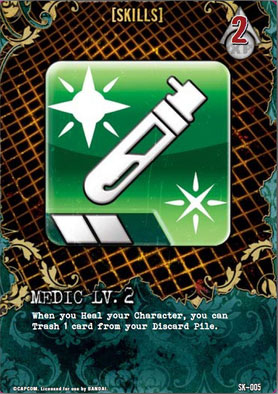
Medic_Lv1_Mercenaries Medic_Lv2_Mercenaries
Medic_Lv3_Mercenaries

As you see by the set of Medic skills displayed here, there are 3 levels of each Skill, with slightly different abilities for each level. Having all 3 of the same set doesn’t give you any bonuses–actually, you’ll do better to diversify which types of Skills you take–but being aware that there are various levels within each Skill type is helpful.

Generally, Level 3 is the best kind of skill for that particular type, but it usually takes a lot of XP to activate, so you’ll be waiting longer in-game to get that awesome effect. Sometimes taking a Level 1 or 2 Skill is just as good, depending on your Character’s needs and your personal playstyle.

Giant_Killing_Lv1_Mercenaries_SK-022 Giant_Killing_Lv2_Mercenaries_SK-023
Giant_Killing_Lv3_Mercenaries_SK-024

The Giant Killing set of skills, above, gives you more awesomeness while Exploring, just as the Medic set improves the effects of Healing. Check out more Skills, below, for previews of what they do as well!

A Small Sampling of Skill Cards

These certainly aren’t all the skills in the new Mercenaries set, but this gives you at least an idea of what’s out there. Skills provide many new ways to give your character an offensive boost, a defensive shield, and even ways to get the best hand or best play, turn after turn!

Reversal_Lv1_Mercenaries SmartReload_Lv2_Mercenaries

Big Change #3: Other New Updates

Anticipation_Mercenaries_AC-047 Move over, Shattered Memories, this is my new best Trashing friend. You wouldn’t believe how fast you can ramp up to the best Ammo just by using this little beauty. Trash two Ammo x10 cards from your hand, and not only do you get +10 Gold from each of them for Trashing them, but Anticipation then gives you +20 extra Gold for Trashing two cards of the same type! You end up with 40 extra Gold, which can buy you an Ammo x20 easily.
Custom_Bolt-Action_Rifle_Mercenaries_WE-047 One of the new XP-specific Weapons–remember that every time you Explore, you get XP. You don’t have to automatically move that XP to a Skill–you can keep it on your character to boost this Rifle if you wish!
Custom_Full-Bore_Machine_Gun_Mercenaries_WE-045 This Weapon gives you 1 additional XP for Exploring–great for building up XP fast to activate those Skills!
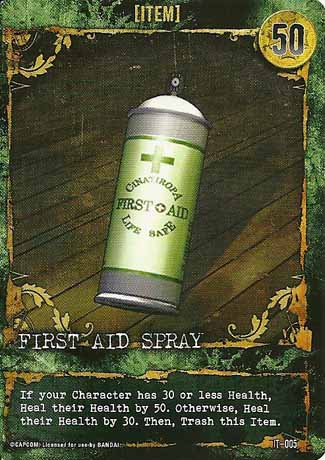
First_Aid_Spray_Mercenaries_IT-005 A First Aid Spray with variables! Works to either give a BIG heal or a little one, since some Skills and Characters are dependent on having less than Maximum Health to get the best effect.

For More Information/Credits

Most of these images were scanned in by hand by my awesome boyfriend who owns a copy of the game. Any other images have come from the following websites. (All images are used in this post for instructional purposes only.)
Resident Evil Deck Building Game: Official Site
Resident Evil DBG: Mercenaries @ BoardGameGeek.com
Resident Evil DBG @ Wikia

We Should Not Call Anyone “Too Dirty” for God

Acts 10:27-28
27 Talking with him, Peter went inside and found a large gathering of people. 28 He said to them: “You are well aware that it is against our law for a Jew to associate with a Gentile or visit him. But God has shown me that I should not call any man impure or unclean.”

In this passage, Peter is addressing the large group of people that have gathered at the house of a man named Cornelius, who is “God-fearing” yet not Jewish–in other words, a Gentile. In this time period, Gentiles and Jews just didn’t mix, for cultural and traditional reasons such as the one Peter mentions here. In fact, many Jews of the day considered Gentiles just as heathen as complete nonbelievers. So it was no wonder, when Cornelius sent for Peter to come, that people came to see what would happen–it was quite a spectacle indeed.

But Peter by this time is not a Jew any longer himself, but a Christian–a follower of Christ, who has died and risen again. And he’s experienced so much, not only walking with Jesus but preaching Jesus’ message; he knows now that Jesus is the Savior of all, not just the Jews. In short, he knows that the cultural and traditional divide between Jews and Gentiles is merely human law, and not God’s. Tradition dictates that Peter can only visit, help, and witness to certain folk; Jesus showed him that everyone could be visited, helped, and witnessed to.

This passage is a teaching moment for the whole crowd–no longer is religion just for a few privileged people, but for anyone who believes. This inclusiveness and accessibility by all was what set Christianity apart from Judaism and other established religions right from the start. Yet even today, the modern Christian church struggles with accepting quite all of the curious and the faithful. Certain people are deemed “not good enough to go to OUR church,” and so they are never witnessed to. Or, sometimes believers are discouraged from coming back to a church because they get the message “you’re not OUR kind of people.”

These are messages we must eradicate from our minds if we are to serve God purely. God made clear that as long as a person believes in Him and accepts Jesus’ sacrifice, they are saved; who then are we to judge them “unfit” to attend our churches, or “not good enough” to visit us or for us to visit them? We humans divide ourselves up like this all the time, often for reasons of “tradition,” but tradition doesn’t always come from God. Dividing humanity up along the lines of socioeconomic status, political parties, races and ethnicities, cultures, genders, etc. does nothing except to splinter the church apart, and keep us from witnessing to and prayerfully serving anyone whom God has put in our path.

So, this is our challenge as Christians, then: to aid and witness to anyone who needs God and needs our help, no matter if they are unwashed, no matter if they are poor or of a different race, no matter if we know their past legal history, etc. As Peter says here, “God has shown me that I should not call any man impure or unclean;” that goes for us, too.

The Car Sign: A Way to Communicate With the Drivers Behind You

Driving in high-stress, often touch-and-go traffic situations has always annoyed me, but not just for the more obvious reasons of gridlock and drivers behaving badly. I have long wanted a way to communicate with other drivers beyond a horn honk or hand gestures, both of which can be taken in wrong or aggressive ways. I often feel the need to explain what I’m doing, or to apologize for braking too soon, etc.

Thus, I have an idea: what if there were a way to put a small LED sign in the back window of cars, to flash up a few pre-programmed messages to warn the driver(s) behind us or around us?

To illustrate, I’ve created a few graphics to display a few helpful messages:

omg_oops
This would be a great multi-purpose message–short and to the point, covering anything from cutting someone off to braking or swerving suddenly.

i_am_lost
Lord, how I have NEEDED this sign in times past…more to warn the drivers behind me that I might make sudden turns or brake suddenly upon missing my turn. LOL!

let_car_in
Sometimes, drivers behind you might not be aware that another car is trying to change lanes or merge into traffic–this message would keep them from being so frustrated at the otherwise-unexplainable slowdown.

sorry_for_turning
Good for those “gotta-gun-it-to-get-on-the-road-right-now” moments…

please_stop_tailgating
To politely remind the driver behind you that you’re aware of his/her rudeness.

driver_ahead
Sometimes, it would really pay off to warn the drivers behind you that there’s a really erratic driver up ahead, no matter what the cause of such behavior.

please_turn_brights_off
Most important at night, when some folks seem to love keeping their brights on AND tailgating at the same time, utterly blinding you by way of your rearview mirrors. (If you do this to others, know that it’s not going to make them go any faster–it actually might make them slow down further because they can’t see!)

i_have_a_small_car
Because I literally do worry about being hit by large vehicles–drivers of said large vehicles don’t seem to notice us small-car drivers as much, and come pretty close to shaving my doors off more often than I like.

driving_slow
I’ve never understood why some drivers, even given the chance to go around on a multi-lane highway, tend to stay behind a slow driver, tailgating and flashing their lights. This sign would be a good way to politely tell such drivers to stop being highway pests.

do_not_worry
A little calming message for anxious or frustrated drivers. We could use a little positivity on the road!

Bonus: (Funny) Signs You Probably Shouldn’t Put on a Car Sign

However, while creating these graphics, I came up with a few messages that would probably not solve any problems (but would be pretty funny):

im_gonna_laugh
‘Cause it’s always funny to see that driver who was being annoying and bossing you around a few minutes before suddenly being pulled over by the law. Vicarious revenge.

tired_of_tailgating
A less polite version of my earlier tailgating warnings…

honk_at_me
For those drivers who like to use their horns a lot, especially when they are annoyed with you.

sideswipe
Know what I said earlier about small cars vs. SUVs? Yeah. This wouldn’t make the situation any better, but it’s what I usually say behind the wheel anyway. (I’m occasionally snarky in traffic, LOL)

traffic_jam
Sometimes, it might help to humanize the traffic situation with a little humor. But, then again, you might be mistaken as flirting with the driver behind you, too. Whoops!

drivers_like_you
Because if you observe the driving habits of some folk, it does make you worried… 😉