Education on TED, Strange Children’s Bookbag, Drawing vs. Photography, and DIY Chan Luu Bracelet

Education @ TED.com
Awesome educational video library right here.

The Harry Potter Sonic Obama Bookbag
This bookbag…seems a little confused as to what it’s marketing…xD

Amazingly Creative Drawing vs. Photography
Cool combos of photography and sketches. Wow!

DIY Chan Luu Bracelet Tutorial
Make an awesome wrap Chan Luu bracelet with this DIY tutorial!

Never Ask “What’s That M:TG Set Symbol?” Again!

Over the last few years, Magic: the Gathering has released many official sets–but those are not their only products. In fact, there have also been quite a few special collections, such as the Duel Decks, the From The Vault collections, and the Premium Deck series. Plus, there have been new formats introduced, such as Commander and Archenemy.

All of these mentioned products have their own set symbols, and that leads to quite a bit of confusion for both M:TG newbies and veterans. I’ve heard quite a few M:TG players trying to figure out these rarer symbols, and I’ve been a little bewildered by it all as well. Finally I decided to compile a reference article about it, to help us all learn these special symbols. (I’ve covered only the last three years in Magic, to cover as many “new cards” and “new sets” as possible in a short article.)

Special Collections for New Formats

Set Symbol Set Name Release Date
archenemy Archenemy June 2010
commander Commander June 2011
commandersarsenal Commander’s Arsenal November 2012

Duel Decks

Set Symbol Set Name Release Date
phyrexiavscoalition Phyrexia vs. The Coalition March 2010
elspethvstezzeret Elspeth vs. Tezzeret September 2010
knightsvsdragons Knights vs. Dragons April 2011
ajanivsnicolbolas Ajani vs. Nicol Bolas September 2011
venservskoth Venser vs. Koth March 2012
izzetvsgolgari Izzet vs. Golgari September 2012
sorinvstibalt Sorin vs. Tibalt March 2013
heroesvsmonsters Heroes vs. Monsters September 2013

Premium Deck Series

Set Symbol Set Name Release Date
fireandlightning Fire & Lightning November 2010
premiumdeck_graveborn Graveborn November 2011

From the Vault Collections

Set Symbol Set Name Release Date
ftv_relics From the Vault: Relics August 2010
ftv_legends From the Vault: Legends August 2011
ftv_realms From the Vault: Realms August 2012
ftv_twenty From the Vault: Twenty August 2013

Expansion Sets

Set Symbol Set Name Release Date
scarsofmirrodin Scars of Mirrodin October 2010
mirrodinbesieged Mirrodin Besieged February 2011
newphyrexia New Phyrexia May 2011
innistrad Innistrad September 2011
darkascension Dark Ascension February 2012
avacynrestored Avacyn Restored May 2012
returntoravnica Return to Ravnica October 2012
gatecrash Gatecrash February 2013
dragonsmaze Dragon’s Maze May 2013

(All the preceding symbols were retrieved from the MTG Salvation Wiki, an excellent resource for set symbols and tons more M:TG information.)

Like Paul, Pray for Those You Witness To

Acts 26:24-29
24 At this point Festus interrupted Paul’s defense. “You are out of your mind, Paul!” he shouted. “Your great learning is driving you insane.”

25 “I am not insane, most excellent Festus,” Paul replied. “What I am saying is true and reasonable. 26 The king is familiar with these things, and I can speak freely to him. I am convinced that none of this has escaped his notice, because it ws not done in a corner. 27 King Agrippa, do you believe the prophets? I know you do.”

28 Then Agrippa said to Paul, “Do you think that in such a short time you can persuade me to be a Christian?”

29 Paul replied, “Short time or long–I pray God that not only you but all who are listening to me today may become what I am, except for these chains.”

After Paul has given quite a testimony of what happened to him to change his faith, Festus, the governor, interrupts him; he believes that Paul’s long hours of study on the Scriptures has led him into a manic state. But Paul counters with calm reasoning–everything Paul has said so far can be vetted and researched for its truth, and indeed King Agrippa would know most if not all of the details anyway.

Then Paul asks the king directly (and bravely), “Do you believe the prophets? I know you do.” (Most Jews of the day believed that the Old Testament prophets spoke true when they claimed a coming Messiah–they just didn’t think that Messiah was Jesus.) Now, if Agrippa answers either “Yes” or “No,” he would either be forced to admit Paul was right, or to risk angering the devout Jews of his court by saying he didn’t believe in the prophets. Agrippa chooses to evade the question, answering with some dubiousness, “Do you think that in such a short time you can persuade me to be a Christian?”

Paul’s answer is an example to all Christians–he prays for those listening to receive the kind of blessing that he has experienced through Christ.

When we witness to others, it is not about showing that we’re the best Christians ever, or acting like we’re better than everyone else. It’s about sincerely wanting others to experience the fulfillment and spiritual peace of knowing Jesus. Paul’s life had been changed for the better after he met Jesus on the road to Damascus, and he wanted others’ lives to be changed this wonderfully as well.

As Christians, let’s resolve not only to witness to others about Jesus, but to pray for them to receive the peace we enjoy, too. After all, someone else prayerfully shared the gospel with us once, otherwise we would not be Christians ourselves.

Transform Unwanted Shampoo/Shower Gel into Foamy Hand Soap!

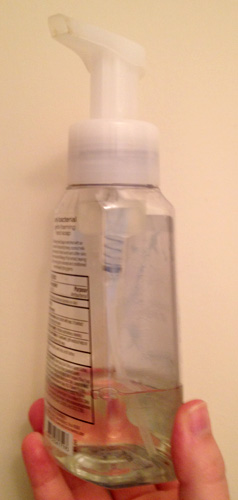
foamysoap Recently, as I purged my bathroom of all sorts of old shower gels and shampoos, I realized I had quite a little collection of almost-but-not-quite-used-up bath products. Most of them were a bit old to continue using for their original purpose, but, being the borderline hoarder that I am, I didn’t like to see wads of money going in the trash can if I could repurpose the leftover products for any other household use.

I was quite at a loss, till I discovered that there was a way to make your own foaming soap using some of these unwanted products. Yes, you read that right–your own foamy soap, without having to go out and buy it! With this process, I’ve been able to both use up leftover products AND save money on hand soap…a definite win-win!

The Process

(There are many blog articles about this out there on the Internet, but the tutorial I followed was this one over at KingdomFirstMom.com. I have added my own tips and advice to this, gained through trial and error.)

  1. First, only use shower gels/shampoos that are see-through for this project. If it’s not a see-through product, it will not foam well at all, AND will gunk up your foamy soap dispenser to boot. (Learn from my fail.)
  2. Make sure your foamy soap dispenser is rinsed out completely.
  3. Measure out 1-2 tablespoons of your chosen product and pour it into your dispenser bottle.
  4. Run a very thin stream of warm water into the dispenser bottle until the bottle is filled up almost all the way to the top, leaving room for the foamy dispenser top to fit in.
  5. Screw the top of the bottle on firmly, and then begin to turn the bottle over and over in your hands slowly to combine the soap and water. (This is important–if you shake the bottle too hard, all the foam will be “stuck” in the bottle and won’t come out the top. Learn from my fail.)
    • I find that turning the bottle over to the rhythm of “thousand-1, thousand-2, thousand-1, thousand-2” works well.
    • Turning the bottle end-over-end ensures that the product distributes throughout all the water in the bottle.
  6. After a few minutes of this slow-churned process, try out your foamy soap by pumping the top a couple of times. (If it doesn’t foam right at first, try a few more pumps, or shake the bottle up a teensy bit faster–some shampoos and shower gels distribute at different rates in water.)
  7. YAY! You have your own foamy soap, made from a repurposed product!

One Final Note: Obtaining a “Foamy Soap” Bottle

The real trick to making anything into “foamy soap” is the bottle, or more accurately, the top of the bottle, which adds air into the soap/water mix as you pump it out of the bottle. There are some fillable foaming soap pumps out there, but most of them have really bad reviews, either for being leaky or for the foamy dispenser part clogging up really easily.

At our house, we had several empty Bath & Body Works foaming soap bottles and pumps lying around; I just rinsed one out and repurposed it for my “homemade” foamy soap. This has worked out really well! So, if you can’t find a foamy soap pump you like, you may want to ask friends if they have any empty storebought soap pumps they’d be willing to let go. One less item of clutter/trash for them, one very cheap way to stretch soap for you!

Webcomics for Webdesigners

Sometimes, we webdesigners need a little humor–but not just any good ol’ laugh will do. Sometimes, we need to hear and see someone tell our stories…to perfectly detail how freelance webdesigners struggle, how irritating it can be to debug a layout, how software updates throw monkey wrenches into your carefully-coded website at random.

The Internet knows our need and has responded! Here is a selection of webcomics about webdesign (and the techie life in general)–for each comic you read, you’ll laugh because it’s true, and you’ll laugh because you’ve been there.

kopozky
Kopozky – A subtle and witty comic, with lots of design and development references only we will get.

pcweenies
PCWeenies.com – Our complete lives as designers, developers, and “tech people,” told with wit and color.

firstworldproblems
The Brads – Tales from a fictional webdesign workplace, Dilbert-esque and hilarious. (This comic creator also did a series of comics for .Net magazine as well 🙂 )

okcancel
OK-Cancel – For techies of all sorts, including webdesigners and developers.

theoatmeal
TheOatmeal.com’s Tech Archive – A small but mighty cache of techie comics, delivered with TheOatmeal’s generous dollops of penetrating observations and hilarious phrasing. (Warning, language)

freelancefreedom
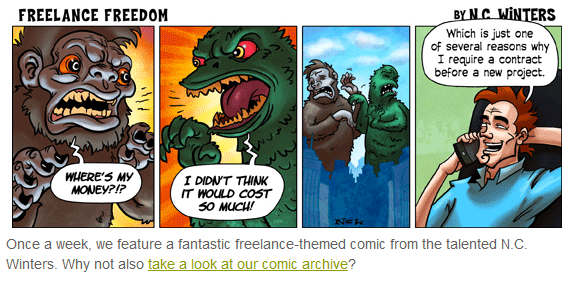
Freelance Freedom – For those of us who are freelancers (which is most of us web designers and developers these days), this comic is us. Period.

1stwebdesigner
1stWebDesigner’s Life Webcomic – Interesting concept–a comic as much made by the readers as its creator. Lots of reader input went into each webdesign strip!

bugbash
BugBash.net – A tech-based comic for all of us who’ve battled the digital bugs in our programs and websites.

thesystem
The System: Web Design Archives – Within this larger comic, these little humor gems about web design appear.

“Synonym Syndrome”

As I’ve written about before, choosing exactly the right descriptive word when you’re writing is important–words carry not only a direct meaning, but an implied meaning as well, called a connotation.

I noticed this afresh during an impromptu “writers’ club” meeting with my guy friend; we had switched computers to read each other’s stories so far, and I saw that while he had scattered descriptive words all throughout his story, some of them didn’t quite seem to fit the tone of what he meant. Instead of saying “said” a million times, for instance, he had put in apparent synonyms for the word “said”, like “noted,” “stated,” etc. Yet these words didn’t have the right “shade” of meaning in the context of what the characters were saying, etc.

I’ve run into this same problem many times in my own writing–I call it “synonym syndrome,” when you’re trying desperately not to use the same word over and over. The problem comes in when the synonyms you’re trying to use don’t quite match your meaning; they can cause a little confusion in the reader as they try to picture the scene you’ve written.

Examples of Synonym Syndrome

“I can’t believe this is happening to me!” Sandy noted.
“Psst, look over there,” Nathan stated.
“This is my original opinion,” he cited.
“WILL YOU JUST LISTEN TO ME?!” she murmured.

All of these speaking words in these examples do have the basic meaning of speech, but the more subtle shades of meaning in each one render our mental picture of the described action a little differently. It’s hard for readers to imagine a character murmuring in all caps, for instance. When you overuse synonyms like this, which is very tempting to do, it’s almost like your writing becomes a thesaurus in and of itself–it reads in a more stilted fashion rather than flowing naturally.

Some Ideas to Fix Synonym Syndrome

  • First of all, don’t be afraid to use the same word a few times in as many pages. If the right word to describe a character’s speech is “said,” then use “said,” and don’t worry about it. It will read much smoother.
  • As you look at a synonym list, mentally picture the action you’re trying to describe, as if you’re watching a movie form of it. How are the “actors” in your mental scene acting or speaking? Which of the words you’re looking at describes that action the best?
  • If you can’t find exactly the right synonym for an action verb, remember that you can add an adverb, which will spike the verb with a little more descriptive meaning. Just be sure to use adverbs sparingly–they’re like garlic, good in small quantities but easily overwhelming if you put in too much.

    Examples (adverbs in italics):

    • “She sighed tiredly
    • Swiftly, he answered”
    • “The box slid slowly down the slope”
    • “Sinking down into a chair dramatically, she closed her eyes”

Additional Food for Thought: Taking Apart Synonyms’ Meanings

Really take time to dissect the words you want to use. Do they really mean what you want them to mean? This can help you determine whether your word choice is natural or whether it’s got a little synonym syndrome. As examples, let’s look at the words “said” and “moved.”

Synonyms for “Said”

  • remarked – implies that the sentence spoken is either a retort/comeback or a pointed/smart reply.
  • noted – implies a quiet addition to someone else’s comment
  • cited – implies a quotation by the speaker rather than an original thought
  • answered/replied – requires another character to have spoken before to make sense
  • stated – implies a strident or resolute tone of speech, unmovable by others’ opinions
  • muttered – implies a resentful tone
  • murmured – implies a very quiet tone, either of a shy comment or a loving one
  • whispered – implies a quiet tone, but more of passing information secretly between characters

Synonyms for “Moved”

  • stomped – implies anger/frustration
  • tiptoed – implies timidity or caution, possibly stealth
  • glided – implies graceful movement–can be snakelike (negative/evil) or swanlike (positive/good)
  • skipped – implies carefree, blissful state of mood
  • sneaked – implies stealth, usually for an underhanded purpose
  • strode – implies confidence, possibly arrogance or anger
  • moseyed – implies an unhurried, almost lazy pace
  • strolled – a casual walk
  • sauntered – a casual walk with a slight shade of conceitedness/overconfidence; often used when a female character is approaching a male character she’s interested in

That’s Not Hieroglyphics, It’s Hero Clix Code

If you’ve bought any of the most recent HeroClix sets, you might have noticed some very strange-looking new symbols printed on their character cards, like the following:

improved_targeting improved_movement destroysblocking characterbase

They have also begun to appear in rules text like the following:
sharpshooter_example
swim_example

These and several other symbols like them now stand for certain rules within HeroClix, which the 2012 Powers and Abilities card goes into in detail. The symbols just make it a lot simpler to print these rules on character cards. Today’s blog post will make you an expert at decoding this newest Hero Clix code!

What These Rules Are All About

Collectively, these rules are known as the “Improved Movement and Targeting” rules. Movement is symbolized by the improved_movement running man, and targeting is symbolized by the improved_targeting bullseye. These two symbols are the first ones you should look for on a character’s card, to determine which kind of character action (moving or shooting) is affected.

Take the Swim example from above:
swim_example
In this example, we can see that the Swim ability affects movement, because it’s got the little running man symbol in its rules text.

sharpshooter_example
By contrast, we can see that the Sharpshooter ability affects targeting, because it’s got the little bullseye symbol in its rules text.

The Other Associated Symbols

Now that you know the two main symbols, you can see how the additional symbols tell you more about how each special power and ability works.

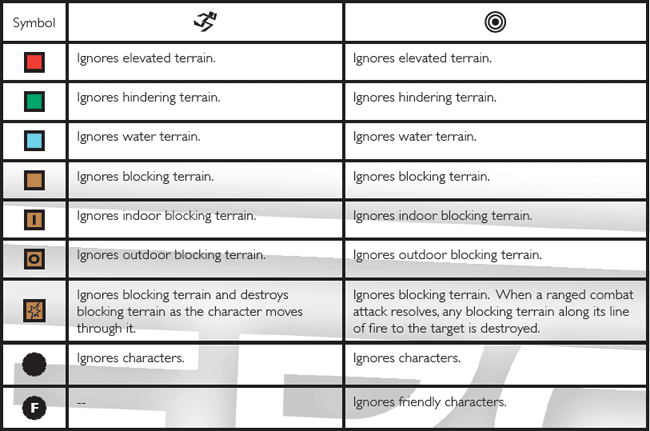
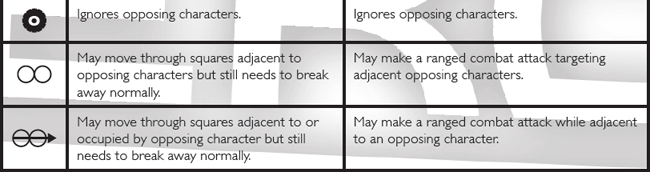
Here’s the whole chart of Improved symbols and their meanings, taken from a screenshot of the powers and abilities card PDF file:

improvedchart_1
improvedchart_2

The difference between the two columns is that the Improved Movement column (left) shows what things the affected character ignores for movement purposes, while the Improved Targeting column (right) shows what things the affected character ignores for attack purposes.

For instance, someone with the bullseye symbol followed by a green square means that they ignore Hindering Terrain for attack purposes (like Superman ignores Hindering Terrain for attack–watch out, Batman!). However, a running man symbol followed by a green square means that the character ignores Hindering for movement purposes. (Anybody with Leap/Climb on their dial has this ability!)

There are some additional symbols here–the roundish, Hero-Clix-dial-shaped symbol means that character bases can be ignored for either line-of-fire or movement purposes, for instance (depending on whether the running man or bullseye symbol precedes it). Though these new symbols look a little daunting, this chart generally makes easy work of understanding and referencing them.

Test Your Decoding Skills!

Let’s check out a few examples of rules text where these symbols are used! (Answers at the end of this article)

flight_example

  1. Which kind of ability is Flight: an Improved Movement or Improved Targeting ability?
  2. Which types of terrain does it ignore?
  3. Can Flying characters move through squares occupied by opposing characters?
  4. Can Flying characters break away automatically?

pulsewave_example

  1. Which kind of ability is Pulse Wave: an Improved Movement or Improved Targeting ability?
  2. Which types of terrain does it ignore?
  3. Do character bases block Pulse Wave’s line of fire?
  4. Can a character using Pulse Wave move through opposing characters’ spaces?

sharpshooter_example

  1. Can Sharpshooter ignore character bases for line-of-fire purposes? If so, which kind of character bases?
  2. If an opposing character is adjacent to a Sharpshooter character, can the Sharpshooter still make a “ranged” attack against that character, according to these symbols?

greatsize_example

  1. Which kind of ability is Great Size: an Improved Movement or Improved Targeting ability?
  2. Which types of terrain does it ignore?
  3. Can Great Size characters move through squares occupied by opposing characters?
  4. Can they break away automatically?

swim_example

  1. Which types of terrain does the Swim ability ignore?

And now for the last question–a little tricky!

leapclimbphasing_example

  1. What is the main difference between Leap/Climb and Phasing’s rules symbols? (Look closely, now!)

Practice with These Symbols Makes Perfect!

How’d you do on the little quiz above? It may take a little time and frequent referencing back to the Powers and Abilities Card to master these symbols, but you’ll get ’em down pat soon enough! In the meantime, HeroClix.com has provided us materials so that we never forget the rules too easily.

To download a copy of the 2012 Powers and Abilities card for yourself, visit HeroClix.com’s Rules Downloads page.

Answer Key

Flight:

  1. Improved Movement
  2. Ignores Elevated, Hindering, and Outdoor Blocking
  3. Yes, they can move through opposing characters’ squares
  4. No, they cannot break away automatically

Pulse Wave:

  1. Improved Targeting
  2. Ignores Hindering
  3. No, character bases do not block line of fire for Pulse Wave attacks
  4. Yes, Pulse Waving characters can move through opposing characters’ squares

Sharpshooter:

  1. Yes; they ignore opposing character bases only
  2. Yes, they can make a ranged attack against adjacent characters

Great Size:

  1. Improved Movement
  2. Ignores Elevated, Hindering, and Outdoor Blocking
  3. Yes, they can move through opposing characters’ squares
  4. No, they cannot break away automatically

Swim:

  1. Ignores Water Terrain

Leap/Climb and Phasing:

  1. The only difference is that Leap/Climb only ignores Outdoor Blocking Terrain, while Phasing ignores ALL Blocking Terrain.

Our Modern Idols Aren’t Powerful–God Is

Isaiah 48:3-5
3 I foretold the former things long ago, my mouth announced them and I made them known; then suddenly I acted, and they came to pass. 4 For I knew how stubborn you were; your neck muscles were iron, your forehead was bronze. 5 Therefore I told you these things long ago; before they happened I announced them to you so that you could not say, ‘My images brought them about; my wooden image and metal god ordained them.’

Here, God is rebuking ‘stubborn Israel,’ His people who have gone off and worshipped regional Canaanite deities of metal and wood rather than following God. All the things the prophets spoke of so far have come to pass; Israel as a nation is struggling, yet still they cling to tangible idols, sacrificing to them in a vain effort to change their circumstances, rather than turning back to God and trusting Him.

It’s very easy (and tempting) to laugh at the ancient Israelites for doing this. They knew the right things to do, so why didn’t they just do them? Very easy, indeed, to say these things, until we realize we are doing the same things in the present day. Our idols may not look the same as the Canaanite deities, but we still worship the gods of money, technology, and power, and we often trust in those powers far more than we trust in God. There’s a belief, subtle and insidious, that tells us if we just have enough money/technology/power, we will outrun our problems and trials–and we like to believe in that rather than trusting a God we cannot even see.

The Israelites were doing the same thing, trusting in things they could see, touch, and even create rather than really trusting the God who had brought them out of Egyptian slavery and through the wilderness. And then they wondered why their deities had “abandoned” them! God, through the prophet Isaiah, is proving that He is the only One they can trust, and the only One who has power to help them–if they can just trust in that, and stop running off after the tangible things that are powerless to change anything. We need that reminder, too.

Why I don’t worry about my eyebrows

Amid all the beauty articles you’ll see me post every now and again, there’s one topic you’ll never see me cover: eyebrows. You know why? Because I, unlike so many girls and young women my age, have never and will never pluck my eyebrows to shape them. It’s just a part of the typical female beauty routine that I have never adopted.

In thinking about this issue, I realized there was a little more to it than just not liking to pluck eyebrow hairs out. It has more to do with my philosophy of beauty, which is vastly different from the beauty industry’s philosophy of beauty (not to mention society at large). Read on, to find out how a simple pair of eyebrows could make such an elegant point.

How My Brows Actually Look

As evidence of my unplucked eyebrows, I have a few pictures of myself, with no makeup and no retouching:

eyebrow_closeup
Barring the fact that you can tell I haven’t slept right in several years days (LOL), my eyebrows are thick and nearly-black, going almost straight across rather than having the thin, graceful arched shape so coveted in the beauty industry over the last several decades.

Every eyebrow article I read subtly tells me that I, too, should want those perfectly groomed and plucked brows for my own face. It’s almost like your face isn’t “feminine” enough without plucking these hairs out of your face every week, or having them waxed off every few months. But I just haven’t done so. Being as squeamish about pain as I am, it seems ludicrous to inflict such pinching pain on myself for a goal that I’m not even interested in.

Now, why would I not be interested in such a beauty goal? Because when my eyebrows are taken in context with the rest of my face, as seen below without glasses and with glasses…

withoutglasses_small withglasses_small

…they actually look pretty normal, fairly well-scaled to the rest of my facial features. True, they’re thick and straight, and some kids I went to school with used to pick on me for having “guybrows,” but they do what God intended them to–namely, to keep sweat out of my eyes (which is very handy during Zumba).

The Eyebrow Epiphany

I used to think about “getting my brows done” (as it’s usually called), but I don’t anymore. And I think this whole eyebrows thing has led me to an epiphany about beauty:

Beauty is not for other people, but for the self.

If you think about it, it’s true. Each of us are the only ones who know what that makeup product feels like on our faces, what those false lashes feel like when they’re glued to our eyelids, how much those eyebrow hair roots can hurt when they’re plucked out with tweezers. Isn’t it, then, up to us which products we use and which beauty routines we do, rather than depending on someone else to tell us “what we SHOULD be using” and “what we SHOULD be doing?”

And yet, the beauty industry–and modern society as well–does not think that way. In most people’s eyes, beauty products and routines are used to visually impact other people, not to make ourselves happier…in effect, saying that our outward beauty is solely for the visual consumption of others.

I don’t buy into that line of thinking anymore; I’ve had my turn trying to “fit in with the crowd,” beauty-wise, and I just don’t. I would rather spend my time using products and doing routines that make ME feel good about ME. Thus, why I’ve never touched my eyebrows with a tweezer, but instead use hand softeners, scrubs, and lotions to make my hands feel baby-soft after a good workout.

People might even judge me through this blog post, thinking “Why would you ever let yourself look that ugly?” or “You ought to shape your brows, you’d look so much better,” but neither opinion really matters. After all, they’re my brows on my face–if some folks don’t like them, that’s perfectly okay, because my brows are not on their faces and they don’t have to live with them. My beauty routine is for me and me alone, and I think more girls and women have a right to think that way as well.

I’m not saying that we all throw down our tweezers and stomp ’em–if you love to keep your brows groomed and plucked because it makes you feel better, then that’s awesome; keep doing it. But if you’re clinging to old beauty routines and products just because some expert said you ought to or because your friends all do it, then maybe it’s time to reevaluate your beauty thinking and start doing only the things that make you the happiest about your appearance. After all, it’s your appearance–if others don’t like it, they ain’t got to live with it!