Let’s Be ONE Family of God

Ephesians 4:1-3
1 As a prisoner for the Lord, then, I urge you to live a life worthy of the calling you have received. 2 Be completely humble and gentle; be patient, bearing with one another in love. 3 Make every effort to keep the unity of the Spirit through the bond of peace.

Though he’s addressing the ancient Ephesians, the apostle Paul could be writing to any modern Christian church. He urges us–not just suggests to us–that we as Christians should live a life that praises God, that is worthy of the sacrifice Jesus made for us. Part of living that God-honoring life is to be “completely humble,” “gentle,” “patient,” and unified in spirit when we Christians deal with each other on a day-to-day or week-to-week basis. We should “bear with one another in love.”

But how often do we see this “Christian love for each other” cast aside in the church when a petty disagreement erupts into a full-on social feud? How often do we see gossip flow around the church faster than encouraging words? And how often in the church do we see impatience, pride, and verbal brutality passing itself off as “honesty,” instead of humility, gentleness, and patience?

The answer: far too often, far more often than any of us would care to admit. We might be Christians, but we still sin, and social sins which occur within the church are sometimes the hardest to expunge because we want to pretend they don’t exist. The Ephesians were having difficulty with this concept, too–this is not a new problem. That’s why Paul wrote to them, to encourage them to relate to each other as Jesus related to us, to see each other as God sees us.

What does this entail? This means forgiving someone who took “our” parking space at church last Sunday, or speaking an encouraging word to that person who never seems to have a good word for anyone. This means accepting a fellow member’s admission of guilt when they have done something wrong, and not holding their past sins over their heads as if we have the power to judge and forgive.

This seems like such a simple concept, but it is VERY hard to enact in real life–thus, why Paul has to repeat it a lot in his letters. We must make an effort, every time we are in church, to see the other people around us as children of God, spiritual works in progress, and to treat them accordingly. That’s how we become ONE family of God, not “a bunch of different social cliques who all happened to show up at the same building on Sunday morning.”

The Pollenmobile: Spring’s Practical Joke on Us

You can tell it’s spring here in the South when my normally-blue car gets a nice yellow-green coating on it. (Living in the midst of trees and blooming flowers as we do, it’s par for the course.)

It usually does no good to rinse your car off in these blooming spring days, either–a few hours to a day later, the yellow sheen is back. I have even taken to calling my car the “Pollenmobile” recently, since the bees seem to like my car even more than the flowers. (Case in point: at a long stoplight in town the other day, a few wasps and bees visited my side mirrors and the hood of my car…they had a grand old time crawling around in the yellow dust.)

But as yellow-green as my car has looked recently, it doesn’t even hold a candle to these lovely depictions I’ve found all over the Internet. Take a look at some of these pollenmobiles, and feel better about your own car this spring!

pollen_consumerreportsorg
ConsumerReports.com

pollen_detailedimagecom
DetailedImage.com

pollen_ipswichstarcouk
IpswichStar.co.uk

pollen_yarnsetc
Yarns, Etc.

pollen_2environmentalgraffiticom
Environmental Graffiti

pollen_environmentalgraffiticom
Environmental Graffiti

pollen_mentalflosscom
MentalFloss.com

Grammar Matters Online (Really)

Though it may not seem like grammar still matters online, considering how some websites are written, it most certainly does.

I say this not just as a former English teacher, but as someone who communicates with words. We who create content for the Internet are creating websites to communicate our ideas; if our grammar is incomprehensible, our ideas will not be understood. (For instance: how would some ill-constructed English content translate into another language if a user needed it translated? It probably wouldn’t translate well at all.)

Thus, we webdesigners and developers must be concerned, at least partially, about our grammar, especially if we are running an informational website. Above all, we want our users to understand our content!

Recognizing Bad Grammar: A Quick Little Quiz

They is gonna go, down their soon.

There are four grammatical problems with this sentence. Can you find them all? Not only is this a common spoken sentence, but this contains some of the most common Internet grammar slip-ups, too. (Answers at the bottom of this article!)

The Difference Good Grammar Makes

Read the following two samples. Which one seems more professional, more trustworthy, and worth following up?

Example #1

Hey what up Im an web master and I could do your web site. Cause I can program and style it too. I been trained 3 year. Me and my brother been working on web sites together 4 a long time we like it. If you want me 2 design your site just msg me and well work something out.

Example #2

If you’re looking for a webmaster, I would be glad to offer my services. I can do both development and design, and have 3 years’ experience working both with a design team and on my own. Please send me a message if you are interested.

Analysis

While there is something to be said for #1’s easygoing style, #2 takes the cake in terms of professionalism, trustworthiness, and clarity. To understand #1, you need a basic working knowledge of textspeak/chatspeak; additionally, the sentences run on a bit long, yet they don’t really add anything to the “sales pitch,” so to speak. #2 makes its points clearly and quickly, and with more polish.

The only difference between #1 and #2? Grammar. Sentence construction, punctuation, even some basic elements of writing style–all fall under the broad heading of “grammar.” Simply put, grammar can make or break your website’s readability and enjoyability, not to mention its use as a reference.

If you had to choose between these two webdesigners for a project, which one would you trust more to do a better job? Most clients would go with the second designer, simply because the person sounds more capable and professional. We have to remember that our websites will be judged for their professionalism and trustworthiness in the same way.

How to Achieve Good Grammar

  • Read your content aloud. Just like with checking your spelling, reading what you have written out loud will help you catch most of your grammatical errors, because your sentence won’t “sound right.”
  • Consult Internet references–I have a selected list picked out below.
  • If you’re still unsure of your grammar, have someone who is good with grammar and writing read over your content before you post it to your website. Better safe than sorry!

Online Grammar References

GrammarBytes
The Elements of Style
GrammarBook.com
Guide to Grammar and Writing

Final Notes: Answer Key

  1. “They is” is incorrect. It should be “They are,” unless you are purposefully writing in Southern dialect.
  2. “Gonna” is not technically a word–only in casual speech. “Going to” is the proper form.
  3. The comma between “go” and “down” is unnecessary.
  4. “Their” is a word that is spelled right but not used correctly. The right word to use in this sentence is “there,” which references a place, rather than “their,” which references possession of something.

Making Your Own iPhone Backgrounds

No longer do you have to download pictures from other websites for your iPhone backgrounds, nor do you have to rely on pictures you’ve taken with your iPhone. If you’ve made an image you want to move to your iPhone, you can!

Please pardon my enthusiasm–after a few months of owning my iPhone, I finally figured out how to load self-made pictures onto my iPhone, and I’m very happy about it, as you can tell. 😀 If you’re like me and enjoy playing around in image creation programs, your iPhone provides you yet another outlet for your creative expression; it just takes a little time!

Some Visual Examples!

Here are a few (shrunken) examples of iPhone background images I either made myself or edited:

neptune
glassheart
colorful_lake

sagegray starry

The first three images are edited from images I downloaded from the Internet; credits are at the bottom of this article. The last two are simpler abstract images I made myself.

Here are some tips and tricks I came up with while I was making, editing, and transferring these images:

Image Styles Technical Stuff
  • For home screens, it’s generally best to have more abstract/simpler backgrounds, since most of your picture will be covered up by app icons.
  • For lock screens, anything goes–recognizable images or photos work great, since you’ll be able to see more of the picture.
  • Want to be able to read the app icons’ text? Then make sure your background image is darker so the white text stands out.
  • Images can be in JPEG, GIF, or PNG format.
  • Because you can move and scale the image once you load it onto your iPhone, the picture’s width and length doesn’t much matter–but pictures which are taller than they are wide usually work the best.
  • Keep your file sizes as small as possible without skimping on quality, so that your iPhone’s memory isn’t stuffed full of just background pictures. Photos saved as JPEGs usually have smaller file sizes; so do fairly simple abstract images saved as PNGs.

Putting These Works of Art on Your iPhone

WonderShare.com has an excellent, simple tutorial to help you through transferring your images to your iPhone. If you don’t want to sync all your photos/images to your iPhone, simply make a separate folder for your created/edited iPhone backgrounds, and just sync that folder to your iPhone.

Credits/Resources

There are lots of image resources on the Internet which can provide you with beautiful pictures to use as iPhone backgrounds (and lots more). Here are some of my favorites:

FreeFoto.com
FreeImages.co.uk
Vector4Free.com

Swans on a Colorful Lake Photo

Sleepy Silence, (Funny) Ways to Be Cool, Dutch National Ballet, and Free Online Classes

Sleepy Blissfully Happy Silence
Physical closeness doesn’t have to mean sex…

Ways to Be Cool
One kid’s “to-do” list to make him cool. “Learn to speak European” made me LOL.

Dutch National Ballet: Photos
Beautiful, amazing pictures of ballet dancers in action.

10 Awesome Online Classes You Can Take for Free
Learn more for free without using Wikipedia–take these online classes!

3 Ways to Be A Fun Opponent

All of us gamers, whether we’re casual gamers or tournament players, have probably met the “un-fun” opponent. This is the guy or girl who can’t seem to lighten up and just play the game, who either loses and rage-flips the table, or wins and rubs it in everyone’s face for the next few hours. The un-fun opponent can also manifest as a player who overthinks every move for fear of losing the game, or who quits a game when the mere shadow of defeat falls across the table.

None of these all-too-common gamer attitudes make a game fun to play for the other person. I should know; I’m one of those who quits before I lose, and overthinks far too often, and so I see how my negative reactions suck the life out of a game for my opponents. So, today, I thought I’d challenge myself and all of us gamers to try being a little more fun–not necessarily playing more casually, but making all gaming more entertaining and less draining.

#3: Dare to Smile a Little More

A simple smile at your opponent can work wonders for a gaming atmosphere. When you’re both (or all) super-focused on the game, smiles can fall by the wayside, easily forgotten in the heat of tabletop battle. But if you take the time to smile at your opponent, you’re reminding him or her that you’re human, and that this is a game rather than a life-or-death situation.

This little jolt of positive emotion in the middle of a tense game can lighten the mood and help everyone have a better time. You don’t have to tell a ton of jokes or make silly faces, nor do you have to lose all concentration on the game for a moment…just smile. You wouldn’t believe what a positive effect that can have on another player.

#2: Dare to Try New Strategies

If you’ve got an amazing, butt-whooping deck or team of figures which you love to play in tournaments and casual games alike, that’s wonderful. But don’t limit yourself to playing only “the stuff that wins.” The best gamers are not the ones who have flawless win/loss records, but the ones who try out all types of strategies to discover new ways to win, new combos that work, and new modes of self-expression.

When you attempt new strategies, you flex your gaming creativity muscle, which makes any game more interesting. No longer do you have to rely on the Internet to tell you which hot new strategy is winning everything this month (AHEM, lookin’ at you, Friday Night Magic tourneys). Instead, your strategy comes from within you, and can be tweaked in any way you personally wish. It gives you a certain amount of freedom, even within a tournament format!

#1: Dare to Lose

“WHAT?!” you’re probably thinking. But just as in life, losing in gaming can teach us quite a bit more about our strategies, if we don’t allow ourselves to stew in anger and misery first.

This might be hard for some of us gamers to grasp (it’s hard for me!), but winning all the time doesn’t make us the best human beings on earth, nor does losing all the time mean that we are wastes of space. When we win so often that it seems like a foregone conclusion, it can suck the interest out of the game, both for us and our would-be opponents. No one wants to play us in a “quick game” because both parties know how it will end; the game is no longer fun for us because there is no challenge in it anymore.

That’s why I suggest being willing to lose a little more often. This does not mean “throwing the game,” but perhaps using your old favorite strategy pieces in new ways. Maybe avoid using that old reliable combo of figures that wins the game every time, and instead rely on some of your backup figures, to see how well they perform. Maybe change out a card or two in that well-oiled deck you lovingly use in tournaments, and see what results. If you lose, so what? There’s always another game. (Plus, when you play against newbies, it’s important not to thrash them in their first game–who would ever want to get soundly defeated by an expert when you’re still learning the game?)

Bottom Line: Be Human, not a Winning Machine

All three of these suggestions boil down to allowing humanity to creep back into our gaming. We likely game among friends, so why not treat them like friends instead of opponents? We likely started playing these games because they were fun, so why let gamer-rage and overthinking take the place of fun?

I’m stepping all over my own toes with this post, because I’m still working on becoming a more fun opponent. But I think if we all really worked on behaving more humanly toward each other, we could end up having a lot more fun even at “serious gaming” tournaments. Isn’t that a worthy goal?

God Makes No Empty Disciplinary Threats

Joshua 6:26
26 At that time Joshua pronounced this solemn oath: “Cursed before the Lord is the man who undertakes to rebuild this city, Jericho: At the cost of his firstborn son will he lay its foundations; at the cost of his youngest will he set up its gates.”

1 Kings 16:34
34 In Ahab’s time, Hiel of Bethel rebuilt Jericho. He laid its foundations at the cost of his firstborn son Abiram, and he set up its gates at the cost of his youngest son Segub, in accordance with the word of the Lord spoken by Joshua son of Nun.

Joshua had destroyed Jericho according to the will of God, as a symbol of what happens to people who practice unrepentant wickedness–it was one of the first sites in Canaan that was cleansed of sin in this way. Afterwards, he pronounces this curse on anybody who would try to rebuild Jericho as the great walled city it had once been, so as to keep the site dedicated to God.

But, inevitably, after a time, the Israelites forgot this as they forgot God, and in 1 Kings we see Hiel of Bethel rebuilding Jericho’s walls, paying for the sin of rebuilding a wicked city just as Joshua had decreed. (This all happened within the reign of King Ahab, who did nearly as much wickedness as the citizens of Jericho had.)

This is not a particularly comforting pair of Scriptures to read, but it makes an important point: God is Almighty, and has power even over the most powerful of men. When we act against Him, we will face consequences, stemming from divine discipline. Hiel’s sons die not because God worked an act of vengeance or evil, but because God disciplined Hiel for grasping at power. (Note: Joshua’s curse is not merely something spoken by man, but something coming from God, since Joshua led the “cleansing force” of the Israelites through Canaan to reclaim the land for God.)

So, when we purposefully do things that are against God, we should not then wonder why distressing things begin to happen in our own lives. This is not God being evil, because that is impossible; it is God disciplining us for going against Him, much as a parent disciplines a child for breaking rules. Sometimes God has to do fairly drastic things to get our attention, because we’re so bent on having our own way, but it is ultimately for our betterment, and for our realignment with God.

Don’t Feed the (Internet) Trolls

When I say the word “troll,” you might think of the children’s stories where a troll hides under a bridge, just waiting to surprise and take advantage of innocent passersby. In reality, “trolls” on the Internet are much subtler and more insidious than this.

What Is An Internet Troll?

The definition of an Internet troll is a person who posts inflammatory comments on articles and websites just to start fights or disagreements, not to express a valid opinion. Trolls often take advantage of an already-heated discussion, or pester people who strongly believe in their opinions. Basically, they want to feel important–this is why they do what they do.

What Doesn’t Work: Asking Them to Stop Posting/Arguing With Them

As a victim of many Internet troll attacks over the years, I at first responded to them with bewilderment or anger. I had no idea why they were saying such horrible things to me, nor did I know why they kept coming after me and attacking me. Thus, I kept trying to battle them back with either pleas for them to stop or logic to try to debunk their arguments.

Neither of these tactics works against a troll–it actually just feeds them, giving them more amusement and more fodder for trolling. Remember, they are only doing this for laughs and/or attention. They aren’t interested in your opinion, only your reaction. The larger and more dramatic your reaction, the more they laugh and the more they keep coming back to get it–as I unfortunately found out.

How To Beat Trolls: Ignore Them and Devalue Them

The way to handle and defeat trolls is twofold:

  • Firstly, if you are a member of a forum/website where the troll is posting, ignore the comment entirely. Remember, they just want attention, so don’t give them any.
  • Secondly, if you are an admin of a forum/website where a troll is posting, delete their comment(s) and block their IP address from posting on the board. Don’t make any announcement about it, since you don’t want to draw attention to the troll’s attacks–just do it quietly, as if the troll never even existed.

This strategy may just seem like a revision of the tactic “Ignore them and they’ll go away,” but it’s not. What I’m suggesting is both ignoring and devaluing their commentary, silently telling them that their words are not even important enough to keep around on the Internet, much less react to. This is about the only way to get rid of trolls, because you’re not giving them what they want: a reaction, either for laughs or to make them feel important.

A Final Note: This is Not Cruelty, but Self-Preservation

This may seem cruel; for years I resisted following this course of action, because I felt bad about treating another person this way. But what we have to remember in dealing with trolls is that they are entitled to their opinions, but you are also entitled to yours. On your own forum/website and in your own world, you don’t necessarily have to keep their opinions around to look at, nor do you have to let their comments influence your life.

The bottom line: trolls are basically Internet bullies, and both bullies and trolls are sad, pitiable individuals who try to make themselves feel important by stomping on others. Pity them, sure, but pay no attention to what they say. You’ll have a much better time on the Internet if you do so.

Spellcheck Your Graphics!

It never fails: I come across a website with really beautiful site graphics (like a site header), only to see that the site name or description is misspelled on the graphic. (Either that, or I catch an error in my own graphics. LOL) A couple of examples, below:

amazingnatuer
visitmywebstie

Errors like these pop up all the time across the Internet, usually because we get caught up in the throes of website creation, or we’re in a hurry. Thus, letter reversals (like the above) and other misspellings can slip through the cracks and end up posted for everyone to see.

This IS a Problem!

The Internet these days is chock-full of such errors. But, unfortunately, misspellings (especially in site graphics) make your site look unprofessional, and therefore less likely to be trustworthy. It’s not just English majors and English teachers who have a problem with misspellings, either; many users will be turned off by such errors, because it makes one’s whole site look amateurish or ill-made.

Thus, it’s worth taking a little extra time to spellcheck first–after all, we don’t want to turn visitors away from our sites because of a few little errors!

How to Spellcheck Graphics (Don’t Worry, It’s Easy)

Most image editing programs do not have a spellcheck function built in, so you’ll have to do it yourself. Don’t worry, though, it’s not a hard process!

  1. Before you save your image, read the text on it aloud–this alone will help you catch 90% of your errors, because you’re taking the time to look at each word while you read it.
  2. If you are unsure of a word’s spelling, search for it using a search engine, or look it up through Dictionary.com.

Just these two simple steps can remove most errors–it just takes a little more effort. Additionally, if you don’t trust your own spelling, have a friend or colleague who is good with spelling check your image before you publish it. A second pair of eyes always helps!

Spelling’s Not the Only Thing that Counts

Next week, I’ll demonstrate another important language point in web design–grammar! (It’s not just for school anymore–it’s for communicating your ideas correctly!)

A Day for Writing–Literally

A few Tuesdays back, I wrote about how the Alarmed iPhone app has revolutionized the way I do household chores, schedule blog posts, and do a whole bunch of other things. In short, it’s made me much more organized and on-time doing things. Now I have entire days set aside for things like cleaning the kitchen, tackling cluttered areas of the house, posting all the blogs for the upcoming week, etc.

But I did not mention that this app has also revolutionized the way I write…because I simply did not think of it as a “writing app” until about two weeks ago.

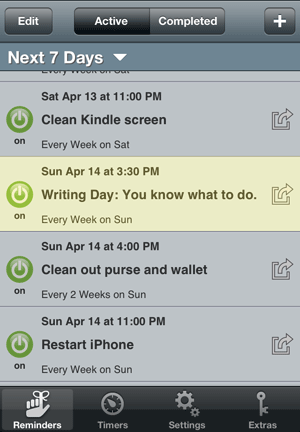
How did a reminder app change my writing habits? Simple: I set aside a “Writing Day” reminder, just like I set aside a “Kitchen Day,” a “Clutter Day,” etc.

writingday This screenshot from my phone shows how Writing Day falls on Sunday every week, sandwiched in between mundane, tiny little tasks. Sunday afternoons are the times I can finally wind down for the week and recharge for the next–it’s a time of reflection, and more importantly, a time of just being able to BREATHE. No one needs my time, no one really needs me to do anything–everything for the week is done, and my time is my own. In short, it’s the PERFECT time to write.

I’ve left myself a simple instruction, too–“You know what to do.” Because I do know what to do on Writing Day–just write. I can write in my novel, I can write in a fanfic or two, I can write anything I want as long as it’s creative. That’s the only rule.

Has This Helped? YES!

This app has already helped me move ahead three pages in my novel. Though it might seem paltry, three pages is a victory, since I’ve been stuck in one place for nearly a year.

Before making a specific “writing day” reminder, I had had a hard time making time to write. It seemed I wrote all the time, either doing blog posts like these, preparing my Sunday school lessons to teach on Sunday, or writing website content…but I hadn’t really done much creative work aside from just little random bits here or there. I ended up almost burned out on writing, just not feeling like I had the energy to write anything when I had free time.

When I finally set aside a special “day” to write, boy, did that change. I’ve begun to write more on my novel, and I’ve started looking forward to Sunday afternoons as “my time,” even. Just allotting a special day of the week to writing makes me feel less anxious about accomplishing my creative writing goals, and less anxiety = more productivity. This is a HUGE change for the better. I don’t force myself to produce a certain number of words or pages when I write this way–I just relax, get rid of all my anxiety about “getting things done,” and just enjoy the process.

Making a “Writing Day” for Yourself

  • Choose a day of the week which is less busy than all the others, or which has mostly non-writing tasks. This is important–you don’t want to be mentally “burned out” on writing before you even begin.
  • How much time do you have during that day? According to your schedule, budget in a block of time to write. It can be 15 minutes, one hour, 3 hours–whatever time you have free.
  • Create a consistent reminder for yourself, either on your phone/computer as I did, or place a paper note somewhere where you will see it every day.
  • When your chosen “writing day” comes around, just write SOMETHING creative. If it’s a few words, awesome. A few lines or a paragraph? Great! A whole page, or even a bunch of pages? Amazing! Count it all as progress, because it is.

I hope this helps you get back on track with your own creative writing–it certainly has helped me!