Category Archives: Thursday in the Zone

Gaming-related posts, covering games of my particular interest from the collectible, video, and PC genres.

Favorite Magic Cards, part 1: Creatures

Ever since I started playing Magic back in 2005, I’ve had a growing list of creatures that are just plain favorites to use in decks. Maybe it’s because I like using the creature type, or maybe it’s because they’re just plain GOOD for how much mana you invest in them. Whatever the reason, the following creatures are and probably always will be standouts for me:

akroma
Akroma, Angel of Wrath: An old favorite for her slew of abilities.
avatarofhope
Avatar of Hope: I love the big toughness and “able to block any number of creatures” ability.
beaconofdestiny
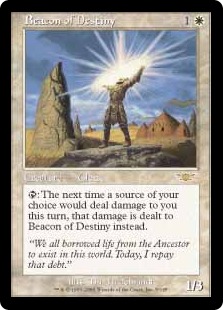
Beacon of Destiny: Redirect all damage to this creature, no matter its source? Why not?
belovedchaplain
Beloved Chaplain: Protection from creatures for two mana. Not bad!
courierhawk
Courier Hawk: The 2 toughness and vigilance is more help than it seems!
dawnelemental
Dawn Elemental: Flying 3/3 that can’t be killed by damage…WIN.
dawnstrider
Dawnstrider: A creature which can Fog when you Spellshape. What an unexpected bonus!
empyrialarchangel
Empyrial Archangel: A defensive instead of aggressive Angel. Me likey.
elvishpiper
Elvish Piper: Makes playing the huge-mana-cost creatures actually worthwhile!
essencewarden
Essence Warden: Because Green needed quick, creature-based life-gain, too. LOL
exaltedangel
Exalted Angel: One of the first Angels with lifelink, and even more fun with the Morph ability.
grizzledleotau
Grizzled Leotau: A Green/White creature with a huge toughness…which costs only two mana!
indomitableancients
Indomitable Ancients: Because a 10 toughness for 4 mana is just hilarious.
jenaraasuraofwar
Jenara, Asura of War: A multi-colored Angel for only 3 mana (gasp!), with the ability to get more P/T over time.
jhessianinfiltrator
Jhessian Infiltrator: I love the low-mana-cost Unblockable damage, especially in Green.
krosancloudscraper
Krosan Cloudscraper: Admit it, swinging for 13 with one creature is pretty hilarious.
prideoftheclouds
Pride of the Clouds: Love the artwork; plus, this is one cat that likes fighting alongside the birds!
skyhunterskirmisher
Skyhunter Skirmisher: White so rarely gets double strike, and this is flying double strike at that!
timberprotector
Timber Protector: I’ve built a Treefolk deck. ‘Nuff said. 🙂
wallofhope
Wall of Hope: This is hilarious to play on your first turn, because of the defense/life-gain combo.
yavimayadryad
Yavimaya Dryad: Absolutely need a Forest? She’s got you covered. Need to give the other player a Forest so that your creatures can Forestwalk? She’s got that, too.
yavimayaenchantress
Yavimaya Enchantress: Funny with Blanchwood Armor, Gaea’s Anthem, and the like. 😀

Image Credits

All card images came from Gatherer.

I Called It! HeroClix Gets a Pink Power Color

Back in June 2012, I wrote about ideas for introducing pink as a new HeroClix powers and abilities color. Well, as of a few weeks ago on HCRealms, the new 2013 Rules and PAC (Powers and Abilities Card) was revealed. Apparently, someone at Wizkids was on the same wavelength as me–future figures will have pink as an available power color.

Pink Powers and Abilities

Quoted from the official forum post:

Pink Speed Sidestep: Give this character a free action; it can move with a locked speed value of 2.
Pink Attack Precision Strike: When this character makes an attack, it can’t be evaded, and the damage dealt can’t be reduced below 1 or transferred.
Pink Defense Invincible: Half of damage dealt to this character is ignored. (Note that the rules state you can only apply one game effect that reduces or ignores damage, so Invincible does not combine with damage reducers)
Pink Damage Empower: When an adjacent friendly character makes a close combat attack, this character modifies that adjacent friendly character’s damage value by +1.

What Does This Addition Mean for the Game?

With four new standard powers available for all future HeroClix figures, I believe this will help the game’s standard powers better reflect superheroic abilities from the comics. I can easily see a Batman or Robin figure with Sidestep, for instance, or an Iron Man with Invincible.

Furthermore, all these new abilities even out the strength of others. For example, I can make great use of a figure with Precision Strike–finally, the game has an answer to Shapechange, Super Senses, AND Mastermind, which isn’t Outwit! And I love the fact that adjacent close combat characters will finally be able to enjoy the same damage-boosting benefits that adjacent ranged characters have had for so long; this makes the close-combat game a lot more playable.

Of course, opinions are divided on this newest addition to the Standard Powers and Abilities (see the “Pink Powers? This will ruin Heroclix” thread on HCRealms). Personally, I think we will all be a little more reconciled to the idea when the first truly kick-butt figure with any pink power is released–I think seeing a highly-valuable figure with these powers will make it “official,” more so than this announcement does.

What’s Your Take on the New Pink Powers?

Tell me about it in the comments!

More Info

“2013 Rules and PAC are up” HCRealms thread

How to Tell How Old Your M:TG Cards Are

Most of us Magic: the Gathering players began our collections with a fairly random assortment of cards, a mix of the most current booster packs plus some donated cards from other players’ collections. Because of this, sometimes it can be hard to know exactly what value your cards have, or even what set the cards are from in some cases.

So I compiled this handy little guide, with the help of my awesome boyfriend (who’s been playing Magic since Revised came out), to help all of us know what sets some of those unidentifiable “old cards” come from. Who knows, you might be sitting on a small fortune and not know it!

For these illustrations, I used the card “Healing Salve,” which was printed from Alpha all the way through 8th edition–it shows how the early sets changed and varied.

limitededitionalpha-2

Alpha

  • Heavily-rounded corners (compare to modern card and see the difference)
  • Black borders
  • Big rules text
  • No copyright date
  • No set symbol
limitededitionbeta-2

Beta

  • Normal rounded corners (same as modern-day cards)
  • Black borders
  • Big rules text
  • No copyright date
  • No set symbol
unlimited-2

Unlimited

  • White borders
  • Normal corners
  • Big rules text
  • No copyright date
  • No set symbol
revised-2

Revised

  • Card colors look lighter overall–light print run
  • Smaller rules text
  • White borders
  • No copyright date
  • No set symbol
4thed-2

4th Edition

  • Copyright 1995 on the bottom of the card
  • White borders
  • No set symbol
5thed-2

5th Edition

  • Copyright 1997 on the bottom of the card
  • White borders
  • No set symbol (except for the Chinese release which had a Roman numeral V)
classic6thed-2

6th Edition (aka “Classic 6th Edition)

  • Set symbol: VI (but see note about early set symbols and card rarity, below)
  • White borders

Chronicles Reprints

The set called Chronicles, which was released in July of 1995, was a set made up entirely of reprints from older sets–a mega Core Set, if you will. However, for each reprinted card, Chronicles used the card’s original set symbol instead of the Chronicles official set symbol.

The only difference between an original printing and a Chronicles reprint? The border color. The original sets all used black borders; Chronicles used white. See the example below:

legends
Original Legends printing
chronicles
Chronicles reprint

The Chronicles reprints are worth less, usually, than their original-print counterparts. Be wary if someone claims to be selling original prints of these cards–check the border color before you buy it at top price!

Set Symbols and Rarity

Unlike modern sets, many older sets either did not have set symbols at all, or only had a black set symbol for all cards, no matter what their rarity. In June 1998, Wizards of the Coast released the set called Exodus, which introduced the color-coded rarity system: black for common, silver for uncommon, and gold for rare, as seen below:

exodus_symbols

Be sure to look up the real value of older cards with no color-coded set symbols–what everyone else thinks is a “common” card (because of its black symbol) may in fact be a rare!

Useful Resources/Credits for Card Information

Gatherer (card images)
EssentialMagic.com’s Card Sets List (some set information)
CrystalKeep.com’s Symbols List (Exodus symbols)

3 Ways to Be A Fun Opponent

All of us gamers, whether we’re casual gamers or tournament players, have probably met the “un-fun” opponent. This is the guy or girl who can’t seem to lighten up and just play the game, who either loses and rage-flips the table, or wins and rubs it in everyone’s face for the next few hours. The un-fun opponent can also manifest as a player who overthinks every move for fear of losing the game, or who quits a game when the mere shadow of defeat falls across the table.

None of these all-too-common gamer attitudes make a game fun to play for the other person. I should know; I’m one of those who quits before I lose, and overthinks far too often, and so I see how my negative reactions suck the life out of a game for my opponents. So, today, I thought I’d challenge myself and all of us gamers to try being a little more fun–not necessarily playing more casually, but making all gaming more entertaining and less draining.

#3: Dare to Smile a Little More

A simple smile at your opponent can work wonders for a gaming atmosphere. When you’re both (or all) super-focused on the game, smiles can fall by the wayside, easily forgotten in the heat of tabletop battle. But if you take the time to smile at your opponent, you’re reminding him or her that you’re human, and that this is a game rather than a life-or-death situation.

This little jolt of positive emotion in the middle of a tense game can lighten the mood and help everyone have a better time. You don’t have to tell a ton of jokes or make silly faces, nor do you have to lose all concentration on the game for a moment…just smile. You wouldn’t believe what a positive effect that can have on another player.

#2: Dare to Try New Strategies

If you’ve got an amazing, butt-whooping deck or team of figures which you love to play in tournaments and casual games alike, that’s wonderful. But don’t limit yourself to playing only “the stuff that wins.” The best gamers are not the ones who have flawless win/loss records, but the ones who try out all types of strategies to discover new ways to win, new combos that work, and new modes of self-expression.

When you attempt new strategies, you flex your gaming creativity muscle, which makes any game more interesting. No longer do you have to rely on the Internet to tell you which hot new strategy is winning everything this month (AHEM, lookin’ at you, Friday Night Magic tourneys). Instead, your strategy comes from within you, and can be tweaked in any way you personally wish. It gives you a certain amount of freedom, even within a tournament format!

#1: Dare to Lose

“WHAT?!” you’re probably thinking. But just as in life, losing in gaming can teach us quite a bit more about our strategies, if we don’t allow ourselves to stew in anger and misery first.

This might be hard for some of us gamers to grasp (it’s hard for me!), but winning all the time doesn’t make us the best human beings on earth, nor does losing all the time mean that we are wastes of space. When we win so often that it seems like a foregone conclusion, it can suck the interest out of the game, both for us and our would-be opponents. No one wants to play us in a “quick game” because both parties know how it will end; the game is no longer fun for us because there is no challenge in it anymore.

That’s why I suggest being willing to lose a little more often. This does not mean “throwing the game,” but perhaps using your old favorite strategy pieces in new ways. Maybe avoid using that old reliable combo of figures that wins the game every time, and instead rely on some of your backup figures, to see how well they perform. Maybe change out a card or two in that well-oiled deck you lovingly use in tournaments, and see what results. If you lose, so what? There’s always another game. (Plus, when you play against newbies, it’s important not to thrash them in their first game–who would ever want to get soundly defeated by an expert when you’re still learning the game?)

Bottom Line: Be Human, not a Winning Machine

All three of these suggestions boil down to allowing humanity to creep back into our gaming. We likely game among friends, so why not treat them like friends instead of opponents? We likely started playing these games because they were fun, so why let gamer-rage and overthinking take the place of fun?

I’m stepping all over my own toes with this post, because I’m still working on becoming a more fun opponent. But I think if we all really worked on behaving more humanly toward each other, we could end up having a lot more fun even at “serious gaming” tournaments. Isn’t that a worthy goal?

Never Ask “What’s That M:TG Set Symbol?” Again!

Over the last few years, Magic: the Gathering has released many official sets–but those are not their only products. In fact, there have also been quite a few special collections, such as the Duel Decks, the From The Vault collections, and the Premium Deck series. Plus, there have been new formats introduced, such as Commander and Archenemy.

All of these mentioned products have their own set symbols, and that leads to quite a bit of confusion for both M:TG newbies and veterans. I’ve heard quite a few M:TG players trying to figure out these rarer symbols, and I’ve been a little bewildered by it all as well. Finally I decided to compile a reference article about it, to help us all learn these special symbols. (I’ve covered only the last three years in Magic, to cover as many “new cards” and “new sets” as possible in a short article.)

Special Collections for New Formats

Set Symbol Set Name Release Date
archenemy Archenemy June 2010
commander Commander June 2011
commandersarsenal Commander’s Arsenal November 2012

Duel Decks

Set Symbol Set Name Release Date
phyrexiavscoalition Phyrexia vs. The Coalition March 2010
elspethvstezzeret Elspeth vs. Tezzeret September 2010
knightsvsdragons Knights vs. Dragons April 2011
ajanivsnicolbolas Ajani vs. Nicol Bolas September 2011
venservskoth Venser vs. Koth March 2012
izzetvsgolgari Izzet vs. Golgari September 2012
sorinvstibalt Sorin vs. Tibalt March 2013
heroesvsmonsters Heroes vs. Monsters September 2013

Premium Deck Series

Set Symbol Set Name Release Date
fireandlightning Fire & Lightning November 2010
premiumdeck_graveborn Graveborn November 2011

From the Vault Collections

Set Symbol Set Name Release Date
ftv_relics From the Vault: Relics August 2010
ftv_legends From the Vault: Legends August 2011
ftv_realms From the Vault: Realms August 2012
ftv_twenty From the Vault: Twenty August 2013

Expansion Sets

Set Symbol Set Name Release Date
scarsofmirrodin Scars of Mirrodin October 2010
mirrodinbesieged Mirrodin Besieged February 2011
newphyrexia New Phyrexia May 2011
innistrad Innistrad September 2011
darkascension Dark Ascension February 2012
avacynrestored Avacyn Restored May 2012
returntoravnica Return to Ravnica October 2012
gatecrash Gatecrash February 2013
dragonsmaze Dragon’s Maze May 2013

(All the preceding symbols were retrieved from the MTG Salvation Wiki, an excellent resource for set symbols and tons more M:TG information.)

That’s Not Hieroglyphics, It’s Hero Clix Code

If you’ve bought any of the most recent HeroClix sets, you might have noticed some very strange-looking new symbols printed on their character cards, like the following:

improved_targeting improved_movement destroysblocking characterbase

They have also begun to appear in rules text like the following:
sharpshooter_example
swim_example

These and several other symbols like them now stand for certain rules within HeroClix, which the 2012 Powers and Abilities card goes into in detail. The symbols just make it a lot simpler to print these rules on character cards. Today’s blog post will make you an expert at decoding this newest Hero Clix code!

What These Rules Are All About

Collectively, these rules are known as the “Improved Movement and Targeting” rules. Movement is symbolized by the improved_movement running man, and targeting is symbolized by the improved_targeting bullseye. These two symbols are the first ones you should look for on a character’s card, to determine which kind of character action (moving or shooting) is affected.

Take the Swim example from above:
swim_example
In this example, we can see that the Swim ability affects movement, because it’s got the little running man symbol in its rules text.

sharpshooter_example
By contrast, we can see that the Sharpshooter ability affects targeting, because it’s got the little bullseye symbol in its rules text.

The Other Associated Symbols

Now that you know the two main symbols, you can see how the additional symbols tell you more about how each special power and ability works.

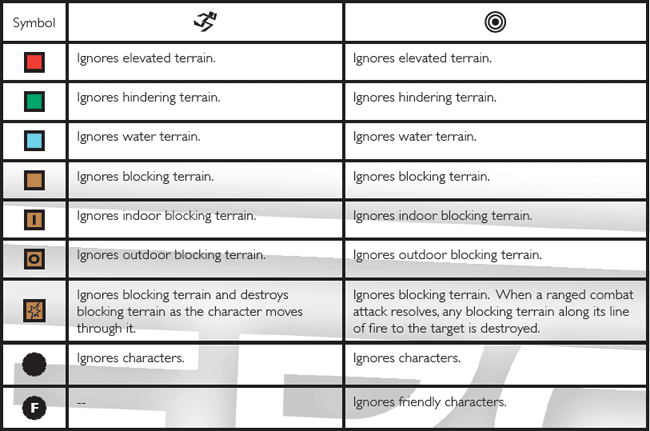
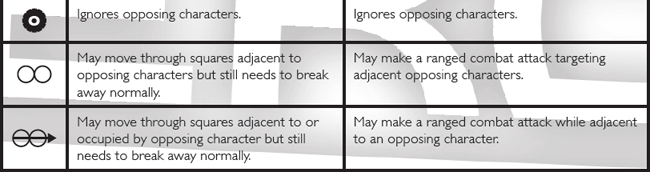
Here’s the whole chart of Improved symbols and their meanings, taken from a screenshot of the powers and abilities card PDF file:

improvedchart_1
improvedchart_2

The difference between the two columns is that the Improved Movement column (left) shows what things the affected character ignores for movement purposes, while the Improved Targeting column (right) shows what things the affected character ignores for attack purposes.

For instance, someone with the bullseye symbol followed by a green square means that they ignore Hindering Terrain for attack purposes (like Superman ignores Hindering Terrain for attack–watch out, Batman!). However, a running man symbol followed by a green square means that the character ignores Hindering for movement purposes. (Anybody with Leap/Climb on their dial has this ability!)

There are some additional symbols here–the roundish, Hero-Clix-dial-shaped symbol means that character bases can be ignored for either line-of-fire or movement purposes, for instance (depending on whether the running man or bullseye symbol precedes it). Though these new symbols look a little daunting, this chart generally makes easy work of understanding and referencing them.

Test Your Decoding Skills!

Let’s check out a few examples of rules text where these symbols are used! (Answers at the end of this article)

flight_example

  1. Which kind of ability is Flight: an Improved Movement or Improved Targeting ability?
  2. Which types of terrain does it ignore?
  3. Can Flying characters move through squares occupied by opposing characters?
  4. Can Flying characters break away automatically?

pulsewave_example

  1. Which kind of ability is Pulse Wave: an Improved Movement or Improved Targeting ability?
  2. Which types of terrain does it ignore?
  3. Do character bases block Pulse Wave’s line of fire?
  4. Can a character using Pulse Wave move through opposing characters’ spaces?

sharpshooter_example

  1. Can Sharpshooter ignore character bases for line-of-fire purposes? If so, which kind of character bases?
  2. If an opposing character is adjacent to a Sharpshooter character, can the Sharpshooter still make a “ranged” attack against that character, according to these symbols?

greatsize_example

  1. Which kind of ability is Great Size: an Improved Movement or Improved Targeting ability?
  2. Which types of terrain does it ignore?
  3. Can Great Size characters move through squares occupied by opposing characters?
  4. Can they break away automatically?

swim_example

  1. Which types of terrain does the Swim ability ignore?

And now for the last question–a little tricky!

leapclimbphasing_example

  1. What is the main difference between Leap/Climb and Phasing’s rules symbols? (Look closely, now!)

Practice with These Symbols Makes Perfect!

How’d you do on the little quiz above? It may take a little time and frequent referencing back to the Powers and Abilities Card to master these symbols, but you’ll get ’em down pat soon enough! In the meantime, HeroClix.com has provided us materials so that we never forget the rules too easily.

To download a copy of the 2012 Powers and Abilities card for yourself, visit HeroClix.com’s Rules Downloads page.

Answer Key

Flight:

  1. Improved Movement
  2. Ignores Elevated, Hindering, and Outdoor Blocking
  3. Yes, they can move through opposing characters’ squares
  4. No, they cannot break away automatically

Pulse Wave:

  1. Improved Targeting
  2. Ignores Hindering
  3. No, character bases do not block line of fire for Pulse Wave attacks
  4. Yes, Pulse Waving characters can move through opposing characters’ squares

Sharpshooter:

  1. Yes; they ignore opposing character bases only
  2. Yes, they can make a ranged attack against adjacent characters

Great Size:

  1. Improved Movement
  2. Ignores Elevated, Hindering, and Outdoor Blocking
  3. Yes, they can move through opposing characters’ squares
  4. No, they cannot break away automatically

Swim:

  1. Ignores Water Terrain

Leap/Climb and Phasing:

  1. The only difference is that Leap/Climb only ignores Outdoor Blocking Terrain, while Phasing ignores ALL Blocking Terrain.

Cards from Middle-earth: The Lord of the Rings Card Game

lotr_cardgame
This beautiful image, used here only for illustration purposes, was made by BoardGameGeek user Legynd, and was originally posted on the Lord of the Rings BoardGameGeek page.

Part roleplaying game, part card game–that’s the best way to describe the LOTR card game in a nutshell. If you like the Lord of the Rings books and you love fantasy, you’re going to have a blast with this game, a self-described “Living Card Game” that bridges the gap between booster-pack-driven card games and static dungeon crawls.

Basic Gameplay

This cooperative card game is for 1-2 players using one 226-card Core Set; you can also have up to 4 people playing if you have two Core Sets. All players, using constructed decks, work together to defeat the challenges on each of several epic “Quests” included in the game (thus, why I said it’s sort of like a roleplaying game such as Dungeons and Dragons). Yet part of the game is also the luck of the draw every turn, which makes it a card game quite like Magic: the Gathering.

Players don’t directly play through the events of the LOTR trilogy in order, but there are plenty of Middle-earth and Mordor-themed challenges and stories to see. Plus, you’ll see a lot of familiar heroes and enemies as you play through each quest, so the flavor of the trilogy is not lacking in any regard!

There are four different starter decks to choose from, or you can create your own as well. (For first-timers, it’s easier to use one of the prefabs to get the hang of the game.) Each prefab uses different characters from the Lord of the Rings books, combined together to help the deck achieve its specific goal to help the group. But if you want to build your own deck, you certainly can using the Core Set’s selection!

Different Types of Strength

Remember, all players work together, so not every player’s deck is meant to kick as much butt as possible in a short time–a good team of players requires various strengths to survive. In the LOTR card game, there are four basic strengths, called “Spheres:”

Leadership

Charisma
Inspiration
Command

Lore

Knowledge
Wisdom
Experience

Spirit

Willpower
Courage
Loyalty

Tactics

Strategy
Skill
Cunning

You will more than likely find that one of these spheres is easiest for you to play. For me, I played the Lore sphere really well, especially the prefab deck which served as the group’s “healer.” The other players I played with did better at the Leadership and Spirit spheres, respectively–the Leadership sphere has a lot more ranged attacks, and the Spirit sphere is more about taking damage and keeping on truckin’. Together we made a pretty sweet team! It just takes a little experimentation to figure out which sphere is right for you.

Adventure Packs: The New and Improved Booster Packs

You can play a full game with just the Core Set, but Fantasy Flight Games is also going to be releasing expansions called Adventure Packs every month, which will have new Quests, characters, items, etc. to add to your Core Set over time. Unlike booster packs, the cards will be known ahead of time, as far as I know, so you can pick and choose which Adventure Packs you want to add to your LOTR card game collection.

For More Information

Official LOTR Card Game Site
LOTR Card Game @ BoardGameGeek.com
Lord of the Rings Card Game Review with Tom Vasel (Youtube)
Lord of the Rings Card Game Playthrough, Part 1 (Youtube)

An Idea for Safely Storing Miniatures

This week, I thought I’d share with you my system for storing miniatures figures; in this case, it’s my Clix collection, but conceivably you could store several types of miniatures in the system I’m going to show. It has completely changed the way I organize my miniatures, and definitely for the better!

clixtray_empty
This translucent plastic sectioned tray is part of the Really Useful Products line. It is 8 3/4 inches wide, 11 inches long, and 2 1/2 inches deep; each of its 16 sections measures 2 1/4 inches wide, 2 3/4 inches long, and 2 1/2 inches deep.

clixtray_full
This is an example of how I use a tray to store Clix figures–this particular one holds all my team-support figures, and they are separated out according to type using the handy sections. For instance, all my Paramedics are in the top left section, while all of my combat-ready Probability Control figures are in the top right section, and so on. I find that the sections are big enough even to hold double-based figures, like the Green Lantern & Green Arrow piece stored at bottom right!

clixtray_side
The whole thing is translucent, so you can easily tell which figures are stored within on all sides. VERY handy for quickly picking out which tray you want to look at!

clixtrays_closet
The other great thing about this tray? Multiples of them stack really easily. This is my entire Clix collection, stored in 5 of these style trays on a shelf in my closet. They are sturdy enough to stand up to being stacked, without being so heavy that they threaten the shelf’s stability.

My Experience with This System

If you’re currently looking for a way to store minis at home, I would definitely recommend this kind of tray. Since I switched over to this system of storing my Clix, I find that I keep track of my collection easier, and find figures much more quickly. Plus, the figures don’t get damaged as easily, nor do they collect too much dust.

The only caveat is that this system of trays is not very portable on its own, because they are open trays with no lids or handles. However, you can purchase boxes which hold several trays securely at one time (see below). This system’s modular functionality is the real winning ticket for me–we gamers need systems that easily expand to fit our growing collections!

Where to Buy

The following links to the Really Useful Products online store should help you find trays and boxes that will work for your miniatures collections:

Storage Tray Details
Storage Box Details

New M:TG Abilities, part 2: Gatecrash

gatecrash The very latest Magic set (as of February 1st), Gatecrash features five more new keyword abilities, one for each of its featured dual-color guilds. As we examine these, you might just find another one you want to fit into your deck–there are some REALLY interesting ones here!

Ability Keyword

Associated Guild

Rules Text

More Info

Battalion boroslegion
Boros Legion
This mechanic means slightly different things on every card, but it always activates when the battalion-bearing creature and at least two others are attacking at the same time. Battalion @ MTGSalvation Wiki
Cipher housedimir
House Dimir
702.97a Cipher appears on some instants and sorceries. It represents two static abilities, one that functions while the spell is on the stack and one that functions while the card with cipher is in the exile zone. “Cipher” means “If this spell is represented by a card, you may exile this card encoded on a creature you control” and “As long as this card is encoded on that creature, that creature has ‘Whenever this creature deals combat damage to a player, you may copy this card and you may cast the copy without paying its mana cost.'”

702.97b The term “encoded” describes the relationship between the card with cipher while in the exile zone and the creature chosen when the spell represented by that card resolves.

702.97c The card with cipher remains encoded on the chosen creature as long as the card with cipher remains exiled and the creature remains on the battlefield. The card remains encoded on that object even if it changes controller or stops being a creature, as long as it remains on the battlefield.

Cipher @ MTGSalvation Wiki
Bloodrush gruulclans
Gruul Clans
Allows players to discard creature cards in order to give an attacking creature a temporary power/toughness boost equal to the power and toughness of the discarded creature card. Bloodrush @ MTGSalvation Wiki
Extort orzhovsyndicate
Orzhov Syndicate
702.99a Extort is a triggered ability. “Extort” means “Whenever you cast a spell, you may pay 1 black or white mana. If you do, each opponent loses 1 life and you gain life equal to the total life lost this way.”

702.99b If a permanent has multiple instances of extort, each triggers separately.

Extort @ MTGSalvation Wiki
Evolve simic_combine
Simic Combine
702.98a Evolve is a triggered ability. “Evolve” means “Whenever a creature enters the battlefield under your control, if that creature’s power is greater than this creature’s power and/or that creature’s toughness is greater than this creature’s toughness, put a +1/+1 counter on this creature.”

702.99b If a creature has multiple instances of evolve, each triggers separately.

Evolve @ MTGSalvation Wiki

Which Ability is Right for You?

  • If you love playing creature-heavy decks (especially with lots of weenie creatures) and attacking all out every turn, Battalion is your new favorite ability.
  • If you like to put extra abilities on creatures, but hate how easily Enchant Creature cards are destroyed in-game, you will DEFINITELY want to try Cipher.
  • If you always end up with one creature out on the field and three or four in your hand unable to be played (due to mana problems, etc.), Bloodrush will work wonders for you.
  • If you already have a Black/White deck, or if you’ve always been intrigued by the color combo, you’ll want to start gathering Extort cards–it’s pretty much exactly how Black/White has always worked, with a little more punch. (And it’s HILARIOUS in group games!)
  • If you don’t like ending up late-game with a bunch of 1/1s sitting helplessly alongside your beefy attacker, having a few creatures with the Evolve ability will help your deck ramp up in strength as turns go by.

New M:TG Abilities, part 1: Return to Ravnica

returntoravnica Return to Ravnica, one of the more recent Magic: the Gathering sets, includes five new keyword abilities printed on the cards, one for each of the five dual-color guilds featured in the set. Let’s take a moment and look at each of these abilities–you might find one you want to incorporate into a deck build of your own!

Ability Keyword

Associated Guild

Rules Text

More Info

Detain azorius_senate
Azorius
Senate
701.26a Certain spells and abilities can detain a permanent. Until the next turn of the controller of that spell or ability, that permanent can’t attack or block and its activated abilities can’t be activated. Detain @ MTGSalvation Wiki
Scavenge golgariswarm
Golgari
Swarm
702.95a Scavenge is an activated ability that functions only while the card with scavenge is in a graveyard. “Scavenge [cost]” means “[Cost], Exile this card from your graveyard: Put a number of +1/+1 counter equal to the power of the card you exiled on target creature. Activate this ability only any time you could cast a sorcery.” Scavenge @ MTGSalvation Wiki
Overload izzetleague
Izzet
League
702.94a Overload is a keyword that represents two static abilities: one that functions from any zone in which the spell with overload can be cast and another that functions while the card is on the stack. Overload [cost] means “You may choose to pay [cost] rather than pay this spell’s mana cost” and “If you chose to pay this spell’s overload cost, change its text by replacing all instances of the word ‘target’ with the word ‘each.'” Using the overload ability follows the rules for paying alternative costs in rules 601.2b and 601.2e–g.

702.94b If a player chooses to pay the overload cost of a spell, that spell won’t require any targets. It may affect objects that couldn’t be chosen as legal targets if the spell were cast without its overload cost being paid.

702.94c Overload’s second ability creates a text-changing effect. See rule 612, “Text-Changing Effects.”

Overload @ MTGSalvation Wiki
Unleash cult_of_rakdos
Cult of
Rakdos
702.96a Unleash is a keyword that represents two static abilities. “Unleash” means “You may have this permanent enter the battlefield with an additional +1/+1 counter on it” and “This permanent can’t block as long as it has a +1/+1 counter on it.” Unleash @ MTGSalvation Wiki
Populate selesnyaconclave

Selesnya
Conclave
701.27a To populate means to choose a creature token you control and put a token onto the battlefield that’s a copy of that creature token.

701.27b If you control no creature tokens when instructed to populate, you won’t put a token onto the battlefield.

Populate @ MTGSalvation Wiki

Which Keywords Are Right for You?

  • If you like to play control, Detain was tailor-made for you. Period. 😀
  • If you like to swing with big creatures, both Unleash and Scavenge are great mechanics for pumping up creatures’ power and toughness, albeit through very different means.
  • If you like to amass lots of little creatures very quickly, Populate will serve you well–just make sure you have one token to start off, and then let the Populating mechanic go wild!
  • If you like to play combos, or if you like big splashy game effects, Overload in all its various forms will give you great options for both early-game and late-game.