All posts by Robin

I'm a woman in my early thirties living in North Carolina, USA, and I have a lot of varied interests; I love creative writing, music composition, web design, surfing the Internet, thinking out loud, and gaming. And yes, my glasses are crooked. :)

Makeup Box Spring Cleaning

springcleaning
As part of my (endless) organization/cleaning purge, I decided to tackle my makeup collection recently, with some very surprising results. (Bonus: tips for helping you spring-clean your own makeup collection are at the end of this article!)

I had thought my makeup collection was about as streamlined and simple as it could get, since I don’t wear much makeup these days anyway. But I noticed that there were a few products that I wasn’t using as much. So, I literally took the organizer that serves as my makeup storage and dumped it out on the bed to sort through it…and this is what happened next:

Products Before the Purge

glossbefore
Lip glosses (yes, yes, I know, one girl does not need so many! LOL)

lipbefore
Lipsticks (can you tell lip products are my favorite makeup yet?)

facebefore
Face products (foundation powder, blush, bronzer)

eyeshadowbefore
Eye products (eyeshadow, liner)

The Purging Process

Once I had sorted each category, I took a long, hard look at each product. Was I using this? Was it still safe to use? Did it work like I wanted?
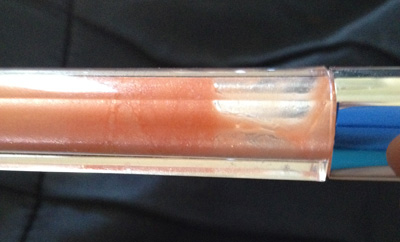
ewww
One thing I saw was that several of my lip glosses had begun to separate and change color slightly in the tube. Yuck! (The pictured lip gloss was bought in 2011–definitely wayyyyy too old to be using!)

superoldlippalette
This lip palette, for instance, was bought back in 2007, according to my note in Sharpie on the bottom of it. Yikes! (This is a really handy tip for keeping track of how old your makeup is–note the month and year on the bottom of it when you get it, and then you’ll know when it’s too old to use!)

minimakeup
Some of the products, like this mini-makeup kit, have been gifts–and gifts are especially hard for me to get rid of because I’m very sentimental. But in this case, this kit has been sitting in my box for at least the last 4 years…:/

I was REALLY tempted to quit in the middle of this purge, to just keep all of the makeup, but when I realized how old some of it was, I knew I couldn’t in good faith keep putting that on my face. Makeup definitely doesn’t last forever! So I set my mind to be ruthless about getting rid of the oldest products, the products I didn’t use, etc. (I don’t wear a lot of makeup, so I didn’t need all of them anyway.)

The Results
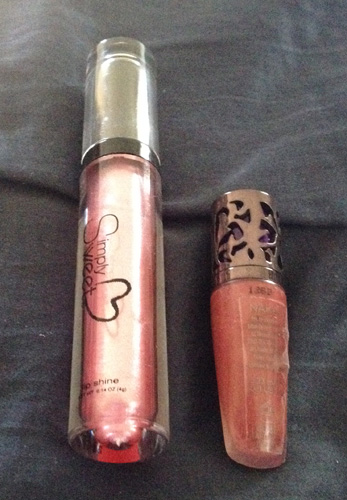
glossafter
A MUCH-reduced gloss collection, taking out all the ones that were now too old to use…

lipafter
And a little smaller lipstick collection to match 🙂

eyeshadowafter
I pared down all the eyeshadow palettes to the one I really love and use the most…

liner
…and I kept the one eyeliner I have (though I don’t break it out very often).

faceafter
I took out the foundation powders that I haven’t used since I graduated college in 2007 (seriously!), but I swapped in a couple of the lip stains to see if I could use them as “cream blushes.” (Note: you can’t really blend them well enough to make them work, sadly.)

tools
A couple of trusty tools round out my new, much lighter makeup collection.

What I Kept and What I Got Rid Of

Just to show you exactly how much I got rid of, here’s the “After” picture of my makeup organizer:

whatikept

And here’s the basket of stuff that went away:
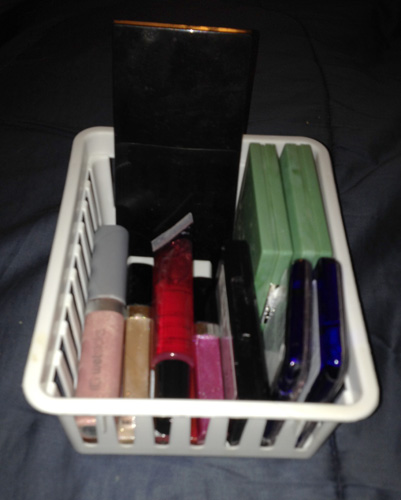
gotridof

Yep, I got rid of about half my makeup collection in one fell swoop! Pretty amazing for this hoarder in rehab! LOL

To Purge Your Own Collection

  • Mark each makeup piece with the date you first used it so you know when to throw it out. (This is SO helpful!) Refer to this article for when to throw away various makeup products.
  • Check each product for changes in texture, smell, or application; if it looks “goopy,” smells weird, or doesn’t seem to have the same “oomph” that it used to, it’s probably gone bad.
  • Be ruthless when deciding whether to purge an item. Are you REALLY going to use that product if you keep it, or are you keeping it to justify the expense of it? (I kept falling into this trap during the makeup purge, and I had to keep thinking, “Is this something I REALLY love and use?”)


I Hate Slideshow Articles!

hateslideshows

As an Internet user, I inwardly groan upon discovering that an article I really wanted to read is actually a slideshow. In fact, it’s one of my top pet peeves of Web content formatting!

I’m not alone in this opinion: there are articles about why slideshows should be banned entirely, as well as workarounds for those of us who hate slideshows and other multi-page articles. (There are a few people who defend slideshows as a practice, but even they admit that the format can be overused.)

Since I’m both a Web content consumer AND a Web content writer, I studied this problem from both angles. Why do slideshows bother me so much, as a user, and why might Web content formatters choose this format when so many users hate it? The 4 following reasons explain why:

Why We Should Stop Using Slideshow Article Format

#1: It’s basically a strategy for getting page ads to load more often per user.

Above all, this is what irritates me about slideshow articles: they are invariably riddled with ads (including that dadgum “Ad Slide” that always pops up right in the middle of my reading and disrupts my whole thought flow). It actually feels like the content formatters are highlighting the ads INSTEAD of their content.

News flash: users hate ads! As a user, I don’t care if those ads are “paying for your site”–I don’t want to be bothered with them, ESPECIALLY not when I’m trying to read your admittedly interesting content. Making me click through a 10 or 12-page article just so you can get a few more cents feels like a huge tease. (And as a content writer, I know that the LAST thing we ever want to do is make our users feel like we think of them as money-generators and nothing else.)

#2: Because each slide is so short, the articles end up feeling skimpy on content.

You’d think that if an article is 10 pages, it would actually have some decent content, right? But unfortunately, in the slideshow format, article content is often compressed and badly written to fit alongside or under pictures. Each slide usually contains maybe 5 sentences, which may be enough to satisfy some users, but leaves this English major feeling pretty cold. Explanations are often glossed over in favor of using a picture that usually doesn’t really explain anything, and so the whole article feels rather useless.

Being a largely text-based content creator, I don’t want to waste my users’ time with insipid articles like the ones I end up clicking through all too often. If I’m taking the time to write an article, I want my users to feel like they’ve really learned something at the end of it. And I’d rather not have the format of the article steal emphasis away from my content.

#3: Slideshows don’t work well on mobile devices.

I’ve noticed this while trying to read slideshow articles on my tablet and smartphone–slideshows (especially the pictures!) are usually so huge that the mobile screen has to be scrolled around the page to read everything. And what if the screen can’t be zoomed out or in? Sorry, this content just isn’t visible, and you wasted your time clicking on this article. (Trust me, it’s happened more often than not!) There are some websites I actually just don’t visit on mobile (though I’d like to), because all their articles are slideshows and I can never read the content anyway. (Not to mention that tapping your touchscreen to advance to the next slide is very frustrating when you have big fingers and are trying to target small buttons/text!)

I realize that there are quite a few hurdles to jump when it comes to making slideshows mobile-friendly. In fact, the whole slideshow format seems ill-equipped to handle mobile users in general, from what I’ve been able to see. With that in mind, why aren’t we moving away from slideshow format to something that actually works on all devices?

#4: It makes reading the article take a lot longer.

Admittedly, this is probably my impatience/A.D.D. talking, but I am a fast reader and prefer to scan articles rather than sit and read each line word by word. Having to stop reading to click on to the next slide is an unnecessary block in my information digestion process. Not to mention that the pictures take longer to load than the text, and sometimes the slideshow article software decides to hang in the middle of the article. All of these factors make reading slideshow articles much more of a drag than they ought to be.

Those of us who write and format content for the Web have to be careful of frustrating our users like this. After all, a frustrated user is a non-returning user. Do we REALLY want people turned off from our awesome content because of the way we formatted it?

Logic Problems, How to Survive Early Work Shift, Sugar Sugar Game, and Flash Games for Kids

logicproblems
Difficult Logic Problems
REALLY hard logic problems…all of these make my non-logic brain hurttttt. Can you figure them out?

How to Make the Most of Working the Early Shift (funny)
Not sure whether these “basic instructions” would help more with work or your social standing in the company, but either way, you’re guaranteed a laugh!

Sugar Sugar (game)
Get the sugar into the cup on each level by drawing ramps for the sugar cubes to slide down. Gets trickier with every level!

FlashChild.com Game List
HUGE sorted list of all sorts of free kid-friendly online games. WOW!

The 5-Minute Off Switch

5minuteoffswitch
My brain seems to have forgotten its “off switch” on occasion. Has yours?

I’m not only describing the next-to-impossible fight to go to sleep every night, when all my electronic devices are beckoning me to DO MORE THINGS on the Internet, etc. I’ve actually found myself disconnecting from my artistic side more and more as I have become involved with things on the Internet. There just seems to be less time for me to be creative when there’s one more article or video I haven’t seen yet. (This very blog post is late because I started out trying to write it and ended up wrapped up on Pinterest for an hour!) Because I get so thoroughly involved in what I’m doing on a screen, I end up locking out the outside world–and thus, my creativity sense is dulled. How can I write or sing about a world I’m no longer in direct contact with?

The “Off Switch:” An Abrupt but Necessary Change for Creativity

What if we all turned off our devices, our news feeds, our constant stream of data from the outside world, for 5 minutes? I don’t mean just locking the screens and putting the devices aside, but literally turning every device of distraction off and going to another room. What could we start to be aware of? Our own bodies? The tick-tick-tick of time passing? Our family members in the house? The feel of the seat we’re sitting in? The weather outside the window?

As connected to my devices as I am now (and I’d guess that most of us are like that), I think such a disconnect would be VERY difficult–almost impossible at first. We’re all Internet junkies these days, relying on constant connectivity to avoid being bored in line, to avoid difficult conversation, etc. A 5-minute “off switch” would force all of us to confront what’s truly in our minds, and perhaps an idea or two can begin to synthesize at last. Even if you don’t think of yourself as creative, simply not being bombarded with everyone else’s thoughts and worldly data can be incredibly freeing!

Give It a Try!

When you turn off all your devices and go to another room to sit quietly, allow your own thoughts to bubble to the surface. This is what makes the “off switch” different from meditation (I can never clear my head of ALL thoughts, so this is the next best thing). If you find yourself at a loss for what to think about (or are itching to get back to being connected), think about this: what are you missing in the world? What do you wish existed?

Take these 5 minutes and generate something from within your own head, instead of what you think about the daily headlines and that annoying person’s status message. Who knows, you may come up with something brilliant that would have never seen the light of day without the “off switch!”