Category Archives: Thursday in the Zone

Gaming-related posts, covering games of my particular interest from the collectible, video, and PC genres.

The Slow, Agonizing Death of AE Missions

deathofaemissions
Author’s Note: Though this post references the currently slumbering MMO City of Heroes, it’s an important historical post because it reminds us players of what we need to be careful of if/when the game returns. I’d like to see true Architect Entertainment missions enjoy a renaissance along with the game itself!

Architect Entertainment missions (also known as AE missions) enjoyed a great popularity when issue 14 of City of Heroes/Villains was released back in 2009. For the first time, City of Heroes players could write their own missions and have other players play them, instead of doing runs of the same in-game content over and over again. The week i14 released, you couldn’t even walk your character by the Architect Entertainment buildings without lagging, because there were so many heroes crammed inside waiting to take part in the new facet of gameplay.

But in 2011, just two scant years after the AE system was introduced, the AE building stood mostly deserted. If you came in to play a player-created arc, you likely had the run of the whole place to yourself. New players didn’t even know what the building was for, because nobody much played there anymore.

As a CoH player who dabbled in creating her own arcs (and as a player with an arc-crazy boyfriend), I’ve wondered why this creative outlet lost its charm, when it had been such a hopping, popular place to be for months on end after its addition. But, with a little digging, I believe I discovered at least some of the reasons why the AE mission system’s novelty wore off:

“XP Farm” missions were outlawed.

When the AE building was first unveiled, crafty and clever gamers were quick to jump on the bandwagon of making missions–but these players were making missions that focused solely on gaining XP, throwing storylines and character creation completely out the window. Some missions were created around enemies that wouldn’t fight back, so they were easy kills; others were made of thousands of copies of the same purple Elite Boss enemy, so the XP was maximized and the sheer challenge level was lifted. These and other types of missions like these were called “farms,” because you could easily gain XP from them.

Needless to say, the game developers were not happy with this–suddenly, people were leveling their characters so fast that it wasn’t even about enjoying the gameplay anymore, but about having the most level 50 characters! Thus, the devs began to put in place several “safeguards” against farm creation in the Architect Mission editor (for instance, you couldn’t pick enemy groups that don’t fight back), which lowered the power levels of these “farm” missions severely. (Not to say that all farm missions were gone–they just became less XP-crazy than before.)

More interesting in-game content was added.

The AE building predated several of the most important game updates: the Going Rogue expansion, Alignment Missions, and the Incarnate system. All 3 of these innovations drew attention away from the AE system.

Going Rogue

The Going Rogue expansion box allowed for two totally new character alignments (Vigilante and Rogue), as well as the ability to cross Heroes over to City of Villains, and vice versa. Not only that, but there was a whole new area of the game to explore, a group of three islands known collectively as Praetoria (a level 1 to 20 city).

Alignment Missions

Players suddenly got the chance to change their status from “Hero” to “Villain” (or vice versa) with what were called “Tip” missions, or spur-of-the-moment missions you could run in any zone you happened to be in. “Tip” missions aided a player’s ability to either reinforce their character’s current alignment or to start the process of changing alignment.

For instance, I had a Villain character that I wanted to change over to Hero, so I ran 10 Heroic Tip missions, then a Morality Mission that allowed me to change my alignment to Rogue. From there, I was able to run 10 more Heroic Tip missions and another Morality Mission that allowed me to finally change over to Hero. The Tip missions were fairly easy to complete and didn’t require returning to a contact, so they were much faster and easier processes, while still being good ways to gain XP, especially with a team.

The Incarnate System

Lastly, with the game update called issue 20, the game developers released the Incarnate in-game content, made specifically for level 50 characters. Pre-issue 20, City of Heroes mirrored real life in a way–your character got to level 50 (was done leveling up), and they didn’t really get to do anything more of importance except make you double money every time you defeat a bad guy. It was like a middle-aged person having worked 30 strong years only to retire, sit at home, and do nothing.

With the addition of Incarnate content, there was suddenly something to strive for on your level 50 toons. Not only were there new challenges to unlock (like the super-challenging Incarnate Trials), but a whole new system of upgrading your character’s performance, called the Incarnate slot, was unveiled. Now you could potentially choose to upgrade all your characters’ powers at once with one Enhancement, to boost Damage, Accuracy, Endurance Cost, or Recharge Time. In short, there was a reason to play your level 50 characters again, those characters that you worked so hard on. Thus, less attention was paid to AE missions.

There was very little special reward for playing AE missions, outside of getting AE Tickets and a few badges.

AE Tickets could purchase in-game Invention Salvage, Enhancement Recipes, Inspirations…and very little else. It wasn’t exactly the most enticing prize ever. Not to mention that the CoH developers began to dislike the system itself because of all the farm missions, which meant they withdrew much of their official support. While the AE system was still an occasional showcase for creative talent, it wasn’t attractive to most players, who were not willing to put that much effort into creating their own game content.

The “rating” and “searching” system for player-created missions was idiotic at best.
Picture this: when you finished playing an AE mission, you had the option to rate it and type in a comment, which was then sent as a private message to the author of the mission. But since most people don’t like giving 5-star (top) ratings to just any mission, they often just gave a mission 4 stars.

Doesn’t sound too bad, right? But in fact, when you rated a player-created mission 4 stars, you doomed that player to never having their mission played again. Basically, if a mission didn’t show up on the first 3 pages of the Architect Editor’s simplistic search function, nobody saw it, and so nobody would play it unless you talked it up on the CoH forums or to other players directly. There is a reason players referred to this phenomenon as “Four-Star Hell”–when your mission dropped to a 4-star rating, you could just about trust that your hard work wasn’t going to be seen by other players. (Trust me. I made a mission that got rated 4 stars, and it got maybe 5 plays over a 16 month period–and it only got that because my boyfriend suggested it to a team I was playing on.)

There was really no way to type in a “type” of mission and search for it–you either had to know the mission arc’s ID number/title, or you needed to know the author name. Again, nobody was willing to put in that kind of effort for a game, so the same old missions on pages 1-3 of the AE Machine got played over and over again.

What Could Be Done Differently This Time Around?

  1. Giving some kind of more tangible reward, such as a special costume choice, extra influence, a cool power, etc., for mission creators; maybe even extending that to players who do certain numbers of AE missions.
  2. Making it possible to search missions by keyword, custom character names, enemy groups used, etc–in essence, making the search engine more diversified.
  3. Supporting mission creators by picking a mission with very few plays and hyping it every week or every month–just knowing that someone else actually cares about player-created missions is a huge boost for shy creators like me who don’t like to holler and shout about their creations.

These are just my ideas–what do y’all think?

Boomshine

This relaxing and yet mentally stimulating game is based on chain reactions–you try to set down your beginning dot in a place where it will ripple out and catch the most dots in its ripples. It is deceptively easy at first, with its soft piano accompaniment and simple goals. Just wait ’til level 12. 😀

Basic Gameplay


Level 2: The goal is to get 2 dots. Your goal number of dots is always in the bottom left part of the screen; there are currently 10 floating around in this level, hence the words “from 10”. For each level, you click a spot on the screen; the mouse cursor in this shot is the clearish dot with the pale halo around it.

Once you click, a white dot will expand out from where you clicked for a few seconds, and any dot that comes close enough to touch the white dot will expand out as well, showing that it’s been activated.


Here, I clicked close enough to 2 dots to get my goal, and then a third knocked into the first two I got, making my total score “3 of 2”–basically, I got more than the requirement. This is normal.

When you have reached the goal for the level, the screen turns a paler shade of blue-green, and then closes out; thus, the reason for the screen color change in the screenshots.

The chain reaction continues until either the goal for the level is reached, or the last activated dot shrinks away into nothingness.

You have infinite tries at the game, but if you can do it in as few rounds as possible (minimum 12 rounds), you’ll have a better score at the end.

Strategy

Boomshine is a patience game more than anything. I’ve found it requires a sense of timing and observation–you observe where the dots on the screen are bouncing around, and try to time your click to when the most dots possible will be intersecting with the dot you are about to place.

Do not feel compelled to click within the first five seconds–there is no time penalty! You’ll actually waste more time if you keep clicking and not getting enough dots every time you try. Waiting for just the right time and place to put down your dot will help you achieve your goal faster, especially in the harder, later levels.

Have fun–this is a great “don’t worry, be happy” game, with great music and a fun, simple interface!

Play the Game: Boomshine

Bad Dice! Bad!

baddicebad
Usually, I have horrible dice rolls while playing HeroClix. Lady Luck, I think, would rather have a good ol’ fashioned hair-pulling scrap in the ladies’ restroom with me than be my friend. Say I need a 5 on my pair of 6-sided dice to succeed–I’ll usually roll a 4. I need anything but “snake eyes?” Guess what I roll.

Why Do the Dice Hate Me? Several Possible Reasons

I’m not sure why I am so prone to bad dice rolls. Sometimes I think it’s how hard I throw the dice, or how tentative I am about rolling them. I tend to go “bowling for Clix figures” if I roll them too hard, or send the dice rolling off the table and away. Thus, I often hold and roll them very, very carefully so that they land just right. Perhaps this extra care is not good for my luck.

Also, I’ve often wondered if it’s the actual temperature of the dice–if the dice are cold to the touch, I have found that they will somehow roll better for me. If I’ve sat there holding them in my hand for a while, they get “hot” and start rolling badly. This might have something to do with the nature and quality of the plastic used to make most of my dice, but I’m not sure. All I know is that I’ve rolled far more double-sixes and single-sixes at the beginning of a game of HeroClix than I do at the end!

How I Try to Fix My Bad Dice Rolls

Many Clix players have posted on a topic about influencing dice, trying to get around their own runs of bad luck playing Clix, so I’m not alone in this. The primary way I get around bad rolls is to build in a lot of Probability Control for my teams, so that if I have a bad roll or two, it doesn’t have to “stick.” My habitually bad dice rolls are the #1 reason I play Destiny, Jason Blood, Jinx, Saint Walker, etc.!

Secondly, I try to roll the dice against something solid, either a box on the table or actually dropping them into a box lid, so I don’t worry so much about damaging figures or dice rolling off the table. (I find it helps if you don’t roll directly across the HeroClix map–those nasty little “hills” and “valleys” made by the map folds get my dice every time, turning a 5 into a 1 in a heartbeat!)

Lastly, I switch dice often (testing out the “cold” versus “hot” dice theory), and about 60% of the time, it works. (It’s probably still a placebo effect, but it just FEELS good to put aside a pair of dice that seem to be malfunctioning!)

I’m not sure if any of these fixes really get around my bad luck or if I’m just staving off my Crit Misses for later (LOL)…only time (and more games) will tell! But for now, it eases my mind just a little so I can get back to playing a good game of Clix. 🙂

Dice Wars

dicewars
This Risk-like Flash game has been both a favorite addiction and a source of frustration for me for the last several years. Even though your opponents are computerized and the dice rolls are random, there is plenty of room for strategy and plenty of ways that the game can change up, every time!

Basic Rules and Gameplay

You start out as the purple player in this game, and you get a random number of dice allotted to you, automatically spread out for you over 2 to 5 spaces (at least in my gameplay). (If you don’t like the number of spaces or dice you’re given, you can hit “No” when the game asks you “Do you play this map?” and it will give you another scenario.)

Each round, every player on the map tries to take over other territories from other players. To attack, click your space, and then click the adjacent space you want to try to take over. If the attacker’s dice roll exceeds that of the defender’s dice roll, the attacker gets that space (very Risk-like). With every space you gain, you get access to another die at the end of your turn; those dice are applied randomly to the spaces you control when you click “End Turn.” Luck and chance determine where your extra dice will be placed, so you have to play carefully to outlast your opponents.

The dice stack up on your owned spaces, from 1 measly die all the way to 2 stacks of 4 dice each (the highest you can go). I refer to dice stacks in-game by how many dice are in them–for instance, the 2 stacks of 4 dice I refer to as an “8-stack,” and the 1-die spaces are 1-stacks, etc.

A Typical Game

The following is a funny PowerPoint I put together to show a typical game of Dice Wars, almost turn-by-turn, with funny and real written commentary. My commentary was not recorded audibly because I want this site to be PG-rated. 😛

dicewars_typicalgame

Strategies

How Many Players?
I’ve found that I play best in a game with 7 other players, because I like to build my dice empire from the ground up rather than rely on the game to give me either a greatly stacked-up territory or territories of one- and two-dice stacks each. With 7 other people, you can easily take over the smaller territories and then camp out, waiting for the big guys to thrash each other while you build up and build up.

When To Attack and When to Hold Back?
Generally, you can attack an enemy territory and win it if you have a number of dice equal to or greater than what they’ve got defending that territory. For instance, you wouldn’t want to try attacking an 8-stack with a 2-stack, because you have no chance of winning those odds. But you could attack a 4-stack with a 5- or 6-stack, easy. You might not get it, but the chances are greater that you’ll take that territory over.

Turning Your Flank
In most cases, turning your weakest flank to the enemy is a bad idea. Where possible, move your strongest defenders (your 6-, 7-, and 8-stacks) to be your new borderlands–this can be accomplished with some creative arrangement, taking over territories carefully so that you have a smooth line of big dice stacks moving across the map.

Never leave a 1- or 2-stack open where an enemy can just stampede in, unless you’re like me and like to leave a small hole for your enemies to fall in. In my PowerPoint, I left a 1-stack of mine right beside a larger stack belonging to an opponent. That opponent attacked my 1-stack and took it over, but it freed me up to attack back with my 6-stack that had been inaccessible and unusable before. Sometimes, you can tempt opponents to push their luck, and they end up spending down their 8-stack into a much more manageable 5- or 6-stack, which you can then take over with a free 8-stack of yours adjacent to it.

To Play the Game

Play Dice Wars

For More Information

Dice Wars @ JayIsGames.com

The Art of the Expensive Combo

expensivecombo
In Magic: the Gathering, I gravitate toward late-game awesomeness. Forget quick and easy combos–I want something that takes several turns to set up, so that I can savor the win when it becomes unstoppable. The idea of building an invincible combo one unassuming card at a time is so much fun.

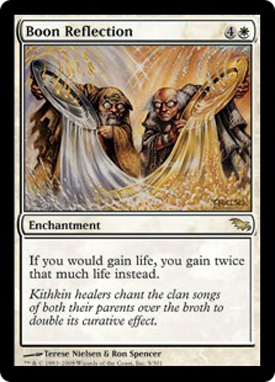
This tendency certainly hasn’t dimmed or vanished in recent years. One of the recent decks I’ve been working on is basically a combo deck involving Sanguine Bond and Boon Reflection.

 
The epic–and expensive at 10 mana–combo

I LOVE This Idea…

These two card effects blend beautifully, making my opponents lose double life every time I gain life. I’ve actually been able to use two Whitesun’s Passages to defeat somebody in one turn with that combo on the table.


With Boon Reflection on the table, you gain 10 life instead of 5. Two of these played while Sanguine Bond’s out, and you’ve just made your opponent lose 20 life… 😀

…But It Took a Lot of Work to Get Here

However, just because a combo works beautifully in your head doesn’t mean that it will ever come to fruition. I worked on my Sanguine Boon deck (as I’ve come to call this particular combo deck) for almost a year before it really got off the ground, because I couldn’t draw enough mana to play all the combo pieces when I needed to play them. Either that, or I couldn’t even draw the combo pieces at the right time. Since it’s a deck that involves enemy colors working together, I knew it would be difficult, but I didn’t expect it to be impossible.

So, I ended up chatting with one of my friends about this conundrum I was having, forgetting momentarily that he was quite knowledgeable about many of the cards and strategies available to Black. I was (admittedly) venting about my frustration with the deck, and after a few thoughtful moments, he said, “Hey, you ever tried Dark Ritual or Demonic Tutor in that deck?”

 
These cards solve two problems: having enough mana and getting the card you need at the right time.

I hadn’t. Truth be told, I kinda knew the cards existed, but I hadn’t really paid attention. Black has never really been “my color” in M:TG, so I didn’t know the color inside and out like I know White and Green. His question made me ask myself: why am I not using Black’s support cards to get my combo, anyway?
Making This Expensive Combo Run Right at Last!

I realized then that I had been relying completely on the luck of the draw with this deck. I had built the deck with only Sanguine Bond as the main Black card, and had not used Black’s wealth of searching cards (also called “tutor cards”) to get the cards I needed into my hand. When you have an expensive combo like Sanguine Bond and Boon Reflection, you need both the actual cards to play AND the available mana to play it, fast!

The addition of Demonic Tutor and Dark Ritual has helped Sanguine Boon become a truly winning deck in the games since then. The Black components (deck-searching and mana generation) helps all the White components be able to gain their life and defend life points long enough to get the combo in play. Once Sanguine Bond and Boon Reflection are both in play, White takes over and begins to kick butt by gaining life (a LOVELY strategy if I’ve ever heard of one!).

Moral of the Story

Don’t put aside the idea of a combo just because it takes too much mana to pull off. There are plenty of cards in M:TG to support even the most expensive of combos, if you’re willing to look outside your comfort zone!

Resident Evil DBG: Alliance

residentevildbgalliance
Resident Evil: Alliance works as a standalone game box or as an addition to the Resident Evil: DBG basic box. I’ve played Alliance as both its own game and as a addition, and I have to say, it offers some pretty amazing cards to amp up your Basic box.  12 new character cards (some revisions of existing cards, and some totally-new characters) await, as well as some awesome new game mechanics.

New Rules: Partners

The Alliance box brings with it a totally new envisioning of the Resident Evil game–playing with two characters instead of one. You get two Character cards, usually at random, at the beginning of the game, and you choose one to be your Main and one to be your Partner, playing both characters together. Your Partner is basically another character to use when you Explore, and another pair of hands to hold a Weapon or two; whenever your Partner character takes lethal damage, however, he or she is removed from the game completely, and you continue on with just your Main character, who respawns one turn after death as usual.

Who Leads When Exploring the Mansion? You Decide!

Whenever you Explore, you declare one character to be the leader, but both characters help Explore with their weapons. The only time this matters is if one of your characters has a special effect that specifies that it happens when he or she explores. For instance, Ada Wong’s Level 1 “peek” ability specifies that it can only happen when she is the one to lead an exploration; thus, you must declare her the leader if you want to use that ability. Your leading character does not have to be your Main character.

Attaching Weapons and Other Cards to Your Partner

You can attach up to 2 weapons or action cards to your Partner unless otherwise indicated. This is a wonderful asset–the act of attaching a card to your Partner gets it out of your deck, and it can be a constant weapon that you don’t need to Reload onto every turn. Best of all, any cards attached to your Partner character cannot be removed, except by your choosing to replace it, or a small number of specific game effects. For instance, there’s a Zombie that removes the highest-costing card from your Partner if you didn’t kill it with exactly 35 damage, and there’s an Action that makes everyone else discard down to 1 card or less on their Partners.

New Cards

There are several new weapons and actions, lots of them able to be abused, such as Gathering Forces and the Flamethrower. My personal favorites so far, however, are as follows:

Quirk of Fate: like Ominous Battle in that it allows you to Trash a card from your hand, plus you get an Action back and get to draw a card. Drawback: you can’t Trash Quirk of Fate out of your deck once you buy it (unlike Shattered Memories), making it a dead card late-game.
  Russian Assault Rifle & Signature Special: X Ammo required, X damage cost. The RARs can only be filled with a max of 20 ammo for 20 damage, and the Signature Special has a max of 60 damage. But these are both awesome, since you fill them with just as much ammo as you have available and that’s exactly how much damage you deal.
Star-Crossed Duo: attached to your Partner, this gives them +10 damage if they are the ones leading the Explore. Helps out more than you might think! You also get +2 cards and +1 Buy when you first play this on your Partner.
Fierce Battle: Have somebody else in the game draw 1 card, and you draw 4 cards. Absolutely awesome with a deck full of Russian Assault Rifles and the Signature Special, and/or with the new Jack Krauser–you have the possibility of drawing tons of ammo and rifles to feed said ammo into!

For More Information

Images courtesy of: BoardGameGeek.com’s Resident Evil DBG: Alliance page.

How Robin’s Getting Her (HeroClix) Groove Back

gettingclixgrooveback
“Game fatigue” is not a new phenomenon, but I’ve found that it occurs more often in collectible games like HeroClix. As the game evolves with new expansions, new figures, etc., the old standby figures get pushed aside or simply outclassed by the new hot stuff.

HeroClix is definitely no exception to that rule, and it’s one reason I virtually quit playing Clix tournaments for a while. But I’m starting to get back into it…and for more of that story, read on!

Before: No Groove Left

As a largely Casual Clix player, I just wanted to PLAY the game–to play my favorite pieces, which I could combine into many game-winning teams. My teams, made up of little figures with lots of support powers, might not win in 50-minute rounds, but give me about an hour and a half and I could outlast most any opponent. I had more fun when my games with an opponent were a back-and-forth tug-of-war, never knowing until the last few turns who would come out on top–thus, I favored longer games and lots of backup.

Unfortunately, my slower, defensive swarm style didn’t translate well into tournament play. I kept getting beaten by kids running huge, overpowered figures broken out in special powers, or people running almost unbeatable “gimmick” teams. And to add insult to injury, it seemed that tournament/competitive play was all that my new gaming shop friends wanted to do. But they could afford all the new pieces, and I couldn’t…and honestly, I didn’t WANT to resort to buying and playing overpowered figures just to “survive.” Tournaments were simply NOT what I wanted to be involved in, but it seemed to be the only game in town (pun intended).

So I kept trying to play in the tournaments, just to try to keep my hand in the game and to connect with friends, but I only ended up getting angrier and angrier over my losses. I felt outmatched, and soon the game was little more than a frustration engine.

The Breaking Point

Something had to give. I was taking it all too seriously, and I couldn’t seem to stop being angry about the game long enough to have fun. After all, I couldn’t exactly hang out with my friends when I felt ready to throw my hard-earned Clix pieces across the room. So, I finally quit the tournaments, and almost completely quit playing HeroClix casually as well. I got away from it, put aside my pieces I’d worked so hard to collect for myself, and just came to the gaming shop to use the Internet for a couple of months.

I was a lot happier in the short-term (probably a good move for my blood pressure), but after a few months, I was ready to try again. I wasn’t about to step foot back into the tournaments, but I did know what kind of game I wanted–a casual game, the type I had first learned to love back when my boyfriend taught me how to play. (In all the hubbub of quitting HeroClix, I had also temporarily lost that link with him, too, which hurt more than I realized!)

A New Game, a New Outlook

So, one day, I just asked my boyfriend if we could have a true casual game–not a crazy overpowered game full of new figures and special powers, but just a good ol’ classic HeroClix game. He agreed–he wanted to see me have fun, too, and we were both hopeful that I could start afresh.

That first casual game led to a second, and then a third a few days later. He never pushed me about it, but suggested it as something we could possibly do rather than something I absolutely HAD to do. I was starting to enjoy it again, even though I knew he was building less powerful teams to match mine. It was not ideal, but it was better than being shut away from the game entirely.

I began to share possible strategies with him again, and we even began to talk about the metagame, discussing how I could possibly make my old favorites playable amid newer figures. It wasn’t just that I wanted to save money by not buying a ton of new figures; I also wanted to be able to beat the “hot new figures” with my favorite old standards, showing other players that you don’t always have to play overpowered stuff to win.

And, once I started playing some Casual games at the shop again, the craziest thing happened…suddenly, some people became interested in the Casual Clix scene again. They wanted to know more about using support powers, or using figures with no special powers. And best of all, they wanted to play me in one-on-one games outside the tournaments, or even group games. Little by little, the change I had so wanted to see was finally happening–and it had started with me!

Success, a Little at a Time

So this, finally, is how I got my HeroClix groove back:

  • Combining older figures with newer to update teams without having to buy all new pieces
  • Playing strictly casual games rather than trying to win in tournaments
  • Being open to playing casual games rather than just using the Internet at the shop
  • Being willing to learn about new figures and not just relying on old ones

This new approach to Clix is much less competitive, and thus less likely to aggravate my competitive tendencies. It’s also better for building community between all my gaming friends–now, we’re no longer just playing tournaments, but we’re also just enjoying the pieces we have and building teams out of the ones we love to play the most. It might not be as “hardcore,” but then again, I’ve seen what a “hardcore” mentality does to players like me. I much prefer this new outlook on Clix.

Summary

If you’re suffering from “tournament fatigue,” or even “Clix fatigue,” then how about trying something completely different–how about a casual game? Don’t laugh…you might just find yourself getting your HeroClix groove back, too!

Stress Test: Being the Healer

stresstestbeingthehealer
Players of MMOs, like World of Warcraft and City of Heroes, know the value of a “healer”–the character who heals damage in a team, so that the team’s big bruisers and snipers stay alive long enough to do their job. Healers are always in demand, whether a group is advertising for a priest or for an Empath; they know they will need someone backing them up with supportive, team-oriented powers.

But not everyone is cut out to play a Healer. If you like to deal lots of damage and kick a bunch of butt, the Healer class is not for you. If you don’t like playing with other people, and prefer to go your own way, the Healer class is also not for you. Creating and playing a Healer is about being defensive and supportive, being team-oriented, and most of all, maintaining that team as long as you can. It can be a lot of hard work, but I like to think of it as a “stress test.” If you can handle being a Healer, you can handle just about anything the game throws at you.

Throughout this article, I’ve used actual screenshots from a session of playing Lyssadia, my Empathy/Energy Blast Defender. Empath Defenders are one of the most common builds for Healers in City of Heroes, and Energy Blast typically knocks enemies back so that they are stunned for a few seconds, so her attacks still work to support the team.

Healers have to care. A LOT.

No longer can you just run ahead of your team, heedless of everything the other players are doing, and shoot or slash the living daylights out of everything. If you’re a healer, you need to care about what your team is doing, because without you to back them up, they can easily get wiped out in the middle of a big enemy spawn.

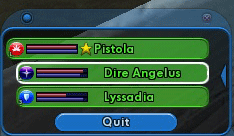
You also need to care about the welfare of each of your teammates mid-battle. Your particular MMORPG, like City of Heroes, may allow you to have a sort of “Team Window” where you can monitor each member’s health and other vital stats.


This little window is a godsend for healers. Out to the side, you can see all the little icons representing many of the buffs each character has on them–this helps me figure out who needs which buff, who needs healing, etc. I just look for the bright green icons to know whether I’ve buffed somebody recently, and I can easily watch their red Health and blue Endurance bars, too.

Believe me, as a person who’s played just about every Archetype available in City of Heroes/Villains, damage-dealing characters do depend on their healer teammates to be the “net,” to catch them if they fall! Caring healer players can literally be the saviors of their teams during huge battles.

Healers have to be responsible.

Caring also entails responsibility. You have to be paying attention to where the team is going, not wandering off randomly by yourself because you accidentally closed your Map (*raises hand* Guilty). You also need to scan the battlefield at all times, not just focus on the particular enemy or ally in front of you. This helps you stay alert to rapidly-changing battle events.

For example, here’s what happens when you focus too long on one particular thing as a Healer:

I’ve selected one of my teammates’ names in the Team Window at left, denoted by the white box around the name, and have just healed him close to full health. My own health bar isn’t looking so great, though, because in healing my teammate, I’ve come a little too close to the battle front.
See all those red numbers above Lyssadia’s golden halo? That means somebody’s damaging her. The red and blue bars just above the halo show her health and endurance–her blue endurance bar is nearly full, but her red health bar is almost half gone. I have to get her out of the line of fire fast!

Healers have to be careful not to make themselves targets; that’s one reason I say to keep moving and keep watching your screen. Otherwise, you can end up with one very dead Healer…


(This is what happens when I’ve gotten a little overzealous shooting stuff and forgotten to heal myself. Poor Lyssadia. Learn from my fail.)

Healers have to FOLLOW the team, not lead.

Healers actually work best at bringing up the rear–many healers have secondary attacks that they can fire off to prevent a few straggling baddies from stabbing the group in the back, and you can also monitor your teammates more carefully if you are behind them rather than in front of them. As the healer, don’t be the first to fling an attack or explore ahead of your group, because this is a good way to get your Empath character killed.


(Through the confusion of colors, you can see the two names in green in this screenshot–those are my two teammates up ahead of me. Since I’m behind them, I can visually monitor what is going on, and I can click-and-heal them if I need to.)

Several of my healers can fly, so usually I will hover above the fracas, healing, buffing, and offering a bit of cover fire when needed. This elevated position helps a Healer see more of the battlefield, and it can keep you in range of allies who would otherwise be out of range of targeted heals and buffs. Whether you choose to fight from the air or ground, however, it’s important to stay in a central position in the team–if you’re too far forward or too far back, you might not be close enough to a teammate to help them.

Here’s Lyssadia in flight, going “pewpewpew” at the Auto Turret in her sights. My teammates were still in sight in the larger version of this screenshot, so I could take a few shots, then heal or buff if necessary.

Healers have to heal/buff first and fight second.

Even though most healers on City of Heroes are ranged attackers as well, they really work best if you focus on buffing everyone and healing everyone first, and only attacking if absolutely necessary. It can be very tempting to start fighting along with your teammates if you start taking damage yourself, but stay the course–if you can keep your teammates alive by a few well-timed heals and buffs thrown their way, then you won’t have to worry very much about taking damage!


(In this shot, I’ve targeted onto one of my teammates, marked by the green box around his character, and am sending an application of Fortitude his way, which will increase his Damage Resistance to just about every type of damage for 1 minute.)

Healers have to focus.

Eating, watching TV, or doing anything else while trying to play a healer will not work. Even if you can type quickly, sometimes even chatting with your teammates takes too much attention away from the job at hand. Since much of the team depends on you to keep them in fighting shape, you have to maintain a focus that you don’t necessarily have to have when you’re playing a damage-dealing character.

It can be a bit stressful, especially if you’re trying to keep up with a team whose members don’t talk about what they’re going to do before they do it. But if you’ve got a good team going, with lots of communication, it’s relatively easy to stay focused.


(I’m staying a bit further back from the fray in this shot, because there are still several high-level enemies alive, but my teammates are generally mopping ’em up okay. I just need to be alert in case a teammate gets caught unawares by an enemy shot. This time, I’m not making Lyssadia fly into the fight just to get shot!)

Summary

Playing a healer does require a bit more work, but it is a very rewarding type of character to play if you enjoy being needed. It’s a team-oriented mindset that can make battle less boring and more involved…for certain, it is a VERY different kind of challenge. If you’ve never played a Healer before, give it a shot!

Competitive Magic is for Plagiarists

competitivemagicplagiarists
I might be kicking a hornet’s nest with this post, but I feel this ought to be said. Competitive Magic: the Gathering, the kind played in tournaments, is usually a bunch of players copying and winning with strategies that someone else thought up, commonly called “netdecking.” When you go to tournaments, you can just about expect to see the same 5 decks over and over again. And it really makes me angry, to be honest.

Netdecking: Plagiarism by Another Name

Considering my background in English literature and composition, the idea of stealing an idea from someone else and claiming personal winnings from it is anathema. Where I come from, that kind of thing gets you kicked out of college, not 1st place in a Magic tournament. Any idiot can steal a term paper off the Internet, or copy from Wikipedia and the like; it doesn’t necessarily mean that they themselves have gotten any wiser from the copying. The same goes for Magic decks–just because you can copy a deck doesn’t mean you’re suddenly a star player.

I view each of my Magic decks as an original work of art. Maybe it’s not an optimized game-winning machine, but I thought of it and it’s mine–it represents my creativity and my thoughts. Running someone else’s deck feels wrong somehow, as if I’m trying to take credit for the work they did in putting the original concept together. I would rather lose with a deck I created than win with something I didn’t have the slightest hand in shaping.

Yet most tournament players these days win with decks they pulled off the internet, just like the player next to them did. Instead of introducing new ideas to the Magic: the Gathering community, they’re content to just take a “deck that wins” and profit from it. How does that express individuality and creativity? How does that prove anybody’s smarts? IT DOESN’T!

This is why I get angry when I’m in a tournament full of nothing but copycat decks. I resent it when my playing skill and deckcrafting ability is judged to be of poorer quality because my lovingly crafted strategy didn’t win against a netdeck. And I hate it when these punks act so smug about winning with their netdecks, as if their win proves they’re somehow “smarter” than I am, when all they did was search Google for a few minutes. I feel like shouting, “Go home and build your own blasted deck instead of copying from everyone else, and then we’ll see who wins!”

Why This HAS TO STOP

I’d like to have fun again in Magic. And right now, the competitive tournament mentality is absolutely WRECKING the Casual Magic scene that I used to enjoy so much. Most people just bring in their netdecks now for CASUAL games, instead of working on deck ideas they actually thought of and want to test out. And you just can’t test a new deck against a netdeck that’s designed to win in 5 turns or less–it’s not even a contest, just a foregone conclusion.

Maybe for everyone else, “fun” equals “beating the crap out of someone’s copied Tier 1 deck with your copied Tier 1 deck,” but it’s not fun for me, and it’s not fun for most of the Casual Magic players I’ve talked to, either. Competitive Magic definitely has its place, but I don’t want it in my living room, and I don’t want it in my casual games. Just for once, can we all just build our OWN strategies and actually have FUN?

Resident Evil Deck Building Game

residentevildbg
For those who are not familiar with any of the Resident Evil video game series, the whole concept sounds like something you don’t want to mess with. Arming yourself with various and sundry weapons to fight zombies? Sounds like a horror movie gone crazy.

I certainly thought this way about the video games, and wasn’t too enthused about playing a deck building game based on the same mythos. Horror and killing stuff really isn’t my bag in movies or video games either one, so when my boyfriend (a major Resident Evil fan) asked if I would like to try the deck-building game, I expected it to be not much fun.

Boy, was I proved wrong! In the Resident Evil DBG, like many other deck building games such as Ascension and Dominion, the long-term strategy is the winning strategy, which means lots of fun happy times for gamers like me who like to play for the long-term gain rather than the short-term strike.

To Begin The Game

All players in the Resident Evil DBG start out with a character card of your choice (more about those later) and the same 10 cards in their decks:

7 ammunition/gold cards, worth 10 ammo and 10 gold each, used for powering your weapons and purchasing upgraded items and ammo
2 combat knives, each of which can deal 5 damage and doesn’t require any ammo
1 handgun, which requires 20 ammo to work and which can deal 10 damage

From this original 10-card deck, you draw 5 cards and begin your turn. On your turn, you may buy 1 resource from the rows of resources laid out on the table, play 1 action, and explore the Mansion 1 time if you choose. Once your turn is over, you take all the cards you’ve played this turn and place them in the graveyard (your used cards), and draw 5 new cards to prepare for your next turn.

Wait, What’s the Mansion?

The Mansion is familiar to those who have played the Resident Evil video games, but in the context of the game, it’s simply another deck of cards on the table. When you want to “explore the Mansion”, you must have a weapon (like the Combat Knife, the Handgun, or other sundry upgrades to these items) in your hand, as well as enough ammo to power it. You then declare you’re going to explore, and then turn over the top card of the Mansion deck. Whatever Infected zombie creature is revealed, your weapons must deal it enough damage to defeat it in one hit, otherwise the Infected creature deals your character damage and then goes back under the deck.

Say, if you explored the mansion with two Combat Knives and a Handgun. You’re able to do 20 damage, because each Combat Knife does 5 damage, and the Handgun does 10. All the weapons you play combine together for total damage, unless otherwise specified on the card or the character.


If a Male Zombie shows up as the top card, you’re in luck, because it has 20 health and will be defeated with your combined 20 damage. You then get 1 decoration for having defeated it.


However, if the top card is a Licker instead, you’re out of luck–it has 40 health, and will not be defeated by two Combat Knives and a Handgun combined. You will instead take 30 damage from the undefeated Licker, which will then go under the Mansion deck to be rediscovered later. (Be careful–you can end up taking enough damage from undefeated monsters to actually kill your character!)

Different enemies have varying levels of decorations–some give you 2, 3, or 4 decorations if you defeat them, and the two strongest monsters in the Mansion (Nemesis T-Type and Uroboros Aheri) give you 5 and 8 decorations, respectively. Whenever Uroboros Aheri is successfully defeated, the game ends, and everybody counts up decorations–the highest total wins.

Character Cards

Fans of Resident Evil games will recognize the various characters included in each box of Resident Evil:DBG. Familiar faces like Jill Valentine and Chris Redfield are there, alongside others like Jack Krauser, Sheva Alomar, and Ada Wong (my personal favorite).

Some characters have weapon specialties–you’ll want to give Jill all the Grenades she can carry, for instance, while Sheva makes magic with Rifles and Krauser is a beast with Knives.

Each character in the original DBG has two abilities that activate when they have gained a certain number of decorations. At Level 1, the character can use the first ability listed on their card; at Level 2, they can use both abilities.

The reason Ada Wong (at left) is my favorite is because of her Level 1 ability, which allows her to “peek” at the top card to see if it’s something she can defeat with her current damage total. Ada can put the “peeked” card on the bottom of the Mansion instead of trying to defeat it, and she can then go for the second-from-the-top card instead. (This is great for moving Uroboros Aheri out of the way when I don’t have 90 damage to defeat his 90 health, because with my luck, I’m ALWAYS drawing the boss. XD)

Another important point to remember: each character also has a set amount of health. Some characters can survive a 70-point hit by Uroboros and live to tell about it next turn. Unfortunately, Ada and several other characters only have 70 health to begin with, so they have to be played more carefully. No haphazard reckless exploring the mansion for them!

Look through each of the character cards and see which ones fit your playstyle. Since I’m horribly unlucky in my Mansion draws, Ada’s ability suits me well. But you may find that another character is your favorite!

Game Modes and Resources

You can play Resident Evil: DBG several ways–a list of possible scenarios follows.

  • “First-Timer:” helps you get used to the game mechanics, basic and fun
  • “Mercenaries:” timed game, with various mini-scenarios to act out
  • “Versus:” where instead of fighting the zombies, you try to defeat the other players!
  • “Custom:” you and your fellow players choose resources to purchase, and play much like First-Timer

There are many, many different resources you can use to build your perfect streamlined deck in the game, such as upgraded weapons, healing herbs, and cards that let you get weapons back, trade out items, draw more cards, etc. Each game mode has its own set variety of resource cards–in First-Timer, for instance, there are some cards in the box that aren’t even allowed on the table, whereas in Versus mode, you’d make copious use of those cards.

My Personal Strategies

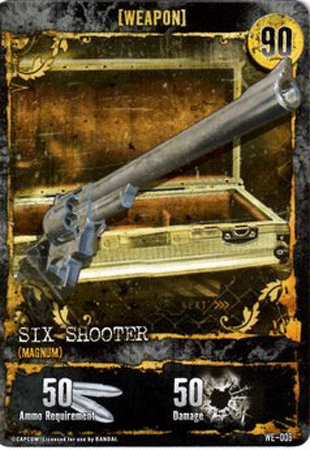
After several times of playing the game, I generally know what some of my first purchases are going to be. Purchasing upgraded ammunition cards is the first order of business–trading out all those 10s for 20s and eventually 30s will help power bigger weapons and will help you pay for those bigger weapons, too. Also, purchasing cards that help you clean out the cards you no longer need is very important. (Once you’ve purchased bigger and better weapons, you’ll want to get rid of the Handguns and Knives unless your chosen character has a specialty with them, for instance.)


The Six Shooter is kind of an upgrade from the Handgun, is it not?

Action cards such as Shattered Memories, Ominous Battle, and Item Management (no image) are great support cards for early- to mid-game deck thinning and streamlining. Other helpful Actions include Reload (get a weapon back from your graveyard, get 2 actions), Umbrella Corporation (draw 2 cards, put 1 card from your hand back on top of your deck, get one more Action to play), and Escape from the Dead City (draw 1 card, get 2 actions).

I generally don’t explore the Mansion for about half of the game–most of the first half of the game is getting my deck streamlined, and I usually avoid getting damaged by too-strong monsters until I’m ready to take them on.

However, by not exploring the Mansion, I sometimes miss out on the two most epic weapons in the game, which are actually hidden in the Mansion. Sometimes, you’ll Explore and come across one of these babies as the top card:

 
The Gatling Gun can be filled with any amount of ammo for equal amount of damage; the Rocket Launcher deals a flat 90 damage for 0 ammo investment.

For me, I’m not willing to risk Ada on the possibility of getting one of these weapons, so I play carefully. If the other players get the Gatling Gun or the Rocket Launcher, that’s great for them–I am simply more comfortable using tried-and-true (and safe) methods to last through the game. I don’t know if this playstyle would work for everyone, but it’s won me most of the games I’ve played so far!

To Find Out More

Unfortunately, the official game website has been closed because Bandai is no longer publishing RE:DBG as of 2013. But you can still find information through the RE:DBG page on the Resident Evil Wikia. Also, BoardGameGeek’s page on this game is a great resource as well, and I used it heavily while writing this article.